
How dogs see our world
Animals see and sense the world completely differently than humans. To better understand their pet and develop effective training plans, it's important for owners to understand how cats and dogs see, what they respond to best, and so on. Knowing these characteristics will make it easier to interpret their pet's behavior and avoid demanding more from them than is naturally possible. So, let's try to answer the question: what kind of vision do dogs have and how do they see the world around them?
Content
How pets see us
Surely every dog owner would like to know how their beloved dog sees them? Illustrator Kelly Engel pondered how a pet perceives its owner and created a whole series of drawings on this theme. We often perceive this relationship as follows: the person is the owner, and the animal is just a pet. But if you look at it from a different perspective, for the animal, their owner is not just an average person, but the embodiment of all that is best in this world: a superhero, a chef, the most beautiful, successful, and a true leader.










If you feel unwanted and useless, your dog sees you as the best and strongest person on Earth. Therefore, in moments of extreme sadness and self-doubt, remembering what your pet thinks of you will immediately warm your heart.
Dogs don't care about material possessions; the mere presence of their beloved owner is enough to make them happy. They value objects around them only by their usefulness. For example, expensive shoes made of genuine leather are soft and chewable, making them ideal for scratching teeth.
Anatomical features
The difference in how dogs and humans see the world is due to significant differences in the structure of their visual organs. Their retinas are divided into two halves:
- the upper one is responsible for the sharpness and visibility of objects in the dark;
- The lower one is activated during daylight hours and serves as a filter, blocking bright light and sunlight. This eliminates the need for sunglasses, although some manufacturers try to profit from this.
Interesting fact: the structure of the retina is what causes dogs' eyes to "glow" in the dark. Like other nocturnal animals, between the layer of cones and rods is an additional layer of filaments and crystals that reflects light when it hits them. This is what causes the eyes to appear to glow.
How dogs see colors
Until recently, everyone was convinced that dogs see the world in black and white, but American scientists have managed to prove that these animals perceive the surrounding space in brighter colors.
The human eye has three types of cones, which perceive red-orange, blue-violet, and yellow-green parts of the spectrum. Dogs lack the cones that detect red-orange colors (long-wavelength rays), limiting their palette. To a dog, a red apple and green grass would look exactly the same, and traffic lights are also indistinguishable. Guide dogs rely not on color, but on the sequence of signals. It's likely that dogs see other hues and perceive the world differently. in a different color.
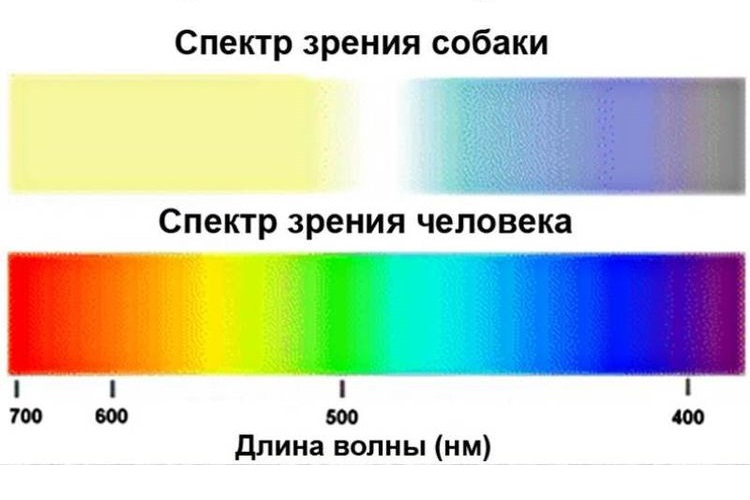
A person suffering from color blindness (red-green color blindness) can roughly understand how a dog sees the world around him.
Note: the most contrasting colors for a dog are yellow and blue, which should be taken into account during training (for example, when choosing equipment).
Range and breadth of vision
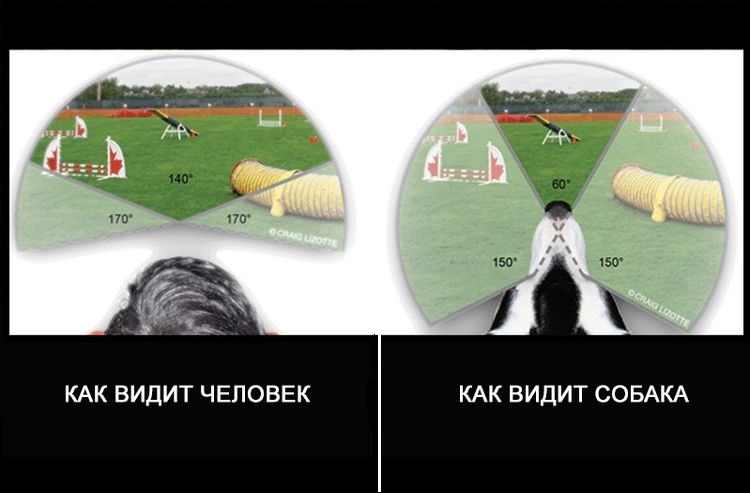
In addition to rods and cones, the retina contains receptors that detect the movement of objects, the appearance and disappearance of light signals, and other phenomena. The eyes of these animals only receive information, while the brain processes it and forms a single image, analyzing the data coming from the eyes (both eyes see independently, and then the image is combined). Dogs and humans have binocular vision, where an image is formed based on partially overlapping information coming from both eyes. This enables the ability to distinguish relief, perceive depth, and estimate the distance of an object from the eyes.
Unlike humans, dogs lack a fovea containing cones, which provides maximum visual acuity. This allows dogs to see equally well across the entire retina. Their eyes provide a panoramic view of the world, eliminating the need to quickly follow a moving object.
The absence of this fovea also explains pets' poorer visual acuity. This is especially true for nearby objects, which appear blurry at a distance of less than 30 cm. However, at this distance, their sense of smell is highly sensitive, allowing them to recognize even blurry images, whether it's a bowl of food or their owner's face.
Dogs can see medium-sized objects at a distance of 100-150 meters. However, this distance is not as important as other predators, as they respond more to movement, including facial expressions and gestures from their handlers.
By comparison, a dog can detect a running person at a distance of up to 400 meters (and even up to 800 meters with special training). If the person remains motionless, the dog may not notice them even at a distance of 100 meters until it detects their scent.
Particular attention should be paid to dogs' peripheral vision. Their field of view is generally wider (250 degrees) than that of humans (180 degrees), while their sweet spot is narrower. This is also explained by evolutionary factors: a predator needs to look straight ahead and concentrate on its prey, but at the same time, it must remain aware of its surroundings.
The features of the field of view also depend on the breed and body structure: individuals with a wide muzzle and a small nose have a smaller field of view compared to representatives of hunting breeds.
Visibility in the dark
Dogs' vision in dark or twilight conditions is much better than humans'. Their visual organs have a much higher number and sensitivity of rod cells, which are responsible for night vision, so they require less light to determine the size and shape of an object, as well as its speed and direction. In low-light conditions, dogs see the world three to four times more clearly than humans.
Visual acuity at night is also determined by the ability to distinguish nearly 40 shades of gray thanks to the presence of an additional membrane, the tapetum lucidum, in the upper part of the retina. Therefore, while objects blend into the darkness for humans, their pets clearly distinguish each one and navigate their surroundings well. A photo can give you an idea of how dogs see the world in the dark.

Other features of world perception
For humans, the eyes provide approximately 90% of the information about the surrounding world, while humans' best friends gain insight primarily through smell and hearing. Which sense is more important for a given individual, hearing or smell, can be determined by the anatomical structure of the ears:
- with erect ears (like those of shepherds) – hearing;
- with hanging ears (like a spaniel) - sense of smell.
An object that makes no sound or smells may go completely unnoticed. For example, a human can glean a significant amount of information even from a black-and-white photograph, but to a dog, it's just a piece of paper smelling of chemicals and reagents.
A dog's nose contains over 200 million receptors, making their sense of smell 100,000 times sharper than a human's. A well-developed sense of smell allows a pet to recognize and sense its owner from a distance of up to 1.5 kilometers. The exact number of receptors varies depending on the breed. Dachshunds have approximately 125 million, while German Shepherds have over 225 million. The Bloodhound holds the record for the most receptors, with 300 million.

Members of this breed are able to detect the molecules of a substance that produces an odor up to 300 hours after it's released. Even US courts take advantage of these abilities, recognizing bloodhounds as authoritative in courtrooms. Thanks to the work and keen sense of smell of Nick Carter, a bloodhound, more than 600 criminals have been put behind bars.
Read also:


Add a comment