
How cats see our world
Cats have lived alongside humans for millennia, yet they remain enigmatic creatures endowed with special abilities. This is why many owners are concerned about how cats see the world around them and how their vision differs from that of humans.
Content
Features of cat eyes
Cats' vision has a number of unique features. The most striking feature is the size of their eyes—relative to their body size, they are significantly larger than those of humans. Their convex shape allows their field of vision to reach approximately 270 degrees. Cats' eyes can come in a variety of colors, from light gold to deep green, and some breeds even have blue eyes.
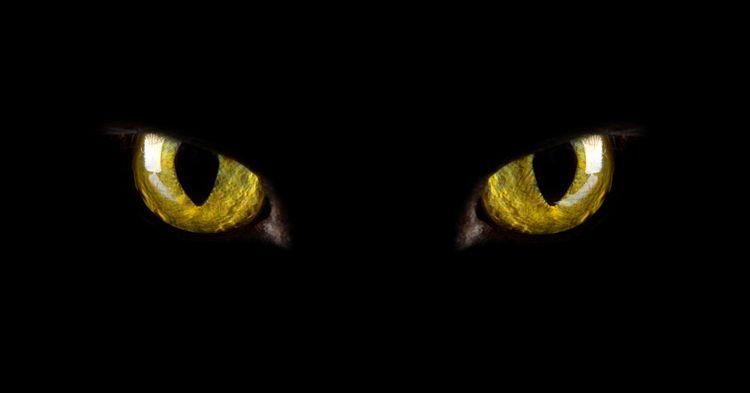
The pupil possesses a remarkable ability – its shape can change depending on the intensity of the light. The width of the pupil reveals all the emotions, moods, and feelings of the animal. Interestingly, large felines (lions, tigers) have pupils that are always round.
Another distinctive feature of the cat's eye is the third eyelid. It acts as a protective barrier, protecting it from damage and dust. This is crucial for a predator, who often has to scoot through grass and branches while hunting. The third eyelid can be seen when the cat is at rest with its eyes half-closed.
There's a scientifically proven theory about how cats see our world. Domestic predators have binocular vision. Because the areas they can see overlap in a certain way, the animal is able to examine an object with both eyes at once.
Color perception
Unlike most animals, which perceive the world in black and white, cats have color vision. However, the range of tones they can distinguish is much narrower than that visible to humans. Cats primarily see the world in gray-blue tones, but in good lighting they can also perceive other colors:
- Violet.
- Green.
- Blue.
Things are worse with red, brown, and orange. Yellow is often confused with white. Nature has not endowed cats with the ability to distinguish the wide range of colors that humans possess. To successfully hunt rodents, it is not at all necessary to identify potential prey by color.
The color spectrum perceived by a cat's eye differs significantly from that of a human eye. This is due to a different set of photoreceptors located in the retina. The receptors responsible for color perception are called cones. Cats lack cones, which detect some color signals, and therefore cannot distinguish shades of red, orange, and brown.
How do cats see in the dark?
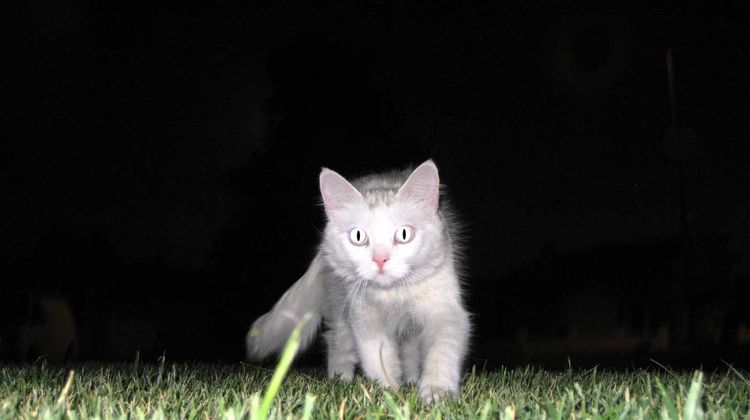
Some mystical abilities attributed to cats aren't always true. This applies to the claim that domestic pets see perfectly in complete darkness. To perceive their surroundings visually, cats require a small amount of light, at least a fraction of what allows humans to discern objects in the dark. Cats can't see properly in complete darkness, but their twilight vision is eight times sharper than that of humans. This ability is genetically determined—felines had to hunt in the dark.
The cat's eye has a unique structure. It has significantly fewer long-wavelength cones, responsible for color perception, than humans. However, it has numerous light-sensitive receptors, enabling the animal to navigate perfectly in dim light. Furthermore, the back of the retina is coated with a special substance called the tapetum lucidum. Acting as a mirror, it reflects light, giving cats much sharper vision than other animals or humans.
Observation Sector
Any cat owner knows how quickly a cat can catch a rodent or a bird in a single leap, despite the fact that a minute earlier its entire demeanor betrayed a sleepy and lazy person. This is impossible to deceive a predator due to the special structure of its eyes. Cats can move their eyes around the visual axis. Their visual field is up to 270 degrees, allowing them to notice everything.
With just one eye, a cat sees 45% of the scene and accurately calculates the distance to any moving object it detects. Using its sense of smell and hearing, the predator leaves its prey no chance.
Distance matters
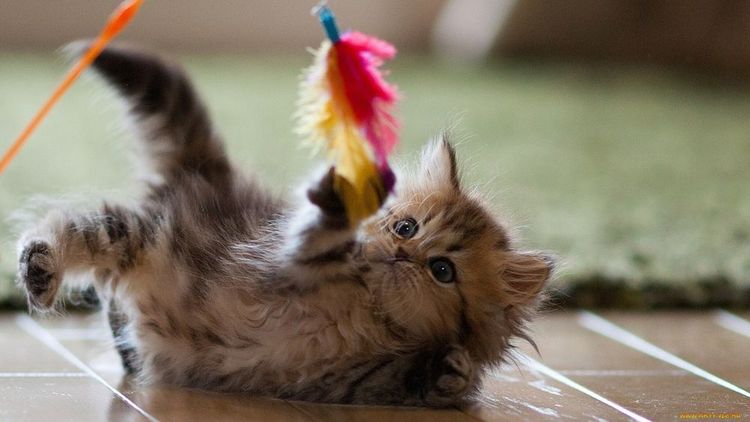
Through scientific research, ophthalmologists have discovered that cats lack the ability to distinguish objects located more than 20 meters away. This is due to the fact that predators often have to ambush potential prey, which means they don't need to notice distant objects. Another characteristic of feline vision is the inability to distinguish anything directly in front of their nose, closer than half a meter. In such situations, cats use their olfactory organs and whiskers to scan the surrounding air. When playing with your pet, be mindful of this peculiarity and avoid holding toys too close to their face.
Perception of the world
The works of American photographer Nikolai Lamm, who used photographs to demonstrate the colors cats can see and how they perceive their surroundings, have generated considerable interest among cat lovers. The blurriness of the images illustrates the animal's ability to recognize moving objects without obsessing over details. Nature has designed each organ to be used for its intended purpose. Cats' hunting instincts are driven by capturing the movement of prey, while such details as fur color and tail length are irrelevant. The photo series, on the theme of how cats see our world, was created by the artist with the help of specialists such as ophthalmologists and felinologists.
Cats' sense of hearing, which distinguishes the pitch and intensity of sounds, helps them perceive their surroundings more fully. Furthermore, cats have a keen sense of touch, using their sensitive organs, the whiskers. These are located not only on their faces, but even on their tails.
A cat's life is largely spent in a world of smells, which play a more significant role than sight. It's not enough for a cat to see a new object; sniffing it is far more important.
Nevertheless, vision is a true survival mechanism for cats. Their ability to recognize prey in low light makes them one of the best hunters in the animal kingdom. Understanding their pet's perception of their surroundings can help owners establish a closer bond and understanding with them.
Read also:
- Do cats see themselves in the mirror?
- Why are cats afraid of vacuum cleaners?
- Why does a cat twitch or shake its tail?


Add a comment