
How does a cat behave before giving birth?
Cats are capable of reproduction from the age of 7-9 months, their pregnancy lasts 65-70 days. Although in most cases childbirth in cats They proceed normally, but sometimes they may need assistance. To prepare for the birth of a cat's offspring, the owner doesn't need to know exactly when their cat became pregnant. The approximate date can be determined by her behavior—cats often exhibit very unusual behavior before giving birth.
Content
A cat's behavior a few days before giving birth
Few cats believe that their owners will take care of organizing a suitable place for the birth, leaving them to rest and recuperate. Most pregnant cats, however, begin looking for a "nest" a week or two before the due date, climbing onto cabinet shelves, into sofa drawers, and anxiously exploring the apartment for other, from their point of view, cozy refuges. This is the main sign of impending labor. Other behavioral changes become apparent closer to the onset of labor.

If your pet has access to the outdoors, it is not advisable to let her out during the last stages of pregnancy, as she may build a nest and give birth to kittens outside the home.
How to make a nest for a cat
It is better if the cat has a nesting place the owner will build, then your pet will give birth to her kittens not under the couch or in a stuffy closet, but in a safe and comfortable place, away from drafts and noise. To ensure the cat "recognizes" the proposed nesting box as suitable, it's best to build it in advance, two weeks before the expected birth, so the expectant mother can "test it out," evaluate it, and get used to it.
A hard-sided carrier, a special cage with a removable top, or a clean cardboard box can serve as a cat birthing nest. The nest should be spacious enough to comfortably accommodate the mother, her kittens, and, if possible, their food and water bowls. If a cardboard box is used, cut an entrance hole high enough above the floor to allow the mother to easily exit and prevent the kittens from crawling out.
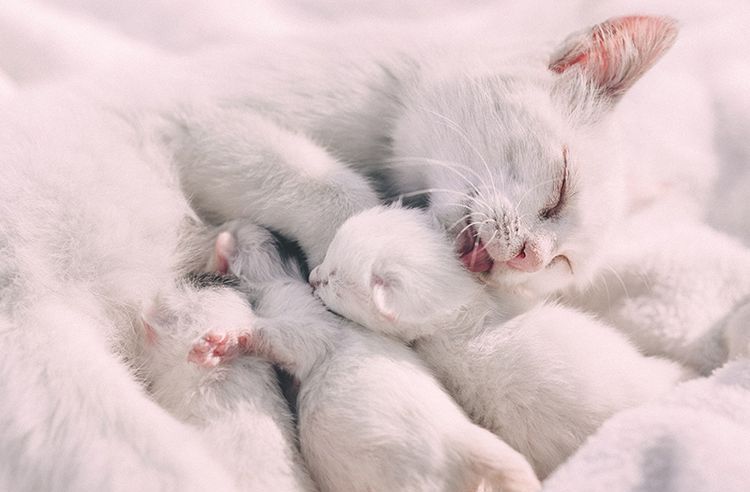
The nest box should be lined with bedding. You can use old, discarded bedding, towels, or unwanted cotton knitwear. The bedding should be soft and absorbent. It's a good idea to place a separate box with soft bedding and a heating pad near the nest box, where the newborn kittens can be temporarily placed.
When making a nest from a cardboard box, ensure it does not contain any sharp fasteners. Boxes glued with polyethylene polyamine, epoxy, or phenol-formaldehyde resins (these types of adhesives contain toxic substances) are also not permitted for use as a maternity ward.
Physiological signs of imminent labor
As the due date approaches, the cat's behavior and well-being change noticeably. She becomes lethargic and apathetic, spending a lot of time in the nest. Some cats, on the contrary, become restless, constantly following their owner, considering them a source of "moral support" and physical safety.
This is especially true for first-time cats, who have little understanding of what's happening to them and rely on their owner's help. Cats who are pregnant for the first time should be given special attention: out of fear, the animal, ignoring the comfort of its familiar nest, may hide under a sofa or closet and there start giving birth.
Two to three days before giving birth, the cat's abdomen drops, the mammary glands swell, and in some cats, colostrum begins to leak from the nipples. This can be seen by gently pressing on the nipple toward its tip. The cat will urinate more frequently than usual because the enlarged and lowered uterus before giving birth puts pressure on the bladder.

A day before delivery, the cat may stop eating, but will continue to drink water as usual, so a bowl of fresh water should always be kept near the nest. The cat will frequently and vigorously lick her genitals: this is both a hygienic procedure and an instinctive method of inducing labor. The passage of the mucus plug, which occurs during this period, may go unnoticed if the plug is released during a bladder or bowel movement.
Signs of impending labor also include a slight change in body temperature, which can drop from the usual 38-39°C to 37°C. During the pre-labor period, the cat's body experiences severe stress, which may even be accompanied by vomiting. These symptoms are not considered pathological and do not require intervention.
A few hours before the onset of actual labor contractions, a cat may experience so-called "practice contractions," caused by brief contractions of the uterine muscles. The cat tenses for a few seconds, arches her back upward, and then lies down again calmly. This phenomenon can be considered the onset of labor. Read about it on our website.How long do contractions last in cats?.
Although birth is a natural process, and in most cases, cats experience no complications, unplanned situations can arise where a cat is unable to produce kittens on her own. Therefore, once you know the expected due date for your pet's litter, it's recommended to ensure she receives the assistance of an experienced veterinarian if necessary.
Read also:
- Bleeding in a pregnant cat: what to do
- How long does it take for a cat to give birth?
- Can a cat eat her kittens?


Add a comment