
How to knit a sweater for a dog
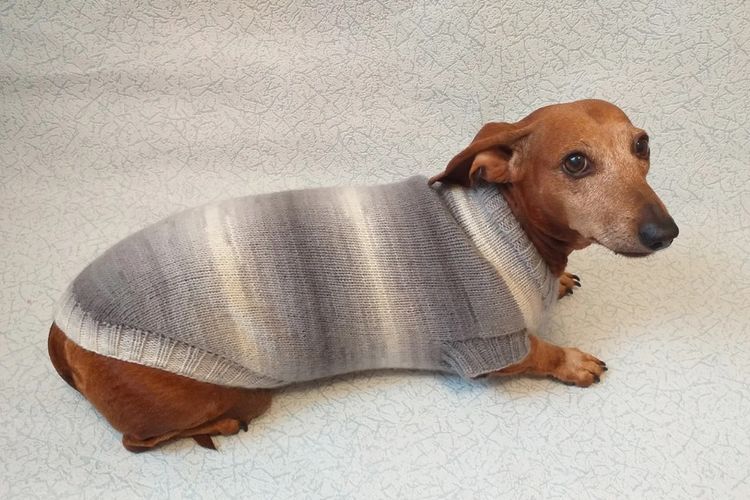
A warm sweater will help keep your beloved pet warm in chilly weather. To ensure your dog can move comfortably, it's best to knit one yourself, custom-made to your pet's measurements. Even a beginner can do this using simple knitting or crochet patterns.
Content
- 1 Selection of threads and tools
- 2 Taking measurements
- 3 Since dogs are active during walks, the sweater should not restrict their movements. Therefore, it's best to add 1-2 cm to the paw measurements. There's no need to add back or waist measurements, as the garment should fit snugly. Let's start with a sample.
- 4 Diagrams with step-by-step descriptions
- 5 Crochet pattern
Selection of threads and tools
The purpose of a sweater is to keep the dog warm, so the threads should contain warm fibers. It's also important to understand that the garment will need to be washed frequently, so the threads shouldn't unravel. It's best to choose a combination of wool and acrylic in equal proportions. You can consider threads with this composition from the children's line; they tend to be more delicate.
Knitting needles or a crochet hook should be matched to the yarn. The yarn packaging will indicate the correct needle or hook size. Double-pointed needles are best for raglan patterns, while regular needles with eyes are best for classic patterns. The tools should be high-quality: the needles should be perfectly smooth thanks to careful polishing, and the hook head should not be too sharp. This will ensure the quality of the project is excellent, and knitting will be much more enjoyable and easier.
Taking measurements
To ensure a proper fit, take your dog's measurements before knitting. It's best not to rely on standard breed measurements, as every animal is unique. Compare a Yorkie, Chihuahua, or Dachshund to a French Bulldog or Lab. The following measurements are required for knitting:
- neck circumference;
- back length (from collar to base of tail);
- chest circumference;
- distance from the armpit of the front paw to the back paw (for girls);
- distance from the armpit of the front paw to the penis (for boys);
- distance between front paws;
- waist circumference.
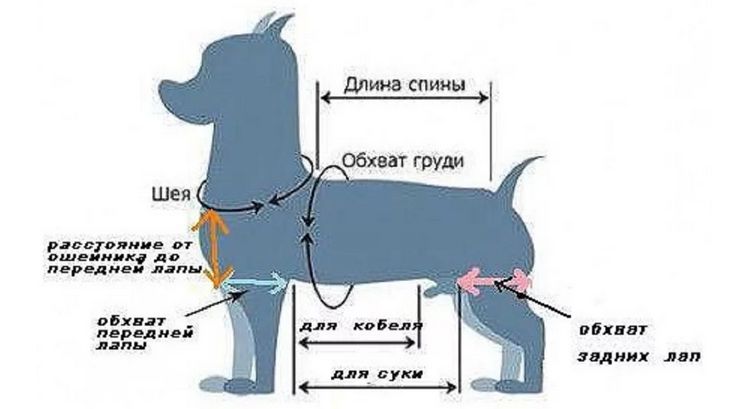
Since dogs are active during walks, the sweater should not restrict their movements. Therefore, it's best to add 1-2 cm to the paw measurements. There's no need to add back or waist measurements, as the garment should fit snugly.Let's start with a sample
After choosing a pattern and stitch pattern, you need to knit a swatch. This step is crucial and should not be skipped. This is the only way to accurately and precisely calculate the number of stitches. The swatch will show the knitting density and the chosen stitch pattern. At this point, you can change the knitting technique, pattern, or yarn if necessary.
The more stitches in the sample, the more accurate the calculation. The workflow in the master class is as follows:
- cast on 20 sts on two needles;
- remove one knitting needle and knit the first row;
- then we knit according to the chosen pattern;
- knit to a height of 10-12 cm;
- We close the loops of the sample, trying not to tighten the top edge.
- place the sample on a flat surface (if the edges do not lie flat, pin them);
- we apply a ruler to the knitting and count how many loops are removed in 10 cm along the length of the knitting;
- we calculate how many rows are removed in 10 cm along the height of the product;
- We write down the results and calculate the density using the formula: number of loops (rows): 10 cm (for example, 16 sts: 10 cm = 1.6 sts and 25 rows: 10 cm = 2.5 rows);
- We calculate the required number of loops using the formula: the width of the piece multiplied by the knitting density (for example, if we need a piece 25 cm, then 25 cm * 1.6 = 40 sts).
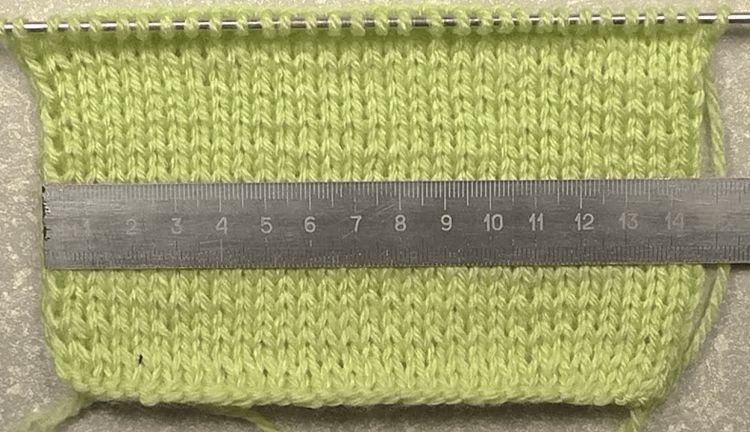
Edge loops are not taken into account when calculating the knitting density of a sample.
Diagrams with step-by-step descriptions
Beginners can easily make a dog sweater using simple patterns and detailed instructions. We offer three simple knitting options. All models are comfortable for dogs and attractive in appearance.
Warm sweater made of melange yarn
A knitted sweater made of melange yarn looks great on small pets. The weave of the yarn will hide any mistakes made by beginners, and the variegated coloring will smooth out the appearance of uneven stitches. This yarn can also be used for knitting without a pattern.
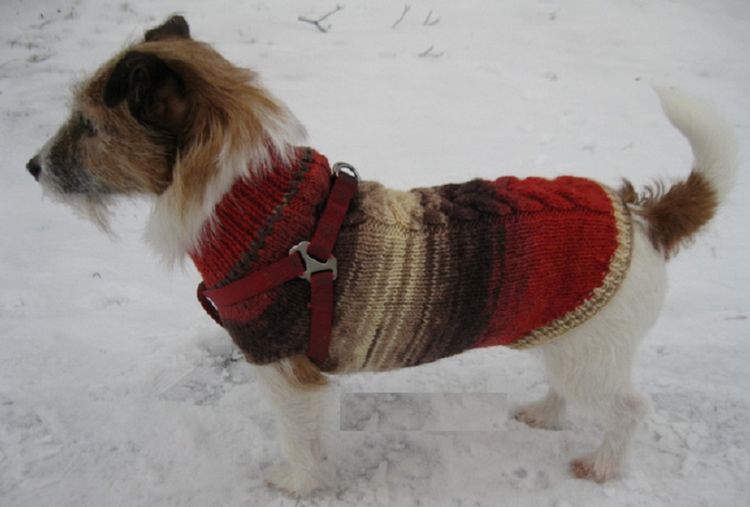
To work you will need:
- knitting needles No. 4;
- melange threads (100 g thick per 10 meters);
- hook No. 3;
- threads and a needle for sewing the pattern pieces together.
Job Description:
Let's start step by step with the collar. For a miniature dog, such as a Spitz or Pug, its width should be no more than 5 cm. The knitting pattern is 1x1 rib.
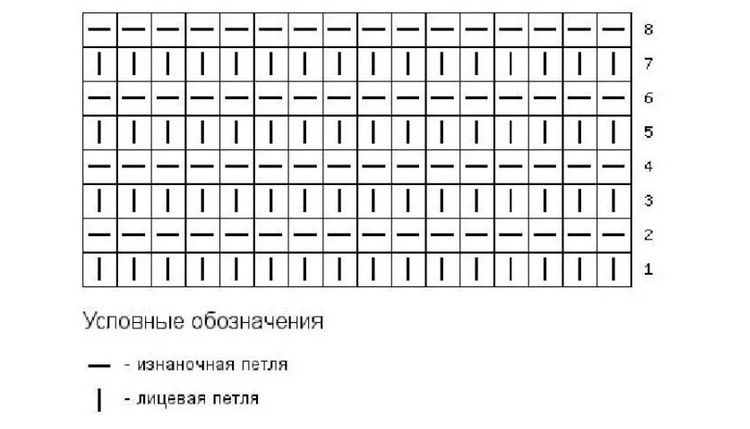
The main body of the garment is knitted together with the collar. Therefore, we continue the back using a simple stockinette stitch. Starting with the third row of the main fabric, increase two stitches in each row. Continue increasing until the width of the fabric equals the bust measurement. If you didn't add centimeters for seam allowances when taking your measurements earlier, you should do so now. Add 2 cm to the bust measurement.
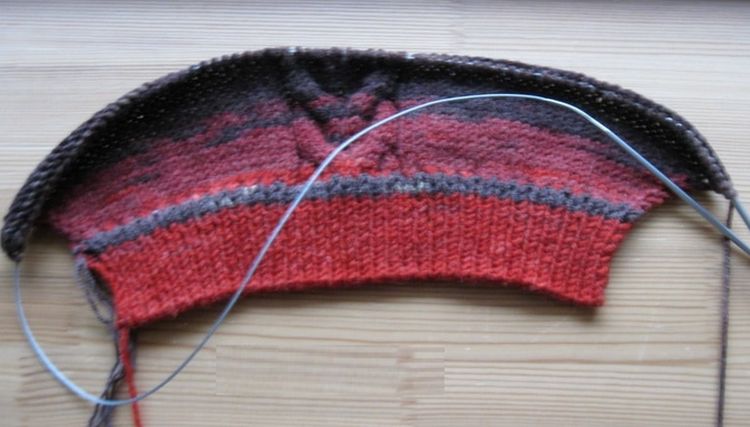
You can add a cable pattern to the center back. To do this, after finishing the collar, find its center and count 17 sts in both directions. These will be where the pattern (diagram) will be located.
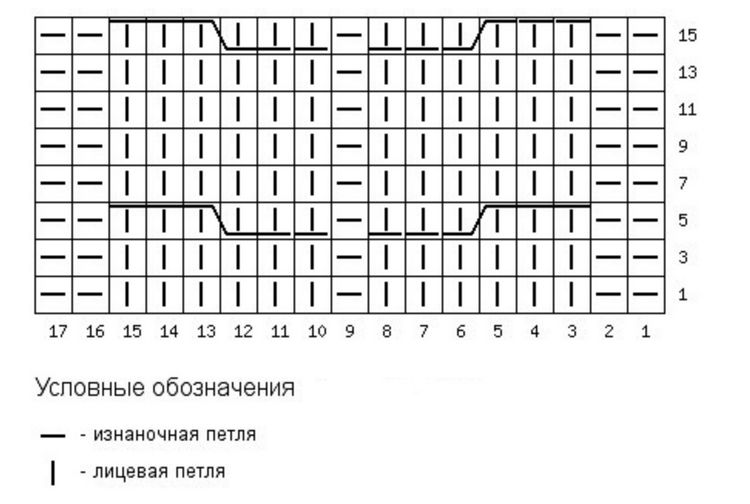
We try the sweater on the dog. If the chest is the right size, we knit three more rows without increasing.
When trying on, for convenience, you can transfer the knitting to circular needles, and then back to working needles.
Next, we'll knit the fabric, leaving slits for the front paws. For this, we'll need a measurement—the distance between the front paws. Knit, skipping the required number of stitches (centimeters), knitting only the side panels of the "sleeves." First, knit 3 cm high, then bind off 6 cm, and knit the fabric to the second "sleeve." Once the desired measurement is reached, add chain stitches and continue knitting as a single piece.
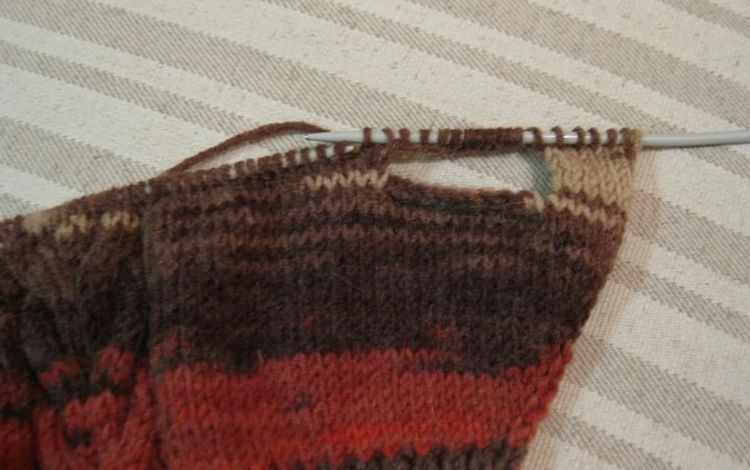
Continue knitting, decreasing two stitches every six rows. Aim for the correct measurements—back length and waist circumference. To avoid having to rework the sweater, try it on your pet several times as you go.
Finish the length of the garment with six rows of 2x2 ribbing. Crochet the armholes for the paws with 1-2 cm single crochet stitches. Sew the sweater along the belly line.
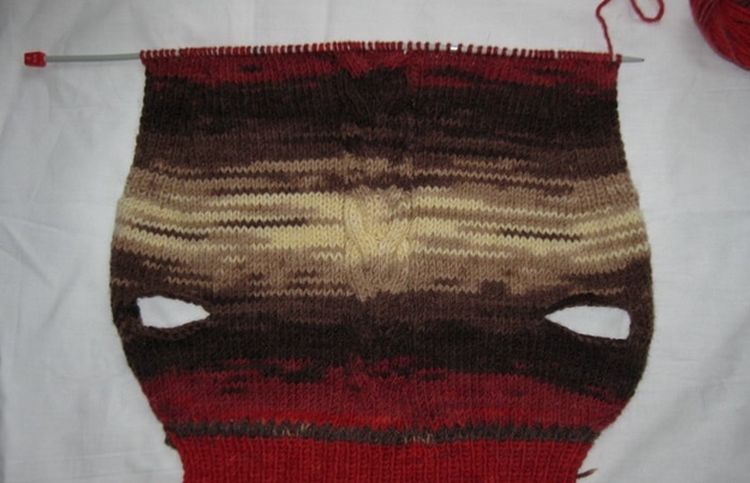
Petal sweater
Knitting this warm piece is easy, even for a beginner. The sweater consists of just two pieces—petals—that are easily knitted and joined together. Despite its simplicity, the sweater is comfortable and beautiful.
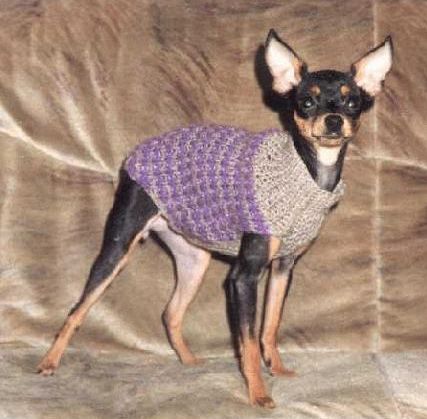
To work you will need:
- semi-wool threads;
- knitting needles No. 5;
- knitting needles No. 2.5;
- hook No. 2.5;
- ruler;
- scissors;
- needle and elastic thread.
Job Description:
- We begin knitting with the top half of the garment. You can knit it in a regular stockinette stitch or a rib pattern. The latter option will provide good stretch and will fit any figure perfectly. Cast on 22 stitches and knit a "tail" that will cover the lower back. Increase the width by adding two stitches every other row (one at the beginning and one at the end). The width of the "tail" depends on the size of the animal. For example, for a medium-sized toy terrier, the optimal width is 14-16 cm.
- After finishing the tail (rows 9-12), continue knitting the back. To do this, increase the knitting width by 20 sts (10 on each side). Continue knitting evenly without changes until the desired length is reached (measurement - back length).
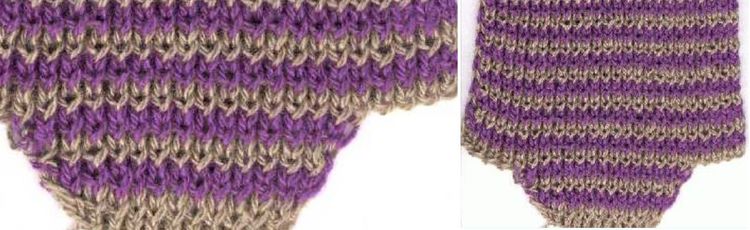
We finish working on the first piece by shaping the neckline. In the last row of the back, decrease 12 stitches at a time. For the neckline, it's recommended to switch to thinner needles (#2.5), as this will give the collar a neater look. Knit the collar to the desired length (4-5 rows).
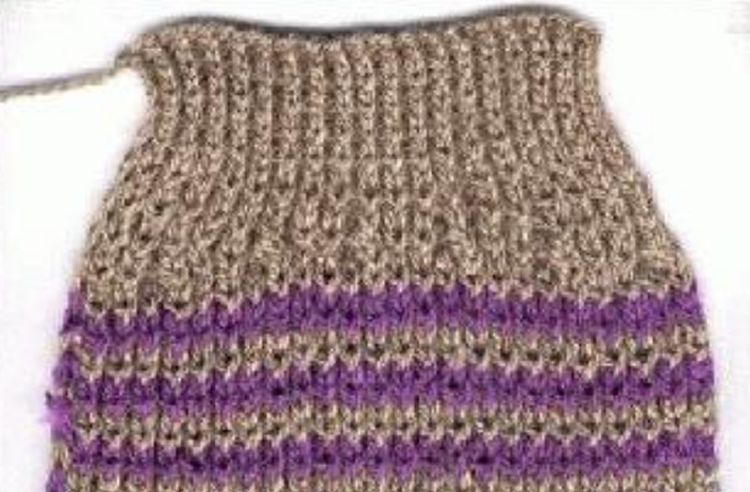
Let's start working on the second piece. Cast on 10-12 stitches and knit a strip equal in length to the sweater length without the tail.
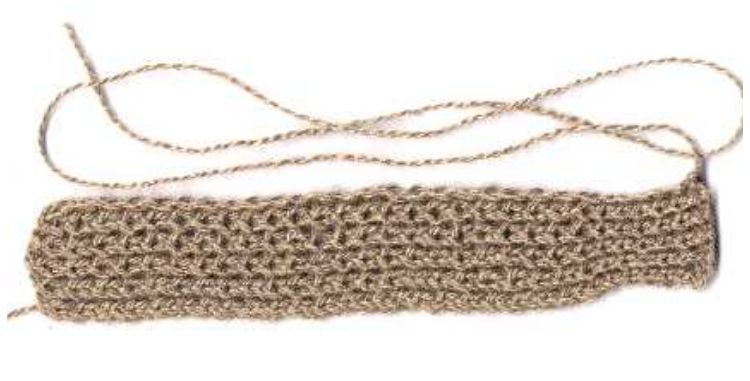
We finish the neck piece, just like on the back, 10-14 rows long, using thin knitting needles No. 2.5.
Let's begin assembling the garment. Using a needle and thread, begin sewing the sweater together from the neckline. Sew up to the point where you decreased 12 stitches—leaving a 6-7 cm opening for the paws. To ensure comfort for the dog and prevent the sweater from slipping, reinforce the belly and neck area with elastic thread. Simply stitch a few lines under the loops. If desired, instead of reinforcing the neckline with elastic thread, you can use a drawstring to secure the neckline and decorate the sweater.
Crochet pattern
You can also crochet a sweater for your beloved dog. Crocheted clothing is thick and very durable. Your pet will be very warm and cozy in it. This pattern can be used as the basis for not only a sweater but also a dress.
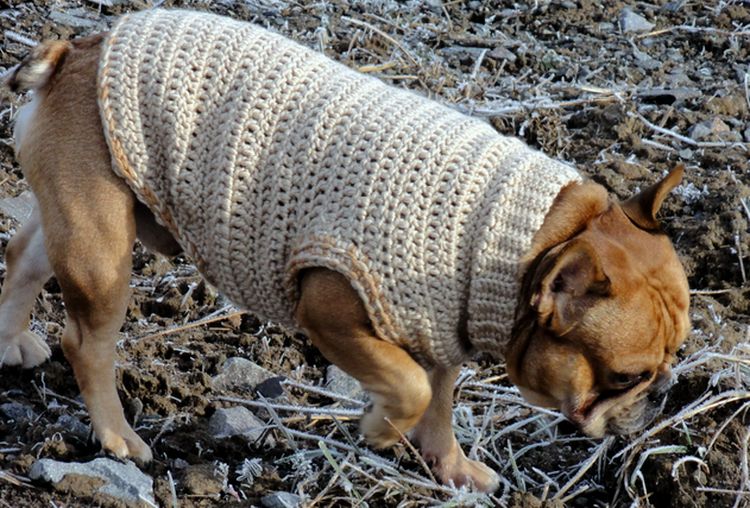
What you will need:
- hook No. 2;
- medium thickness yarn;
- thread and needle for sewing parts together;
- decoration as desired.
Job Description:
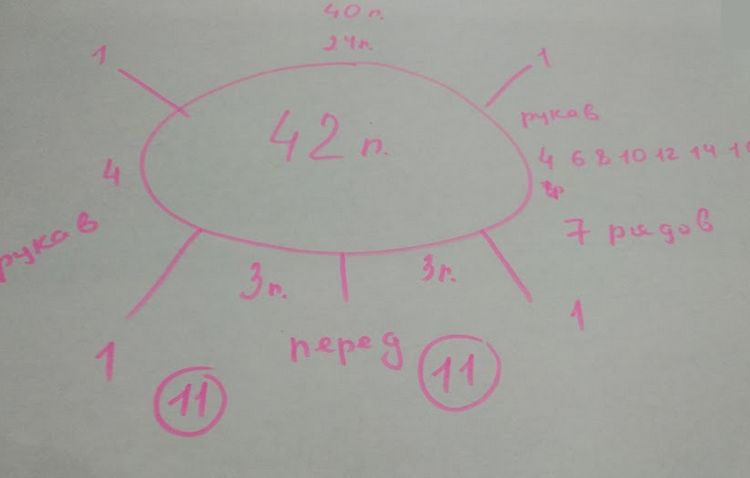
We cast on 42 chain stitches, close them into a ring and knit two lifting chain stitches and then knit rows clockwise in a circle in the following order:
- 1st:
3 tbsp. s/n;
3 dc in one loop (increase);
4 tbsp. s/n (space for the sleeve);
3 tbsp. s/n in 1 p. (raglan or increase);
24 st. s/n;
3 tbsp. s/n in 1 p. (raglan);
4 tbsp. s/n (space for the other sleeve);
3 tbsp. s/n (raglan);
last 3 tbsp. s/n;
Through the top chain stitch we connect the posts into a ring.
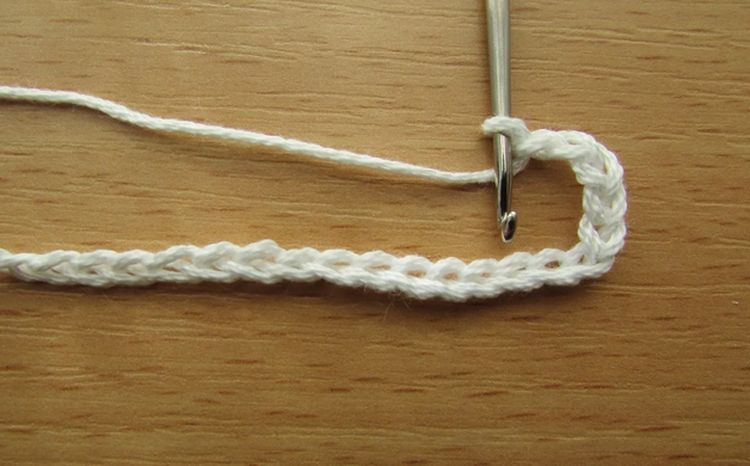
- 2nd
2 ch lift;
4 tbsp. s/n;
3 tbsp. s/n in 1 p. (raglan)
Knit the second row to the end similarly to the first, increasing the raglan stitches. Knit seven more rows using the same principle.
- 8th
Knit a single crochet stitch to the first raglan and join it to the opposite one to form a sleeve. Form the second sleeve in the same manner.
- 9th row knit dc - you should get 62 dc.
- 10, 11, 12, 13, 14th knit similarly to the 9th.
In rows 15 and 16, decrease 2 sts (1 st on one side, 1 st on the other side).
Next, knit the sweater to the desired length (measured by the back). The armholes can be bound with single crochet stitches. If desired, continue the binding from the armholes for long sleeves. Rib the neckline with a 2x2 ribbing pattern, 3-4 cm high. Reinforce the collar with a drawstring or elastic thread.
How to knit a sweater for a dog: video
Read also:


1 comment
Tatiana
I knit affordable overalls for dogs. 89296118516
Add a comment