
How to give a dog an intramuscular injection into the thigh
Pet illnesses are common. Giving a dog pills for a couple of days isn't always enough to cure the condition; sometimes it's necessary to administer medication subcutaneously or intramuscularly. However, if injections are required for a week, and more than once a day, taking the sick animal to the clinic every time isn't practical, and constantly having a veterinarian make house calls isn't affordable for everyone. Therefore, it's helpful for dog owners to learn how to administer injections to their pets themselves.
Content
Where and with what syringe should I give an intramuscular injection?
In veterinary medicine, three types of injections are most commonly used: subcutaneous, intramuscular, and intravenous. When prescribing a course of treatment, the veterinarian will explain exactly how to administer the medication to the animal.
Some medications cannot be administered via certain routes. For example, diphenhydramine injections are not given subcutaneously due to their irritating effects, oil solutions are not administered intravenously, and calcium chloride can only be administered intravenously: if injected into a muscle or subcutaneously, it will cause tissue necrosis.
From a safety and convenience standpoint, the most suitable site for an intramuscular injection in dogs is the thigh—the outer upper part of the hind leg. This area lacks major vessels and tendons, the muscle layer is quite strong, and the bone is located fairly far away. Consequently, it's virtually impossible to harm the animal during the injection, and since this part of the body has few nerve endings, the animal won't feel much pain.
The size of the syringe and needle depends on the medication and the quantity to be administered, as well as the body weight of your "patient." For example, for medium-sized dogs, a 2 ml syringe is optimal, while a dog weighing over 10 kg may require a 5 ml syringe. Puppies and small breed dogs (Spitz, Shih Tzu, lapdog, miniature dachshund, Yorkie, Chihuahua), you can use a 1 ml insulin syringe.
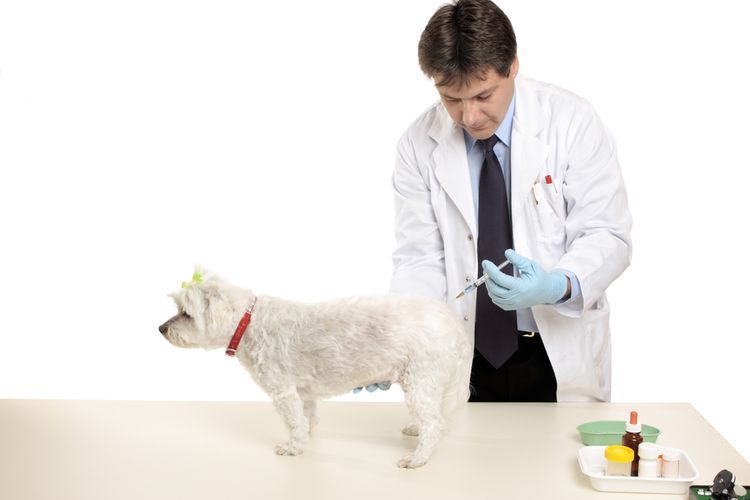
When choosing a syringe, the viscosity (flowability) of the drug to be injected is also taken into account. In particular, insulin syringes are not used for injecting oil-based solutions, as they quickly harden, clog the thin needle, and prevent the drug from being fully injected.
Recommendations for preparation
Before giving your dog an intramuscular injection, you need to:
- Make sure that the name of the drug written on the ampoule matches the drug prescribed by the veterinarian.
- Wash your hands with soap.
- Wipe the ampoule with a swab soaked in alcohol.
- File down the neck of the ampoule and break it.
- Remove the syringe and needle from the paper packaging, then, holding the needle by the base, place it on the syringe.
- Draw the solution from the ampoule into a syringe.
- Turn the syringe needle up and press the plunger to remove all air. Solution will appear at the tip of the needle to indicate that all air has been expelled.
There is no need to wipe the injection site with an antiseptic: dogs' skin is covered with a protective layer of natural lubricant that has antibacterial properties.
An important step in preparing for the injection is creating a positive psychological state for the dog. If the dog is fearful or anxious, its muscles will tense, making it more difficult to insert the needle. Therefore, veterinarians strongly recommend sitting close to the pet, petting it, and offering a tasty treat before the injection.
The optimal time for this procedure is considered to be after a walk and meal. Your pet will be in a good mood and half-asleep, allowing the injection to be administered quickly and accurately. If the dog is aggressive, it is recommended to muzzle it and have a family member assist in holding and petting the dog.
Performing the procedure
First, you need to find the right injection site. To do this, gently massage and palpate the dog's outer thigh—the appropriate area is where the muscle layer is thickest.
The syringe should be held in a way that allows comfortable pressure on the plunger without changing the position of your fingers. The needle should be inserted quickly to minimize pain. The recommended insertion depth for small dogs is 0.7 to 1.5 cm, and for large breeds, up to 3.5 cm. If you suspect the needle has hit a bone, remove it immediately.
The solution should be injected smoothly, supporting the dog's leg with your other hand to prevent the needle from shifting during the procedure. It is recommended to secure the needle with a finger at the base of the syringe in case the animal makes a sudden movement or tries to escape.
Once the medication is finished, the needle should be quickly removed from the thigh at the same angle it was inserted. The injection site can be gently massaged. If a small amount of blood appears on the skin, it means the needle has entered a small vessel. This is not a concern; simply remove the needle, wipe it with an alcohol swab, and inject at a different site. If a subcutaneous hematoma forms at the injection site, you can apply an iodine patch to the dog's paw.
If necessary, after practicing giving your dog intramuscular injections a few times, you'll see that this simple procedure is easy to master, even for a novice. This useful skill will not only save time and money when treating your pet, but can also be a lifesaver if your dog needs relief from severe pain, fever, or urgent treatment for poisoning before the veterinarian arrives.
Read also:
- When do puppies open their eyes?
- Inflammation of the third eyelid in dogs: symptoms and treatment
- Dry Eye Syndrome in Dogs: Causes and Treatment


Add a comment