
How to give an injection to a dog
A dog can become ill unexpectedly for the most trivial of reasons. Often, to provide timely assistance to their pet, owners need to know how to administer intramuscular or subcutaneous injections without waiting for the veterinarian to arrive. Knowing how to administer injections yourself will allow you to quickly relieve pain or eliminate other negative symptoms, as well as save time and money when a long course of treatment is required. To achieve this, it's important to learn the proper injection technique and memorize the rules for this procedure.
Content
Basic rules of injection
Before giving your dog an injection, it's important to determine the correct medication and quantity. This can only be the medication prescribed by your veterinarian, or one that has been used previously in similar situations.
The second important condition is the dog's calm. If the animal is reluctant to be touched due to playfulness or, conversely, is afraid of the syringe, someone must restrain it during the procedure. Otherwise, the needle may break, and the remaining tip will be very difficult to remove on your own. Therefore, it's important to reassure the pet by petting and calming it down.
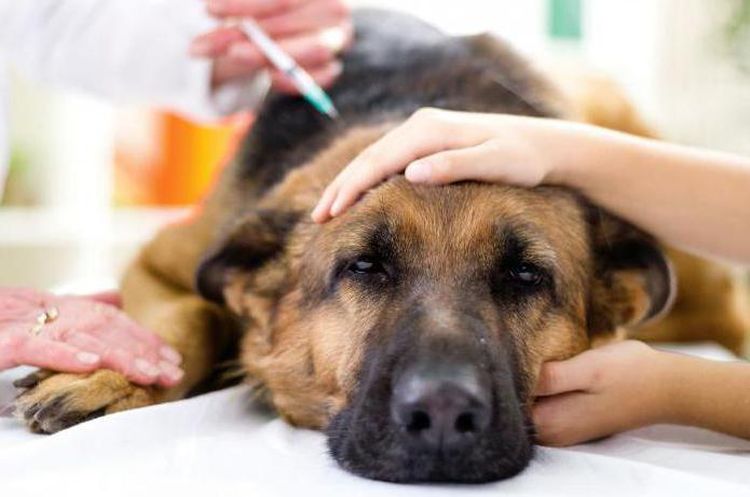
In addition, giving an injection to a dog requires following certain rules:
- Do not reuse the needle or touch it with your hands;
- It is not allowed to mix several drugs in one syringe unless prescribed by a veterinarian or in the instructions;
- An opened ampoule must not be stored - if its volume is greater than a single dose, the remainder is collected in doses into different syringes and placed in the refrigerator for no longer than 3 days;
- Before administration, the medicine is warmed in the hands to room temperature.
The dog's skin is not treated before the injection, as it has its own antibacterial layer. However, there should be no breaks in the skin at the injection site.
Direct preparation for the injection consists of the following:
- Wash and disinfect your hands thoroughly with alcohol or a disinfectant.
- Open the ampoule and draw the medicine into the syringe.
- Raise the needle up and move the plunger to release air from the syringe until a drop of medicine appears.
Further, the injection technique depends on the required method of drug administration – intramuscular or subcutaneous.
Important! The basic requirements for administering medication to a dog by injection are sterility, the correct injection site, and adherence to the correct dosage. It's important to clearly understand what, where, and how much to administer.
Subcutaneous injections
If the medication package insert or your veterinarian's instructions specify a subcutaneous injection, the needle should be inserted subcutaneously (without penetrating the muscle) at the withers, shoulder, or inner thigh. When choosing an injection site, keep in mind that the withers are the least sensitive but very dense and thick. The inner thighs, on the other hand, are very soft but rich in blood vessels, making them easily pierced by a needle. Therefore, if you're inexperienced, it's best to administer a subcutaneous injection at the withers or shoulder. If the course of treatment is long and the medication is very painful, it's recommended to alternate injections at the withers, shoulder, and then shoulder.
How to give a dog an injection in the scruff
The withers are the area between the shoulder blades, designed by nature to protect a dog during fights with other animals. This is why the skin there is rough and not very sensitive. This places certain demands on the injection process: to avoid bending the needle, it is injected more slowly than usual.
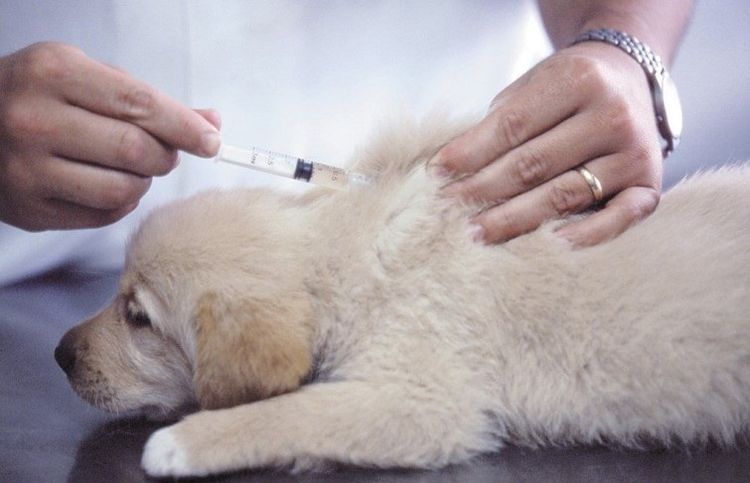
Before giving a dog an injection in the scruff, it's important to determine the injection site correctly. Since this area borders the neck, avoid piercing the skin too high, as this can cause irritation, infection, and inflammation.
The procedure is carried out according to the following scheme:
- the skin is pinched into a fold and pulled upward;
- the needle is inserted at the bottom of the fold, slightly above the place where the skin has moved away from the body, at an angle of 45º;
- the depth of penetration of the needle is controlled so that it just enters the subcutaneous space (this will be indicated by the cessation of skin resistance);
- After this, the medicine is released by pressing on the plunger.
It's important to pay close attention to the process to avoid puncturing the other side of the fold and releasing the medication. The advantage is that there are no nerves or important vessels on the withers, so there's no risk of harming the dog.
Injection techniques in other places
Since the subcutaneous injection technique is always the same and does not depend on the injection site, it should be performed according to the same protocol as administering an injection into the dog's scruff. The only difference may be in the method of puncturing the skin—the thicker the skin, the slower the needle insertion. The injection rate of the medication itself is not important with subcutaneous injection.
Other places for injection of the drug under the skin are:
- knee crease;
- inner thigh.
In rare cases, based on individual indications, an injection is given to the dog under the shoulder blade.
Theoretically, subcutaneous injections can be administered anywhere on the animal's body. However, given a number of physiological characteristics and the risk of complications, it's best to administer the injection only in the withers and shoulder.
Important! Dogs are very sensitive to their owner's uncertainty and nervousness. Therefore, precision and speed in administering the injection are essential.
Intramuscular injections (in the thigh)
Antibiotics and slowly absorbable compounds are injected deep into the muscle tissue. Since these injections are almost always administered into the thigh, the term "intramuscular injection for dogs" is rarely used by veterinarians and is less familiar to dog owners than the intended purpose. injection in the thigh.
When performing this procedure, the following rules must be observed:
- An injection into a dog's thigh should not be given into a tense muscle - if you feel tension, you must first stretch the paw, bending it slightly, and calm (relax) the dog;
- the needle is inserted into the muscle at a right angle;
- the depth of needle insertion for dogs up to 10 kg is 0.6–1.5 cm, for larger dogs – 1.3–3.5 cm;
- When choosing a puncture site, it is important to remember that not all points are suitable for this - it is important not to hit the nerve trunks in the thickness of the muscles.
Before giving a dog an intramuscular injection, find the right spot by palpating the muscles between the tibia and hip joint to determine their location and the thickness of the skin. This area is considered the most suitable for the injection, as it will be the least painful.
For a more detailed and visual explanation of the procedure, we recommend watching a training video on how to give a dog an intramuscular injection. By observing the veterinarian's manipulations, you can quickly and easily master the injection technique.
Possible complications
Problems after an injection can occur even if everything was done correctly. The needle injures tissue, be it skin or muscle, as well as the underlying vessels. Therefore, a small amount of blood is completely normal and poses no danger. Simply wipe it away with a bandage soaked in disinfectant. To stop more severe bleeding, it is recommended to apply cold for 15–25 minutes. If this does not help, consult a veterinarian.
A number of other consequences can occur from injecting a dog into a muscle, including:
- formation of a hematoma due to excessive bleeding under the skin, on which an iodine mesh or magnesium should be applied (for 20 minutes);
- the needle hits a nerve, after which the animal will experience pain, limp, draw in or pull its paw, which requires treatment by a veterinarian, usually with a novocaine block;
- the appearance of blood in the syringe is also the result of hitting a blood vessel, after which you need to remove the needle, wipe off the blood and make an injection with a new needle in a different place;
- the administration of the wrong drug or a violation of the method of administration (intramuscular instead of intravenous) is corrected by injecting the injection site with Ringer's solution or novocaine.
A special approach is required when administering medications that are particularly painful to inject. To minimize discomfort for your dog, it is necessary to:
- each injection should be given in a different place;
- reduce the concentration of the drug using solvents;
- use painkillers (novocaine, lidocaine).
If several medications are prescribed simultaneously, they should be divided into essential and non-essential. Non-essential medications can be administered less frequently, at least initially, to reduce the strain on the dog's body and psyche. In complex situations, inserting a catheter into the paw is recommended to reduce muscle trauma. However, such a treatment plan should be developed by an experienced veterinarian.
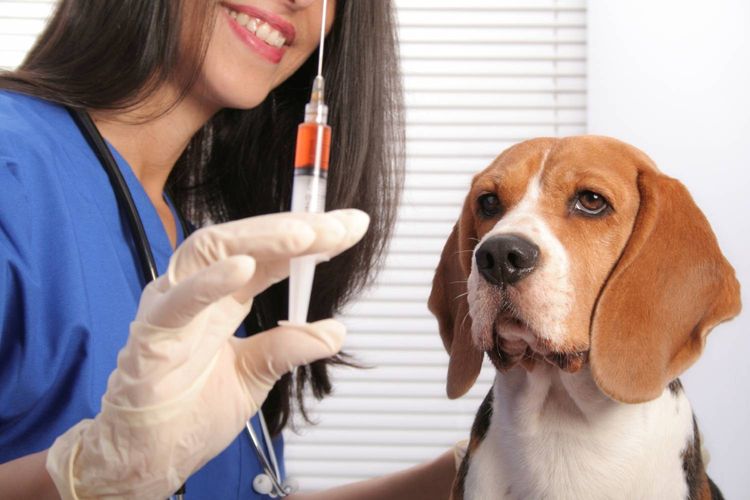
When giving a dog an injection in the leg, be patient, avoid force, and don't yell. While petting and talking to the animal, gently straighten the leg and discreetly administer the injection. Avoid nervousness or panic—your pet will sense it. Act boldly and confidently. If this is difficult to do alone, consider enlisting the help of someone the dog also trusts, or practicing your hand beforehand.
You can also ask our website's staff veterinarian a question, who will answer them as quickly as possible in the comments box below.
Read also:


Add a comment