
How to give a cat an enema at home
A cat owner should not only care for their pet but also be able to provide first aid if necessary. It's helpful to learn how to administer enemas, injections, and medications. However, it's important to keep in mind that any procedure must be prescribed by a doctor: unauthorized intervention in the animal's bodily processes can actually cause harm instead of benefit.
Types of enemas
Depending on the purpose in veterinary medicine, there are several types of enemas:
- Cleansing. These procedures are designed to remove fecal matter from the intestines, flush the colon of mucus and pus, and cleanse it of toxins. They are used in constipation, poisoning, and intoxication. When giving a cat a cleansing enema at home, room-temperature water is most often used, to which glycerin or soap may be added.
- Laxatives. (Oil, emulsion). Like cleansing enemas, laxative enemas increase the contractility of the intestinal smooth muscles. They are used in cases where introducing large amounts of fluid into the intestine is contraindicated (for example, in cats with diseases associated with edema).
- Thermostatic. These are water enemas indicated for intestinal peristalsis disorders. Cold enemas with water temperatures of 10-15°C stimulate intestinal wall tone and are used for bloating, atonic constipation, and colonic atony. Warm and hot enemas with water temperatures of 35-45°C are used for intestinal smooth muscle spasms.
- Hypertensive. They are used for them solutions Sodium chloride or magnesium sulfate. A hypertonic solution increases fluid transudation from blood vessels, reducing tissue swelling and causing stool softening. Hypertonic enemas are prescribed to cats for edema, dropsy, and atonic constipation.
- Nutritious, medicinal. They are used to administer nutrients or medications through the rectum if it is not possible to introduce them into the body in any other way.
Contraindications
Giving a cat an enema at home is only recommended for constipation that lasts less than 2-3 days, and with the veterinarian's approval. Even if you're certain your pet has simple constipation, it's important not only to relieve the symptoms of constipation (difficulty defecating) but also to identify and address the underlying cause, especially if the problem is recurring.
Constipation in cats can be associated with a disease affecting one part of the intestine, as well as other organs, such as the kidneys, liver, or central nervous system. In some cases, enemas are contraindicated, as this procedure can exacerbate the condition and worsen the animal's overall condition.
Enemas are not given to cats in the following cases:
- late stage of pregnancy;
- intestinal bleeding;
- cracks in the anus;
- inflammatory diseases of the gastrointestinal tract;
- suspected intestinal volvulus;
- the presence of a malignant neoplasm in the intestine;
- severe form of helminthiasis.
Preparation for the procedure
First of all, it's a good idea to stock up on medical gloves to avoid getting your hands dirty, and prepare a spacious litter box for your cat to defecate in. To administer an enema to your cat, you'll need:
- A bulb syringe with a soft tip (50 ml for a kitten and 150-200 ml for an adult cat). Some owners prefer to use a gas-relieving tube for newborns instead of a bulb syringe: its small diameter makes it easy to insert into the anus and causes less discomfort for the cat. A large syringe without a needle serves as a water container, with a tube attached to the tip.
- Lubricant for lubricating the tip of the bulb (Vaseline or baby cream).
- Warm water. The optimal water temperature for an enema is 25-30°C; cold water can trigger intestinal spasms, and hot water can cause intoxication due to the ingestion of toxic substances from the feces.
Adding a teaspoon of salt to the enema water will help soften and evacuate the stool quickly. Vaseline oil or glycerin. However, before using such supplements, it's advisable to consult a doctor.
Enema technique
Cats, like humans, should receive enemas on an empty stomach. It's best to do this in the morning, before their first feeding. If the procedure must be performed at another time, it's best to wait at least 1.5 hours after their last meal.
Even the most phlegmatic cat, who allows children to pull its tail and use it as a pillow, will not appreciate such an unpleasant procedure as bowel cleansing, so it's best to perform it with two people. If you don't have an assistant, it's best to secure the cat by wrapping it tightly in a towel, leaving the anus freely accessible. Then, place the "patient" on your left arm, and use your right hand to perform the necessary manipulations.
You can watch a video on how to give a cat an enema at home. The procedure is as follows:
- Squeeze the air out of the syringe and draw in warm water or the prepared oil mixture. For adult cats, administer 50-75 ml of water, and up to 20 ml of mineral oil enema. For small kittens, this dose should be halved.
- Point the syringe with the opening facing upward and press lightly on the bulb to remove any remaining air.
- Lubricate the tip with Vaseline or cream.
- Carefully, without making any sudden movements, insert the tip of the bulb syringe or gas vent tube into the animal's anus and, using a circular motion, insert it to a shallow depth (1-2 cm). The tip of the syringe should be parallel to the spine (this is the orientation of the rectum in cats).
- Slowly introduce the liquid into the cat's intestines by squeezing the bulb. If all the liquid does not fit, or its passage into the large intestine is difficult, the procedure should be stopped.
- Press the cat's tail firmly against the anus and hold it there for 10-15 minutes to prevent the solution from flowing back out.
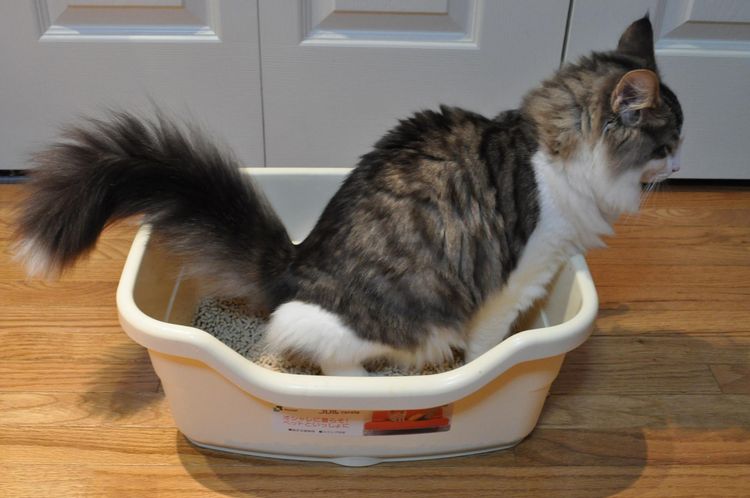
- Place the animal in the litter box to allow the excrement to come out.
To relieve constipation, cats can also use ready-to-use mini-enemas called Microlax. This laxative is packaged in a dosing syringe with a soft tip. It contains sodium citrate, sodium lauryl sulfoacetate, sorbitol, and purified water. The dosage depends on the animal's weight: for an adult cat, this is approximately ½ a tube; for kittens, 0.1-0.2 ml of the product is administered per 100 g of body weight. Microlax has a complex effect: it softens and liquefies feces and stimulates intestinal peristalsis.
Typically, the effect of a cleansing enema is fairly rapid, within 15-20 minutes, and the cat will successfully defecate. After the feces are passed, be sure to inspect them. If you see blood in the litter box, contact your veterinarian immediately; you may have injured the intestinal wall during the procedure. If the enema is ineffective and your cat fails to defecate, the bowel cleansing procedure can be repeated in a few hours.
How to give an enema to a cat: video from a veterinarian
Read also:


Add a comment