
Cat house: buy or make yourself?
If you've decided to get a cat, you're getting another full-fledged member of the family, with all their whims, demands, and needs. Cats, like many people, love their privacy. Even if your pet is playful and energetic, they still need their own corner, so to speak, where they can feel safe and at peace. Hundreds of different cat houses of various shapes and sizes are now available for sale. However, the prices for such popular items, frankly, are steep. So what to do? The solution is simple: build one. DIY cat house.
Content
What types of cat houses are there?
Demand dictates supply: stores offer a wide variety of shelter options for your cat. With the right skills and materials, you can build almost any cat-specific home yourself. All models are broadly categorized as:
- hammocks;
- couches;
- shelter houses;
- play complexes for cats, with a built-in house;
Let's find out in more detail what all these tailed creature shelters are.
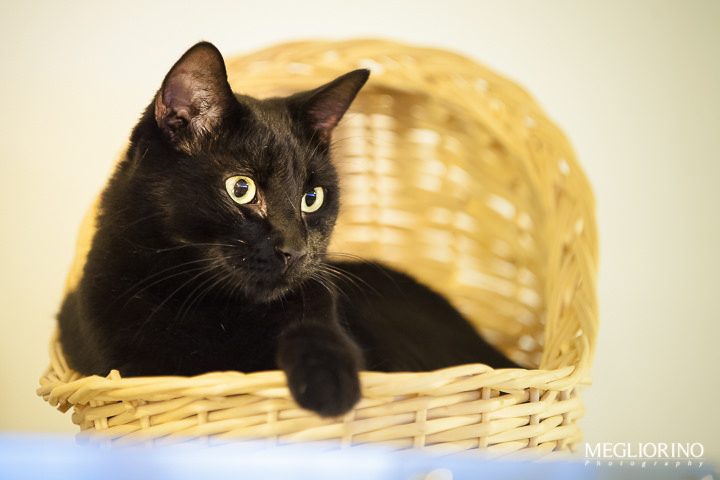
Hammocks
This is a convenient and compact option for a personal space for your pet. Thanks to its simple design and universal attachment with tension rods, you can place the hammock anywhere—even under a chair or by stretching the tension rods between furniture legs. Many cats enjoy lying in the hammock, observing the world around them, and quickly become accustomed to their personal space.
How do you make a hammock-style cat house, you ask? It's very simple: find a piece of thick fabric that's the right size for your kitty and sew some hanging straps to it. You've got yourself a perfect spot!
Loungers
Essentially, a bed isn't a shelter, but a place for your pet to rest. Many pets simply adore lounging in a container with a low edge, occupying bowls and basins. These cats will appreciate a bed—a soft cushion with a low, protective edge.
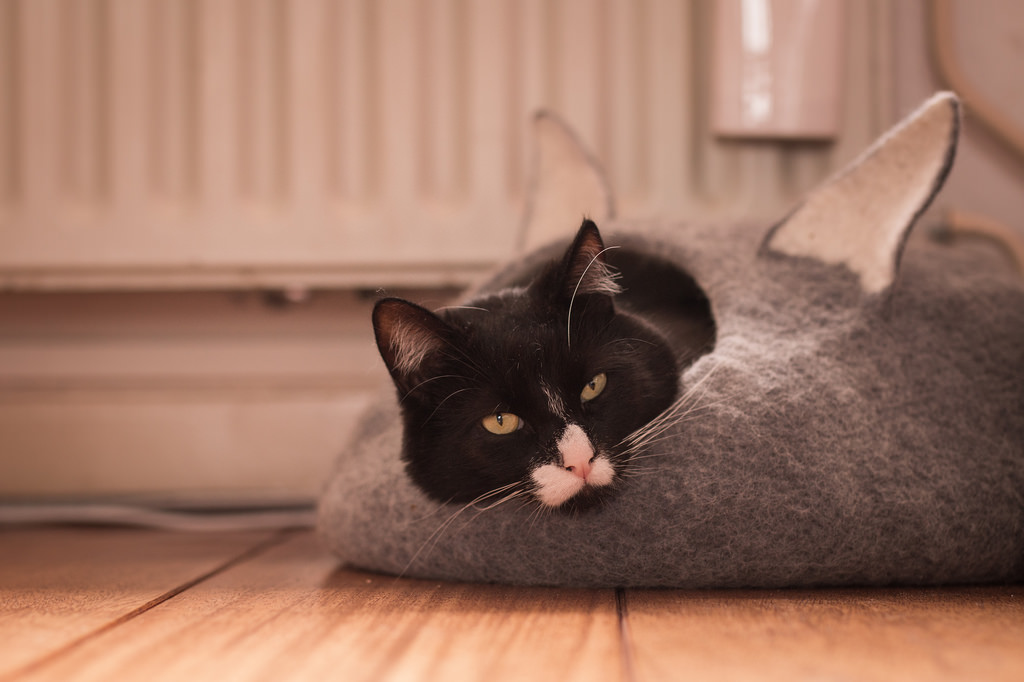
If you don't want to spend money on such a simple item, you can also make your own lounger—all you need is basic sewing skills and a small piece of soft fabric. Patterns for all the most popular lounger models are freely available online, and downloading them is easy.
Shelter houses
All cats are individualists, meaning they value their personal freedom. This also applies to their habitat – a cat needs a "den" where they can be completely alone and guaranteed to be undisturbed. A house designed specifically for a cat can be such a place. There are hundreds of different designs and plans for such structures, so if you're wondering how to build a cat house yourself, you'll definitely have plenty to choose from. The final design, of course, depends on your pet's preferences, as well as the size of your apartment and the location where the future "cat house" will be located.
Typically, such a structure is placed near a radiator, and then your cat won't be able to get out of there by force – it will quickly settle into a cozy and warm home. Such structures can be as simple as a box with a hole in it, or quite complex and interesting multi-story structures with passages and hidden passages. The more elements and hiding places your cat house has, the more your pet will love it.
Playground complexes
With your imagination, such a structure can serve a variety of functions. A house, a bed, a wheel, various toys on ropes and springs, climbing poles that imitate tree trunks—all of these can be made for your cat yourself, without the need to buy expensive cat supplies from stores.
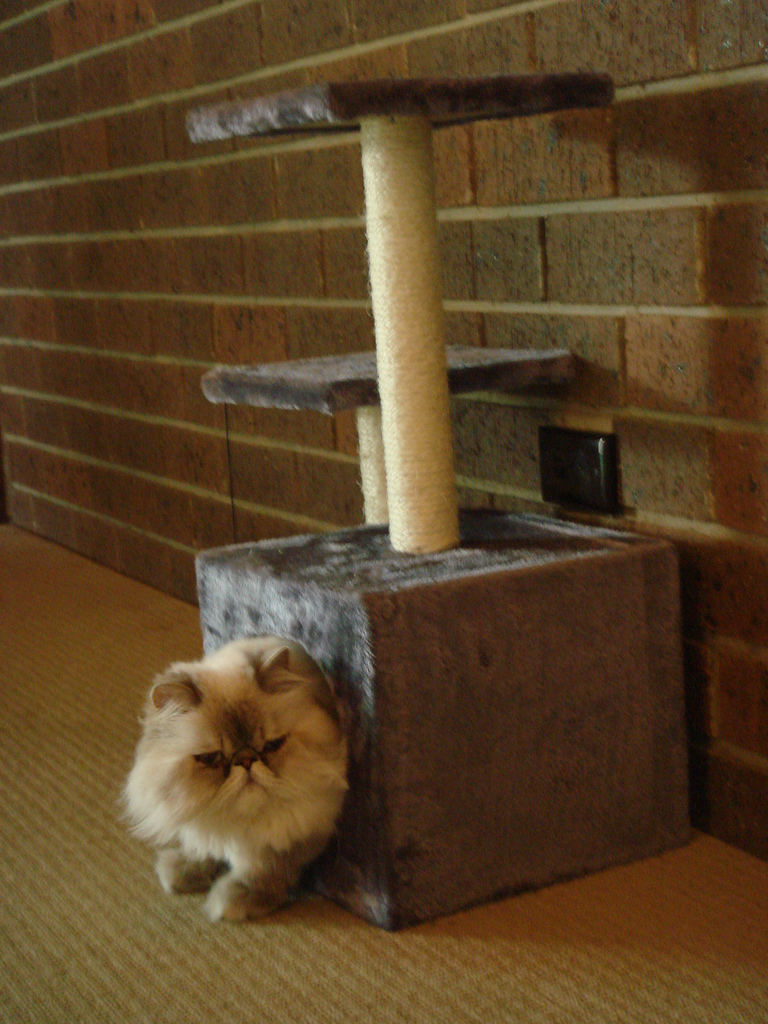
The key is imagination and some basic skills in working with wood and other materials, and you'll succeed. By the way, cat house tutorials, videos of which you can easily find on YouTube, will help you complete the task quickly and easily. With the right skills, your kitty is guaranteed to be happy with its new home.
What materials are the houses made of?
In fact, you're only limited by your imagination—a home for your furry friend can be made from absolutely any material. We've seen shelters made from papier-mâché, cardboard, wood, fabric—in short, from any available materials. However, it's important to remember that cats are capricious and picky creatures, and if your creation isn't to their liking, they'll simply ignore it.
The most common material for building a cat house is wood and various wood-based materials. They're easy to work with and can be used to create any structure, even a multi-story mansion. You'll also need upholstery and foam to create the most comfortable environment for your pet inside. If you want to add play elements to the house, you might need sisal rope and some scraps of string, which your cat will happily scratch its claws on.
The tools you'll need include a full woodworking kit, a stapler, a glue gun, a set of screwdrivers, and screws. With this arsenal, the task of building a cat house yourself will be solved in a matter of hours. But what if you have no woodworking space and don't have much skill with the tools? Then the choice is obvious: create a home for your cat from materials found in every home!
A DIY cat house tutorial
In this master class, you'll learn how to make a cat house using scrap materials and a sewing machine. I'll have to warn you that I'm not particularly fond of sewing machines, so if I can do it, you can too. My cat currently lives in a house made from a sofa. We were initially going to throw it out, but the upholstery was just so good. It's a lovely thing for a cat house—it gives her something soft to sharpen her claws on. So, if you're interested, let's get started.
Choose thick fabric. You'll also need some foam rubber, but you can substitute it with something else if needed. I used foam rubber that was about two centimeters thick. So, let's get started building a house for our beloved cat, or maybe a male cat.
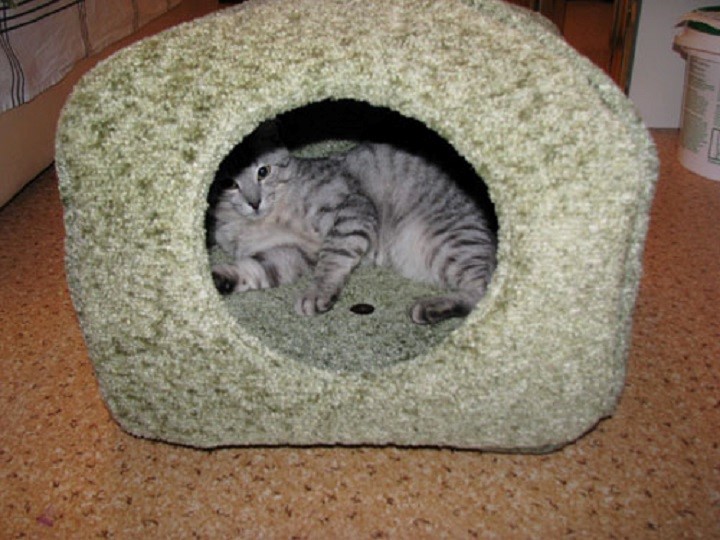
- Pattern of details.
First, make a template on newspaper measuring 40 x 30 x 25 cm. Transfer the template to the fabric (leave about a two-centimeter seam allowance). You'll need to make eight identical pieces. Also, make two pieces of fabric measuring 40 x 40 cm; these will be the bottom of the cat house. Remember to leave a two-centimeter seam allowance for each piece.
Tip! Transfer half of the templates to the front of the fabric. This will make sewing along the drawn line easier.
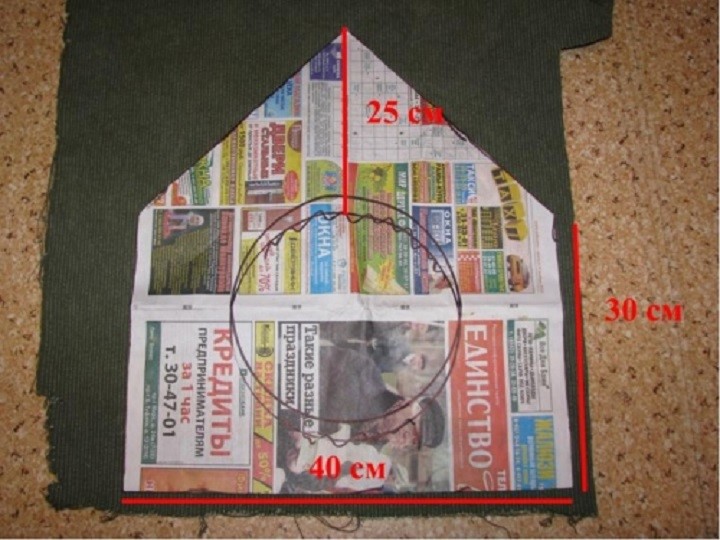
- Now take the foam rubber and cut out the blanks using the previous templates. You will need one piece for the bottom (40*40), and four pieces (40*30*25) for the sides. There is no need to leave an allowance here.
Note: If you're feeling adventurous, you can try building a cat house with five or even six walls, but I prefer the classic four-cornered design.
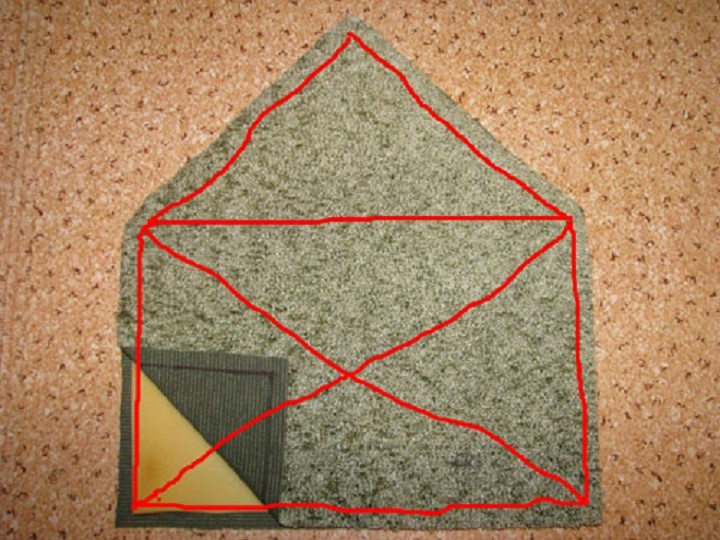
- Stitch around the perimeter of each piece to prevent the fabric from unraveling.
- Now you'll need two identical pieces of fabric and a matching piece of foam. Take them and fold them as shown in the photo. You can start with either the wall of the cat house or the floor—it doesn't matter. Once you've arranged everything correctly, tack the ends of the fabric with thread. This will make your job easier later when you sew the finished wall. Alternatively, you can skip the tack and just sew the finished piece straight away.
In the photo, you can see that the design on the template is printed on the inside. This made it difficult for me, so it's better to draw half of the templates on the front side. Use something that can be easily erased later.
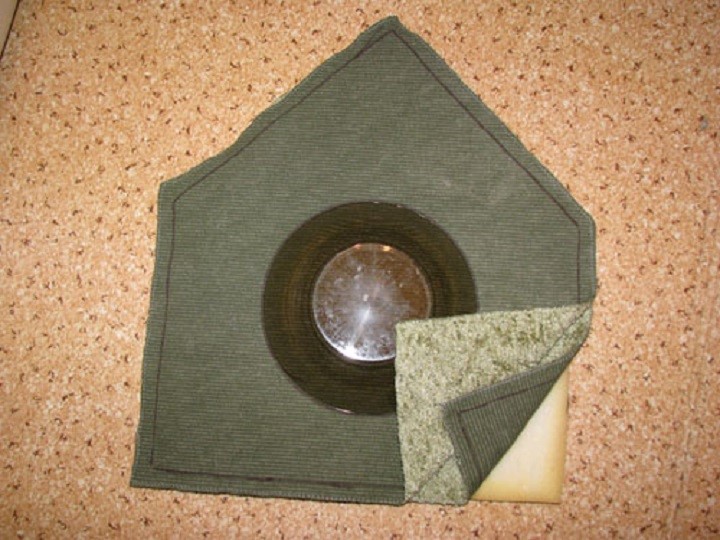
- Repeat the above-mentioned process of folding and stitching the walls three times. The fourth side, however, is a bit trickier. This is where we'll be making the entrance to the cat house. So, watch how I fold the fabric (in the photo) and follow suit. Draw a circle in the center of the piece. This will be the cat's front door.
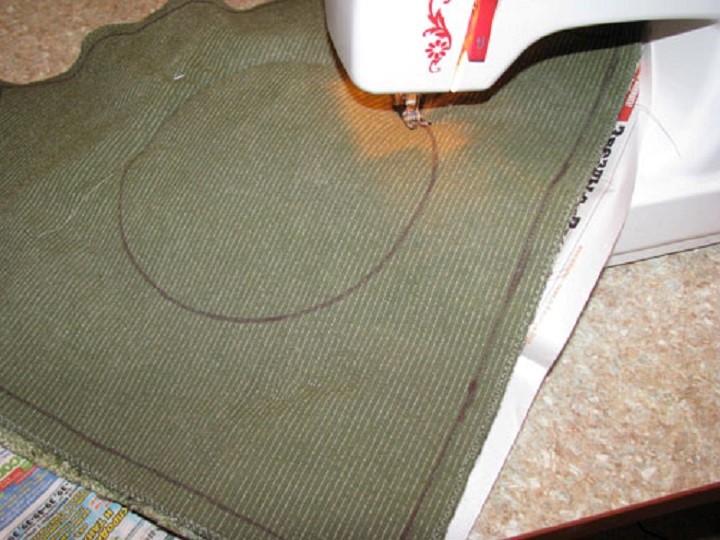
- As with the house walls, you can secure the perimeter of the circle with pins and thread. Then, sew the circle using a sewing machine.
Tip: Place some paper under the foam – this will help the foam slide, making the stitching process easier.
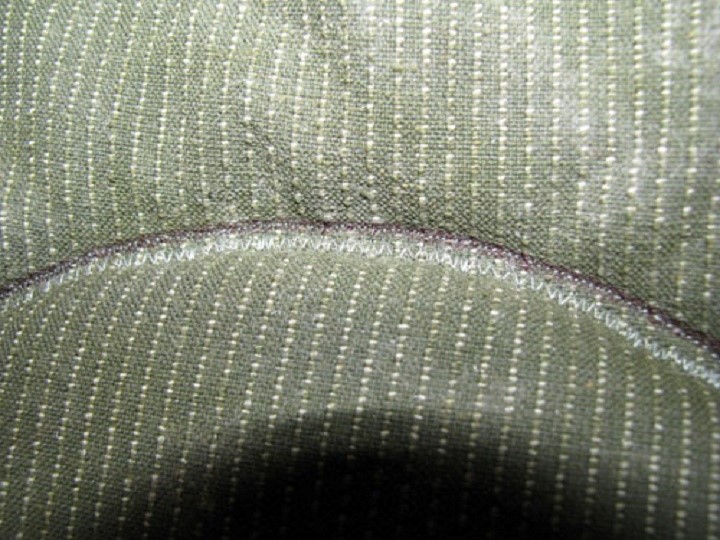
- Make another circle inside the circle and stitch it with a zigzag stitch.
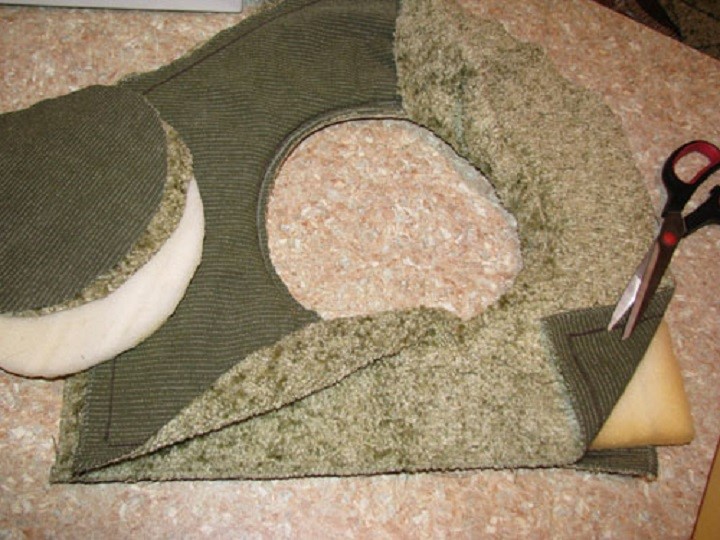
- Cut out everything inside the stitching and turn the fabric through the resulting opening to the front side.
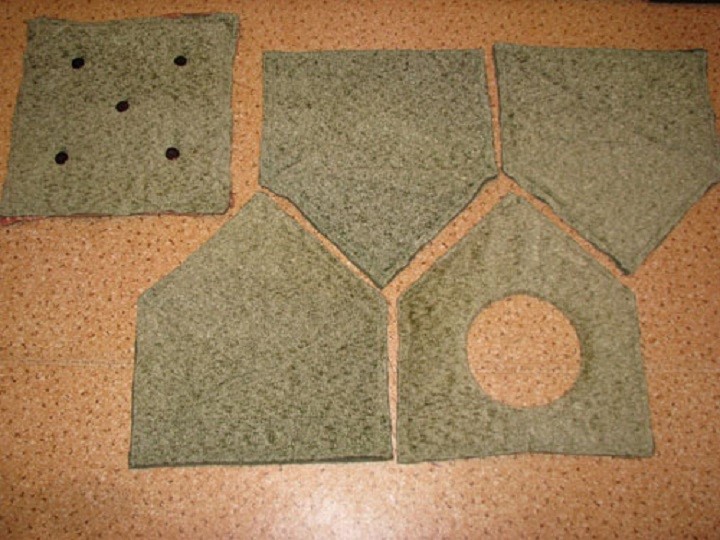
- Do the same with the bottom as with the sides – fold it over and sew it. You can see in the photo that the black circles on the bottom of the cat house are buttons. I couldn't sew the bottom because the foam was thicker (everything for the cat), so I found this fastening method. You should have five of these pieces too.
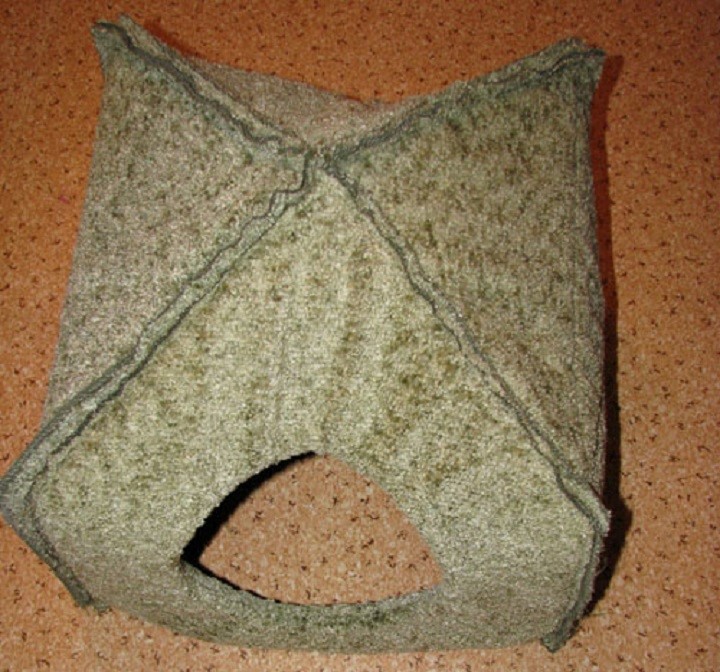
- Now sew the house pieces together. It's best to start with the entrance wall, then sew the back, final wall to the side walls.
Sew the pieces together from the inside out! This is what you should get.
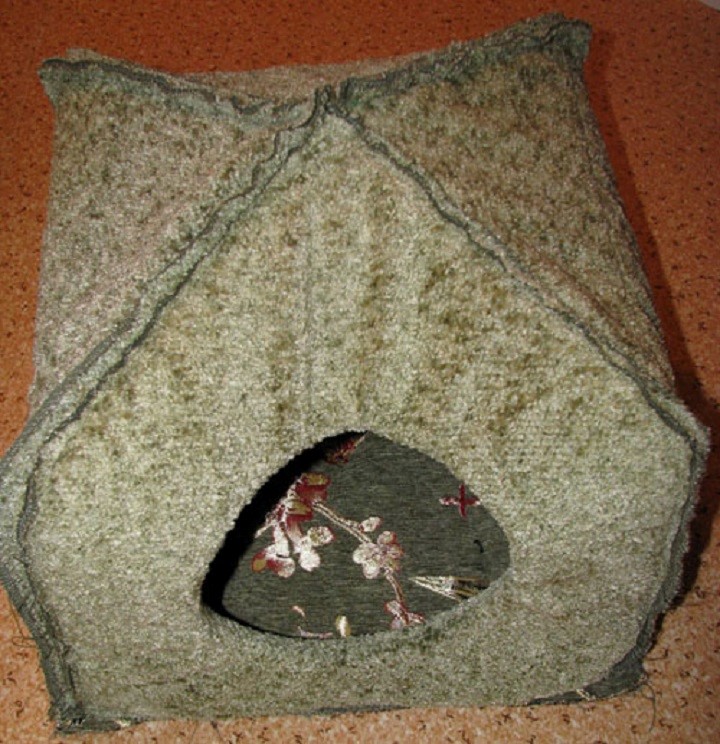
- The last task remains: sewing the bottom. Just to be sure, I'll remind you again. Everything you want to see on the front should now be on the inside of the cat house. After you finish sewing, turn the house inside out. This will hide the unsightly seams. That's it – the job is done. Invite your cat to your housewarming party.
An alternative to a wooden house
If you love cats, you're probably familiar with their love of various boxes. When buying household appliances or even shoes, don't be in a hurry to part with the cardboard packaging—it's a wonderful material for creating a cozy home for your kitty.
How do you make a cat house out of a box, you ask? It's very simple! Just cut an entrance for your cat, line it with soft bedding, and nothing will stop your cat from instantly settling into its hiding spot.
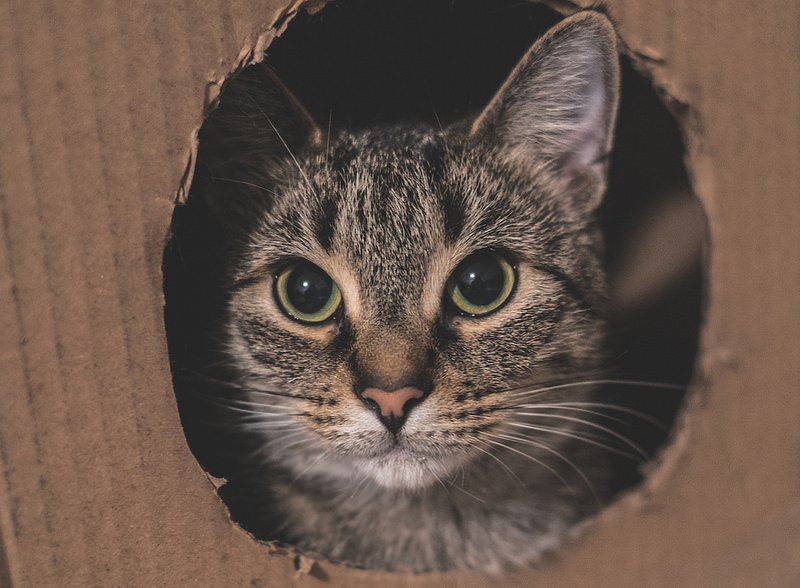
However, with creativity and desire, you can create true masterpieces of cat architecture from corrugated packaging cardboard. Two- or three-story cardboard mansions can charm even the most discerning cat, and they're sure to immediately choose a particular spot within the structure. However, remember that the cardboard house needs to be reinforced—if your pet is significantly heavy, it may simply collapse, permanently discouraging your kitty from coming near it.
So, it's clear that a DIY cat box is the easiest way to house your pet without much effort or expense. Treat your furry friend to a new home, and they're sure to repay you with boundless gratitude and affection.
Read also:
- How to make a cat with your own hands from wool?
- Life hacks for cats that will make life easier
- DIY cat collar

Add a comment