
How to potty train a dog in an apartment
With the arrival of their first puppy, inexperienced dog owners face the question of how to potty train their dog. Since young animals are initially restricted from going outside (until the quarantine period following vaccinations has ended), it's essential to teach the animal to relieve itself in a designated area; otherwise, puddles will simply appear all over the house.
Content
- 1 Simple tips
- 2 Why is it important to train from the very beginning?
- 3 House training for a puppy: indoors and outdoors
- 4 Steps to housetrain a puppy
- 5 Training an adult dog
- 6 How to use a diaper
- 7 How to use newspaper
- 8 Common mistakes and their solutions
- 9 Individual characteristics and difficulties
- 10 Important points
Simple tips
It's important to begin the training process as early as possible. Young puppies are much easier to housetrain than adults. All habits and behaviors are formed by 6-7 weeks. By this time, it's important to explain to the dog where it's allowed to pee and where it's strictly forbidden.
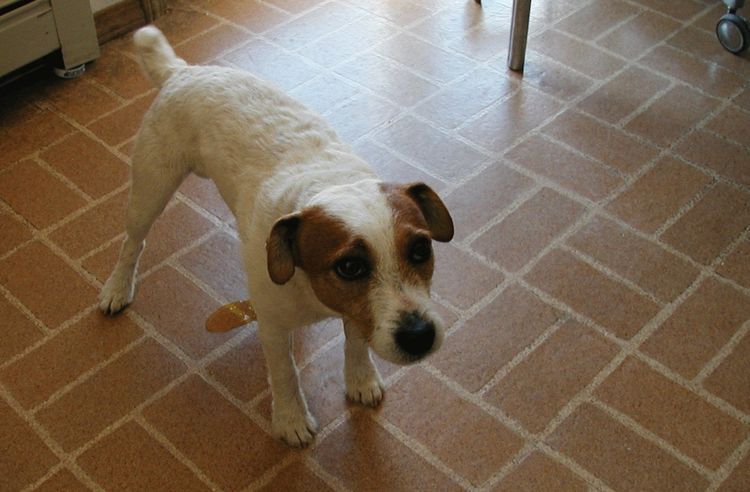
To speed up the process, follow these simple recommendations and tips from experienced dog owners:
- Start house training your puppy as soon as he becomes independent enough or comes into your home.
- Provide a toilet area for your dog in its own area. For small puppies, consider fencing the area or using a crate.
- Remove all rugs and carpets from the floor. Once your dog pees on a soft carpet and notices that the evidence of the crime quickly disappears, he'll be less likely to pee on a cold floor.
- Choose the right litter box for your puppy, taking into account the method his mother uses. Disposable or reusable diapers, less often special trays for dogs.
- If necessary, use sprays as an aid in litter training.
Approach this challenging process with responsibility and patience. Be prepared for your puppy to do its business in inappropriate places.
Why is it important to train from the very beginning?
Puppies and adult dogs don't have a natural understanding of the concept of a "toilet." They perceive the home as a single space and act primarily on physiological needs. If boundaries aren't established, they'll continue to explore the space until the owner restricts them. The sooner you begin training, the easier it is to reinforce the habit, especially before vaccinations—before 3-4 months of age, when going outside is not yet permitted. Training should begin immediately after your pet's arrival—and your patience will come in handy.
House training for a puppy: indoors and outdoors
For puppies the key principle is modeDuring the first few months, your baby needs to go to the toilet every 20–30 minutes, after every feeding, nap, and playtime. Take your little one for walks 5–6 times daily—this isn't overloading your little one, but rather cultivating a habit.
Prepare the space:
-
At home — Arrange the diapers or litter trays. Start with a few spots, then reduce to just one.
-
On the street — agree with yourself: take him to the same place, creating an associative series of “place + command word + praise”.
How can you tell when your pet needs to go potty? Your puppy may circle, sniff, whine quietly, or scratch at the door. The longer you wait, the higher the risk of making a mistake. It's important to be present every morning, after naps, and after feeding.
Steps to housetrain a puppy
-
Home adaptation:
-
During the day: After playing and feeding, place your baby on a diaper/lots.
-
Night training: keep the pad near the bed (affects the night routine).
-
-
Team training:
-
Repeat the word when needed - "toilet", "street".
-
Praise is an essential element of training.
-
-
Crossing to the street:
-
After vaccination (3-4 months): wean from the diaper → move it closer to the exit → then outside.
-
Within a week, the puppy develops an associative connection with the street.
-
Training an adult dog
If you've adopted an adult dog, training it will require patience—1 to 2 weeks. The principle is the same, but you'll need to be even more attentive to your pet's behavior and reactions.
-
At the first sign, move to the toilet.
-
Never punish: a late reaction frightens the dog and breaks trust.
-
If an adult dog "continues to make mistakes for a long time," secure the toilet area with soft barriers to prevent accidental technical errors.
How to use a diaper
Diapers These are ideal for indoor dog toilets. They can be used from the very beginning of training. Once a puppy arrives, it's important to create a designated area for it. Two square meters is sufficient for comfortable placement. The area should only contain a bed, food bowl, and a petting zoo.
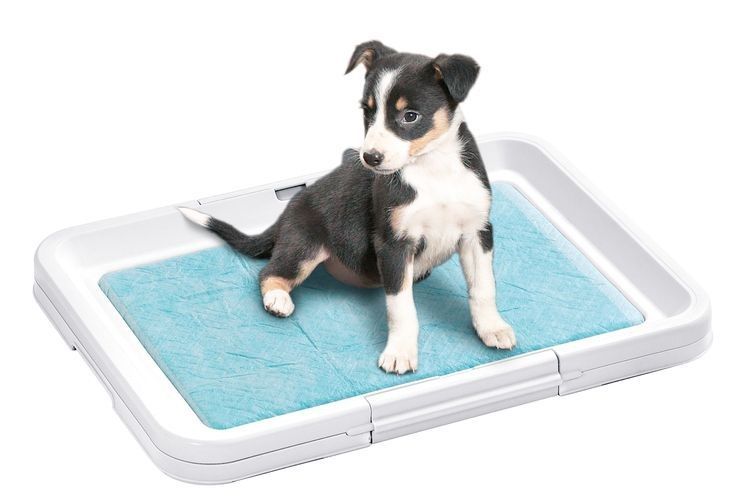
It is important to change the diaper immediately, otherwise the animal will choose a different place next time, since dogs are known for their cleanliness.
Over time, you can expand your dog's territory and decrease the size of the pad. Start by reducing it to half the size, and eventually, a quarter will be enough. Once the dog's enclosures are removed, the pad should be placed in the litter box. This will help the dog learn to use a designated area more quickly and avoid eliminating anywhere. Carpets, as well as any rags, shoes, and certain pieces of furniture, can be attractive to dogs, so put them away and hide them until the dog is fully accustomed to using the litter box.
How to use newspaper
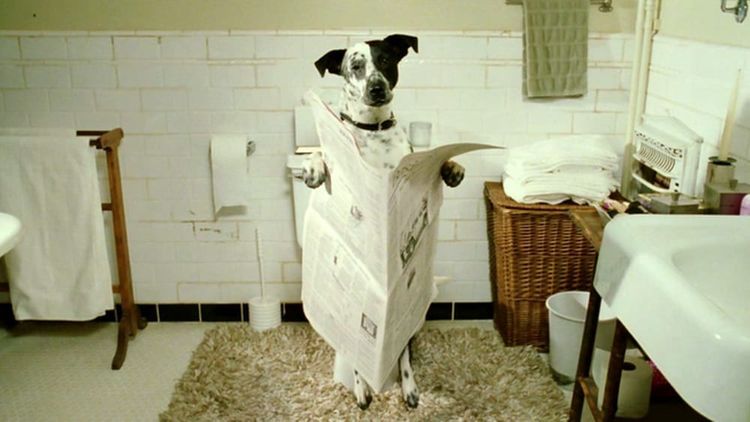
If you're unsure how to potty train your dog indoors and pads aren't helping, use newspaper. Puppies love to pee on sheets of paper spread out on the floor, as long as they're placed in a designated toilet area. When your dog has done its business, remove the newspaper immediately, leaving a small piece of it. Be sure to lay a new sheet next to the remaining piece. This will help your dog use its scent to locate the toilet area.
You can add newspaper to the litter box once your puppy gets used to peeing on it. Please note that dog litter boxes are considered an ineffective method and should only be used in conjunction with pads or newspapers. They come in both male and female versions (with a special post) and are made of plastic or metal. It's important to keep the box clean at all times, and if you leave your dog home alone all day, set out several containers.
Common mistakes and their solutions
The main mistakes are caused by a lack of clarity in the regime and emotions:
-
Punishment - this is ineffective: the dog may be afraid to walk in front of people, which is much worse.
-
Irregular walking - guarantees "accidents": better an extra exit than the hickey of fear afterwards.
-
The tray is too small - discomfort, reluctance to use.
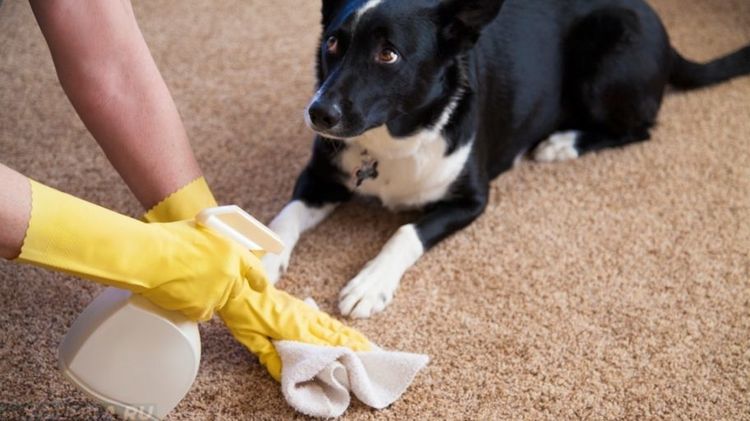
Cleaning after a miss is important. No strong chemical odors. More effective than plain water with an enzyme spray.
Individual characteristics and difficulties
Some breeds, especially miniature ones, require special attention:
-
Small breeds (Chihuahua, Yorkshire Terrier) have a small bladder and metabolism that requires frequent toileting - every 30 minutes.
-
Adults brought in - can be tested: showing tolerance, gentleness and a systematic approach is the path to success.
Important points
If you're looking for an answer to the question of how to potty train a dog in an apartment, consider the following:
- Observe the animal's behavior. Before urinating, a dog usually starts whining, barking, sniffing, circling in one place, and so on. When you notice something like this, immediately send the animal to the designated area.
- If your dog makes a puddle on the floor, scold it, you can poke it with your nose, and then show it the toilet area.
- A dog should only be punished if it's caught in the act. Otherwise, the animal won't understand why it's being punished and may even become offended.
- Don't forgive a dog for something it did right in front of you. Next time, it will think it won't be punished and repeat the same behavior.
- If you see your pet go to the toilet in the right place, be sure to praise them. You can also give them a few pieces of food.
- Keep the litter box clean to prevent your pet from choosing another option.
If you're having trouble training your dog to use the toilet indoors, try using special sprays. There are two types. Some help the animal find the right place to pee, while others help discourage the dog from peeing on carpets and other inappropriate places.
The potty training process typically takes between a week and 10 days, so be patient and follow the advice of experienced dog handlers. Never use physical force. Raising your voice is sufficient punishment, as dogs are quite sensitive.
Read also:
- How to potty train a dog outside
- How to convince your parents to buy you a dog
- Walking the dog correctly


1 comment
Irina
We trained our Yorkie to use a litter box last winter. It turned out to be very convenient—more convenient than diapers and newspapers, especially when we can't take him for a walk (we have a model with a post—for gentlemen). I bought it myself at the pet store. I'll just buy some extra diapers for this season, and we'll be ready for winter.
Add a comment