
How to properly give an injection to a cat?
Today we'll tell you how to properly administer an injection to a cat at home. Any cat can become ill—both indoor cats and those allowed to roam freely. A loving owner will never leave their pet without veterinary care. After diagnosis, a veterinarian often prescribes an injection, which can be given through a shot or an IV.
Even for minor illnesses, injections can be more convenient than administering pills or fluids. Furthermore, antibiotics act more quickly when administered intramuscularly, helping your pet recover faster. Of course, administering injections yourself can be intimidating, but a steady hand and determination are key.
A veterinarian always demonstrates basic injection techniques for cats. They also explain how to administer medications correctly, what medications are prescribed, and the correct dosages.
Content
Safe injection guidelines
First, we need to understand what an injection is. What types are there? How do you properly administer an injection to a cat? An injection (specifically, to a cat) is a very specific method of delivering medication into the body by puncturing and injecting the prescribed medication into specific tissues through a special needle.
To give a cat an injection on their own, its owner must follow a number of mandatory rules:
- mandatory sterility of the injection site, instruments and hands;
- precise adherence to the prescribed dosage of each specific drug;
- strict adherence to the rules for drawing up and administering the drug;
- choose exactly the injection site that was indicated by the veterinarian;
- Never, under any circumstances, administer injection treatment to a pet on your own.
 Please note that once a medication ampoule has been opened, it should not be refilled (for example, the next day or the same day). If the medication is expensive, it should be drawn into several syringes at once and the needles should be capped with sterile caps. These injection kits can be stored in the refrigerator for up to 3 days. Under no circumstances should multiple medicinal solutions be mixed in the same syringe unless directed to do so by a veterinarian. Some antibiotics are administered only with lidocaine or novocaine solutions because the injection is extremely painful. However, this is specified both by the veterinarian in the prescription and in the medication package insert. Otherwise, to conserve syringe space or to avoid unnecessary injections of the animal, mixing medications in the same syringe is strictly prohibited!
A pet's diagnosis should only be made by a qualified veterinarian who has developed a proper treatment plan, including the administration of injection medications. When administering injections, owners should follow these step-by-step instructions:
We wash our hands
Wash your hands with soap (preferably laundry soap or another type with antibacterial properties). Lather thoroughly up to the elbows and rinse (at least three times).
Open the package with the disposable injection syringe
The syringe's volume should roughly correspond to the dose of the prescribed medication being administered. The needle should be from this specific syringe and fit snugly on its tip. It's best to have a couple of medication bottles and a few syringes in front of you. You never know if something might fall out of your hands due to stress, so you won't have to rummage through the medicine cabinet and wash your hands again, while your cat watches you running around, frightened.
We are collecting medicine
Draw up exactly the amount of medication prescribed by your veterinarian. Don't draw up more in the hopes of making the medication work faster or better. Overdosing is very dangerous. Also, don't draw up less than prescribed, otherwise the blood concentration of the medication will be lower than required for recovery. Before drawing up the medication, be sure to check the name of the prescribed medication on the ampoule.
Fixation
Fix the animal (with a towel, diaper, in a special bag, press it to the floor with your elbow"non-working"hands) or call someone for help so that the assistant can hold the cat firmly during the injection.
We administer the medicine
Inject the medication into the tissue according to the instructions for the specific injection type. Do not apply disinfectant solutions to the pet's skin after the injection. Do not sterilize the syringe needle. If you haven't dropped the syringe or touched the needle with your fingers, the factory sterility is intact. Attach the needle to the syringe without removing the cap.
Intramuscular injection
How do you give a cat an intramuscular injection? There are more than one or two possible injection methods for administering medication to an animal:
- intramuscular;
- intravenous;
- intradermal;
- subcutaneous.
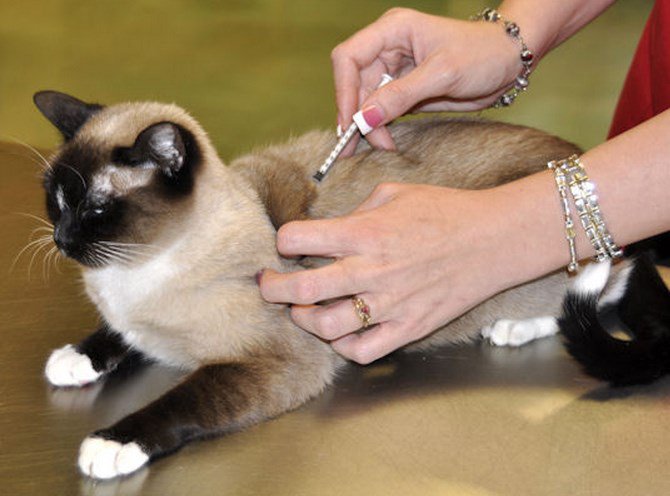
The cat receives an intramuscular injection, usually into the thigh, but sometimes into the shoulder. In both cases, the following guidelines should be followed:
- insert the needle no deeper than one third of its length;
- Take the syringe correctly right away, so as not to move your fingers later, giving the animal an excellent opportunity to escape.
.jpg)
Generally, giving a cat an intramuscular injection isn't difficult—the key is to get the hang of it and do it step by step, without rushing. It's a good idea to practice. As the movie, well-known to almost everyone, says, "Practice on cats!" You can practice on a stuffed animal, using an old, unused syringe and needle. After a few minutes, your hand won't tremble so much; you'll have "rehearsed" the depth of the needle insertion.
Injection into the thigh
The most convenient and safest place to give an intramuscular injection is the cat's thigh. However, this is a fairly sensitive area, so it's recommended to inject the least painful medications there. It's important to avoid excessive muscle tension. If tension is high, gently massage the injection site and, if possible, calm the animal.
The injection is administered slowly into the cat's thigh. Before administering the injection, gently pinch and retract the tissue to avoid injecting into the muscle or nerve. Be sure to avoid entering a blood vessel by gently pulling back on the plunger. If no blood appears in the syringe, you've hit the muscle. If the medication is tinged with blood, you'll need to re-inject (or gently pull the needle out a couple of millimeters and pull back on the plunger).
The drug injected into the thigh should be at room temperature (or body temperature).
An injection in the shoulder
Often, medications are administered to cats in the shoulder. The instructions for administration are the same as for a thigh injection. It is important to ensure that the skin at the intended injection site is free of inflammation and damage.
.jpg)
An injection into the withers
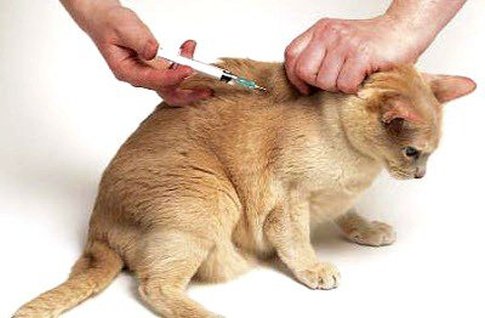
How do I give a cat an injection in the scruff? Injections administered to an animal in the scruff are also called subcutaneous injections. Theoretically, they can be administered anywhere under the skin. However, the least sensitive area on a cat's body is the scruff. Therefore, subcutaneous injections are given in the scruff. A spot is chosen between the animal's shoulder blades, the skin is pinched, and the injection is performed with a sterile needle. Care must be taken not to bend, or even break, the needle, as the skin on the scruff can be thick and tough.
When is it done? an injection into the cat's scruffThe syringe should be held parallel to the surface on which the animal is restrained. This reduces the risk of puncturing the skin or injecting the drug intradermally. Therefore, the injection should be no deeper than the subcutaneous space (to avoid entering the muscle, but to inject the drug precisely under the skin). Once the puncture is complete, press the syringe plunger and inject the drug.
Be extremely careful not to puncture the skin fold at the withers. When administering the prescribed medication, check the skin and fur at the injection site with your finger. If it's wet, you've injected into the skin, not under it. You can inject very small amounts intradermally (literally tenths of a milliliter). All you need to do is insert the needle a little deeper and try again. If administered correctly, the skin and fur will be dry, and nothing will leak out.
Any injection is a microtrauma for a cat. It's important to remember this and try to administer the medication slowly intramuscularly to avoid significant tissue dissection. However, with subcutaneous injections, speed isn't critical. When giving your pet an injection, be calm and don't hesitate. Uncertainty and pity will interfere with proper administration, which will inevitably delay your pet's recovery.
Possible complications after an injection in a cat
Although injections usually go smoothly, complications sometimes arise, both for inexperienced owners and specialists. Knowing the potential consequences helps provide timely assistance to your pet.
-
Blood at the injection site
If drops of blood appear after the needle is removed, the vessel wall is damaged. A few drops can be stopped by applying cold for 10-15 minutes (ice or frozen food wrapped in a clean cloth). -
Infiltrate or lump
The appearance of a lump indicates that the medication is not being absorbed or that an inflammatory process has begun. Causes include: too much medication, infection, too rapid administration, an allergic reaction, or a cold medication. If the lump does not resolve, the area is hot and painful, and the cat's condition worsens, the animal should be taken to the veterinarian. -
Abscess
Lumps that don't resolve over time can develop into an abscess. The injection site will swell, become hot, and become painful. The cat may refuse to eat, become lethargic, and develop a fever. If an abscess develops, it's important to seek immediate surgical attention. -
Lameness
This can occur due to muscle damage from irritating solutions or a needle entering a nerve. It usually resolves within an hour. If lameness worsens, persists for several days, or the limb becomes stiff, the pet should be taken to a veterinarian. -
Temperature increase
It may be caused by an allergy to the drug or inflammation at the injection site, especially if sterility is not maintained. -
Stress and anxiety
Cats are sensitive to pain and discomfort. After injections, pets may hide, refuse food, and become skittish. In such cases, a tablet or suspension can be used, as discussed with your veterinarian. Synthetic pheromones in a diffuser can help reduce stress.
Always monitor your cat's behavior and well-being. If your cat refuses to eat, is lethargic, exhibits a high fever, is ill, or has bloody or purulent discharge, you should immediately take your pet to the veterinarian.
If you have any questions about how to give a cat an injection, please write in the comments.
Read also:


Add a comment