
How to tell if a dog is pregnant
A dog's pregnancy is a crucial period, starting from the first days. During this period, the animal requires special care, as the health of not only the dog but also her offspring depends on the pregnancy. However, the early stages of pregnancy in dogs, especially first-time mothers, are practically unnoticeable. Therefore, it is important to recognize that your dog is pregnant early.
Content
Methods of determination
In dogs, pregnancy lasts an average of 58-64 days, sometimes extending to 68-70 days. The period is counted from the first day of mating. If this day is unknown, then the period is calculated from the beginning of estrus, taking two weeks away from it.
External signs
Pregnancy can be difficult to determine early on. However, there are indirect signs that can help owners closely observe their dog's behavior and changes in habits. Here are some early signs of pregnancy a dog might notice:
- Picky eating (refusal to eat favorite food).
- Decreased activity, drowsiness.
- Behavior changes. Sometimes a dog tries to attract its owner's attention by cuddles, while other times the normally sociable pet becomes indifferent and apathetic.

Knowing the behavioral characteristics of their pet, an attentive owner will pay attention to the changes that appear and, after some time, will be able to find other signs confirming her interesting situation.
During the second week of pregnancy, a pregnant dog's nipples swell and the skin around them thickens. These signs can be detected by palpating her abdomen.
To make sure, the owner can conduct a more detailed examination of the animal at a veterinary clinic.
Why perform an ultrasound?
Some dog owners believe that ultrasounds are harmful to pregnant animals. This belief is completely unfounded, as ultrasounds are completely harmless for the expectant mother and her puppies.
What does ultrasound provide?
This study is multi-purpose:
- Confirms or excludes signs of pregnancy in dogs.
- Determines the number of developing embryos.
- Allows you to assess the viability, size and location of fruits.
- Determines existing pregnancy pathologies.
It is recommended to perform an ultrasound scan on your dog at least once during pregnancy. The optimal time is between days 24 and 28 of gestation. At 28 days, ultrasound is almost 100% effective in diagnosing pregnancy in dogs.
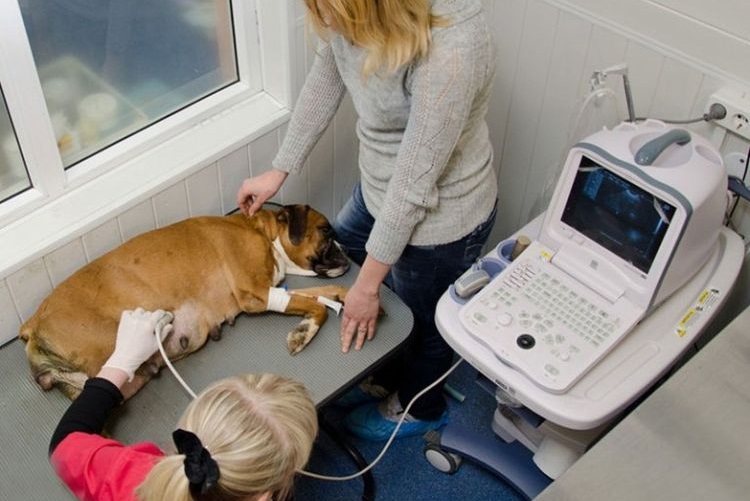
If the ultrasound shows any deviations in the animal’s condition from the norm, then repeated examinations are necessary to carry out corrections and prepare for childbirth.
Other methods of determining pregnancy
There are also other methods for determining a dog's pregnancy. Your veterinarian will recommend the most effective method for your specific animal.
Relaxin test
There's a laboratory test of animal blood serum called the relaxin test. This is a virtually 100% reliable method and is recommended for testing at 2-3 weeks of pregnancy, although a more accurate result is guaranteed if tested at 3-4 weeks.
Relaxin is a specific hormone produced in a dog's body only during pregnancy. It is produced by the placentas of developing puppy embryos.
The test is performed in a laboratory setting, as the animal's venous blood is required for the study. The hormone is detected in the blood serum.
R-research
How can you tell if a dog is pregnant later in pregnancy? This can be done using radiography, starting from day 42, when the fetuses' skeletal calcification process begins. Radiographs determine the exact number of developing fetuses in the uterus, their position, and the ratio of the pregnant dog's pelvic size to the fetuses' size. This information is crucial if the animal has any underlying medical conditions, allowing for timely selection of a birthing strategy.
Late pregnancy
From the second month, the signs become obvious:
- The animal begins to gain weight, the mammary glands swell, and the belly increases in size.
- Active weight gain.
- By palpating the abdomen, the puppies can be easily felt (this procedure is not recommended for owners of pregnant dogs to perform on their own, to avoid injury due to lack of professional experience).
- Female dogs that have given birth may begin producing colostrum as early as 40 days after birth. First-time mothers may produce milk only before or immediately after birth.
- A drop in rectal temperature is an indicator of impending labor. It drops sharply to 37-36⁰C 10-24 hours before the onset of labor.
Content Features
Once you are sure that your pet is pregnant, you need to make adjustments to her routine and diet.
A pregnant dog should be provided with peace and quiet, protected from the intrusive attention of children, and avoid vigorous ball play and running. This doesn't mean she should lie down for the entire pregnancy. Walks in the forest and park are extremely beneficial. You can play with her, but don't overdo it. Long walks should be replaced with shorter ones, but walk her more often than usual.

Your diet should include foods rich in calcium, vitamins, and minerals. Your daily menu should include:
- Boiled meat (beef and veal).
- Sea fish.
- Porridges made from buckwheat, rice, and rolled oats.
- Eggs.
- Vegetables, fruits.
- Kefir, yogurt, cottage cheese.
In the second half of pregnancy, it is necessary to add a vitamin E solution to the food. Also, on the advice of a veterinarian, the expectant mother should add vitamin supplements in combination with mineral compounds.
Shortly before the birth, the pet's sleeping area should be arranged so that she will be comfortable during labor. It should be spacious and private.
Read also:






Add a comment