
How do you know if a cat has given birth to all her kittens?
Domestic cats usually give birth easily, experiencing little pain, and the expectant mother successfully copes with the process on her own. However, there are cases where labor stops while a kitten is still in the womb. This is very dangerous—due to possible complications, your pet risks poor health and even death. Therefore, during the birth of a cat's kittens, her owner must be vigilant and be able to determine whether all the kittens have been born and whether the mother or her kittens require veterinary attention.
Content
How does the process of cat birth work?
Cats gestate their young for approximately 64 days, and in rare cases, up to 70 days. The average litter size is 3-5 kittens, but litters of up to eight have been recorded. duration of labor Several factors influence the birth process: age, litter size, number of previous litters, breed, and diet during pregnancy. On average, the birth process in cats lasts from several hours to a day and a half, and includes periods of contractions, pushing, and expulsion of the fetus.
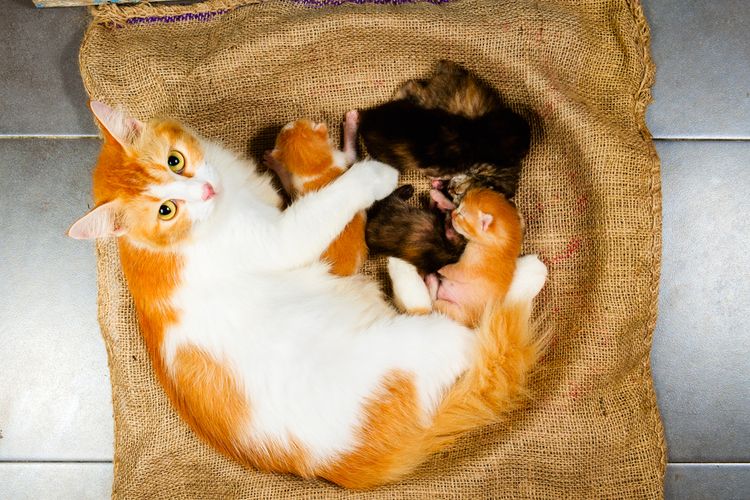
The first ones contractions in a cat The contractions may be unnoticeable to others because they are still weak. During this time, your pet may be busy building a nest. As contractions intensify, the cat may moan, meow, and periodically tense up as she pushes. Then the cervix opens, and the mucus plug is released through the birth canal, followed by the first kitten.
Kittens are born "in order," usually with intervals ranging from half an hour to 12 hours. Their birth may alternate with the expulsion of the placenta, which the mother sometimes consumes. Kittens are born in the fetal membrane (amniotic sac), which the mother chews through, licks the kittens, and then cuts the umbilical cord. The mother may begin nursing the kittens after they've been born between contractions.
If your pet ignores the newborn kitten, the owner present at the birth will have to rupture the amniotic sac, carefully wipe the kitten and place it next to the mother.
During labor, a cat may need several hours of rest. It can be difficult for an inexperienced cat owner to determine whether all the kittens have been delivered or whether labor is taking a break. Even an ultrasound performed during pregnancy doesn't always accurately determine the number of fetuses. Signs of labor ending can be helpful.
Signs that the cat has given birth completely
The mother cat's abdomen, assuming all kittens have been delivered and she has finished laboring, will be soft and free of lumps. It should be palpated gently, without applying force. However, the size of the abdomen alone cannot be used to judge the completion of labor, as the cat's uterus contracts slowly and retains its tone even after 24 hours.
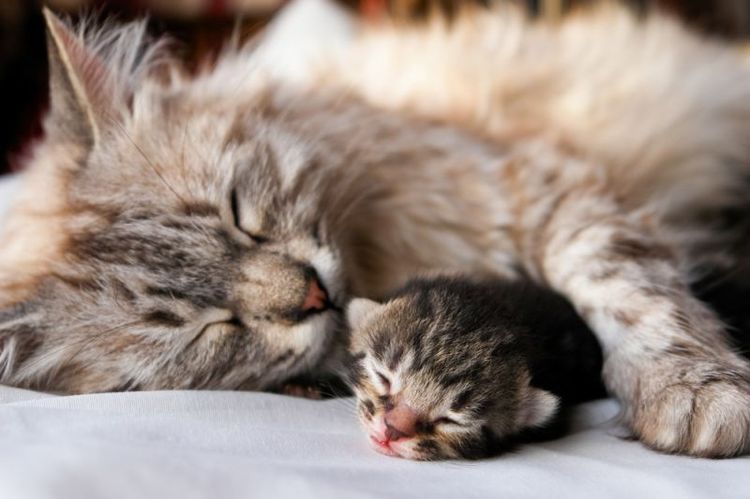
The main signs that indicate that a cat has given birth are behavioral signs:
- The cat is not anxious and there is no straining.
- the woman in labor's breathing is even, her heartbeat is rhythmic, and her pulse is not rapid;
- the mother shows an active interest in her offspring, licks the kittens, feeds them, and brings them closer;
- she can change her body position, get up from the nest, leave it for several minutes;
- After hard work, your pet experiences increased appetite and thirst, and eats and drinks with pleasure.
Signs of incomplete labor
Incomplete expulsion of the fetuses can be caused by prolonged or difficult labor, multiple births, or when the animal simply lacks the strength to fully deliver the fetus. Labor can also stop due to dehydration or stress, such as when she's in danger.
You can suspect that labor is not yet over based on the following symptoms:
- shows no interest in newborn cubs;
- lethargic, lies in one position;
- periodically strains;
- refuses food and water;
- the abdomen is hard and possibly large, in its lower part, in the area of the uterus, a lump can be felt.
The most dangerous sign of incomplete labor is vaginal discharge with an unpleasant odor that appears within 1-2 days. The fetus or placenta remaining in the uterus will inevitably decompose, causing toxicity and a bacterial infection.
What should you do if your cat hasn't given birth to all her kittens? If you notice signs of premature labor, you should contact your veterinarian immediately. The vet will examine the cat, and if there is an unborn kitten remaining in her womb, they will take measures to save the kitten and its mother. If necessary, an ultrasound or x-ray may be performed on the mother.
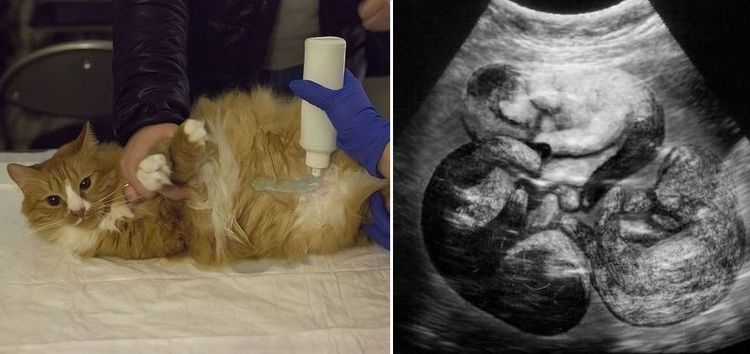
To check whether labor is complete, specialists often use oxytocin, a drug that stimulates the uterine muscles. It is administered in a dose of no more than 0.3 ml; this is sufficient to expel any remaining fetus, and if there is none, to clear the uterus of excess mucus. Self-administration of this obstetric aid is not recommended.
Read also:
- How long after giving birth can a cat become pregnant?
- Can a cat eat her kittens?
- How does a cat behave before giving birth?


Add a comment