
How to tell if a cat is pregnant
Cats reach sexual maturity early, between 6 and 9 months of age. This timing depends on various factors, including health, habitat, genetics, and body type. Shorthaired cats are considered to reach sexual maturity earlier than longhaired cats, and small breed cats are considered to reach sexual maturity earlier than large breed cats.
There's a period when a cat's chance of fertilization is extremely high—estrus, or heat. These favorable conditions for amphimyxis (the technical term for conception) occur approximately every three weeks. They are associated with the maturation and release of gametes (female reproductive cells) into the abdominal cavity.

Content
The first signs of pregnancy
When a cat has mated with a male cat brought into the house, it's not a given that she's pregnant. And if your pet is a stray, meaning she roams freely, it's even more difficult to tell if she's expecting.
The most obvious, but not 100% reliable, indication that a cat is "pregnant" is the absence of her next heat. However, it should be kept in mind that a cat does not go into heat even if false pregnancy.
You can determine that a cat is pregnant at home by certain signs that appear two to three weeks after fertilization, and in some female cats even earlier.
- The pet becomes extremely good-natured and affectionate, purrs more often, cuddles, and demands love and attention.
- Due to hormonal changes, the expectant mother spends most of her time not in active games, but in a relaxed half-sleep.
- The cat's nipples swell, increase in size, and become bright pink.
- Animals, like humans, can experience morning sickness during pregnancy, which manifests as nausea or loss of appetite. This condition typically occurs during the first few weeks and then resolves spontaneously.
- Even in the early stages of pregnancy, when the uterus is still almost not enlarged, the cat experiences a frequent urge to urinate and may visit the toilet more often than usual to empty the bladder.
- About 3 weeks after a successful mating, a veterinarian can determine whether there is a fetus in the cat's uterus by palpating the cat's abdomen.
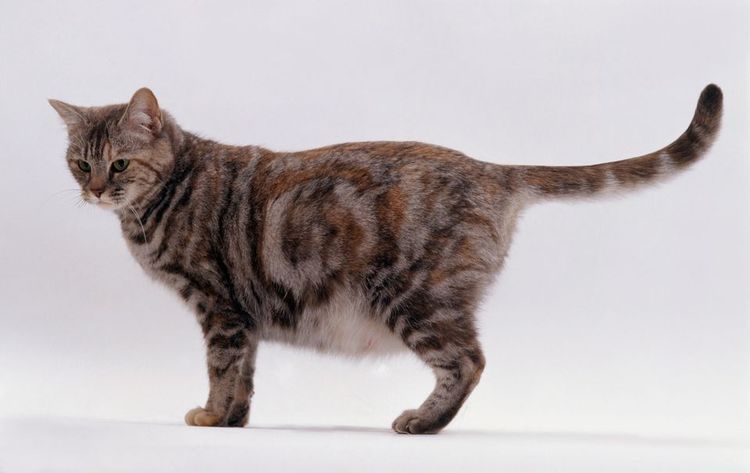
- The increase in the abdomen will be noticeable after one month of pregnancy.
Clinical examination methods
Breeders, cattery owners, and felinologists often use modern clinical and laboratory methods to determine whether a cat is pregnant after mating. Three of these are the most popular.
Tests
This method for determining pregnancy in cats is based on the detection of relaxin in plasma or serum. This hormone begins to be produced in cats three weeks after fertilization, and its levels increase during pregnancy. The test is completely reliable: in cases of false pregnancy, relaxin is not produced. False-positive results from the rapid relaxin test may occur if the cat has ovarian cysts.
Sometimes cat owners, having heard from friends that a cat's pregnancy can be determined with a test, buy a regular, "human" rapid test at the pharmacy. However, this test is not suitable for cats: it reacts to the hormone human chorionic gonadotropin, which is synthesized in the body of pregnant women but is never produced in animals.
Ultrasound of the uterus
Uterine ultrasound (sonography) is a non-invasive diagnostic method that uses high-frequency sound waves to produce images of internal organs. This technique allows one to determine whether a cat is pregnant as early as 15 days after mating. Fetal movement is visible at one month, and with a pregnancy of one and a half months, the veterinarian can determine how many kittens are in the womb. However, it is not uncommon for a large kitten to "overshadow" a smaller one, resulting in a larger litter than expected.
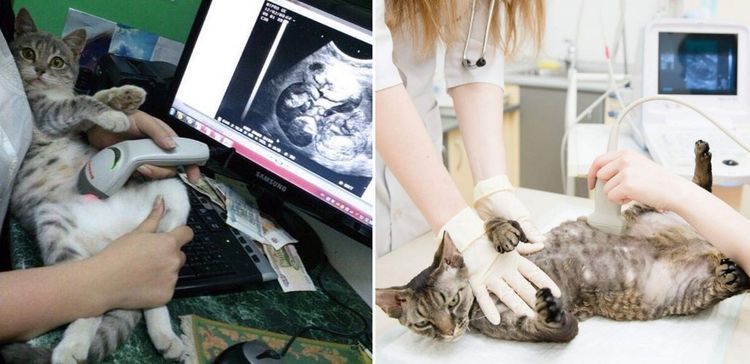
The ultrasound procedure takes no more than 20 minutes. The cat's lower abdomen is shaved, a special gel is applied to the skin, and the doctor then moves the probe over the area being examined. After the procedure, the gel is removed with a damp cloth.
X-ray
An X-ray is a high-contrast, two-dimensional image of the contents of a cat's uterus. Soft tissue transmits electromagnetic radiation well and appears dark in the image, while dense tissue—bones—absorb X-rays much more strongly, appearing almost white on film. Using X-rays, it's possible to determine whether a cat is pregnant 5-6 weeks after mating, when the fetuses' basic skeletal structures have formed.
Read also:
- How do you know if a cat has given birth to all her kittens?
- How long after giving birth can a cat become pregnant?
- Can a cat eat her kittens?


Add a comment