
How to make friends between a cat and a dog in an apartment
A situation in which two different animals end up in the same space can turn into a real disaster for both them and their owner. This is due to instincts that cause animals to see each other as enemies. This is why the question of how to make a cat and dog friends when they coexist in the same apartment is so pressing.
Content
- 1 Reasons for rivalry
- 2 Acquaintance
- 3 How to Introduce a Kitten to an Adult Dog
- 4 Addiction
- 5 First meetings under supervision
- 6 Gradual expansion of the interaction zone
- 7 Table: stages of adaptation in an apartment
- 8 Setting priorities
- 9 Game method
- 10 What to do if you have difficulties
- 11 Maintaining harmony in the apartment
- 12 When to expect friendship and how to understand that it has arrived
- 13 Additional tips
Reasons for rivalry
First, we need to understand why cats and dogs have been enemies for as long as humankind can remember. It turns out, it stems from natural differences. Descendants of wolves forced to live on the streets still display a trait that is somewhat attenuated, but not eliminated, in their domestic counterparts. This trait is the desire to live in a pack. It is precisely because of this that these animals begin to bark loudly when an intruder intrudes into their protected territory—an attempt to alert their "fellow tribesmen," perhaps even nonexistent ones, of the approach of an enemy.
Cats, on the other hand, are solitary creatures by nature. They don't rely on help, and therefore prefer to remain in control of the situation themselves. This usually manifests itself in observing their surroundings from a safe vantage point, usually from above.

Animals also perceive their personal space differently. Dogs tend to explore objects of interest in close proximity, which often leads to conflicts, as cats dislike this behavior. They are very protective of their territory and prefer to observe from a distance.
Moreover, dogs, being natural hunters, are easily spurred on by excitement. Even a docile pet may suddenly see a smaller creature as potential prey.
Important! Many breeders are interested in how to make a cat and dog friendly, but not everyone knows that such a move can actually be extremely dangerous. The problem is that a whiskered pet raised next to a neighbor gradually loses its vigilance and caution. If such a pet ends up on the street, it is highly likely to be mauled by stray animals.
To the happiness and peace of mind of owners, a bracelet has been created for pets who wander alone, allowing them to track their location at any time.
Acquaintance
A well-conducted first meeting is the most important aspect of introducing a cat and dog to each other. Vigilant human supervision and the absence of direct contact will ensure a successful start to the relationship.

The dog must be made to sit with the appropriate command, praised, and given time to calm down a bit, after which the new roommate must finally be introduced. Any attempt to approach must be stopped, and if this occurs aggression – Separate the animals into separate rooms. Before meeting, both pets should be well fed, and the dog should be given a good walk. This will significantly reduce any hostility caused by instincts.
Before the introduction, the dog will need to be placed at your feet, leashed, and muzzled, then the cat will be released to roam the room as it pleases. The "captive" cat will likely react in the typical way—barking, lashing out, and restlessness. However, after a while, the animal will tire, resign itself to the situation, and lie down at your feet, ignoring the situation. Only then should the animal be rewarded so that it learns which behavior was rewarded.
How to Introduce a Kitten to an Adult Dog
When introducing a kitten to a home where there is already an adult dog, it is important to consider several key factors:
-
Age of dogs and kittens: a kitten under 12 weeks adapts more easily even to an aggressive dog than an adult cat to an adult dog.
-
Dog temperamentPeaceful or purebred hunting dogs (retrievers, spaniels) interact more easily with cats. Terriers and greyhounds are more likely to exhibit a hunting instinct and require special care.
-
Socialization experienceDogs that have interacted with cats before adapt more quickly. If they don't have this experience, the introduction process will take longer.
Addiction
For the first three days, the animals, already stressed, should avoid each other. However, they should still be able to hear, smell, and sense each other's presence. Adaptation to the second pet's presence begins as early as the fourth day, and full acceptance of the newcomer occurs within one to two months.
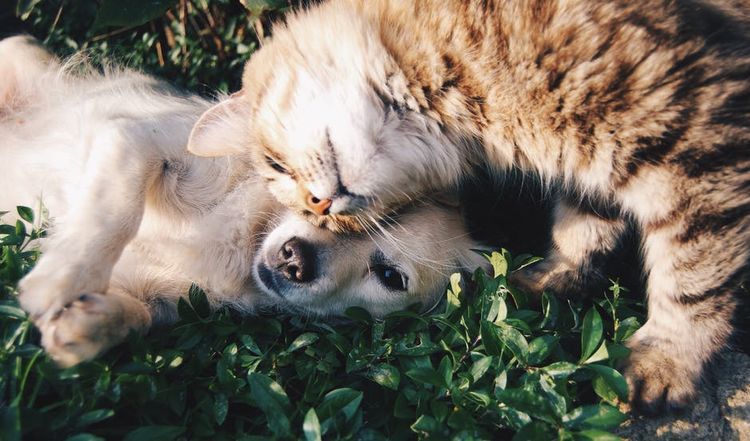
What else can a householder do to help a cat and dog get along? Without a doubt, it's about ensuring the animals' safety and well-being. It's up to the householder to ensure that interactions between pets are positive from the very beginning. Otherwise, if the pets don't get along, they'll need to be separated immediately. To improve the relationship in this case, it's best to consult a professional dog trainer, an experienced animal psychologist, or a breeder. Specialists can help determine the cause of the feud and choose the best training methods.
Don't push things too quickly. It's better to wait until the cat and dog show curiosity and interest on their own. While there's no need to confine them to separate corners of the house, it's still necessary to functionally delimit the space. Each pet should have their own personal resting place. A quiet, secluded nest somewhere high up (a climbing frame, a windowsill, or a shelf or step just under the ceiling) is ideal for a cat, while a perpetually emotional dog will be happy with a simple, soft bed on the floor. This arrangement will be a real lifesaver if the cat tires of the new friend's restlessness. It will then have a place to hide and avoid conflict.
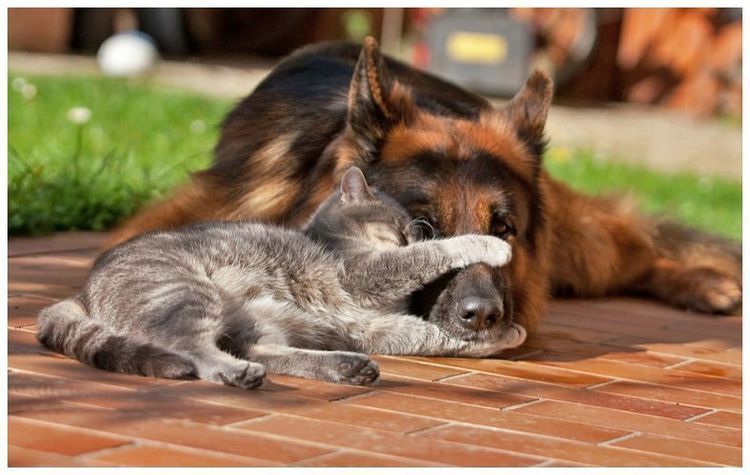
Separating dining areas can also be helpful. Both species are extremely fussy about food, and wolf descendants are also guilty of eating even what doesn't belong to them. Naturally, with such an attitude toward food, it's easy to end up in a fight! That's why experienced owners try to feed their pets in separate rooms, or, if that's not possible, at least on different levels. Dog bowls are placed on the floor, and cat bowls on the countertop or windowsill.
First meetings under supervision
When both sides react calmly:
-
Meet pets in the same room, but keep the dog on a leash.
-
Observe body language: a cat should not cling or hiss, a dog should not bark or try to grab.
-
If the dog listens to the kitten calmly, give treats on command (“sit”).
-
At the slightest sign of aggression or fear, immediately end the meeting and repeat later.
Gradual expansion of the interaction zone
Over time, you can:
-
Let your dog off-leash, but control its distance.
-
Remove the barrier, but leave individual zones: the kitten's bed on an elevated surface and the dog's corner isolated.
-
Plan cooperative play activities using soft toys that engage both animals and distract from potential confrontation.
-
Including short walks and leisure activities together helps create a shared social scenario.
Table: stages of adaptation in an apartment
| Stage | Time | Target |
|---|---|---|
| Separate residence | 3-5 days | Arousing interest through smell and sounds |
| Visual familiarity through the barrier | 1–2 weeks | Developing associations "newbie = safe" |
| First meetings with a leash | A few minutes daily | Control and formation of calm behavior |
| Off-leash communication, safe corner | Gradually | Creating a zone of trust and cohabitation |
| Joint activities | Depending on my mood | Building friendships and playful relationships |
Setting priorities
What can we do about the fact that sometimes it's simply impossible to make friends between an adult dog and cat? The reason is likely due to intense, overwhelming fear. It's this feeling, not love for humans, that largely determines the behavior of four-legged friends. They fear losing their owner's affection and being cast out. Pets that begin to feel a lack of affection and attention become depressed and, consequently, aggressive toward their rivals.
To avoid this situation, you need to show sufficient attention to both animals. However, it's important to remember that the nature of interactions with them will be different. For example, cats don't tolerate excessive clinginess, while dogs are ready to wag their tails with joy at almost any word their owner says to them.
In the family hierarchy, a cat always ends up above its neighbor because:
- She is allowed to do many things that are strictly forbidden for a dog (climbing on windowsills, walking on tables, defecating inside the apartment).
- She does not know what it means to obey, while the dog is a social creature that can easily yield to others thanks to its pack instinct.
- She will try to avoid negative interactions because if there is a quarrel, she will have only one option - to go all the way or retreat in disgrace.

Since it's easier to work with a dog that readily accepts a subordinate role, it's the dog's responsibility to help the owner approach an independent cat correctly. The unapproachable cat needs to be made to understand that its dominance and primacy are not being challenged.
Game method
Active, cooperative "romps" will help the animals get to know each other. The owner's presence is key for play. If one animal injures another during play, the offender should be lightly flicked on the nose and accompanied by a sharp command: "No!" Then, the game should be stopped. Hitting or yelling at the animals is prohibited, as a panicked reaction will result in the animal not learning the lesson.
It's also important to learn to avoid taking sides. Often, owners begin to sympathetically hug the "victim" and show them affection, while the instigator of the unpleasant incident is angrily and harshly criticized. Such demonstrative acceptance of one animal into the pack and exclusion of the other can become the basis for a real war between animals.
Important! If one animal hits its partner with a "soft" paw, without extending its claws, without hissing or pressing its ears back, this is a form of play, not aggression.
After just a few sessions, the animals will understand that the fun stops when their actions go beyond the boundaries set by the owner.
What to do if you have difficulties
If one of your pets shows strong negative reactions:
-
Increase the duration of the scent preparatory stage to 2-3 weeks.
-
Expand the safety zone by creating a second, higher perch from which the kitten can observe.
-
Consult a zoopsychologist, especially if there is aggression towards the kitten or if the dog is too dominant.
-
Constant supervision - do not leave animals unattended until they have established a lasting friendship.
Maintaining harmony in the apartment
Even after the kitten and dog begin to live together peacefully, it is important:
-
Separate food, toys and sleeping areas to avoid competition.
-
Allow the cat to go to a high level at will.
-
Reward any signs of friendliness or cooperative play with treats or praise.
-
Continue training your dog on the commands "heel," "stay," and "stay" to prevent chasing or over-activity.
When to expect friendship and how to understand that it has arrived
-
The dog reacts calmly to the cat and does not try to chase him away.
-
The kitten moves calmly around the apartment, ignoring the dog.
-
Both pets play nearby or even together - chasing toys, sleeping nearby.
-
Important: Friendship develops gradually, sometimes circulating between stages for 2–4 months.
Additional tips
In order to finally reconcile two creatures living in the same territory, you should keep the following recommendations in mind:
- Owners should remain as calm as possible in the presence of their pets. Pets are not only very sensitive to their owner's moods but also mimic their owner's behavior. A person's nervousness can exacerbate the situation, while self-control, on the contrary, will help calm the animal and relieve fear.
- If the head of the household is trying to introduce an adult dog and a kitten to each other, it's important to pay close attention to the older dog. A dog that's showing affection will wag its tail, lower its front paws, and invite the kitten to play. However, if the apartment already has an adult cat, introducing a newcomer of the same age can be extremely risky. The ideal age for introducing a puppy is between 3 and 12 weeks.
- When walking your dog, praise it every time it fails to react to stray cats or shows friendliness toward them. If it displays aggression, give the command "No!" and lead it in the opposite direction.
All the above-mentioned methods and measures will help a person bring these different creatures of nature together without conflict and, perhaps, even make them best friends. If the pets coexist without conflict, they will even begin to sleep together, marking the strengthening of a strong bond between them.
Read also:


-550x450.jpg)


Add a comment