
How to stop a dog from barking
Barking is a dog's way of communicating with its owner and other animals. In some cases, it can be warning or threatening, which can be beneficial for both the pet and its owner. However, if a dog constantly barks at every passerby or barks frequently while at home, action should be taken, as such restless behavior can cause discomfort to both the owner and those around the dog.

Content
Why does the dog bark?
There are a number of reasons why a pet may become anxious and begin barking to attract attention. These include:
- a game where a pet expresses joy by barking loudly;
- fear – most often occurs when the animal is left in a confined space or completely alone;
- anxiety - can be caused by suspicious sounds, the presence of strangers or other dogs, uninvited guests and other reasons that cause such a loud reaction;
- boredom – the pet may become bored, but its choice of entertainment is limited: chewing on some of the owner’s things or barking loudly, attracting attention;
- aggression is a way to express negative emotions (anger, discontent) in response to stimuli, similar to a human cry;
- upset - occurs in many pets when they are separated from their owner, so if they make noise when you leave the house, this is a sign of resentment;
- jealousy – appears when the owner shows more care and attention towards other inhabitants of the house;
- need – the pet needs something and communicates this through its loud behavior.

The easiest way to stop barking is to observe and identify the situations in which the barking begins and try to eliminate these irritants. For example, some dogs often respond loudly to the sound of a telephone or doorbell. To stop them from barking, simply lower the volume or turn off the ringtone. While this won't completely eliminate the problem, it can significantly reduce the frequency of these loud barks.
Stopping Excessive Barking at Home
This issue is especially relevant for pets, who may create unnecessary noise late at night or while a child is sleeping. First of all, it's important to understand that if barking is unacceptable for a dog in the house, it should not be done under any circumstances. For example, you can't praise it for sniffing a neighbor coming up the stairs, but scold it for barking loudly when the doorbell rings.
One simple method for training your dog to bark is to touch the ears or gently squeeze the ear canal with your thumb and index finger. Try these strokes first when the animal is completely calm. If the response is positive, you can confidently use this method when unprovoked barking occurs.
Another method is to teach the command "Quiet!" when your pet barks. If he stops barking, praise him, pet him, and reward him with a treat. With regular repetition, he'll eventually understand that the word "Quiet" means he should be quiet.

These methods are quite effective, but they don't guarantee a 100% result, especially with adult animals, not puppies. However, if they don't work, don't give up and look for other options. If you need to solve the problem immediately, for example, to stop unprovoked barking at night, you can use a spray bottle filled with water. As soon as the dog starts making noise, spray it in the face. Before doing so, issue the warning command "Quiet."
How to stop your dog from barking at passersby
By barking at passing dogs and passersby, the dog attempts to demonstrate fearlessness and intimidate suspicious individuals. When a stranger passes by, paying no attention to the barking animal, the dog gets the impression that the "enemy" is genuinely frightened. As a result, a kind of conditioned reflex is formed when strangers approach, and the barking becomes more confident and louder over time, sometimes even accompanied by aggressive behavior.
To stop a dog from barking at everyone, a distraction method is used. The main goal is to redirect attention to a more important and interesting object. This could be a toy or treat that can be used to entice the pet. For example, you can dangle a treat in front of the dog's nose, or make the dog jump or run after it, so that the desired object occupies the dog's entire mind and makes it completely uninterested in passersby.
Give delicacy This should be done before the "noisy reaction" to the stranger occurs. If you do it afterward, your pet will be convinced that this is a reward for loud behavior and will try even harder next time.
Special devices
There are special devices that can also help stop a dog from barking. If your dog is difficult to train and continues to bark at everyone without reason, these devices can be used either as a supplement to the methods listed above or as a standalone solution. Not all novice dog owners are aware of such accessories, but they are an effective solution.
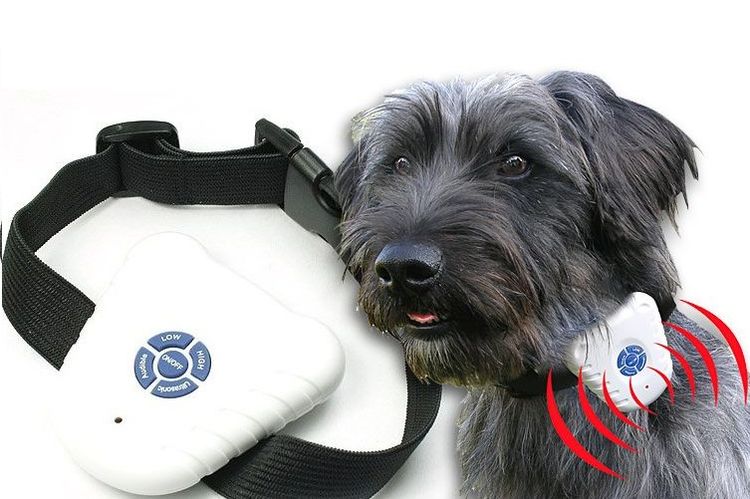
There are several types of anti-barking devices:
- Electric shock collars look like a regular collar, but when a dog starts barking, special sensors deliver a small amount of current. This can be frightening to many dog owners, but when activated, a minimal shock is released that twitches the animal without causing any harmful effects.
- With a special liquid, when a dog barks, the device hisses and releases a small amount of lemon-scented spray. The scent is unpleasant to the dog, causing it to become alarmed and stop making noise. Over time, the dog learns that its barking is the source of the pungent lemon scent.
- Ultrasonic – emits special signals at ultrasonic frequencies, inaudible to the human ear, which irritate the animal and force it to remain silent, but there is a chance that with frequent use, the pet will get used to the signal and stop paying attention to it.
The ultrasonic collar is not suitable for animals with hearing problems, as they simply will not be able to hear the sound vibrations.
In most situations, anti-bark collars do indeed silence dogs, but with prolonged use, they develop tolerance, requiring increased intensity to achieve the desired effect. From a training perspective, such a device is more harmful than helpful. It simply stops unwanted behavior, but the barking animal receives no reasoning or explanations as to why it shouldn't be done.
Barking limiting devices include: muzzle – It will hold the dog's mouth in place, preventing it from barking without interfering with its breathing. The muzzle can be put on before going for a walk to prevent the dog from barking at everyone.
Helpful Tips
For owners of particularly noisy pets, the following helpful tips may be helpful:
- It is advisable to wean your puppy from unprovoked barking from an early age; you should not allow your puppy to whine;
- Situations that provoke barking should be avoided, especially in the early stages of training;
- It's not advisable to praise a dog when it loudly "greets" the owner's appearance. If the praise occurs during the barking training period, it will negate all efforts;
- You should not shout, as the dog may start to snap back;
- perhaps the dog is experiencing attention deficit and if you exercise, play with him and take him for walks often, he will behave much calmer;
- If your pet becomes simply uncontrollable and refuses to obey, you can use the services of a professional trainer who will help identify the reasons for such noisy behavior and teach the animal to control its emotions;
- In case of excessively restless behavior, you can contact your veterinarian to prescribe a sedative.

Each of the chosen methods requires significant involvement from the owner, so it's essential to have sufficient patience and time to overcome the problem of unprovoked barking. However, it's important to remember that barking is a way for a dog to communicate with the outside world, so rather than taking drastic measures to eliminate it, it's important to confidently adjust the dog's behavior and living conditions.
Read also:
- Why a dog howls: reasons and what to do
- Does the dog understand words?
- Basic concepts of training domestic dogs


3 comments
Maria
Thank you, the advice was very helpful, but I disagree about the anti-bark collar... It's stressful for the dog, and millions of people buy these anti-bark collars with shockers. If they can't train their pet to stop barking, then why do they even have a pet? A pet is their friend and partner, and shocking a friend with a shocker won't lead to anything good.
Valentina
My dog has mucus in his throat, like a human's snot. I had a sputum test done for myself because they don't do that for dogs. They found nothing. I also had a sputum test done, and they found nothing. I'm 60 years old, but they diagnosed me with chronic bronchitis. I have a cough in the mornings that lasts until I cough up all this mucus. My dog also coughs periodically. I went to the veterinary clinic, they gave me antibiotics for a week, but the mucus is still there. What should I do next? Another doctor said there's only one cause, to look in yourself—I can't find anything else.
Dasha is a veterinarian
Hello! How old is your pet? How are they kept and fed? Walked? Where does they sleep? What other symptoms are there? Itching, sneezing, and tears may be present. Does the cough get worse after physical activity? Is it more frequent in the morning or evening? Or does it make no difference what time of day it is; the cough is unaffected. Is there any swelling? Does the cough get worse after contact with anything (maybe after cleaning, or a reaction to dust). More information would be appreciated. It could be an allergy, bronchitis, or a cardiac cough (but then where would the exudate come from?) There's not enough information for a medical history.
Add a comment