
How to stop a dog from peeing and defecating in the house
The arrival of a new pet is a real celebration. But it also brings new challenges, the most important of which is the need to instill proper manners and skills. If a dog pees and defecates in the house, it's essential to break this habit immediately. How can you stop a dog from pooping in the house, how can you prevent it from marking corners, and how can you teach it where it's safe and where it's not? It's not as simple as it seems.
Such problems can be encountered not only by new puppy owners but also by those who have long since trained their dogs to behave correctly. To change the situation, you need to be patient and learn the basic principles of breaking your pet of this bad habit.
Content
Reasons
All reasons why a dog defecates and marks corners in an apartment or house are divided into two large groups: physiological and psychological.
Physiological
The most common reason is the puppy's early age. From the first days, all puppies are quarantined due to vaccinations, so they are not allowed outside. When they are brought into the hands of their permanent owner, the puppy may not even realize what is expected of them.
For puppies in the first months of life, the urge to pee or defecate is a complete surprise, so they eliminate wherever the urge strikes. Most believe their toilet is located where their personal diaper or changeable pieces of newspaper are kept. If these items are removed, the puppy will be confused, but will eliminate wherever it finds the most suitable alternative, such as the carpet or bed.
Even after a toddler starts being taken outside, they don't immediately realize they can go to the bathroom there. They might happily stroll around and have fun, but only poop or pee after returning home.
A puppy's bladder is still very small in the first few months of life, so it's unable to maintain eight-hour intervals between walks. It's virtually impossible to wean a puppy from eliminating in the house before it reaches three months of age, so starting training before three months is not advisable.
Among other physiological causes, the following are distinguished:
- Digestive upset. Sometimes, with diarrhea, a dog simply can't wait to go outside.
- Nutritional problems. These may include foods that are of poor quality, stale, unbalanced, or completely unsuitable for a dog's diet.
- Poisoning. Can occur after swallowing objects or household chemicals, poisons, or medications.
- Reaction to drugs.
- Diet change. This occurs when purchasing food from a different brand or suddenly switching from dry to wet food or vice versa.
- Parasitic infections. Can cause bloating, upset stomach, and incontinence.
- Viral diseases or inflammatory processes in internal organs.
- Heat. Associated with hormonal fluctuations, which often trigger such behavior, animals begin to actively mark corners, as driven by their sexual reflex.
If you suspect that the reasons why your dog is defecating and peeing in the house are related to the above, then it is best to consult a veterinarian.
Psychological
Stopping a dog from peeing or urinating in the house after experiencing psychological stress can be quite difficult. Triggering factors include:
- Moving to new owners is a very difficult time for an animal, and it takes time to return to a balanced state.
- The arrival of a child or a new pet in the family, or, conversely, the death or relocation of one of the family members.
- Fright after loud sounds, gunshots, car accidents.
- Medical procedures that caused severe pain.
- Lack of attention from the owner. Often in such cases, negative attention is better for the animal than no attention at all, so the dog often defecates not just in the house, but on the bed or sofa where the owners sleep.
- Insufficient cleanliness of the crime scene. A dog's sense of smell is thousands of times more acute than a human's. If a mark or puddle was cleaned with ordinary scented household chemicals, a human might not detect the odor. However, a dog will clearly detect the scent of urine or pheromones that signal "this is a toilet spot." This will encourage the dog to return to the same spot again and again. It's essential to use special enzymatic deodorizers that completely break down organic odor molecules rather than mask them.
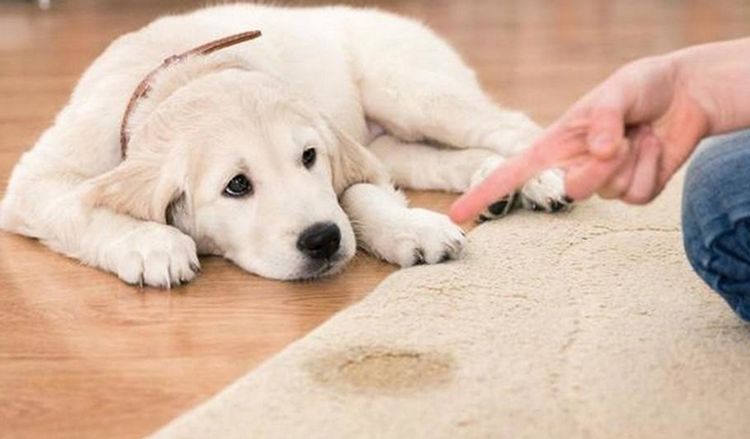
- Difficulty in consolidating the skill. The process of toilet training involves the formation of a strong neural connection. This connection is broken if: the owner's actions are inconsistent (today they take the dog out for a long time, tomorrow for 5 minutes; today they praised it, tomorrow they ignored it); or the dog is scolded after the fact. The animal is unable to connect its actions, committed an hour or two ago, with your anger. It understands only what is happening here and now. Therefore, punishment for finding a puddle is interpreted as "the owner is angry that this is on the floor" rather than "the owner is angry that I did this." This leads to fear of the owner and attempts to hide the "evidence of the crime" in more secluded places.
Basic recommendations
To wean a dog from going to the toilet in an unauthorized place, different approaches must be used for puppies and adult dogs.
For puppies
A caring owner can tell by the puppy's behavior that it will soon pee or poop.
For babies, the main recommendations are:
- When an animal starts to fuss strangely, look for a place, or simply rushes to where it usually goes to the toilet, this means it’s time to go outside immediately.
- Walks should be organized according to a schedule at the same time at least 5 times a day.
- It is necessary to spend sufficient time outdoors, otherwise the pet will not have time to pee and poop.
- The dog should be active, as physical exercise speeds up metabolism and stimulates bowel movements.
- You should take water with you and give it to your puppy often. This will ensure that he pees.
It's important to remember that every time after waking up, eating, or playing actively, your baby needs to go to the toilet. This time should be used to wean them off the toilet.
For adult dogs
Patience is crucial in this matter, as lack of restraint and aggression on the part of the person can only hinder progress. The main recommendations are as follows:
- If training was carried out incorrectly, the same rules as for puppies must be applied.
- If an animal tries to demonstrate its dominance over its owner through disobedience, it should start with training.
- Sprays for treating surfaces where dogs frequently eliminate have proven effective. They are harmless to people and their pets, don't leave stains, but discourage dogs from eliminating in unauthorized areas.
Encouragement
During the weaning process, the main motivation for the dog can be praise when it does something correctly.
There may be several methods of encouragement:
- say nice words to your pet, praise him;
- treat with treats;
- clearly show your joy.
The owner can determine which method is more suitable for a particular animal by observing their pet's reactions.
Sometimes, a word can be successfully used for training, serving as a command for the pet to go potty. It's repeated loudly and clearly each time the dog has done the required thing. After a while, the pet will understand why this word is being used.
Step-by-step system of actions: from diagnosis to solution
To effectively address the problem, a systematic approach is needed. The following action plan will help restore or reinforce hygiene habits.
Step 1: Veterinary diagnostics
This is the first and most important step, especially if the problem suddenly arises in an adult, previously trained dog. Rule out medical causes:
-
Cystitis, urolithiasis.
-
Intestinal disorders caused by diet or parasites.
-
Diabetes, kidney disease.
-
Age-related problems (incontinence in older dogs).
Without addressing the medical problem, all attempts at retraining will be futile.
Step 2: Organize the routine and space
A dog is a ritual animal. A clear daily routine helps it anticipate events and control urges.
-
Feeding by the clock:Feed your dog at exactly the same time 2-3 times a day. This will synchronize their digestive tract with the schedule, and you'll be able to accurately predict when they'll need to go to the bathroom (usually 15-30 minutes after eating).
-
Regular walking:Take your puppy or retrained adult dog out on a strict schedule: immediately after naps, after each feeding, after active play, before bed, and every 2-3 hours during the day.
-
Space limitation:Allowing an untrained dog to roam freely throughout the entire apartment is too much responsibility. Use a carrier, a crate, or limit its range to one room. Its instinct to avoid soiling its "den" is always there. Gradually, the area can be expanded.
Step 3: Proper response and communication
Your actions at the moment of "miss" and success are critically important.
-
If caught red-handed:Interrupt the action with a sharp, but non-threatening sound ("Hey!", "No!") and immediately take the dog outside or to a designated area (like a pad). Praise enthusiastically and give a treat if it finishes there.
-
If consequences are discovered after the fact:Don't punish. Silently and thoroughly clean up after your dog using an enzymatic cleaner. Your goal is to erase any memory of this place as a toilet.
-
Generous praise for success:Every time your dog relieves itself in the right place, praise it enthusiastically and enthusiastically, reinforcing the action with the tastiest treat. Build a positive association.
Comparison table of causes and solutions
| The reason for failures | Erroneous actions of the owner | The right strategy |
|---|---|---|
| Medical problem | Attempts at training and punishment | Immediate visit to the veterinarian and treatment |
| Insufficient cleanliness | Cleaning with chlorine-containing or scented products | Use of specialized enzyme cleaners |
| Inconsistency | Irregular walking, different feeding times | Establishing and maintaining a clear daily routine |
| Misunderstanding of motivation | Punishment after the fact | Seizing the initiative, interrupting and redirecting to the right place |
How to punish correctly
To break a bad habit, it's crucial to punish your pet correctly. You can't ignore mistakes, but you shouldn't overdo it with punishment either, as the dog will associate the owner exclusively with negative emotions.
To make your pet understand that you are unhappy with him, you need to do the following:
- make a stern voice, scold the animal;
- You should take away the pet's favorite toy, showing it and explaining as much as possible what the reason is for this, and give it back only after the pet has finished cleaning and gone to the toilet outside;
- It is important to train the dog teams “No!” or “Ugh!” so that he can quickly understand that his actions are not pleasing to him.
What not to do
To stop a dog from pooping indoors, it's crucial to practice proper behavior. If a dog can't seem to learn to pee and poop outside, it means the owner is making significant mistakes in training.
List of things not to do:
- Hitting your pet or poking its nose into a puddle or pile of feces is not only inhumane but can also exacerbate the problem by further stressing it. Furthermore, a frightened pet may continue to eat its own feces to hide the fact.
- Scream loudly. This will let the animal know that there are consequences for defecating in front of its owner, so it will then try to hide to do its business. Keeping the dog alone at such moments will make it difficult to explain what you want from it.
- Be inconsistent. You need to stick to a strict walking schedule, not ignore mistakes, and remember to praise when everything is done correctly.
Following these simple rules will help you train your pet to stop eliminating or marking corners in the house. It's important to remember that patience and perseverance are the keys to success. It won't necessarily be quick: every dog will take its own time, but eventually, any animal can learn to use the toilet outside.
Read also:
- Toilet for small breed dogs: how to choose
- How to potty train a dog in an apartment
- How to potty train a dog outside


Add a comment