
The kitten bites and scratches: why and what to do?
What should you do if your kitten bites and scratches while playing or just for fun? Why does it happen, and how can you stop this little whisker? This article explains it.
The joy of welcoming a small furry bundle into the home can be overshadowed when it suddenly turns from a cute kitten into a wild devil. Many inexperienced owners face the problem of stop a kitten from biting and scratchingEven tiny teeth and claws can cause a lot of discomfort. Often, owners simply ignore the bites of a small, harmless kitten; some even find it amusing, and indulge in it, deliberately trying to tease it with their hands. And this is their biggest mistake. Before you know it, the kitten has grown up, and its childish play has become a serious threat to the hands and feet of its owners.
The best age to retrain a pet is when they're young. While they're young, they don't yet know right from wrong, how to behave, and how not to behave. And if you don't set boundaries now, it will be much more difficult to break bad habits in an adult cat.
You can prevent scratches and bites by never playing with the kitten directly with your hands or teasing it with your foot from the very beginning. It's best to use fishing rod toys with feathers or a mouse at the end, or you can simply tie something to a string—this will prevent the kitten from touching your hands while playing. And as they grow older, they'll likely show no interest in them or view them as mere playthings. This rule should be followed by all family members, even guests.
If the moment has already passed, and the pressing question of how to stop a kitten from biting arises, you need to be patient and work on training it. First of all, it's important to understand that the pet doesn't mean to hurt its owner; it simply doesn't understand that doing so is wrong.
Content
Why does a kitten bite and scratch?
Why does a kitten bite and scratch while playing, and sometimes just for fun? What might be the cause of this behavior?
Game
Most often, the reason for attacking an owner's hands is simply a desire to play—the kitten is bored and begs the owner to play with it. In this situation, teasing toys on a string are the solution to how to stop a kitten from biting hands. Arm yourself with them and set up a real hunt for the kitten. Let it chase and catch them until it tires out, then it won't have the energy to continue torturing your hands. After the game, treat the kitten to a tasty and nutritious treat, because the hunt should end with the consumption of the prey.
Teething is happening
Another reason for hand chewing is teething. In this case, you can buy your kitten some chew treats at the pet store.
Fatigue
Pets also bite to tell their owners, "Leave me alone, I'm tired." This is their way of communicating that they don't want to play or be held anymore. Just leave them alone, alone. Sometimes biting can occur in response to pain (like someone stepping on their tail) or as a signal that the owner has touched a sensitive spot.
Fear
The feeling of fear is the strongest emotion that can develop into aggressionThis could be caused by the presence of another animal in the kitten's territory. In such a situation, natural instinct kicks in. A frightened pet will desperately defend itself, trying with all its might to protect itself. Claws and teeth are its only weapons. In this case, you need to eliminate the cause of the fear and allow the kitten to calm down. It's best to give the kitten its own place (a house or a box) where it can rest peacefully. This will make it feel safe and will soon return to its senses, and the aggression will subside on its own.
Smells
Sometimes, kitten bites can be triggered by scents brought into the home on the owner's clothing or shoes. While humans may not even notice these scents, if the animal's sensitive sense of smell detects even a hint of a threat to its territory, the pet will likely respond with aggression. A special cat spray, available at pet stores, can be helpful. It can be sprayed in several areas of the apartment. This scent has a calming effect on all cats and can help relieve the kitten's stress and irritation.
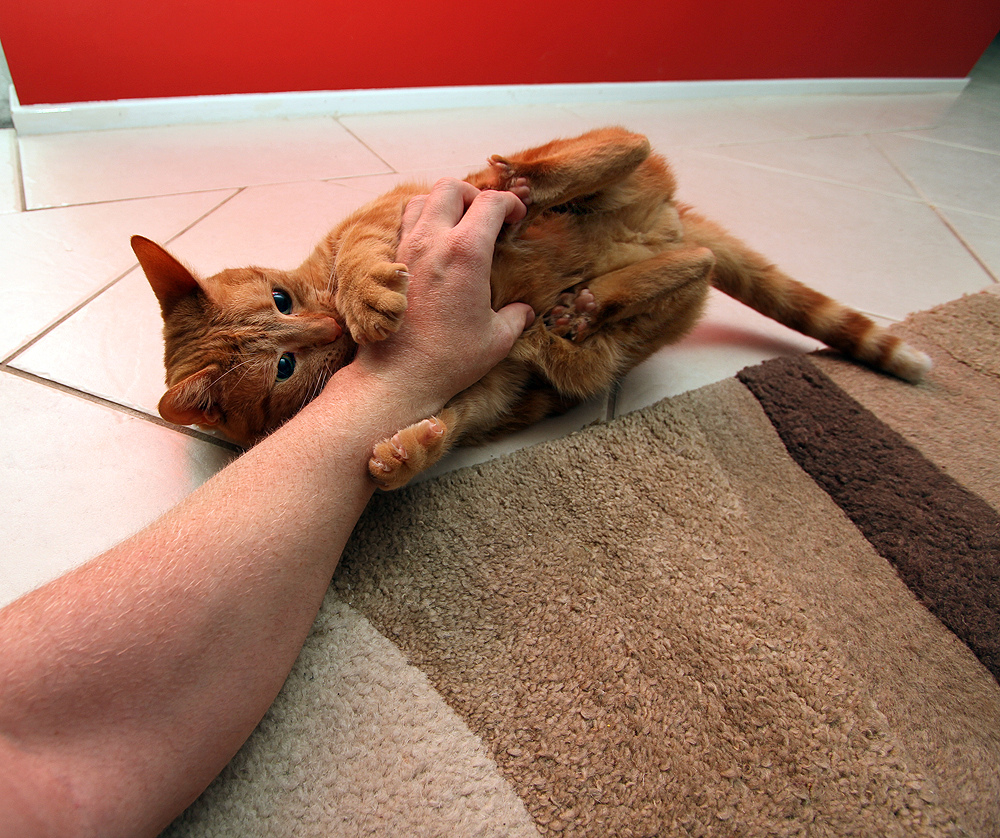
How to properly wean a kitten off biting and scratching?
Many people are probably familiar with the unpleasant experience of a kitten suddenly jumping out from around a corner and latching onto your leg, trying with all its might to tear it apart. Some people are initially even delighted by such little playfulness, but after a while, such games turn into a serious problem. Then the owner faces a pressing question: how to stop a kitten from biting and scratching?
The next step after eliminating the possible causes of a biter's bad behavior is retraining. Never use force when punishing your pet. Hitting a kitten or an adult cat will only lead to the same result: the pet will lose trust and view its owner as an enemy. The best way to raise a friendly cat with a well-balanced personality is through patience and persistence.
The "no" command
You can establish mutual understanding and resolve the problem of how to stop a kitten from biting during play by using the command "No!" When your pet is about to bite, say the command loudly and clearly with the appropriate intonation. A light flick on the nose is also acceptable. To reinforce this, you'll need to repeat these actions for a while, always using the same word and saying it in the same tone. You can accompany the command with a loud clap of your hands or another unpleasant, sharp sound. This will slightly frighten the kitten, and over time, it will understand that certain actions will lead to unpleasant consequences. Of course, the meaning of the word "no" is unclear to it, but animals are very sensitive to intonation. Kittens are very intelligent and quite quickly understand, what is required of them. In the future, use the command to prevent your pet from attacking in advance.
Clearly, correcting established behavior is more difficult than simply stopping it at the outset. And since breaking a kitten of biting and scratching behavior can be difficult, more radical methods can be used.
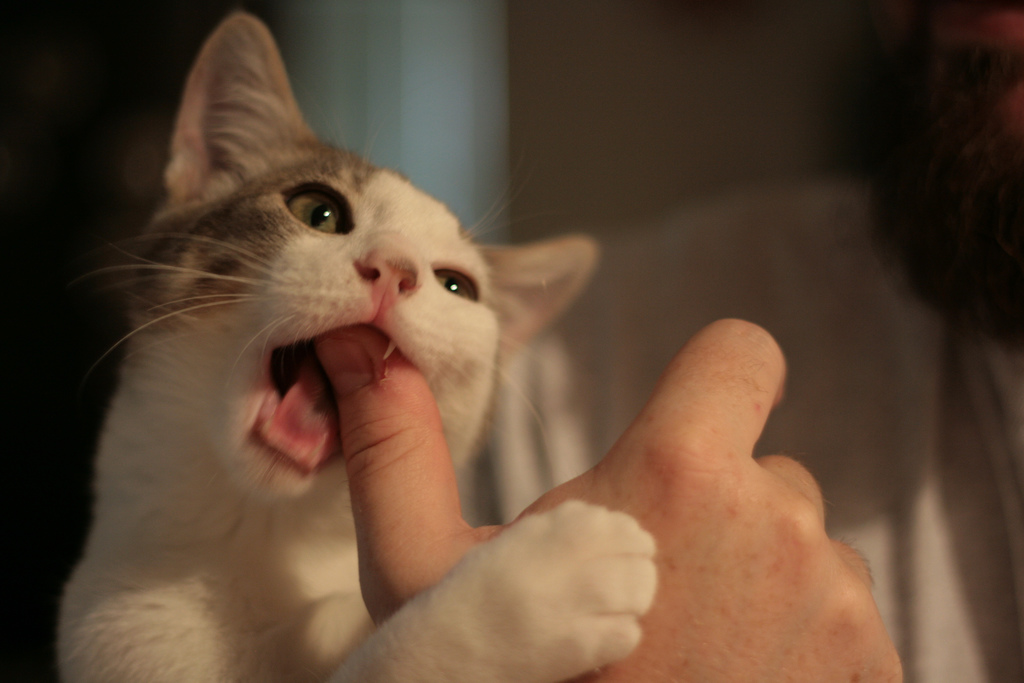
If your pet does bite, don't jerk your hand away abruptly, as this is typical victim behavior—it's trying to break free and run away. Instead, try inserting your hand or finger deeper into the kitten's mouth. This will confuse the kitten, and it will also be quite unpleasant, causing it to open its mouth and try to remove the finger. The next time it's tempted to bite, it will remember its experience with a human finger and be reluctant to repeat it.
A spray bottle (a regular mist bottle) is a great way to stop a kitten from biting. It's a great way to show your kitten that scratching and biting aren't all that fun. Keep it handy, and every time your kitten bites (or does bite), spray it in its face. This isn't just a form of punishment; it helps develop a strong association between the action and an unpleasant, frightening consequence.
When teaching your kitten good manners, you can use a newspaper or towel and lightly spank them when they attack, reinforcing the action with a "no" command or a loud hiss. This will demonstrate your disapproval and dominance. This will discourage them and discourage them from biting. It's crucial to use the same object each time and always be alert to react quickly or prevent a bite.
Special case
Sometimes it happens that a well-behaved and affectionate pet, who never bites or scratches, at some point changes and begins to show aggression towards its owner.
This could indicate a health problem. This is often how cats try to get their owner's attention and let them know they're in pain. In this case, it's essential to take your pet to the veterinarian for an examination.
By following these simple tips, you can quickly and permanently wean your pet off the annoying habit of biting and scratching you and your family members. To establish mutual understanding and bond with your kitten, all you need is patience and affection. Believe me, the results will be immediate.
Read also:


3 comments
Raisa
Thank you for the great article about our beloved cats. We've had cats come and go in our home for 30 years (alas, they don't live as long as we'd like). We just got a two-year-old cat. We had one 14-year-old cat and three two-year-old cats left. We're also having a misunderstanding between the two-year-olds and the "new" cat (we named her Fixie. She started responding to that name almost immediately). Fixie was being bullied in another pack, so we decided to take her in. At first, she growled and purred a lot. She'd run around the apartment "from place to place," but now she's started trotting and walking around the apartment. She doesn't know how to play without clawing and biting hard. Now our cats don't accept her in games. She might urinate outside the litter box, which she does almost daily. Now I realize I need to get her a new, separate litter box. There are three litter boxes in the toilet, and I can't figure out where to fit a fourth one. Thank you for the helpful tips!
Raisa
Thanks for the useful information!
Daria
Cool
Add a comment