
How to stop a cat from stealing?
Quiet rustling sounds and the clinking of dishes at night. The sudden disappearance of household items, or the appearance of strange things in the house, can raise a host of questions in any family. What is it? Ghosts? Brownies? Nosy neighbors? Oh, don't be so alarmed. Behind all this could be none other than a cute, fluffy, and seemingly completely harmless house cat. But how can you stop a cat from stealing food from the table?
Cat theft is well known. But there's a common misconception that only mongrels and poorly trained cats steal. And if a pedigreed cat is caught red-handed stealing, owners begin to suspect that the cat, even if not pedigreed, is a thief. Owners of even a stray but lovingly raised pet may conclude that genes can't be changed, or begin to reproach themselves for their lack of care in training.
Is this true? Any animal psychologist will tell you no. In fact, stealing from cats can't be definitively assessed. There can be many causes, and in some cases, theft can be dealt with using fairly simple methods, which will be discussed in this article. In others, you'll have to accept the theft, trying to minimize the damage to both you and your pet. So, let's discuss the first question.
Content
What and why do cats steal?
First, let's break cat stealing into two categories: food stealing and item stealing.
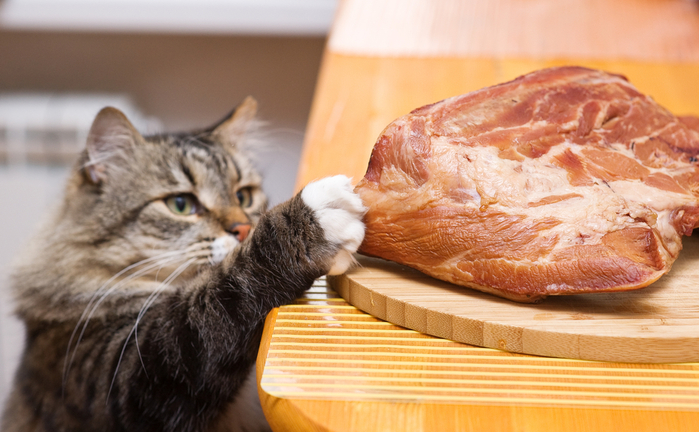
Cats usually steal food when they're hungry. Simple, right? Of course, many owners insist their cat eats enough (in their opinion), so there's no excuse for such stealing. That's the owners' opinion, but clearly not the cats'. Incidentally, cats can indeed steal even when they're eating well, and the reason in this case is simple curiosity.
Think about it: who among us, accustomed to borscht and porridge since childhood, would refuse to try, say, lasagna, cheesecake, or parfait? And could you, having never tried them, calmly walk away from the table where all this mysterious delicacy sits? Believe me, neither can a cat. After all, for a cat, food from the master's table seems simply delicious and mysterious, definitely worth trying. And if a taste test shows it's tastier than his own, it's no surprise that the raids will continue. After all, gourmets aren't just people. A significant number of whiskered striped cats are also among them. Incidentally, while ethical considerations might protect a person from stealing, in the example given, cats don't have them, and by their very nature, cannot have them.
Three reasons for stealing things
But while stealing food can be somehow justified, stealing things can certainly seem unhealthy. And again, that's not true. The reasons for such cat theft are actually quite simple and understandable.
Replacement of hunting
This kind of unconventional behavior can become a substitute for a proper hunt for a cat. Imagine the excitement a furry thief can experience while acquiring things he essentially doesn't need. What can I say, people do even worse for the adrenaline rush.
The desire to get what the owners do not give
The second reason may be that cats also have favorite things that uninformed owners don't give them willingly. They have to take risks and get the necessary toy themselves. For example, our cat will never pass by a brush without a care. She'll steal it. Her hidden brushes are often discovered during cleaning.
To please the owner
The third reason for stealing is the most touching. It's the cat's desire to somehow please its beloved owner. But what's a poor cat to do if the mouse hasn't been caught, the birds are elusive, and the cat senses the gift is about to be snatched? This is where things borrowed from neighbors come in handy. A well-known example is that of Oscar, a cat from England. Feeling immense gratitude toward the owners who adopted him from a cattery, the cat simply showered them with gifts "borrowed" from neighbors.
There were gloves, scarves, and even, for some reason, some underwear that caught my eye. When Oscar's owners encountered this behavior, they were initially shocked, but after understanding the reasons for his strange behavior, they were touched and kept the cat.
Now that we've figured out why cats steal, let's move on to specific steps to wean your pet off the habit.
How to stop a cat from stealing
If you encounter a cat stealing food, first make sure it's actually getting enough food and nutrition. Then, you can learn to apply simple behavioral training techniques by studying and trying several methods to stop your cat from stealing. So, how? stop a cat from stealing food from the table?
Three rules about stealing food
- The first, but very important rule, which is sometimes enough to cool a cat's ardor - feed your cat a hearty meal before you sit down at the table.
- The second rule will help us combat feline curiosity. If your cat is begging for something from the table, offer it the most unappetizing food, by its standards. For example: a leaf of lettuce, a spoonful of that same porridge, or even a piece of meat, but season it with pepper first. Let the cat understand that what you eat is unappetizing to it.
- The third rule, important not only for training a cat but also for maintaining sanitation, is to avoid leaving food on the table. That's what the refrigerator is for.
But, in principle, even if there's no food on the table, a cat shouldn't climb on it. So, if you see a whiskered cat in the forbidden area, scare it. Spray it with water, hiss, or say sharply, "Scat!" If the cat doesn't react, don't let it slide; remove the troublemaker from the table and punish him.
Weaning children off stealing things
When it comes to stealing things, things are more complicated than with food. So, if you think your cat is stealing out of boredom, there's only one solution: play with your cat more. If your cat prefers certain things, maybe it's worth buying him his own set of toys?
Let him have his fun, and you won't have to worry about how to stop your cat from stealing things. And if he steals out of gratitude, I'm afraid there's nothing you can do. Just love your cat and appreciate his love in return, even if it's shown in such an unconventional way.
Additional tips for stopping stealing
If your cat has learned to snatch pieces of fish or meat straight from the pot on the stove, there's only one solution: remember to cover the pot with a lid. This will teach your cat no other way to steal.
You can train your cat to stop stealing using an original method: noise traps. Every cat is a predator, trained by nature to find food, and where else in the house can you find "prey" if not from your owner's plate.
In addition to a noise trap, you can use a water trap. For example, leave the bait on the table and attach a glass of water to it so that it topples over onto the animal if it tries to steal. The principle of a noise trap is almost the same. However, the punishment is not water, but the noise of something noisy, tied to the food.
Keep in mind that your cat might not appreciate your sense of humor if you try to stop it from stealing and might even go on a hunger strike. Ignore the thief, and soon everything will fall into place. In this battle, you must emerge victorious; this is the only way to teach your cat to eat what you give it.
Another effective method for training a cat to stop stealing involves mastering the art of conversation. Many cats are highly structured and intelligent animals. They are very good at picking up on the intonations of the human voice and may well be able to converse with you if you learn to understand what they're saying. Not literally, of course, but experienced cat owners certainly understand. So, you need to speak to your cat as you would to a naughty child, using a specific intonation for each word you say.
And if the diplomatic mission fails, you can always use a spray bottle of water when the cat tries to steal something from the table.
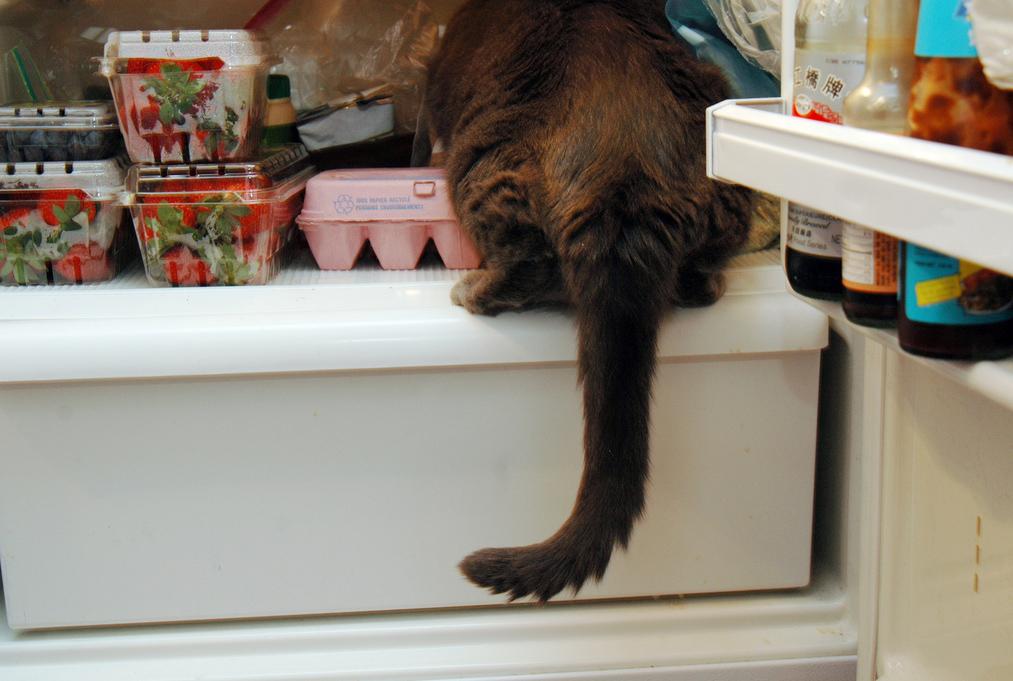
Some cats are natural-born burglars and can even get into a closed refrigerator. If you have one of these creatures in your home, you can save the bins using the same principle described above. Alternatively, place a plastic cup of water or install an alarm system using bells or jars. It may look a little extravagant, but it's effective.
Cats are natural predators. If you live in a rural area, you may have encountered a situation where your pet bullies poultry. If you're unsure how to stop your cat from stealing chickens, follow the recommendations above:
- talk to the animal;
- install protection;
- scare the cat.
Read also:
- How to train cats at home
- What to do if your cat is marking in your apartment
- Types and features of cat litter


2 comments
Alexander
It's all useless! I have a Maine Coon cat,
He had feeding issues since he was a puppy. He was a very picky eater. For a long time, for a year and a half, we picked out his food. We didn't feed him from the table, but he climbed over tables and cabinets, opening every door and scooping up everything he could reach. Water doesn't bother him, nor does sticky tape—well, anything sticks to him until you take it off. As he got older, the problem subsided, but the circumstances also changed. We got other cats, or rather, we moved into a family where they already had cats. Other problems arose: the cat would hit and bully everyone, but he stopped stealing. As he got older, things changed again: some of the cats died, and the Maine Coon got older, he's now 9 years old, and the stealing resumed with increasing intensity. He steals any food left on the table or stove.
If it's a pot or a frying pan, the lid isn't a barrier. If something's in the cupboard above, that's also not a barrier. You have to lock the cupboards with cutlery, hide pots and pans with freshly cooked food in the oven, and cooking in front of it or putting something warm on the table is out of the question. As soon as you turn away for a few seconds, that's it, the cat steals it, carries it off wherever he can, and gobbles it up. No matter what you do—spraying it with water, slapping it loudly, slapping it on the butt with a slipper, slapping it on the table with a newspaper, slapping it on the butt with a newspaper—the cat only eats faster, and then runs away. If you go to pick up its spoils, it hisses and lunges at you. It'll be a bit offended, but then, as if nothing happened, it comes back and survives the moment again.
He doesn't sleep all day, sitting or dozing on the kitchen couch, waiting for something edible to appear so he can steal it again. It would be fine if he didn't make it; he eats more than everyone else, but within his normal limits. In addition to the super-premium dry food from Bachelor, which is always available, we also give him wet food in the mornings and evenings. All the other male and female cats hope and don't beg for it; he's the only cat who's always hungry. So we think this behavior is related to his old age, perhaps the onset of dementia or something similar. He was, as they say, unfriendly to both animals and people before. He only acknowledges me, has followed me around since he was a puppy, and sleeps only with me.
If I'm on a day off and doing chores around the house, and the kitchen is cleared of food, he'll follow me around, begging to be picked up. As soon as I sit down, he's already on my lap, rubbing against my ears, slobbering on my cheeks, grunting with pleasure, and all that jazz. I have to dedicate some time to him, because it's a shame to take him off me right away and then do my chores. It's like this all day. He either sits in the kitchen waiting for something to steal and does it at the first opportunity, or he follows me around with his tail and climbs into my arms at the first opportunity. He constantly hits the other cats, including the female cat, which is why our fur is in clumps all over the apartment. He doesn't let any of them near me, and he doesn't consider other people human. He can growl at them, hiss, and even hit them if someone passes by close to him.
Lawrence
Mine was pulling everything off the table. At first it was funny. Then it became strange. Then sad.
Add a comment