
How to determine the gender of a puppy: boy or girl
So, you're planning to get a pet and have already decided on the gender, certain it should be a boy or a girl. Today, we'll explain in detail how to determine a puppy's sex based on external characteristics, and also share information that will be useful for owners planning to breed their dog for the first time.
Content
Gender differences in dogs
In official documents (for example, veterinary passports), the following gender designations are used for dogs:
- a dog is an animal of the male sex (in English it is written as “male” or simply with one letter “M”);
- A bitch is a female animal (in English it is written as “female” or simply with one letter “F”).
As a rule, experienced breeders know very well how to determine the sex of a puppy and, already at birth, separate all the babies in the litter, marking them with ribbons of the corresponding color.

But for an inexperienced person handling a very small puppy for the first time, it may not be so easy to distinguish between a boy and a girl. Determining the gender of the puppy you're considering is crucial, because:
- you will need to correctly indicate this fact in the documents;
- The choice of nickname depends on gender;
- Gender largely determines the appearance and behavior of an adult dog in the future.
External features
|
Characteristic |
Boys |
Girls |
|
Size and weight |
larger, more massive |
smaller, lighter |
|
Physique |
more powerful, more muscular |
more graceful, with less defined muscles |
|
Paws |
more massive and thick |
thinner, more graceful |
|
Head |
large, with a pronounced forehead |
smaller and neater |
|
Wool* |
thicker and longer |
thinner and shorter |
*Depending on the breed, this feature is typical for Spitz, Collie, Yorkshire Terrier and a number of other long-haired breeds.
Differences in character
|
Characteristic |
Boys |
Girls |
|
The desire to dominate |
clearly expressed |
more docile |
|
Territoriality |
marks, aggression towards males and strangers |
less prone to displays of territoriality |
|
Aggression |
high (often depends on hormonal levels) |
low with proper upbringing |
|
Attachment |
less attached |
more attached to the owner |
|
Trainability and obedience |
may be stubborn |
can be cunning and manipulative |

Features of maintenance and care
When choosing, it is also worth considering the following features of the content.
|
Boys |
Girls |
|
can mark territory urine has a specific smell you'll have to bathe more often after walks tend to pull on the leash always exhibit sexual behavior they can run away when they hear a bitch |
heat and all the associated problems restless during estrus they run away only during estrus there may be pregnancies and childbirth there are false pregnancies |
Castration or sterilization allows you to get rid of many of these problems, make keeping your pet in an apartment easier, and also reduce the risk of developing malignant processes.
How to distinguish a male puppy from a female one
In the first weeks of life, boys and girls look almost identical, so in photos of puppies at a month or even a little older, it can be very difficult to distinguish between males and females. In videos, if the puppies are photographed lying down, it's also impossible to tell the difference. Furthermore, until puberty, the urination process is almost identical in both sexes (their toes begin to lift their paws only after 6-7 months).
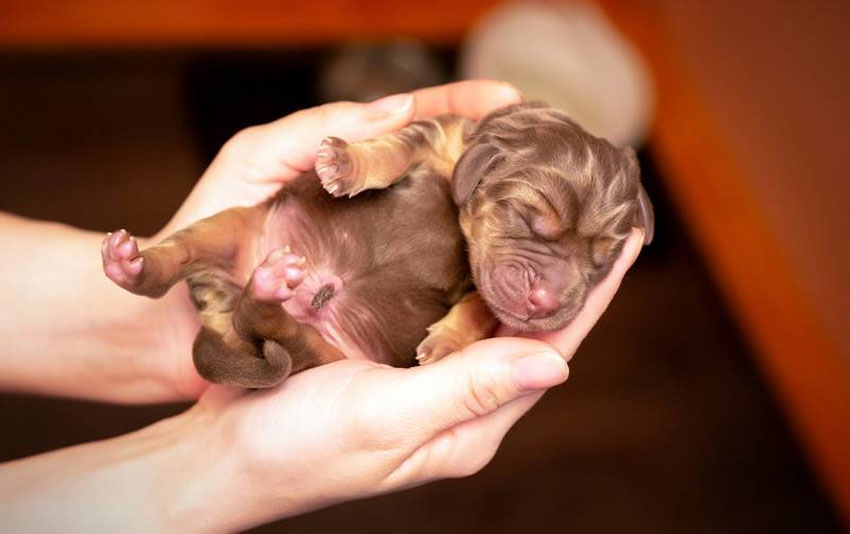
But if you can handle the puppy, we'll tell you how to tell if the puppy in front of you is a boy or a girl. Just look at the baby's tummy and under its tail.
The boy has
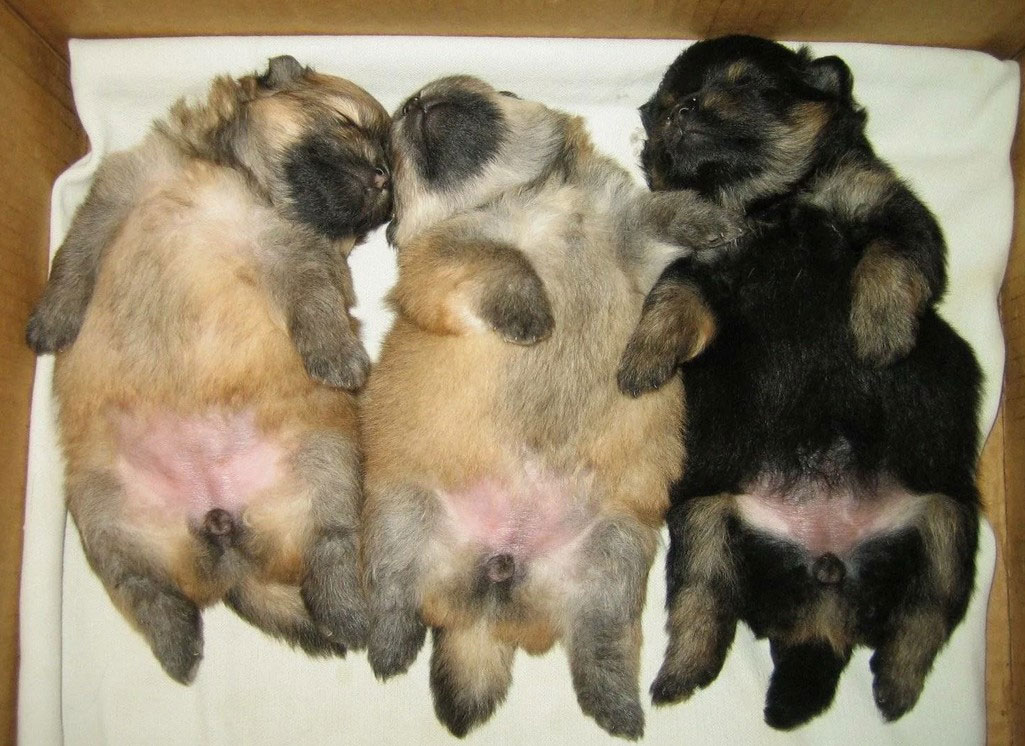
You can recognize a male dog immediately after birth by seeing a characteristic fold with a small protrusion on its tummy just below the navel. This difference is easily visible in short-haired dogs such as the Chihuahua or Jack Russell Terrier.
In long-haired dogs, finding the genitals can be a bit more difficult, as they are not yet fully developed at an early age, and the process of testicular descent in puppies does not begin until after two weeks (usually by two months). In some males, the testicles may not emerge through the inguinal canal for up to four to five months. If the problem persists until six months (the age at which the inguinal canal closes), it is considered cryptorchidism. Such dogs should not be used for breeding and should be neutered.

However, even after a minute of close examination of a puppy, it's easy to determine the dog's sex immediately after birth. Furthermore, in long-haired breeds, the protrusion of the penis on the bare belly is often covered with a small tuft of hair.
The girl has
You can recognize a female dog by its completely smooth tummy. In a newborn female puppy, the only protrusion may be the umbilical wound, which heals within the first few days of life, and the tummy becomes completely smooth (the exception is an umbilical hernia, which we discussed earlier).
You can confirm your suspicion that it's a girl by looking a little further, into the area "under the tail." Just below the anus, there will be a loop (a small fold of skin shaped like a small leaf).
How to determine the sex of an adult dog
In adulthood, there are even more methods for distinguishing a boy dog from a girl:
- Visually, by the position of the genitals. After a year, they are developed enough to be noticeable even from the outside.
- Observe the urination process. Typically, girls "do it" by squatting, and boys by raising their paw.
- Looking closely at the physiological (external) features of a dog's body structure, they are not clearly visible in adolescent dogs, but after 1.5 to 2 years, males become more massive and muscular.
- Look closely at the face. Regardless of the breed in front of you, whether it's a German Shepherd or a Corgi, female dogs have a more refined and feminine expression in their eyes and face.
Is it possible to determine the sex of puppies before birth?
Breeders of particularly popular breeds know that waiting lists for puppies often form even during the dog's pregnancy (and sometimes even during the breeding planning stage). Naturally, customers want to know whether they will have the opportunity to choose the puppies of their desired gender.
According to statistics, demand for female puppies is slightly higher, as a purebred female can potentially produce offspring for her owners. Furthermore, many beginning dog owners are advised to choose a female dog as a companion due to their greater docility.

Naturally, some people wonder how to tell if a dog is having a girl or a boy puppy or how to predict the sex ratio in a litter. Many people draw a parallel to determining the sex of a human baby and want to know what sex their dog will have. However, at this stage, veterinary medicine does not determine the sex of future puppies, as ultrasound imaging is virtually impossible to determine due to the close placement of the fetuses and the poor image quality, and additional invasive procedures are inhumane and expensive.
The only thing the owner can know is the approximate number of babies in the planned litter and how much each baby will weigh at the time of the planned birth.

In most cases, more boys are born than girls. Scientists have found that a large number of male puppies in a litter can be due to various factors:
- heredity (like Husky);
- age of the parents (when crossing young females and old males, usually more males are born);
- the number of puppies in the litter (the larger the total number of puppies, the more boys there will be among them);
- nutrition (excess meat in the diet increases the percentage of male puppies).
Please note! All of the above factors are merely scientific hypotheses and are not 100% certain. Therefore, when booking a puppy during pregnancy, you can only know the number of puppies expected, but cannot guarantee the gender.
Read also:
- Why are dogs so loyal to humans?
- Why does a dog chase its tail?
- Dog licking its paws: why and what to do


Add a comment