
How to teach a dog to lie down
"Down" is a basic training command often used in everyday life. It can be useful when traveling on public transportation or during veterinary checkups. This skill is also a must-have for shows and exhibitions.
Content
When to start training
If you have a puppy rather than an adult, it's recommended to begin training as early as possible (after 3 months), which will be convenient for both the pet and its owner. This recommendation applies not only to this command but also to other commands ("stay," "sit," "no"). Before training begins, the puppy must understand who its owner is. This will be the person who constantly interacts with the dog from day one: feeding, bathing, playing, and taking it for walks. For this reason, it's not recommended to allow strangers (even friends) to regularly treat, pet, play, or call the dog during the first few months.
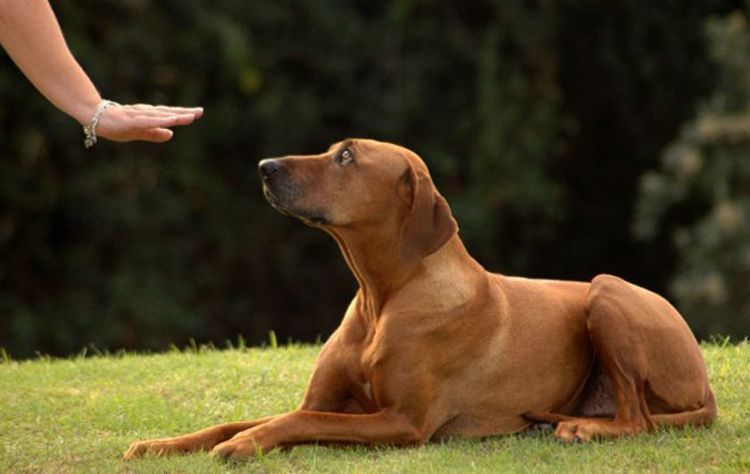
Successful training should result in the dog easily transitioning from a stand to a down position. For toy breeds or pets with a melancholic personality, experts recommend teaching the down command only after the animal has mastered the sit command.
General recommendations
The main principle of training is consistency and consistency. To train your dog yourself, you need to know the basic methods and rules, as well as potential mistakes. Experts recommend watching videos of professional dog trainers available online to learn the techniques and methods for mastering the "Down" command.
Training should be done in a calm and quiet place, free from distractions such as extraneous noises and other animals. It's also important to choose a clean location, as lying down on dirty, cold ground will be unpleasant for the dog. If training is limited to indoors, there's a risk that the dog will only listen to its owner indoors and become unruly outside.
Harshness and cruelty are prohibited during training. Training, like other interactions with a pet, should be based on love and respect. A dog should view humans as leaders, not tyrants.Training must be done correctly from the very beginning, as retraining is much more difficult than starting from scratch. To avoid confusing the dog during the training process, avoid using other commands simultaneously. For example, avoid combining the commands "sit" and "lie down," as the dog will eventually only perform them in that order and will only move to the lie down position after first sitting. It's important not to allow the dog to stand up until the owner gives permission, so as not to undermine the primary goal of training—discipline.
What do you need for this?
For training, as with other activities, you need a certain set of equipment. Although it's fairly simple and standard, it's worth mentioning. For training, you'll need:
- A collar is a mandatory element that allows you to control the dog and serves as a symbolic attribute of power;
- leash – will be needed not only during the training process, but also when moving to the training area;
- delicacy - the most favorite food (crackers, pieces of meat or cheese, dry food), but it is important to take into account that a well-fed animal may remain indifferent even to a delicacy desired in other situations;
- A positive attitude is one of the most important conditions, since animals are very sensitive to human moods, and good results can only be achieved when the pet feels supported by its owner and both enjoy the training process.

Step-by-step instructions
Using a traditional combination of rewards and positive behavior can successfully train a dog to "lie down." The following method is used:
- Take the correct position when the owner stands in a confident pose with the leash in his hands, and the animal is in front of him, on the left side.
- Clearly say: "Lie down", pull slightly leash and show the treat (you can hold it up to your dog's nose). Once your pet is interested, smoothly move your hand forward and down, urging the dog to follow.
- During this time, the dog must be held with a leash. It should remain in place and gradually lower itself behind your hand, assuming a lying position.
- After the dog lies down completely, press with your left hand on his withers (to prevent attempts to rise), reward him with words (for example, “Good”) and a treat.
- If the animal jumps up before the treat is given, give the command and make it lie down again.
- The dog is held in a lying position for about 5 seconds initially and released with the command “Walk”.
- The exercise is repeated several times in a row with short breaks (2-3 minutes).
You can also use a variation without first giving a treat: place your left hand on the animal's withers and place your right hand under its front paws. After giving the command, simultaneously apply pressure to the withers and move the front paws forward. When the animal lies down, praise it, give it a tasty treat, and then release it with the appropriate command.
It's important to ensure the animal initially assumes the correct position, with the front legs, croup, and body extended forward and in a straight line, and the hind legs tucked in. A croup that falls to the side is a sign the exercise is being performed incorrectly.
In most cases, after just a few training sessions, the dog develops the basic skills to perform the command without additional pressure on the withers. After this, you can increase the time between the command and the treat delivery, and then introduce an additional gesture. This gesture consists of raising the right arm horizontally to the shoulder with the palm facing down (1), then lowering it to the right hip (2).
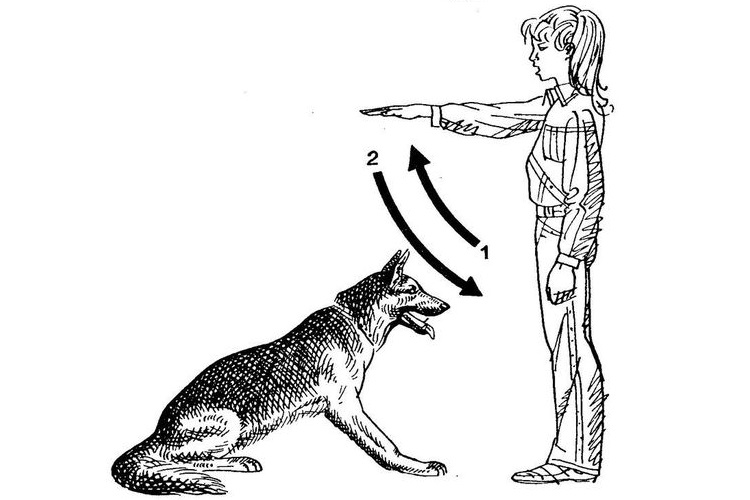
As you develop gesture recognition, gradually increase the distance and holding time. For example, for an eight-month-old puppy, the standard calls for following a command on the first try at a distance of 15 meters for 15 seconds. When training at a greater distance, don't dismiss your pet with the command "Walk" from afar. Approach it, praise and pet it, and only then release it for a rest.
Additional tips
During the training process, dog trainers also recommend adhering to the following guidelines:
- the command to “lie down” should be given before coercive actions, and the treat – after the dog takes a lying position;
- If your pet gets up without permission, you must return it to the required position and repeat: “Lie down!”;
- you shouldn't immediately demand a lot of patience;
- do not start classes on wet or dirty ground;
- the task must be repeated once, otherwise the dog will get used to performing it only after it has been repeated two (or more) times;
- Don't "spare" different orders, demanding their execution every 10-15 seconds; it's better to focus on their clear and correct execution, rather than striving for the maximum number of commands executed in a minute;
- When releasing a dog, you should use the command "Walk," not "Come." The latter is considered a "pleasant command" (provided it's trained correctly), so a dog released with this command will have a harder time waiting, which will reduce the holding time.
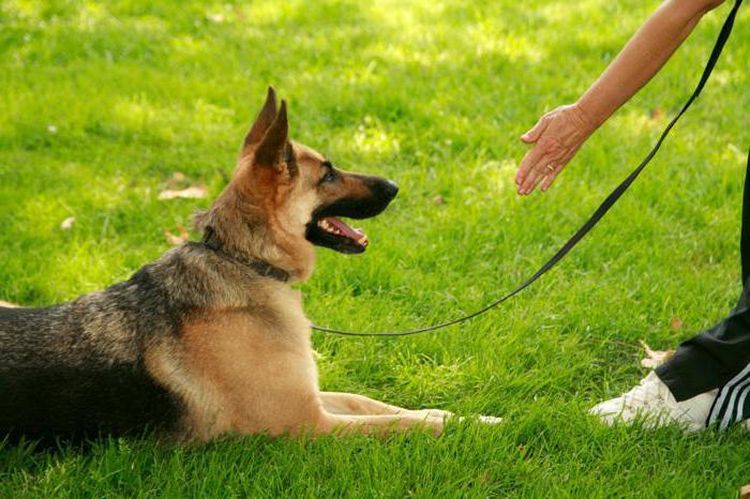
A common mistake is trying to train a dog to multiple commands at once. Don't follow the example of those who succeeded, and especially don't insult or shame the dog by citing the example of your friends' more "observant" pets.
Once your pet confidently performs "Lie Down" in a quiet place, you can try this command in a noisy park or store. Follow the same pattern: first, train your pet to lie down a short distance from its owner and with minimal restraint.
Read also:
- How to teach a dog the "Speak" command
- How to teach a dog the command "Attack"?
- Teaching a dog the "come to me" command


Add a comment