
How to teach a cat to give a paw
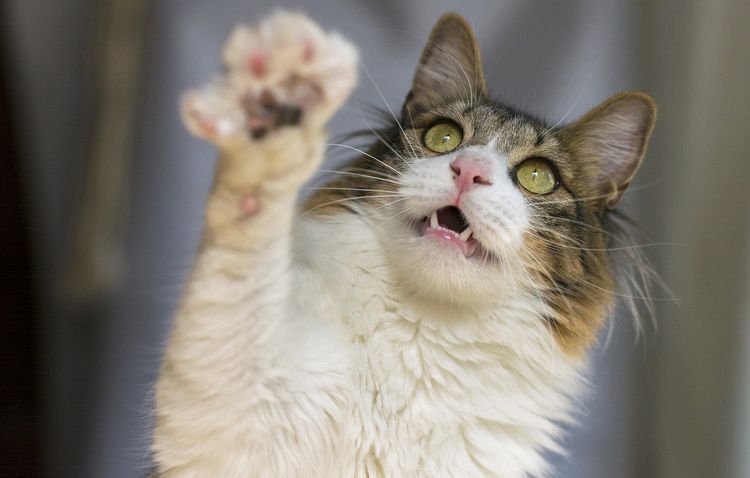
Contrary to popular belief, it's possible to train not only dogs but also cats. After all, owners train them to respond to their name, use a litter box, and perform other tasks. This list can be expanded if desired. For example, teaching them to shake hands. How can this be done? Taking into account the unique personalities of these animals, the right motivation, and regular training will help you achieve your goals.
What to consider when training
Before you begin training, you need to take into account the following recommendations:
- Choose the right time. Your pet should be in a good mood and comfortable, not too hungry or, conversely, overfed. If you start training right after eating, your pet will be unmotivated to follow your requests. If it's hungry, on the contrary, it will think only of food and run to the bowl.
- Determine your cat's favorite treat. Cats can be picky eaters. What one cat loves, another might even refuse to smell. It's important that the treat motivates activity and isn't used as part of their daily diet.
- Choose the "right" trainer. If the cat is attached to only one family member, it's best to train them. If they don't have any preferences, you can train them one at a time to reinforce the association with the command, not the person saying it.
- Reward promptly. The animal must understand a clear connection between the action and the subsequent reward in the form of a treat, so don't delay the latter.
- Avoid punishment. Cats are not naturally submissive. They don't understand the connection between failure to comply with a request and subsequent punishment. This will only lead to resentment and a refusal to respond to any requests.
- Synchronize your voice command with the corresponding movement. Even if your pet accidentally places its paw in your hand during the day, you should immediately say, "Give me your paw!" and praise it.
- Consider individual and breed characteristics. Siamese, Bengals, Abyssinians, Savannahs, and American Shorthairs are considered more trainable. Exotics and Persians are most often found to be completely untrainable.
How to proceed
The "Give me your paw!" command is one of the simplest, along with "Sit!" or "Come!" It's recommended to begin training your kitten no earlier than 7 months of age. Once the above recommendations have been followed, you can begin training:
- Place the cat in front of you. If it's standing, apply gentle pressure on its back without making any sudden movements. You also need to focus its attention on you, which can be achieved by holding a treat between your fingers.
- Gently place the animal's paw in your palm while saying the command out loud. Avoid squeezing or pulling the paw sharply, as this will create an unpleasant association with the command. To begin, use only one paw to develop a habit of the new action.
- Give a treat, pet and praise.
- Repeat the above steps several times. If your cat suddenly gives you a paw during training, immediately say "Give me a paw" and give a reward. For the first couple of days, 3-5 minutes of training is enough. The key is to practice every day.
Recommendation! Treats should be given with a different hand than the one the cat is using to place the paw. If the hand smells of food, the cat will be more likely to sniff it than to follow the command.
Using a Clicker
A clicker—a device with a button that produces a distinctive clicking sound when pressed—can be a helpful aid in training your pet. The principle is to establish a connection between the click and a reward (in the form of a treat) in your cat. To do this, simply reward the animal immediately after the click, without requiring any further action. This training session shouldn't last longer than 5 minutes, but can be repeated 2-3 times a day. The pet's gaze will help confirm the connection: immediately after the click, it will look at the owner or the clicker in anticipation of the treat, and perhaps even lick its lips.
The main advantage of this method is that only the sound is directly associated with the treat. Verbal commands and praise are considered less effective because they are used in everyday life, not just during training. Consequently, they are not perceived by the animal as a call to action.
Once the appropriate clicker response has been developed, you can teach your cat the "Give Paw" command as follows:
- press the button and give a treat to remind the dog of the established relationship;
- then take the cat by the paw, click it, softly say the command and give a treat;
- let go of your pet, pet and praise him;
- change the sequence of actions over time: command - click - treat.
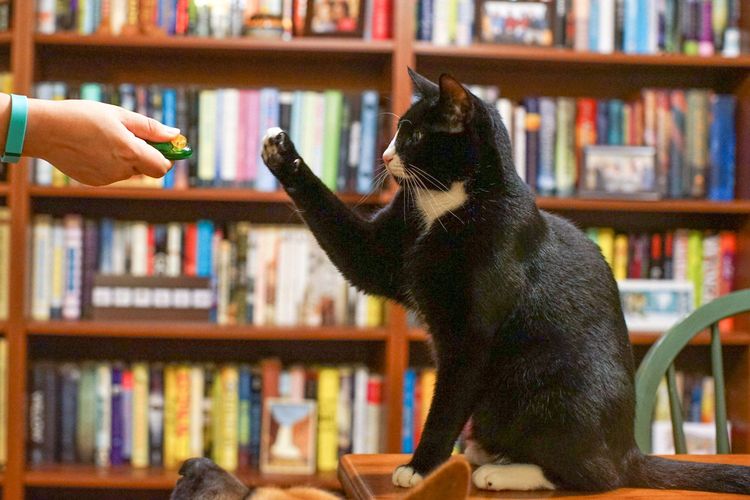
During training, gradually eliminate the clicker and then reduce the amount of treats, but remember to pet and verbally reward your pet for each correct performance. As a reminder, you can also occasionally motivate them with a tasty treat (for example, every 5th time).
Remember that all animals are different. Some learn a command in a couple of sessions, while others flatly refuse. In the latter case, it's best to postpone training until later, as pestering your cat will only cause stress and won't promote learning.
Read also:
- How to stop cats from climbing on tables
- How to stop a cat from scratching furniture, sofas, and wallpaper
- How to stop a cat from biting


Add a comment