
How and why to massage your cat's bladder
Bladder massage is a procedure necessary to help a cat who is unable to defecate without assistance. It's also known as bladder compression. The necessity and appropriateness of this procedure should be determined by a veterinarian, as any unintentional intervention by the owner can lead to serious consequences, including death.
Indications for the procedure
Massage may be prescribed in case of problems with urination caused by the following reasons:
- damage to the nerves of the hind limbs (paralysis, paresis, etc.), often resulting from injuries;
- infectious or inflammatory diseases of the urinary system (urolithiasis, cystitis);
- congenital abnormalities in the development of the urinary tract;
- overexcitation in uncastrated cats, when significantly enlarged sex glands block the urethra.
In cases of neurological damage to the extremities, the veterinarian usually prescribes continuous manual emptying of the bladder. In other cases, when the pet is unable to urinate on its own (for example, in the case of urolithiasis), the cause of this phenomenon must first be identified and eliminated.
Urinary problems become immediately noticeable. They manifest as the following symptoms:
- the animal spends a lot of time in the litter box, but does not release urine at all or only a small amount is released, and the cat behaves restlessly during this time, sometimes meowing;
- the cat may try to urinate in different places in the house;
- appetite noticeably decreases or disappears;
- the pet becomes lethargic or, conversely, restless, and tries to limit any movement.
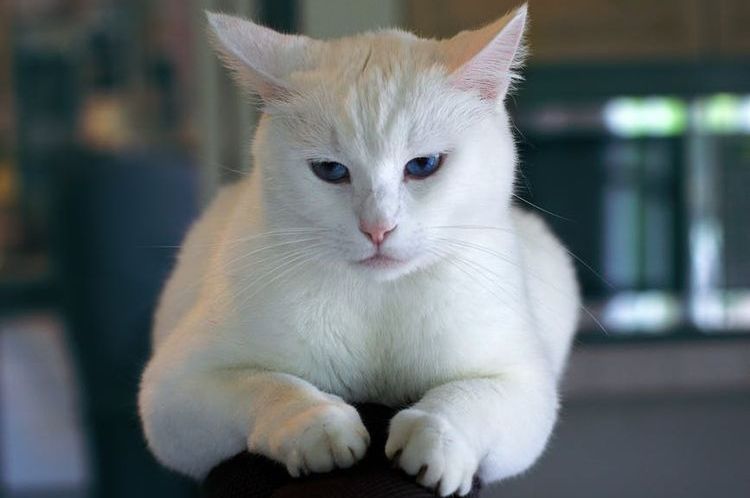
To determine the degree of filling of the bladder you need to:
- Place the cat on a hard surface on all fours, gently holding it under the belly so that the hind legs are closer to the owner.
- Place your hands on the back so that your thumbs are on the pet's croup and the rest of your fingers feel the abdomen in the area of the urinary tract.
- If your pet struggles or becomes nervous during the procedure, it indicates discomfort. Read on to learn how to feel your cat's bladder.
- A soft, walnut-sized lump, with fluid rolling freely under the fingers, indicates a 24-hour urinary retention, while a firmer, tennis-ball-sized lump indicates a lack of urination for more than two days. A larger, firmer lump is a sign of a veterinary emergency, as a catheter will likely be needed to relieve the urine.
The procedure for massage
Before beginning the procedure, calm your pet with soothing words or petting the head. At the same time, gently palpate the abdomen to assess the bladder's density.
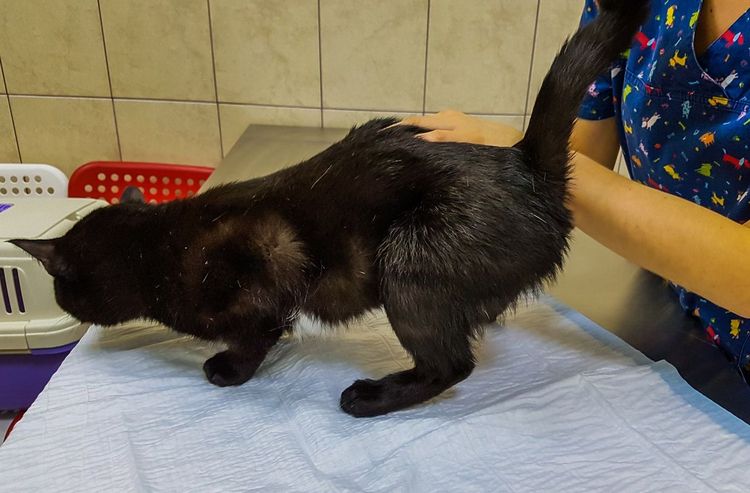
Next you need to:
- Place the cat on its back or side, but the procedure can also be performed in a standing position.
- Check for tiny stones on the penis that could obstruct the flow of urine. If any are found, remove them: gently squeeze the penis with fingers lubricated with a special gel or soap, moving from the tip to the base.
- Cup your palms and gently massage your bladder, using clockwise circular motions to direct the flow of urine toward the external genitals. You can also try applying gentle pressure on both sides of your bladder with both palms to help empty it.
Important! Never apply strong pressure, as any carelessness can lead to bladder rupture. The key to a massage is not force, but correct movements.
- After some time, a small amount of urine will begin to be excreted, with a small amount of blood being acceptable. In cases of urolithiasis, the body will pass sand and salt deposits in the form of a white paste.
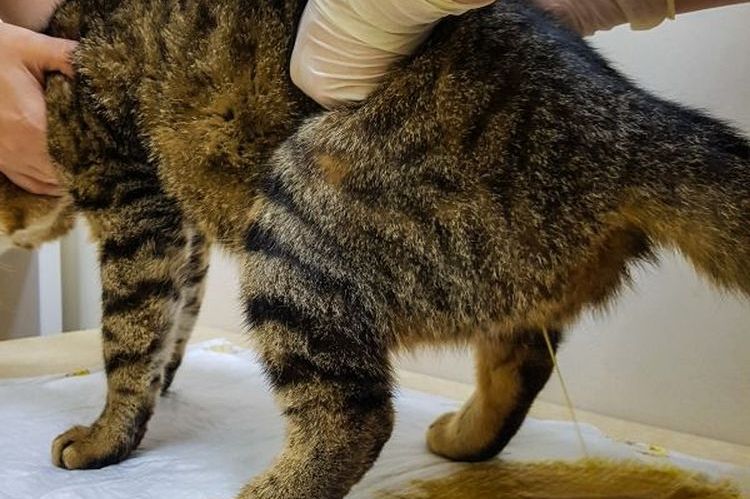
- If your pet is struggling and scratching, you can ask your assistant to hold the cat by the paws and calm it down by stroking its neck.
- If all manipulations are performed correctly, the animal will be able to urinate in the litter box. It is important that the bladder is at least 50% empty. If the cat does not resist too much during the massage, you can continue the procedure until the bladder is completely empty.
The first time, your pet will likely be reluctant to massage and apply pressure to their abdomen. However, it's important to understand that the cat's health and lifespan depend on how thoroughly and correctly the procedure is performed, as prolonged urinary retention can lead to urinary poisoning.
You can also ask our website's staff veterinarian a question, who will answer them as quickly as possible in the comments box below.
Read also:
- Why does my cat pee blood?
- Stop-Cystitis for Cats: A Product Review
- How to massage a cat's hind legs


22 comments
Zhanneta
The cat won't urinate on his own even after a urethrostomy. Two months of treatment have shown no results. He doesn't even have the urge to go to the bathroom. His abdomen is bloated, and we have to go to the doctor every other day to remove urine using a catheter. Manually emptying his bladder is impossible, and there's no one to help.
Andrey
Hello, my cat has cystitis. They prescribed Petkam and Stopcystitis. We've been taking it for a day now, but it doesn't help. The cat still can't pee, only small drops.
Daria is a veterinarian
Hello! What is your pet's diet like (cheap commercial/average quality/well-balanced, or natural food, possibly table food)? How is their fluid intake (how much water does they drink per day, how many drinking bowls are there, and how often is the water changed)? What are the urine culture results, and has there been a follow-up visit to the clinic? Have stress been ruled out? Has anything other than homeopathy and NSAIDs been prescribed? Has an ultrasound been performed? Is urination painful? Is there blood in the urine?
Alexey
My cat stopped peeing on the fifth day after her spay. She drinks, but eats little, and has bowel movements.
Daria is a veterinarian
Hello! You need to pay attention to how much she drinks and how much she pees. You can do this by removing the litter from the litter box. This way you'll see whether she's peeing or not. You might also notice some changes in her urine. It's bad that she's not eating. By the third day, cats are already leading a completely normal life. Take her body temperature; if it's elevated, hold her by hand and take her to the vet immediately. Get an ultrasound and get a prescription for antibiotics. Don't prescribe anything yourself!!! Don't give any medications yourself! There's a risk of harm.
Anna
Good afternoon. My cat has been having urinary problems. Triple phosphates were detected, pH 6.0, and protein 0.5 g/L. We started treatment. But after a few days in the litter box, he started raising his head, wagging it with his mouth open. This is not a sight for the faint of heart. Can you tell me what's going on?
Daria is a veterinarian
Hello! What specific treatment has been prescribed? Just antibiotics? What about antispasmodics? Nonsteroidal anti-inflammatory drugs to reduce inflammation and relieve pain? Diuretics for the first day or two to flush out all the impurities from the bladder? Has a special diet been prescribed? My cat may be raising his head because of pain during urination (stones and sand are passing and scratching the inflamed wall of the ureters, which is quite painful). Have you had an ultrasound? Would it be easier to perform a urestomy or insert a catheter? Could there be a large stone, and there's a risk of urethral obstruction?
Anna
Good afternoon. Initially, my cat ate processed meat and had excellent litter control. About a year and a half later, my mother switched him to a dry diet for 1-1.5 months. There were no problems. My mother was hospitalized, and I took him in. After 3-4 days, he suddenly started swaying and bleeding. I went to the vet this morning... I'll describe the procedures I've had over the last 2-3 weeks: A physical examination of the cat and urine (I could feel sand on my fingers). An ultrasound showed no stones, only sand. The vet gave him 3-4 injections (I can't tell you which ones, I was in tears). He prescribed the dry urinary tract medication Fitmin Purity, Stop Cystitis, and plenty of fluids (I give them with a syringe).
I gave him additional Kotevrvin for a couple of days, but he stopped (by the way, is it possible???). He prescribed a urine collection. The first day, after a little squeezing, it was easier. Then we had the weekend… The cat started shaking his head with his mouth open. The collection didn't work. After the weekend, we did a catheterization (I described the results above), and they prescribed additional Uro-Ursi (they couldn't find it, so we bought some cranberries—we give them with water). It didn't help for about a week. Back to the vet for an x-ray.
There are no kidney or bladder stones. We flushed the bladder with medication (there was even a lot of sand visually). We gave injections for 3 days (2-3 pcs.). We continued the dry food (but I think we should switch to by-products as before - I wrote like a man loudly and often)))). We are giving Stop Cystitis (switched to Cyston), cranberry, Duphalac (severe constipation began), tummy massage with light clockwise pressure (he loves it), 10-15 ml of water with a syringe morning and evening (he drinks well himself), I sometimes add Koterwin to the water ... But ... He goes to the litter box every 10 minutes, with his mouth open, moving his muzzle from side to side ((( (he does not arch his back up). Please advise, advise - maybe I missed something.
Daria is a veterinarian
Hello! Switch from dry food to wet food from the Urinary series! This will provide additional moisture. Why haven't you prescribed antispasmodics to help your cat urinate? Simple ones like No-shpa, papaverine, or drotaverine. Nonsteroidal anti-inflammatory drugs? For example, meloxicam (it will relieve pain and reduce inflammation). Antibiotics to suppress pathogenic microflora, which will certainly "settle" in such favorable conditions. By-products are protein, and protein puts an excessive load on the kidneys, plus the cat will have to drink even more (protein always "attracts" water), so you should stay away from protein foods now. Your cat's illness may have worsened due to stress. Also give sedatives (catBayun, stopStress, fospasim, and others).
Anna
Thanks for the reply! We'll be choosing Urinary pouches. We're currently taking Uro-Ursi, Cyston, and Duphalac. We're adding 10 ml of water twice a day. Regarding antispasmodics, nonsteroidal anti-inflammatory drugs, and antibiotics, so we don't have to self-prescribe the dosage (since the vet hasn't prescribed anything for us in several weeks, even after asking), please advise the dosage and administration schedule. How long should it last? If injections are needed, we won't be afraid to give them! A few days ago, we adopted a 3-month-old girl so she could get along and play together to boost her metabolism and relieve boredom. So far, they're both stressed out))), but he's already showing arrogance and dominance))). Should we give him (or both of them) sedatives now???
Daria is a veterinarian
Hello again! You shouldn't have brought another pet into the house so quickly. It's unnecessary stress for the cat. Sedatives are essential for the sick cat, as this will add an idiopathic "factor," which can lead to not only cystitis but also dermatitis (itching) and enteritis (diarrhea and vomiting due to nervousness).
Meloxicam (available in human pharmacies) is a nonsteroidal anti-inflammatory drug. Cats are prescribed a dose of 0.1 mg of active ingredient per 1 kg of body weight on the first day, then half that dose on subsequent days. Other similar medications are available, including Loxicom suspension, Meloxivet, and Metacam. Meloxicam is given for 1-3 days. Drotaverine, papaverine, and No-Spa are prescribed for cats at a dose of 1-2 mg/kg intramuscularly once daily (a quarter of a tablet can be given, but it is bitter and may cause vomiting).
Daria is a veterinarian
Regarding antibiotics, amoxicillin and its analogues are usually prescribed first. They're the "mildest" ones. If there's no improvement within three days, a different antibiotic is chosen. Amoxicillin, clamoxil LA, betamox LA, amoxicillin 15%, amoxiclav, etc. – if administered intramuscularly, 7 mg/kg once daily; if extended-release, 15 mg/kg every other day. If you're administering suspensions or dissolving capsules, consider a dose of 10 mg/kg 2-3 times daily at equal intervals after feeding. Probiotics and prebiotics are essential to ensure digestion isn't compromised.
Yana
Good evening! My cat was diagnosed with urolithiasis! A urine test was not performed because he had a catheter in place and the urine was bloody (the catheter was in place for three days). The catheter was removed, and he urinated a few drops for 24 hours, but after stroking his belly, he started leaking urine. Now, after giving him a gentle abdominal massage, he's started urinating more. Could this happen after the catheter was removed? Or should the cat have been able to urinate normally on his own after the catheter was removed?
Daria is a veterinarian
Hello! Yes, of course. It's normal for an animal to have difficulty urinating immediately after catheter removal. A catheter is a hard foreign body, which causes swelling of the urethra. Furthermore, if left in place for a long time (and especially with even the most careful removal), the inflamed tissue is easily damaged. Urine gets into the "wounds" of the urethral mucosa, causing pain. This causes spasms again. Consequently, difficulty urinating. Antispasmodics and anti-inflammatory medications (they all have an analgesic effect) are needed. This will improve bladder emptying.
Hope
After a bladder massage, the kitten has been peeing constantly (not in the litter box), almost spontaneously and a lot, for the past 24 hours. What should I do?
Daria is a veterinarian
Hello! So, why did you do this yourself? Now the kitten needs to be taken to the clinic for an ultrasound to rule out bladder injury. Perhaps they applied too much pressure, and now the sphincter is loose. He needs to be examined.
Ira
Good evening. My cat has urinary tract infection. After treatment, he's stabilized. He's taking RK Urinary. But out of the blue, he's developed urinary retention, and he's showing no desire to go to the bathroom. An ultrasound shows no blockage, but a urine test shows only increased specific gravity. What could be causing this, and what can I do to get him to go to the bathroom more often?
Daria is a veterinarian
Hello! Let your cat drink more water. Change the water more often and provide a larger bowl (cats prefer to lap up water from large sources: pots, fish tanks, mugs). My cat drank very little from a small store-bought bowl. I replaced it with a regular deep plate, and she now drinks 100-150 ml a day from that alone, and she even manages to drink from the fish tank. =) Also, replace the food with wet food (canned food). This will add moisture to the diet. This will reduce the density of the urine, which will make it easier for the cat. Give No-Spa to relieve spasms. Perhaps, due to fear of pain or difficulty, the cat is psychologically conditioned to endure it. And this can provoke cystitis.
Alina
By the way, the cat also had swelling of the neck and chin.
Alina
Hello! My cat was out all day and came back this evening with a stiff tail. His mouth is open, he's drooling a little, and there's a blister under his tongue. He's not eating, but he's drinking a lot. I'm not sure about using the litter box, but he's going outside. He meows when picked up. His tail is definitely not broken. The vet says he's poisoned but isn't prescribing any treatment. I can't go to the vet every day. What should I do? Please help!
Dasha is a veterinarian
Hello! So, what treatment did the vet prescribe? Do you need to go every day? How can you rule out a broken tail? Have you taken an x-ray? Could there be a fracture or ligament damage? Maybe the cat was hit by a vehicle and has internal injuries? Have you at least taken a blood sample? Have you checked the sensitivity of the tail?
WomensNews
Cats requiring bladder massage should avoid dry food; instead, feed them wet food. Provide access to clean drinking water to help prevent kidney stones and other complications.
Add a comment