
How to give a cat a deworming pill
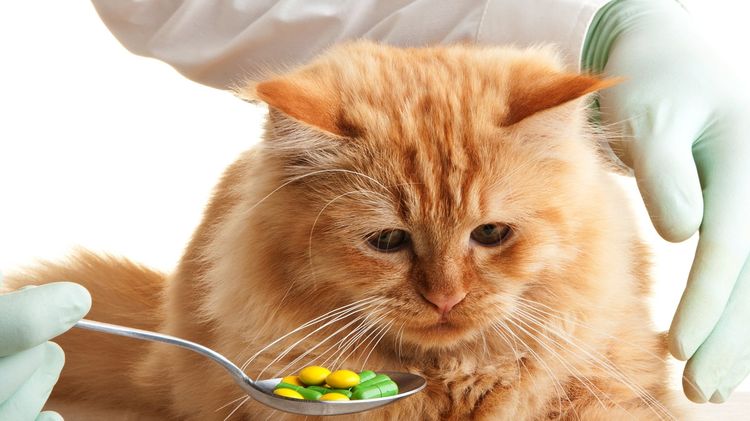
Learn how to deworm a cat, why, and when to do it. We'll explore all the possible methods. We'll also discuss how to minimize potential harm to yourself, as your cat will likely perceive you as a tormentor if you don't follow the instructions. Deworming – while useful, it's far from easy. So don't give up if your first attempt isn't successful. Repeat the procedure or try a different technique.
Content
Symptoms of helminthic infestations
Worms can make a cat's life significantly more difficult. Because of them:
- the immune system suffers;
- metabolism is disrupted;
- allergic predisposition increases.
Parasites can literally damage internal organs, literally eating their way inside an infected pet. Therefore, at the first sign of worms, their complete eradication should be initiated immediately. The main symptoms of infestation in a pet are:
- pale and/or yellowed mucous membranes;
- wet eyes, less often cough;
- loose stools, sometimes with blood and mucus impurities;
- dry and dull coat;
- general apathy.
If too many worms accumulate in the body, the symptoms become more pronounced. The worms are passed in the stool, and the cat periodically rubs its rear end on the floor.
Even if you suspect helminths, you should think about what you can give your cat for worms and take the animal to a clinic.
How to choose a drug
Broad-spectrum medications that kill all worms are usually purchased for adult pets; they can be too toxic for kittens. The best option in this case is a veterinary examination for worms. The doctor will determine the exact type of parasite and prescribe a highly specialized medication. For example, small furry pets are often prescribed suspensions designed specifically for their young age.
Popular drugs
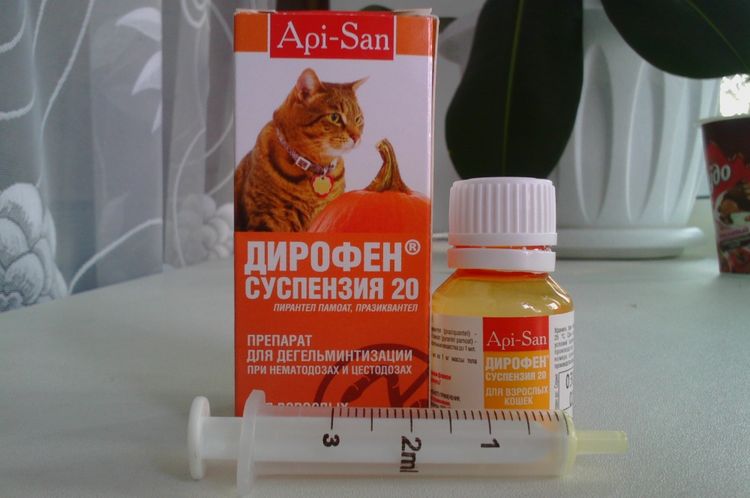
What medications should I give my cat for worms? There's a wide range of effective tablets on the market. Let's look at the most popular products:
- "Dirofen" is a universal drug;
- "Caniquantel plus" is a universal remedy;
- Drontal - effective against roundworms and tapeworms;
- "Prazitel" - destroys nematodes, cestodes, mixed infestations;
- "Poliverkan" fights nematodes and cestodes at any stage of their development.
Precautionary measures
If you're unsure which deworming pills to give your cat, visit a veterinarian for the necessary information. Before deworming, many factors must be considered. For example, deworming a cat that's already ill could harm her, worsening her already dire condition. Firstly, the medication itself is toxic, and secondly, the dead parasites begin to decompose, releasing toxins. Together, these two factors can seriously poison a cat.
It's equally important to determine the exact dosage. Giving too little will have no effect, and some worms will survive. Giving too much will poison your cat. If you're unsure how many deworming tablets to give your cat, consider several factors when calculating:
- weight;
- age;
- state of health.
- time of last deworming.
Advice! Don't try to save money on your pet by buying medications from dubious sources. Buy deworming tablets for cats only from authorized suppliers. As a rule, high-quality medications have minimal or no side effects.
How to give a cat deworming medication – the main methods
There are many methods for this procedure, but not every method is suitable for every type of medication. Therefore, before taking any measures, you should read the instructions, and if you go to a veterinarian, consult them about this. Let's consider all possible methods.
A calm method for quiet cats
The procedure consists of the following steps:
- We turn the fluffy one with its back to us.
- We tilt the cat’s head back with our left hand (it’s better to wear gloves).
- We squeeze the animal's jaw until it opens its mouth.
- We place the tablet in the mouth, clench the jaws and motivate the pet to swallow the medicine by stroking the throat and blowing air into the nose.
Fixation method
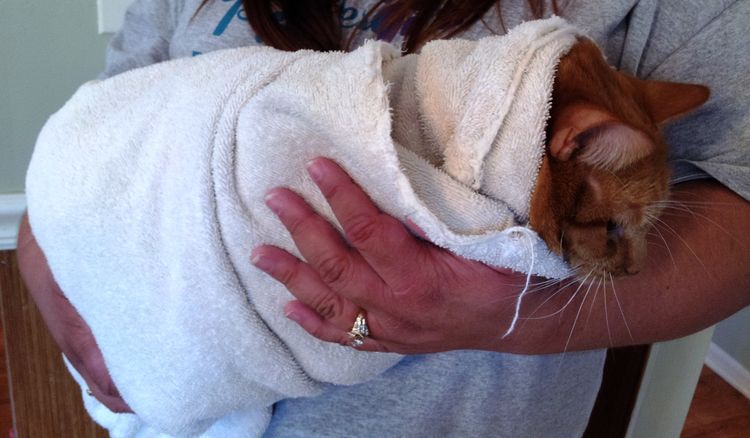
This method is often used when deworming nervous and aggressive animals. The animal literally has to be swaddled. After the procedure, the cat is left with only its head free. However, keep in mind that an anxious animal sometimes doesn't need more than that to injure its owner, so exercise caution. Essentially, this method differs from the previous one only in the swaddling. Then the procedure is repeated. The cat's mouth must be opened, the pill inserted, and encouraged to swallow. Keep in mind that this method is not only cruel but can also have consequences. After the procedure, the animal may turn on you, bite, or leave a puddle out of spite. Therefore, if you don't know how to properly administer a deworming pill to a cat using the restraint method, it's best not to risk it. There are plenty of other methods to choose from that may prove just what you need.
Syringe method
A syringe for this procedure can be purchased at a specialized store, but a regular syringe purchased at a pharmacy will also suffice. The procedure involves the following steps:
- Crush the tablet until a homogeneous mass is obtained.
- Mix the prepared preparation with water.
- We fill the syringe and pour the resulting suspension (without a needle) into the pet’s mouth.
Don't pour it all out at once, as this can frighten the animal and cause it to spit it all out. However, this also has its downside. Not every animal will lie there with its mouth open for long enough to take the medicine.
Method of deception
What could be easier than tricking a simple-minded animal by disguising a deworming pill in a piece of some treat? Alternatively, you can crush the pill and give it with sour cream or butter—whatever your cat prefers.
If your pet is reluctant to lick a treat, you can motivate them. To do this, coat their nose with medicated sour cream. Almost all cats lick anything that lands on their nose. However, it's easier to place a whole tablet in the mouth along with food using the first, more relaxed method. Your cat will taste the food and become more receptive to this unusual feeding method. But how do you give a cat a deworming tablet if they see through all your tricks and refuse even their favorite food? A special treat with a built-in tablet container has been developed for such cases. This product is unique because it contains flavor additives that entice your cat to eat it immediately. The additive also neutralizes the smell of the medication, which is also important in some cases.
If nothing helps
Even if all the above steps don't work for you or your pet proves particularly stubborn, don't despair. There are still many options to solve the problem.
First, find out if the drug you have chosen is available in another dosage form, such as a suspension or drops.
Also consider using an injection if that is acceptable again.
Another piece of advice: pull yourself together. You no longer just know how to best administer a deworming pill to your cat; you've also experienced it yourself. So consider starting over, using the skills you've acquired. Chances are, it'll work.
Side effects
Most often, the principle is the same: the way the deworming medication is administered to a cat is how it works. If you follow the instructions and buy medications from specialized stores, the risk is minimal. Every cat is different. Your pet might be slightly affected by the deworming medication due to individual quirks, but most likely, it won't.
If we talk about manifestations, these are the standard signs of food poisoning:
- vomit;
- nausea;
- diarrhea.
Less commonly – foaming at the mouth, dermatitis, more often allergies.
Helpful answers
- What is the best form of deworming medication for cats?
The effectiveness of an anthelmintic drug depends on its composition, not its form of release.
- Can pregnant cats take deworming tablets?
Deworming a pregnant cat is permitted, but proceed with caution. There are medications designed for pregnant women, but it's best to consult your veterinarian to determine which one is best for your pet.
- How often should cats be given deworming tablets?
To prevent possible infection, administer the medication once every 3 months. If treatment is necessary, administer it immediately. In this case, the procedure should be repeated 2 weeks after deworming.
- How do worms come out of a cat after taking pills?
After the medication takes effect, the parasites die and are eliminated naturally in the stool. Sometimes, if there are too many worms, vomiting may occur as the body needs to rid itself of the worm remains. This is considered normal and is no cause for concern.
Deworming won't intimidate an experienced breeder. They're professionals. But you've already acquired enough knowledge to help your cat get rid of unwanted neighbors without any help. Moreover, over time, your cat will become accustomed to the procedure, and the process will become smoother each time.
Any questions? You can ask our website's staff veterinarian in the comments below, who will answer them as quickly as possible.
Read also:
- Worms in cats
- Deworming tablets for cats
- What types of parasites are there in cats and how to remove them


2 comments
Oleg
Can fenpraz for dogs be given to cats?
Daria is a veterinarian
Hello! The dosage of ALL active ingredients in the product for dogs is 4-5 times higher than in the similar product for cats. According to the instructions, splitting the tablets is not recommended, as there is a high risk of overdose. Therefore, no, you cannot give the dog product to cats, as the risk of overdosing on the anthelmintic is too high, even though the active ingredients are identical and the principle of action is the same.
Add a comment