
Spanish Mastiff
The Spanish Mastiff is a large dog, ideal for guarding a country home. However, unlike other guard and watchdog breeds, Spanish Mastiffs require care and attention. They should be full members of the family, valued for their loyalty, independence, and integrity.
Content
History of origin
The ancestors of the modern mastiff lived for centuries in the Pyrenees, Extremadura, Andalusia, the Catalan coast, and other historical regions of Spain. The economy in this region was based on sheep farming, which flourished largely thanks to mastiff dogs (that's what the Spanish called the flock guardians, without any prefixes or additional words). Mastiffs were born and lived alongside the sheep, forming an integral part of the herd, so when a flock changed hands, the dog was given away along with the livestock. Different regions developed their own distinct dog breeds, suited to specific terrain and climate conditions.
The breed developed thanks to sheep farming. In his chronicle of shepherd life, Emanuel Delrio noted that there were typically five mastiffs for every thousand sheep. Comparing this data with the livestock population in the 18th century, the figure comes to approximately 20,000. Shepherds strictly selected dogs for working qualities, but also considered external characteristics such as body depth, head size, and the presence of wrinkles and flews.
Despite their large numbers and widespread distribution, mastiffs were not given much attention until the 20th century. The first officially registered mastiff was a piebald male named Machaco. He was entered into the Spanish stud book in 1906. He wasn't exactly a paragon of beauty, but no other mastiffs were brought to the Madrid show. Under the pressure of urbanization, wolves began to leave villages, and with them the small fur-bearing animals that were the main food source for the large dogs. Farmers began to switch to more convenient habitats. dogs, small and agile. The breed began to decline and survived only thanks to a few sheep farmers who continued to breed mastiffs, and, of course, to breeders who remembered their national heritage and initiated the breeding of the Spanish Mastiff on a factory farm.
The first description of the Spanish Mastiff was compiled in 1946 for the FCI by breeder Luis Del Portillo, who described the dogs as large, short-haired dogs. In the late 1950s, Luis began searching for large mastiffs, collecting them from pastures in the province of León. In the early 1960s, breeder Amodel Alejandro made a significant contribution to the breed, and from 1970 to 1980, he was involved in breeding and promoting large dogs. It was his dogs that gave rise to several lines that are still known today: Manalo Martineda, Hermiño Tascón, Sacaries Pieto, and El Pinotar.
In the late 1970s, a new standard was created that better reflected the modern appearance of the Spanish Mastiff. In 1981, the breed was officially recognized by the Fédération Cynologique Internationale (FCI), and a breeding program for the Spanish Mastiff was developed under the direction of Carlos Solás. The first Spanish Mastiff appeared in Russia in 1995, and in 1996, 10 more dogs were brought from the Czech Republic and Spain, which became the founders of the Russian lines. The number of nurseries began to increase, and today there are already more than 10.
Video about the Spanish Mastiff dog breed:
Appearance
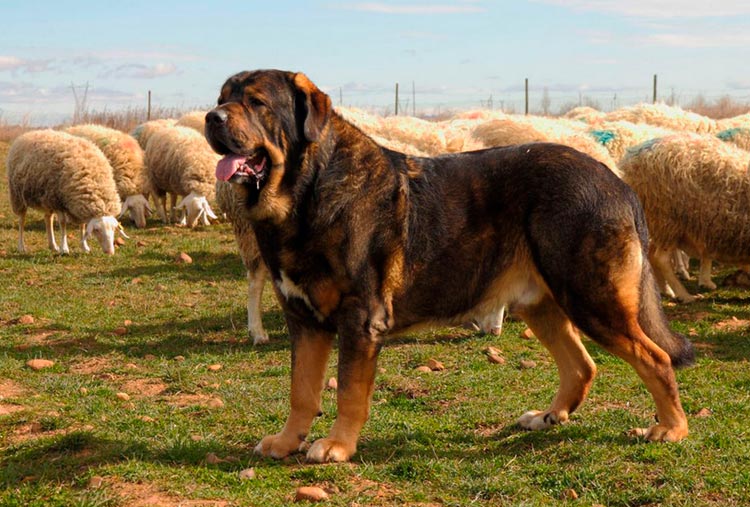
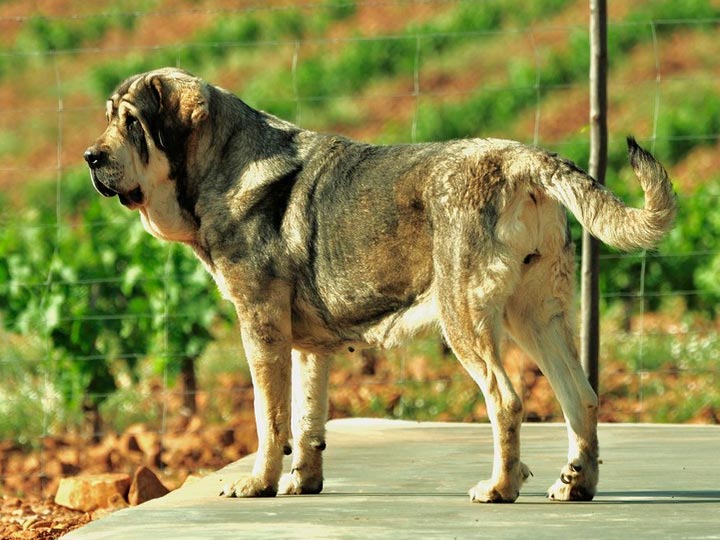
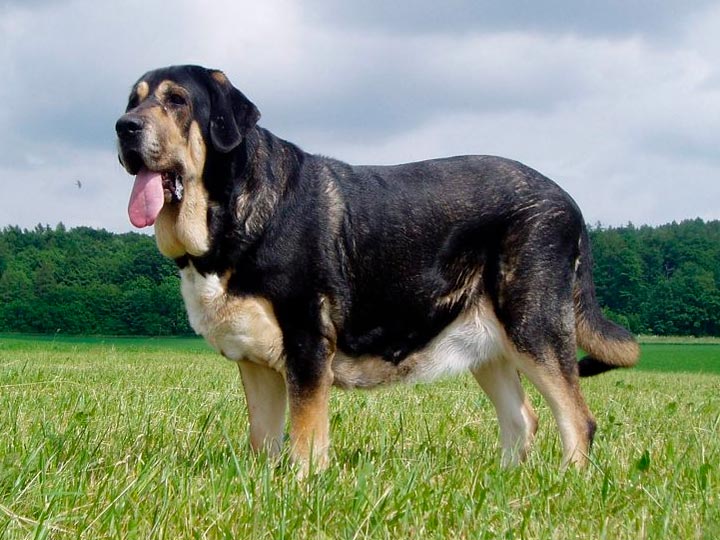
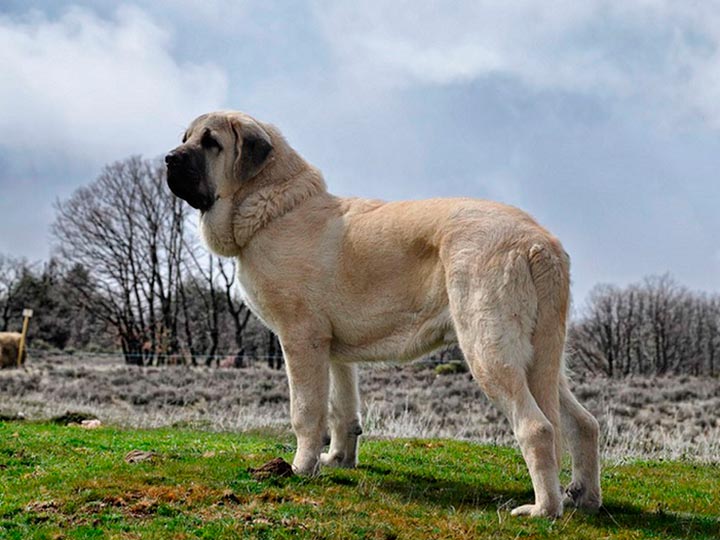
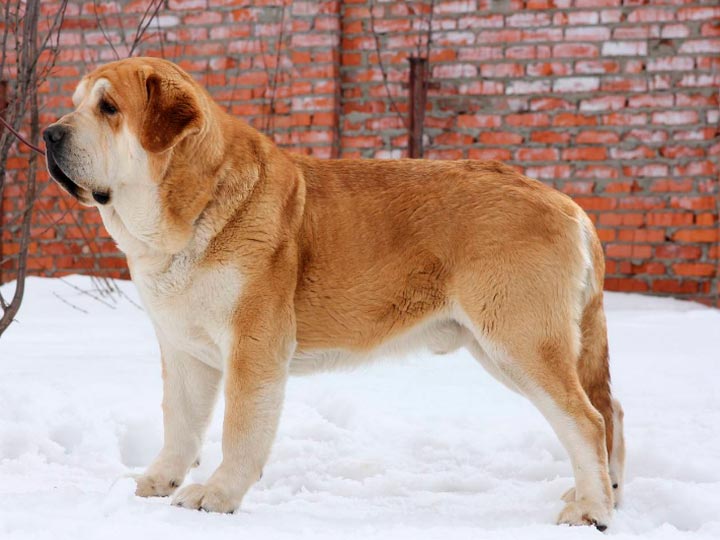
The Spanish Mastiff is a large, well-built, muscular, and powerful dog with a large head and medium-length coat. The body is elongated, but its movement and proportions should be harmonious and effortless. Gender is easily discernible. The height at the withers for males is 77 cm (30 in), and for females, 72 cm (28 in). Weight is not specified in the standard, but the minimum size is 70-80 kg (155-180 lbs).
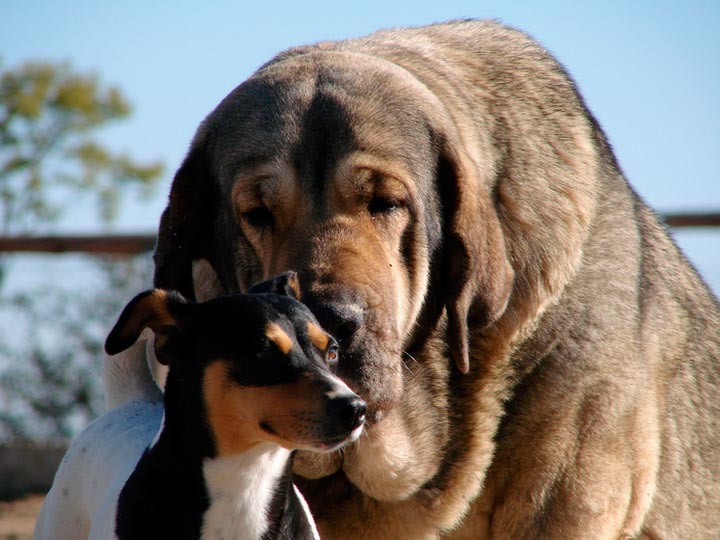
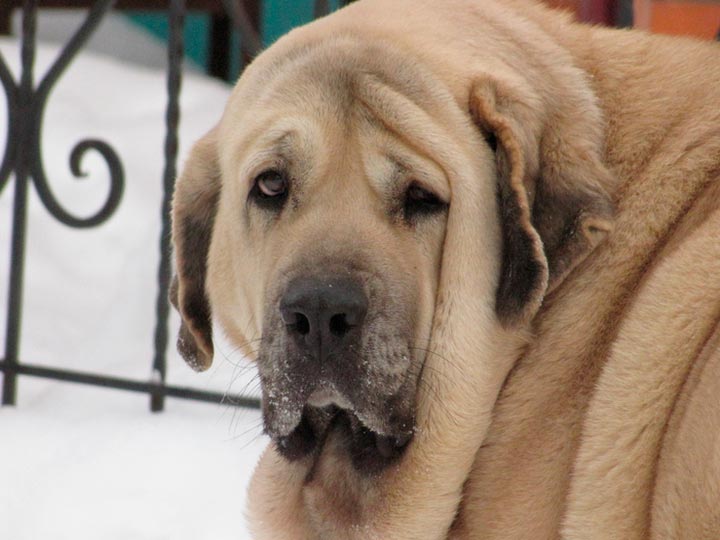
The head is strong and large, shaped like a truncated pyramid with a wide base. The skull is strong, with a pronounced occipital protuberance and a convex profile. The large upper lip covers the lower lip, and the flews are well developed. The teeth are strong and white. The eyes are small in proportion to the skull, almond-shaped, and preferably dark in color. The eyelids are pigmented and thick. The slightly drooping lower eyelid allows the mucous membrane to be visible. The ears are drooping, triangular in shape, flat, medium in size, and may be cropped. The palate is black.
The neck is strong and flexible, with a well-developed dewlap. The body is rectangular, powerful and robust, indicating great strength, yet still agile. The back is flexible and strong. The ribs are well sprung. The loin is wide and long. The croup is strong, its height equal to the height at the withers. The chest is deep, wide, and very powerful. The tail is thick, reaching to the hocks, with a frequently arched tip. The forelegs are straight, parallel, and strong, with strong pasterns. The hind legs are straight when viewed from the rear, with long, strong bones. The paws are rounded, with close-set toes. On the front and back legs, single or double dewclaws are desirable, but their absence is acceptable.
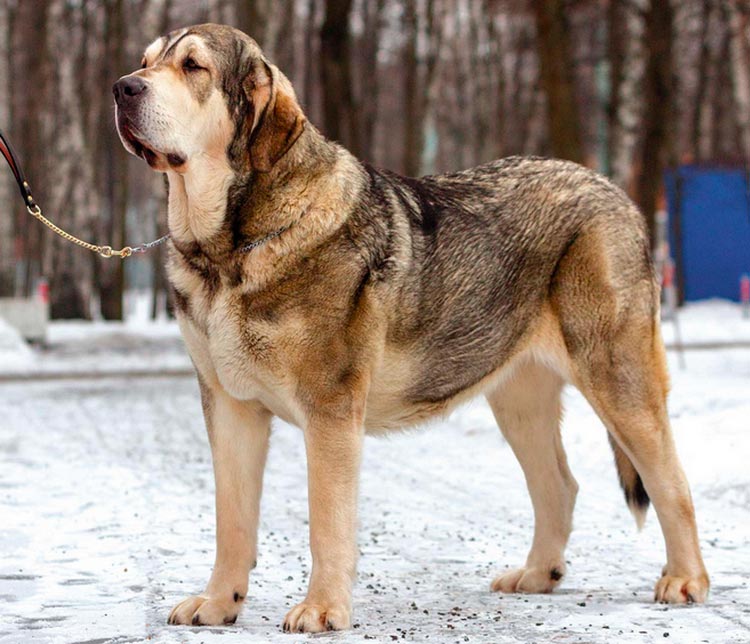
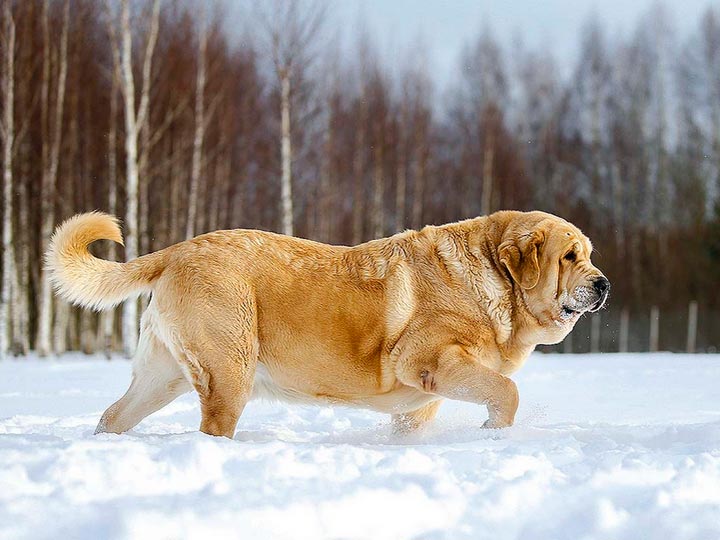
The skin is thick and elastic, forming many folds, with a good dewlap around the neck and belly. The coat is long and dense, with a well-developed undercoat, shorter on the legs and longer on the tail. Colors vary, but the most prized solid colors are red of any shade, black, and any variations of these colors, including piebald and brindle.
Character
The Spanish Mastiff's appearance reflects its purpose and character well. This is an incredibly hardy and capable dog, capable of performing a wide variety of functions, depending on its owner's requirements. But, first and foremost, they are designed to accompany flocks and protect people and their property. Among family, the Spanish Mastiff is calm, affectionate, and gentle. It is a reliable friend and loyal helper, very sociable and sensitive. Despite its formidable and slightly aloof appearance, it greatly requires attention and love. Mastiffs are more family-oriented and outgoing than many other guard breeds.
Spaniards are mentally balanced and not prone to unmotivated aggression. Outwardly, they appear apathetic and melancholic, but their appearance changes dramatically when a real threat appears on the horizon. A large, gentle lout transforms into a large, physically developed, powerful, and vicious dog, confident in itself and its abilities, capable of a swift attack.
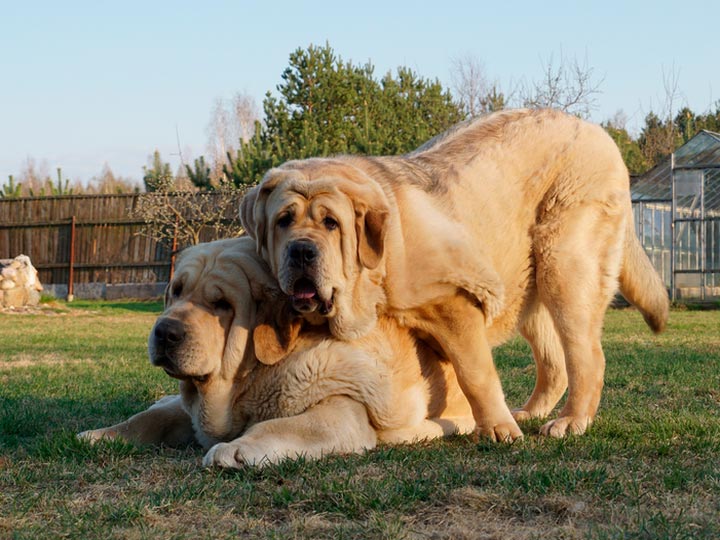
The Spanish Mastiff will become a loyal companion to a child, a caring, protective nanny. This dog will patiently endure all of a child's pranks. Another positive quality of these giants is their friendliness toward other animals. They get along well with other dogs, and consider livestock, cats, and small animals an integral part of their owner's property, so they will protect and guard them. A dog will not bark, only when necessary, will let out an impressive, loud voice. This also applies to night duty – a Mastiff will not bark at the neighbors' dogs all night long.
Spanish Mastiffs are very attached to their home and their protected area; they do not dig or break fences, and they do not try to leave the boundaries of their protected area, even if it is marked by a dilapidated fence.
Education and training
Mastiffs are very stubborn and willful dogs that are difficult to train using standard methods. They are accustomed to working independently and making decisions, and therefore are not eager to follow their owner's orders unquestioningly. For this reason, mastiffs are strongly discouraged for people who have never owned large breed dogs before, and especially for those considering getting a dog for the first time.
Training Spanish Mastiffs requires discipline and regular interaction; they do not respond well to the discipline commonly used for most breeds. Proper socialization is essential. With proper training, a Spanish Mastiff develops into an independent guard dog that can be listened to. While obedient and friendly in everyday life, the Mastiff prefers to follow instinct and personal convictions in work. It's important to remember that Spanish Mastiffs develop physically and psychologically until they reach three years of age.
Content Features
It's not recommended to keep a Spanish Mastiff in an apartment. It's virtually impossible to raise a healthy puppy on hardwood or laminate floors, and the dog will be deprived of proper exercise in the house. It is very important that the dog has the opportunity to move enough - as much as it wants and whenever it wants. The dog should have a territory to patrol and guard. Mastiffs require moderate but regular exercise. Ideally, they should be kept free in a private yard. They should not be chained or confined to a pen. They can be isolated behind a fence, but only for short periods. The Spanish Mastiff needs daily human contact and attention. This dog will benefit from a fairly spacious kennel with a flat roof, which can be used as an observation post. It doesn't require additional insulation in temperate climates.
It's advisable to provide Mastiffs with regular walks to familiarize them with the world around them, the smells and sounds, and to interact with other animals and people. However, it's important to note that these dogs are not designed for active sports.
Care
Grooming a Spanish Mastiff is easy: the dog needs to be brushed regularly, a little more frequently during shedding season, especially in the spring, when all the winter down is lost. This breed needs to be bathed infrequently, usually 2-3 times a year. The ears should be inspected once a week and cleaned as needed. the presence of dewclaws Carefully monitor the growth of their claws, which do not wear down on their own against the surface and need to be trimmed.
Nutrition
Spanish Mastiffs are extremely undemanding eaters. They can be fed both natural and dry food. This large and heavy dog eats according to its size. Mastiffs require plenty of high-quality protein, vitamins, and minerals. It is impossible to raise puppies of this breed on porridge, and feeding adult animals on such a diet leads to the development of all sorts of diseases. It's important to pay close attention to the composition of the diet. Excessive carbohydrates and fats will inevitably lead to excess weight gain and associated problems. Many owners believe that choosing high-quality dry food for large and giant breeds is optimal. Portions are calculated based on the animal's weight and physiological condition.
A mastiff continues to develop physically until it's one and a half to two years old. If it's fed a natural diet, it's essential to provide good vitamin and mineral supplements, which, as prescribed by a veterinarian, may be necessary even when feeding a complete dry food.
Health and life expectancy
In general, Spanish Mastiffs are strong and hardy dogs, but the breed is not without its share of health problems, as they are prone to hereditary illnesses of varying severity:
- Hip dysplasia;
- Gastric torsion;
- Gonarthrosis, accompanied by destruction and dysfunction of the knee joint;
- Eye diseases: cataract, entropion, third eyelid adenoma;
- Spanish mastiffs sometimes develop eczema. This can be due to poor nutrition, environmental degradation, inappropriate cosmetics, or living conditions.
Throughout its life, the Spanish Mastiff requires routine vaccinations and regular treatment for external and internal parasites. Under good care, its lifespan typically ranges from 10 to 12 years.
Choosing a Spanish Mastiff Puppy
The Spanish Mastiff is a serious breed that requires careful consideration when choosing a puppy. Don't just jump at the first offer, especially one with an attractive price.
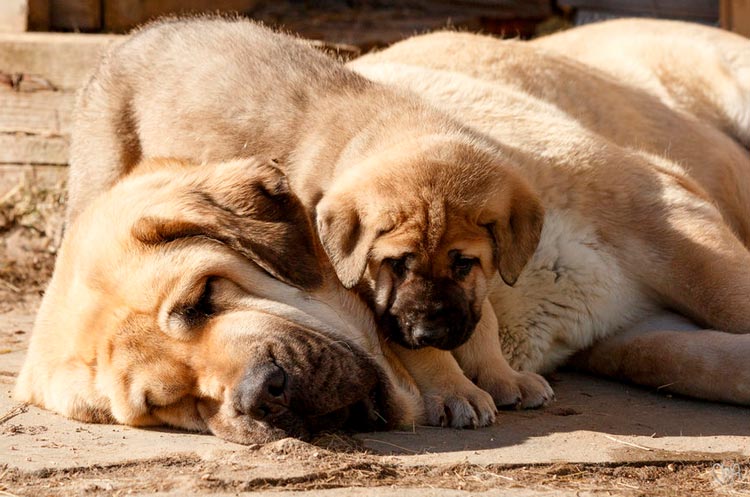
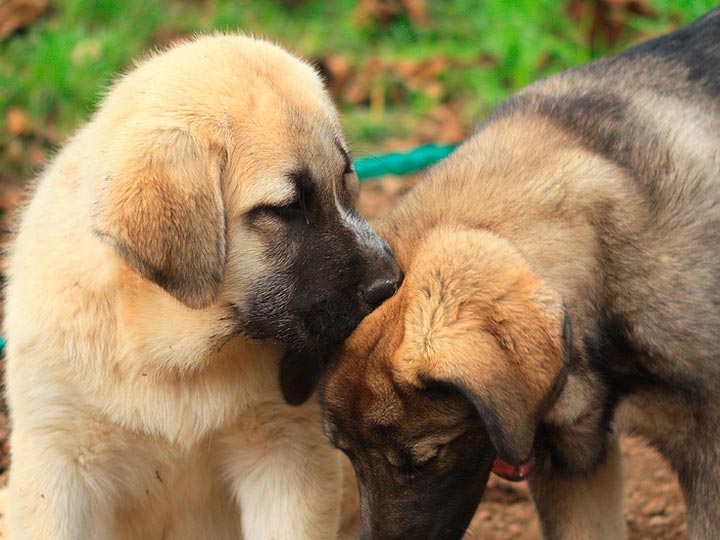
Puppies are usually placed in their new homes at 2.5-3 months, after vaccination and the necessary quarantine, so they can be taken for walks right away and safely kept outdoors. When choosing a puppy, it's important to pay attention to the living conditions—they shouldn't be confined to a small area, let alone in a kennel. It is free movement that reduces the risk of developing musculoskeletal problems. They also pay attention to the dog's skeleton, which should be strong and sturdy, the head type (the facial area should not be longer than the skull), and the presence of dewclaws (single or paired on all four limbs). The puppy should not be overly fat; a layer of fat may be present under the abundant dewlap, but it should be minimal. The bite is scissor-like, although a pincer bite is acceptable. The ears of puppies appear much longer than those of adult dogs; they are thin and fairly wide. It should be noted that the color will become slightly lighter with age, but in all other respects the puppies should meet the standards as closely as possible. And, of course, they should be active, energetic and self-confident, curious, with a good appetite, without any hints of ill health or illness.
Price
The average price for a Spanish Mastiff puppy from a kennel is 70,000 rubles. The price is influenced by the puppy's quality and potential, the kennel's status, and its location. Prices for Spanish Mastiff puppies in Russia and abroad are roughly the same.
Photos
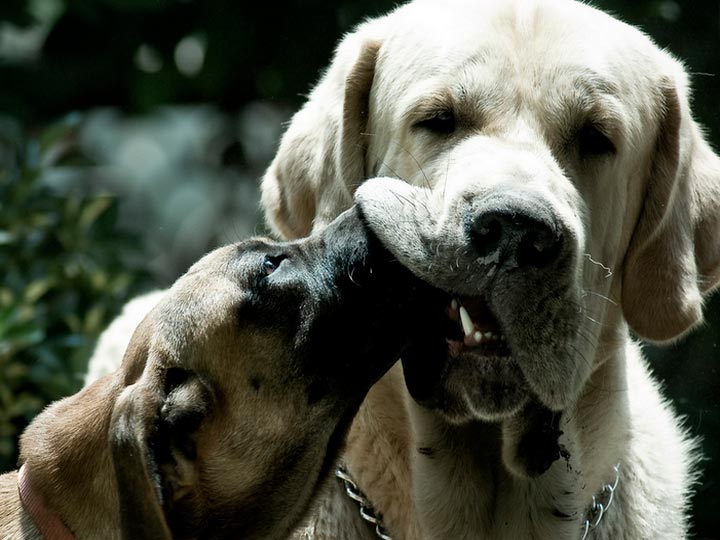
The gallery contains a collection of photos of Spanish Mastiff puppies and adult dogs.
Read also:


Add a comment