
Chlamydia in cats
Chlamydia in cats is a highly contagious disease characterized by lethargy, apathy, stiffness, inflammation of the eyelids (conjunctiva) and nasal cavity, as well as fever and shortness of breath. Today, we'll discuss the pathogen, symptoms, and treatment of chlamydia in cats.
Content
The causative agent of chlamydia in cats
It's also worth remembering that this is a zoonotic disease, transmitted from animals to humans. Chlamydia is a cross between a virus and a bacterium, so treating it isn't easy. Chlamydia in cats is caused by C. psittaci (biotype 7). The cell wall and intermediate layer are composed of a peptide-like layer, characteristic of gram-negative bacteria. However, a closer look at the pathogen reveals that the genetic apparatus (namely, the elementary bodies) consists of a single DNA molecule, while the ribosomes contain RNA.
Chlamydia is also commonly referred to as obligate parasites (intracellular). This is because chlamydia lacks its own energy metabolism and therefore requires host cells to "parasitize." The pathogen reproduces by simple binary fission. All mammals and 132 bird species are susceptible to chlamydia. Cats are infected through airborne droplets and sexual contact. Young animals (between 5 weeks and 7 months of age) are most susceptible. This disease is also dangerous for humans who come into close contact with an infected cat.
And it's not at all necessary for an animal to show obvious symptoms of chlamydia. Even a latent (hidden, unnoticed) infection can cause a lot of trouble. And then, a person infected by a cat can infect other people. That's why it's crucial to take preventative measures early and seek veterinary attention immediately.
A cat can become infected from other meowing cats (usually strays) or rodents (rats, mice). The pathogen enters the environment through secretions from the eyes and nose. The carrier state persists for a long time. When chlamydia enters a cat's body (through the eyes, respiratory tract, or genital tract), it immediately penetrates the mucous membrane (more precisely, the epithelial cells), multiplying within them. The microorganisms are then carried throughout the body via the bloodstream, infecting all internal organs, joints, lymph nodes, the spinal cord, and the brain.
Symptoms
Visible symptoms of chlamydia in cats in the photo:
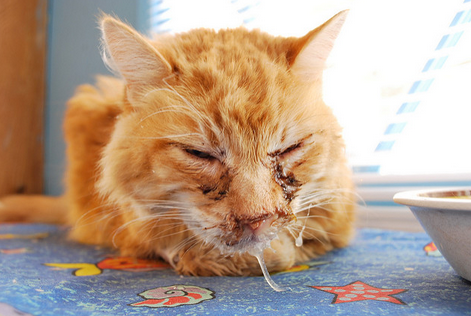
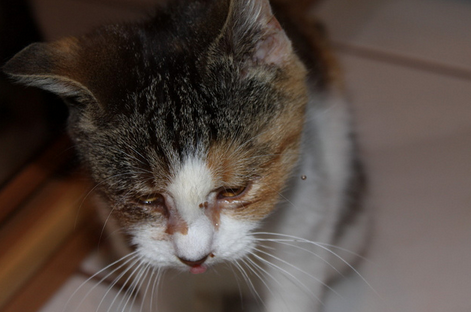
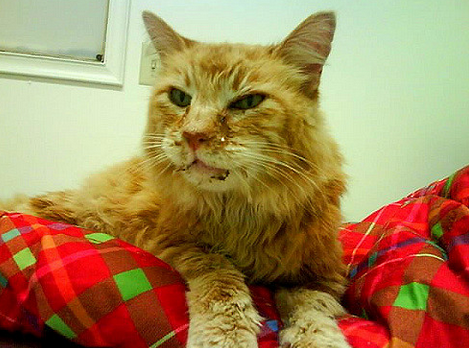
Symptoms of chlamydia in cats don't appear on the first day after infection, but rather after 5-10 days (the incubation period). However, there are acute and chronic forms of the disease. In chronic cases, the signs of chlamydia in cats are less noticeable. The animal experiences periods of exacerbation (relapses) and attenuation (remissions).
Latent chlamydia in cats
If a cat has a strong immune system, chlamydia tends to be latent (hidden). Initially, a slight fever is observed, lasting only a couple of days. Overall, the pet's condition is satisfactory. Appetite is maintained, and activity is not affected. Therefore, it is extremely rare to suspect something is wrong. Even if the cat is slightly ill. are teary-eyed eyes, then the owner perceives it as a cold.
The first days 10-17 conjunctivitis It starts in one eye, then the other one starts to appear. The mucous membrane of the eyelids becomes red and swollen. This condition can last from a couple of days to several months. If purulent crusts appear, it's due to the presence of secondary pathogenic microflora (bacteria, most often cocci). PneumoniaThe latent form of pneumonia is very difficult to diagnose. This is because small peripheral areas of the lungs and bronchioles become inflamed, while breathing is virtually unimpaired (since the affected areas are small, aeration is only affected in these areas). Furthermore, a diagnosis of pneumonia can often only be confirmed by histological examination.
The reproductive system is also affected. Female cats develop cervicitis (inflammation of the cervix), urethritis, and frequent miscarriages. Males experience orchitis (inflammation of the testicles) and balanoposthitis (inflammation of the glans penis and the inner layer of the foreskin).
Acute and chronic forms of chlamydia in cats
In chronic cases, these symptoms are so subtle that it's practically impossible to detect. This is extremely dangerous, as it's so easy to become infected. Who doesn't love holding a cat, petting it, and playing with it? And what affectionate pet doesn't nuzzle their wet nose into your sleepy face in the morning? Yet such contact can lead to human infection.
In acute cases, the signs of chlamydia in cats become more noticeable. However, not all owners pay attention to them. Over time, the disease subsides and becomes chronic. And getting rid of it isn't easy.
Treatment
Treatment of chlamydia in cats begins with an accurate diagnosis. It is impossible to confirm the diagnosis based on symptoms alone. Laboratory diagnostics are essential, as there are many infectious diseases with similar clinical signs (herpesvirus, calicivirus, mycoplasmosis, reovirus).
The state of the immune system plays a huge role when prescribing drugs for therapy.
Not all antibiotics are effective against chlamydia. Therefore, don't self-medicate; consult a qualified veterinarian. They will prescribe tetracycline antibiotics (oxytetracycline, doxycycline, tetracycline hydrochloride, and others).
When prescribed, dairy must be excluded from the diet! This is because the combination of magnesium and calcium ions with tetracycline antibiotics (especially doxycycline) leads to the formation of insoluble compounds. Sulfonamides, penicillins, and β-mycins (neomycin, streptomycin, and biomycin) are prohibited because they are ineffective against chlamydia!
How is chlamydia treated in cats?
| Eye ointments | To treat the eye infection, apply two ointments to the lower eyelid (not simultaneously, but one at a time): erythromycin 2% ophthalmic ointment or tetracycline ophthalmic ointment (if available, 3% ophthalmic ointment is preferable). Apply the ointment every 4-6 hours. The ointment must be combined with intramuscular administration of antibiotics from the above-mentioned series (the course of treatment is approximately 14-20 days, depending on the severity of the infection). |
| Immunostimulants | Immunostimulants are important because they will speed up recovery. |
| Vaccination |
After treatment, vaccinations should be administered with caution. This depends on the medication used. If the antibiotics are extended-release (long-acting), vaccinations should be administered no earlier than 30 days after treatment. If the tetracyclines are not extended-release, vaccinations can be administered three days after treatment has ended. |
Prevention
Preventing chlamydia in cats is crucial. After a cat recovers, its established immunity will no longer be able to protect the animal if it is infected again. Therefore, even after recovery, a cat should be vaccinated against chlamydia. There is a domestic vaccine, Multifel-4, and an imported vaccine, NOBI-VAC TRICAT. They are administered subcutaneously at a dose of 1 ml twice. After vaccination, immunity lasts for a year. Furthermore, immunized mothers pass on antibodies to their kittens, preventing them from becoming ill until the recommended vaccination age.
Avoid contact with strangers, sick animals, stray animals and birds.
Any questions? You can ask our website's staff veterinarian in the comments below, who will answer them as quickly as possible.
Read also:


13 comments
Irina
Hello. I have one kitten (not yet vaccinated), I want to get another one, but she (the new one) has a history of chlamydia, which was treated. Is this cat safe?
Daria is a veterinarian
Hello! Even after treatment, an animal remains a carrier of the pathogen for a long time. Therefore, yes, a female cat will be dangerous for an unvaccinated kitten. First, give the kitten all the necessary vaccinations (twice! Primary and secondary), wait at least two weeks after the second vaccination, and only then introduce it to other animals. Bringing a sick or recovered pet home is extremely dangerous, because in addition to chlamydia, another cat could be carrying another, more dangerous pathogen.
Inna
Good afternoon! What infection or what could have affected the kittens that, at 4-5 weeks, they weakened one by one, began crawling away from their mother, and eventually all "went away"? Their eyes were normal, not sticky. There was also no diarrhea or wheezing. The mother is healthy. There were a few lice, but nothing critical, as it was the season, and she and the kittens weren't treated with anything during pregnancy or nursing.
Daria is a veterinarian
Hello! We can only say what exactly led to the mass death of kittens based on the results of an autopsy and lab tests. If the deaths were numerous and occurred at approximately the same age, it's either an infectious agent or a common toxin (for example, from the cat's milk). It's unlikely that these are congenital internal organ defects (they lived too long for that). The female cat was probably not vaccinated, and neither was the male cat. I suspect that the female cat wasn't dewormed before mating. You didn't describe any symptoms in the kittens, so it's impossible to even "guess" here.
Ramis
Is there any point in treating a carrier of chlomedia?
Daria is a veterinarian
Hello! If the animal remains a carrier after recovering from an illness, and there are currently no clinical signs of the disease, is there any point in treating it? The animal is no longer sick, and completely eliminating intracellular "inhabitants" (such as chlamydia and mycoplasma) is extremely difficult. When the immune system is weakened, they begin to actively multiply again (during the carrier period). Therefore, monitor the animal. If symptoms appear, treat them. If you have other pets in the house, be prepared to treat the others and give the carrier medications that suppress the chlamydia.
Anushavan
My cat has a slightly sticky eye and a slight loss of appetite. He's 13 months old. About seven months ago, he contracted the same disease, and we completed the course of treatment (about a week). Could you tell me what to do?
Dasha is a veterinarian
Hello! There's too little information, and it's a bit confusing. Seven months ago, the cat was sick, treated for a week, recovered, and NOW it's happened again. Or was it seven months of treatment, and the therapy ended a week ago? What exactly was the treatment (medications, dosage, duration, and frequency of administration)? And what was the diagnosis the veterinarian made last time? You certainly didn't prescribe the treatment yourself. Please answer the questions, and we'll figure out how to help your pet.
Anushavan
He got sick for the first time seven months ago. We treated him for about a week. They said it was conjunctivitis and strep throat. Honestly, I don't remember the name of the medication.
And then they prescribed us Ciprovet drops.
In the last couple of days, the symptoms have returned. Fluid is leaking from the eye, and I've lost my appetite (probably because my throat is sore).
I hope for your help. Thank you for your reply!
Natalia
Nobivac Trikat DOES NOT CONTAIN chlamydia, by the way. Multifel 4 (made in Russia) does, and Purevax (made in France) does too.
marina
My cat has runny eyes, is lethargic, and wheezing when he sleeps. Is this chlamydia? Did he get the Multifel 4 vaccine in September? What antibiotic can I give him?
Dasha is a veterinarian
Why chlamydia right away? There are plenty of infections with the same symptoms you described. Further testing is necessary to establish an accurate diagnosis. Without a definitive diagnosis, prescribing treatment is ineffective (the symptoms will go away, but the disease itself will persist, and as soon as you stop taking the medication, all the clinical signs will return). For chlamydia, tetracycline medications are needed, but what if the conjunctivitis is caused by viruses? A completely different treatment plan is required.
Lada
"The danger of cats to humans"—that's all, that's enough to appreciate the level of nonsense. The danger of humans to cats (and the world in general) is hard to overstate. Guys, it's the 21st century, and you're still telling scary stories. You don't have Ebola, honestly.
Add a comment