
Griffon (Brussels, Belgian, Brabant)
Griffons are intelligent and courageous dogs that once performed the dangerous work of rat catchers. Today, they are a purely decorative breed, prized for their lively temperament, intelligence, and distinctive appearance.
Content
Peculiarities of the breed
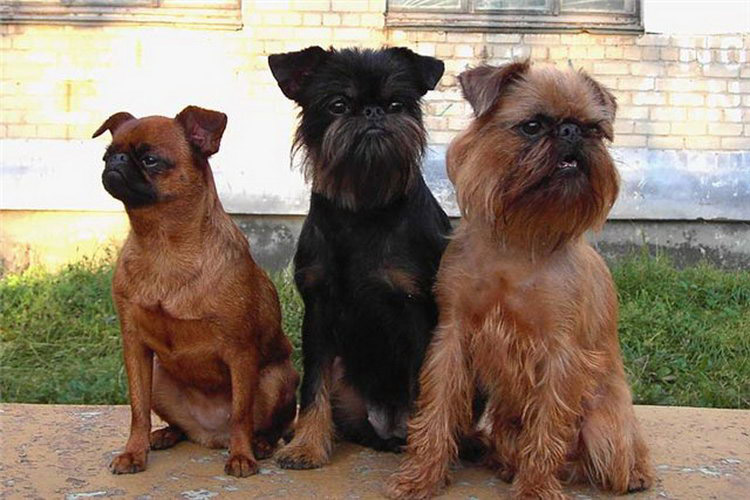
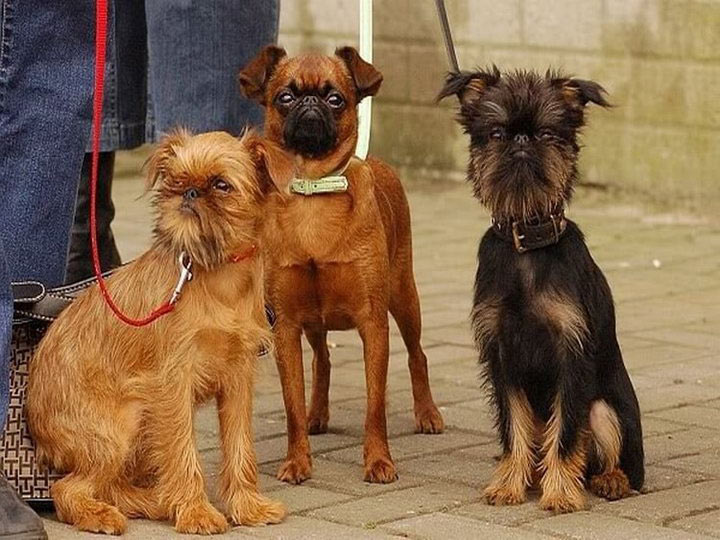
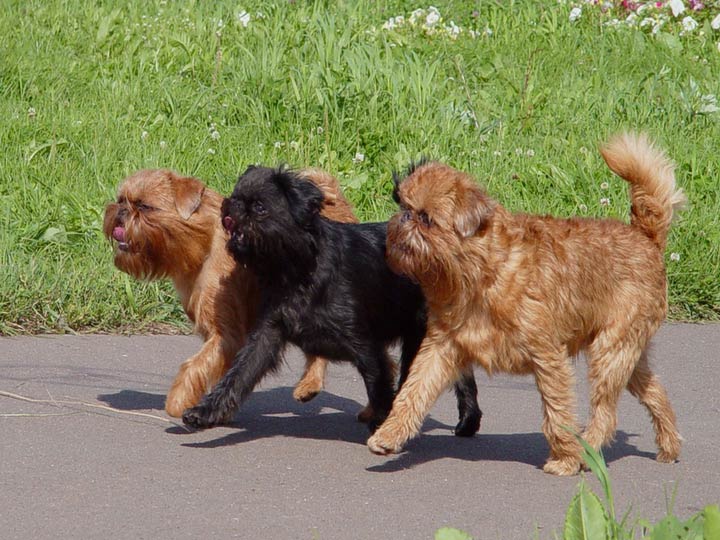
Cynologists distinguish three varieties of Griffon: the Belgian Griffon, the Brussels Griffon, and the Petit Brabançon (Brabant Griffon or Petit Griffon). The FCI has separate standards for each of these varieties; in some countries, they are recognized as separate breeds, while in others, they are merged into one. Griffons differ from each other only in color, texture, and the length of their coats. They are often bred together, so puppies of all three types can be found in a single litter.
History of origin
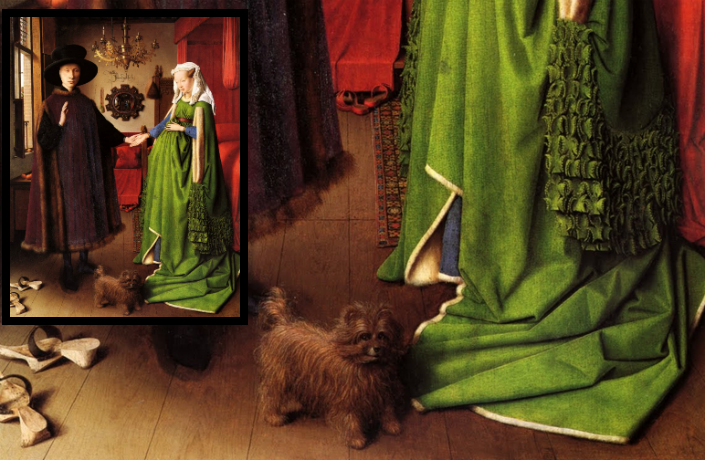
Cynologists agree that griffons originated from miniature wire-haired terriers from Flanders (a region of Belgium). Their first depictions appear in 15th-century paintings, such as the 1430 painting "The Arnolfini Couple" by Jan van Eyck. Along with the couple, the painting also depicts their small terrier, considered the progenitor of the breed. Another equally reliable source is a portrait of Henry III holding a small dog by Jacobo d'Empoli, painted in the late 16th century.
Throughout their existence, these miniature dogs lived not only in the chambers of noble persons, but were also kept by ordinary peasants to guard stables, docks in port cities, and to fight rats.
Griffons were first presented as a distinct breed at a show in Brussels in 1880, under the name "small terrier with a rough coat." After the show, active breed improvement efforts began, crossing them with pugs, Yorkshire terriers, Affenpinschers, King Charles spaniels, and ruby spaniels. As a result, the breed was divided into three types.
In the early 20th century, Griffons caught the eye of the royal family and became a popular breed among the upper classes. However, the military upheavals of the last century took a tragic toll on their fate. In their homeland, these dogs became even rarer than in Italy, France, or Switzerland.
Video review of the Belgian, Brussels, and Brabant Griffon dog breeds:
Appearance and standards
The Griffon, in any variety, is a well-balanced dog with a nearly square build and well-developed bone structure. At the same time, its build and gait exude a certain elegance, and its muzzle has an almost human-like expression. Height at the withers is 26-32 cm, weight 3.5-6 kg.
Head and muzzle
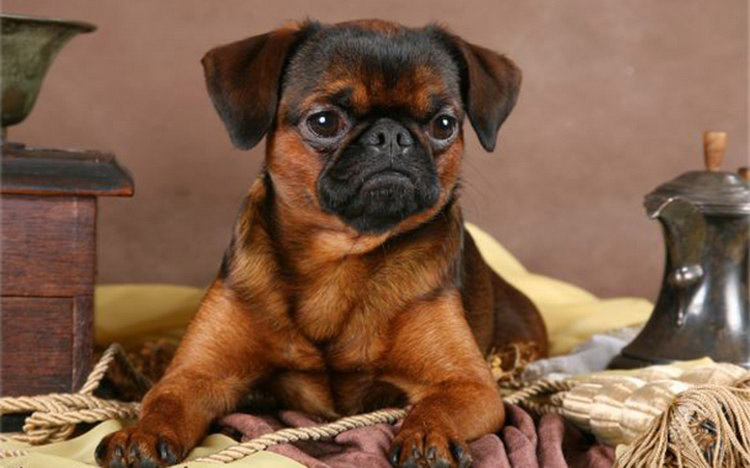
The Griffon's head is quite large in proportion to its body, with a broad, rounded skull. The forehead is convex, with a well-defined stop. The black nose, with wide-open nostrils, is aligned with the eyes, with the tip of the nose slightly angled back. The muzzle is very short, no more than 1.5 cm long. The lower jaw is wide, with an undershot bite. When the mouth is tightly closed, the teeth or tongue should not protrude. The eyes are wide-set, round, large, but not protruding. The iris should be as dark as possible, preferably with the whites of the eyes not visible. The ears are small, set high, and moderately wide apart, hanging on cartilage.
Frame
The neck is of medium length. The back is short, strong, and straight. The croup is slightly sloping. The tail is set high and carried up. The limbs are parallel, strong, and well boned. The paws are small and round. The toes are tightly closed. The pads and nails are dark. The standard allows for docking of the ears and tail by two-thirds.
Coat and colors
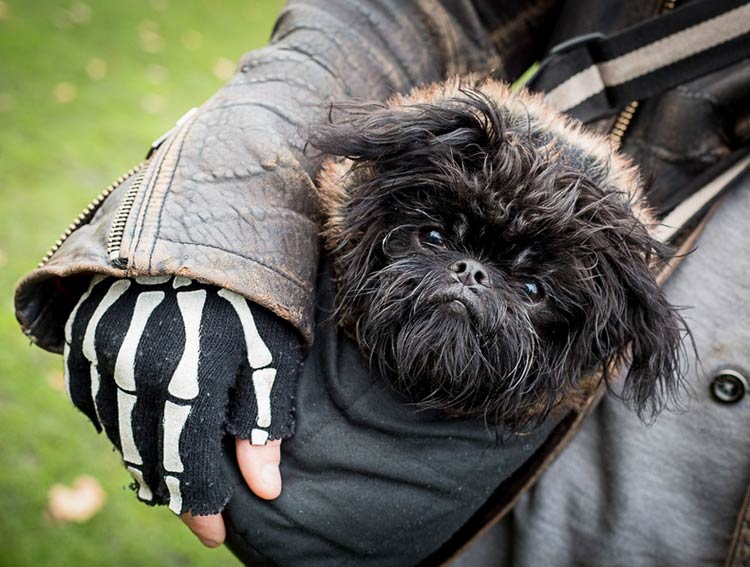
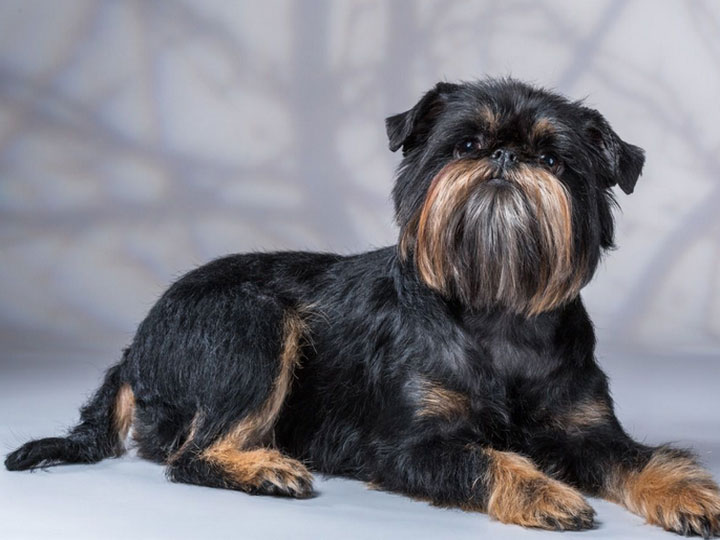
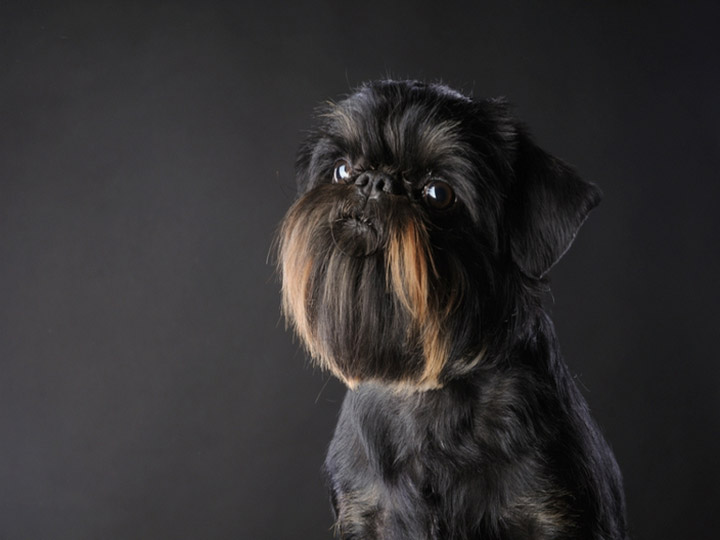
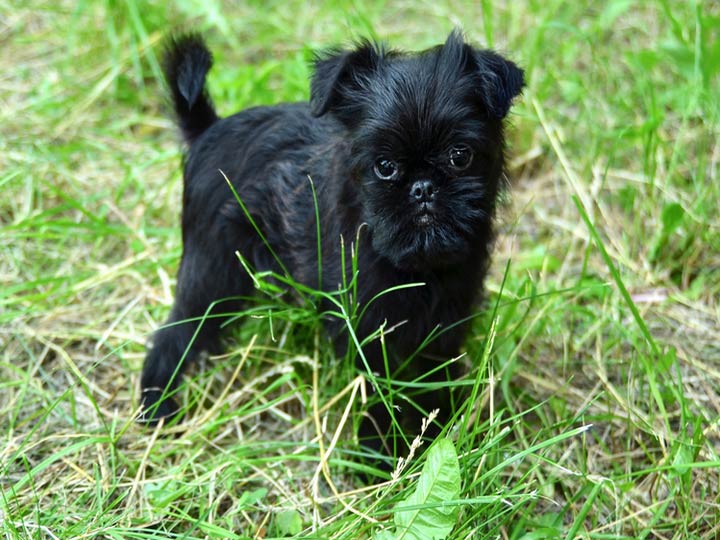
The Belgian and Brussels Giffon's coat is harsh with an undercoat, and can be slightly wavy but not curly. The longer hair on the face forms a thick beard, mustache, and eyebrows.
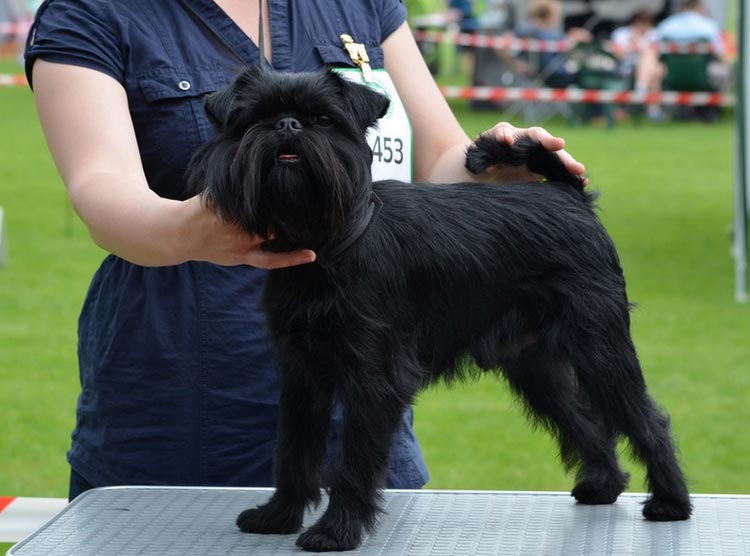
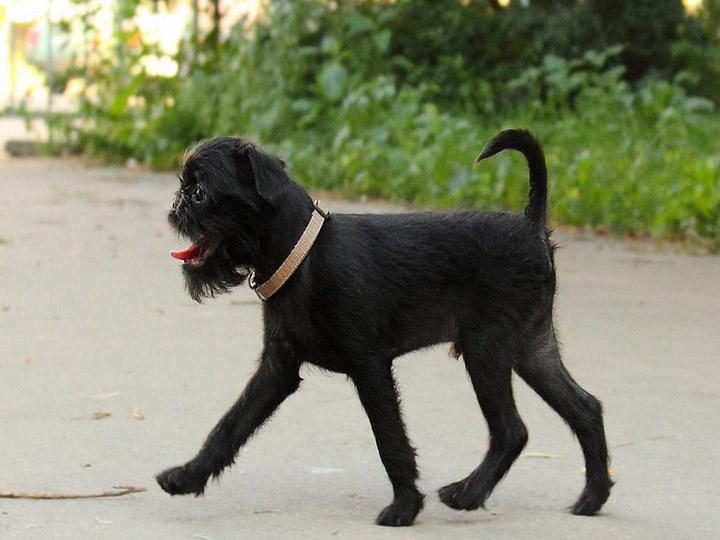
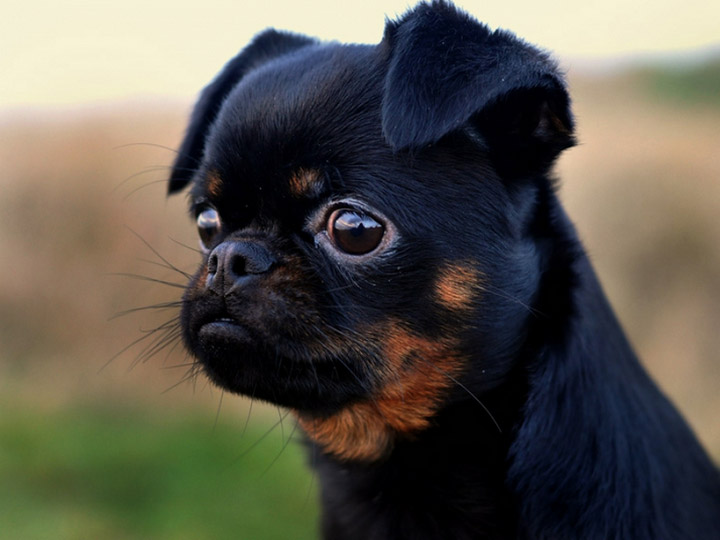
Belgian Griffon The color can only be black or black with tan markings. The tan markings must be a consistent, pure color and located on the forelegs up to the wrist, on the hind legs up to the hock, as well as on the chest, the inside of the legs, the chin and cheekbones, under the eyes, around the anus, and on the inside of the ears. Black may be mixed with brown, as permitted by the standard, but preference is given to dogs with a rich, consistent color.
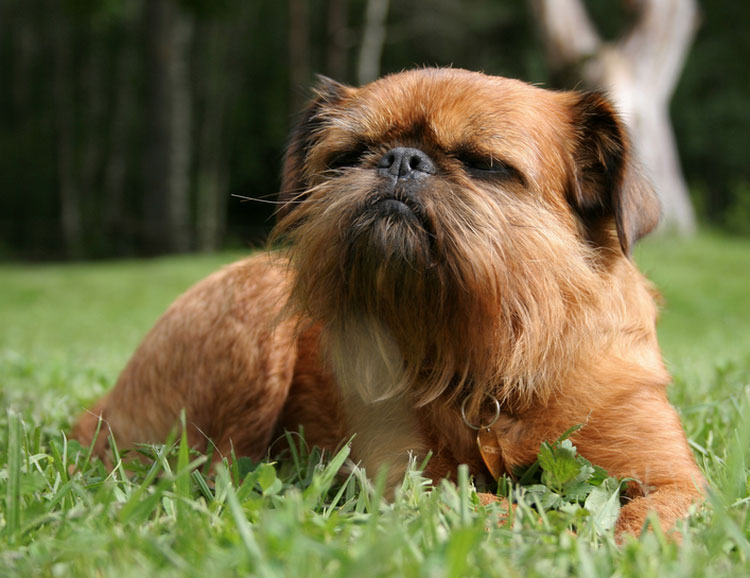
Brussels Griffon It only comes in red. A small amount of black hair may be present on the face: in the eyebrows, beard, and mustache.
Brabant Griffon The Petit Brabancon (or Petit Brabancon) differs from the previous varieties in coat length, typically 2 cm. The hair is stiff, straight, and shiny, lying close to the body. Colors are similar to those of the Brussels Griffon or Griffon Brabant: red, black, and black and tan, but there is a fourth color variant unique to it: mixed, a mixture of red, black, and brown. These dogs have a very elegant appearance, and their coat shimmers in the sun.
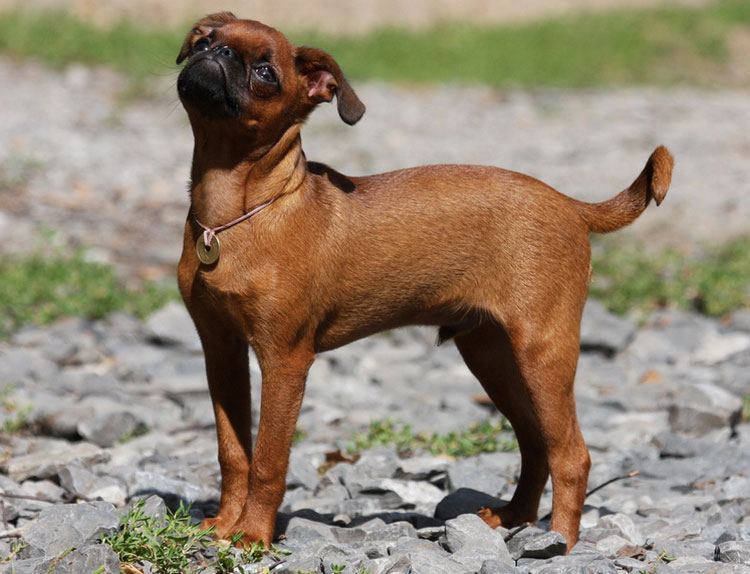
In all three varieties a small amount of white hair on the chest is allowed.
There's a Griffon for every taste. If you want a bearded and shaggy one, red or black, there's the Brussels Griffon or the Belgian Griffon. But if you prefer a smooth coat, without a mustache or beard, there's also the Brabancon. There's only one breed, but several options.
Character and psychological portrait
Griffons are very intelligent, quick-witted, and attentive dogs. They are people-oriented and become very attached to their owners, eager to follow them everywhere and please them in every way. They are also excellent at picking up on people's moods and adapting to the family's pace of life. These dogs are hardy and active, rarely causing trouble when traveling.
Griffons are very playful and friendly, but are wary of strangers. They possess strong guarding qualities and, while they won't harm an intruder, will certainly warn of intruders with a loud bark. Under normal circumstances, they are quite silent.
The pet will happily participate in all family activities. With proper training, puppies grow up to be obedient, tactful, and tidy dogs, but if you show weakness, the Griffon, with its innocent expression, will try to climb on your neck. Griffons are happy in a family with children, as they can be constant and tireless participants in games.
Living in a group with other animals usually presents no difficulties. Griffons are very friendly and peaceful; they will not engage in conflict or argue, and will try to get along with their neighbors. In rare cases, they can be jealous and stubborn.
Owners of small dogs, without exception, leave only positive reviews of their pets. They write that they are easy-going, very intelligent, and well-balanced, which is important for small breeds. They are always ready to travel, are happy to lounge on the couch, and are very happy to play. Griffons are called "monkey dogs" because of the special structure of their muzzle and the ability to use their front paws to grasp toys and light objects.
Education and training
There's no specific training for toy breeds, but the dog should know basic commands and perform them at the owner's behest. It's essential to train a Griffon and teach it obedience from an early age, otherwise its independence will take over. Griffons are very easy to learn, quickly memorize them, and perform them with joy.
Griffons are small, energetic, and very playful dogs. They need to be walked twice a day, but without excessive exercise. In addition to outdoor walks, some playtime is needed at home. Griffons can participate in agility.
Content
Small toy dogs will thrive in apartments of any size. Of course, the dog should have its own space with a bed and toys. They get along well with other animals, even cats, as long as they don't mind their company. Griffons can sometimes become jealous if they feel their owner isn't spending as much time with them as other pets. They get along well with children, but with older ones. It's difficult to explain to a small child that a Miniature Griffon requires extreme care.
A dog of this breed is recommended for anyone in need of a small, playful, and loyal companion. These dogs are easy to care for and are perfect even for beginners, and their cheerful nature makes them a perfect fit for a family with small children.
Diet
Griffons are typically fed dry, prepared food, which is selected based on the dog's age and physiological condition. If desired, they can be fed natural foods. Griffons are not picky eaters, enjoy eating very much, and are not prone to obesity, but they do not like to overeat. If you prefer prepared food, it's best to use high-quality holistic foods or at least super-premium ones.
Care
Grooming a Griffon is easy: the dog is brushed weekly, trimmed and clipped twice a year, and more frequently if participating in shows. Bathing is also recommended. Griffons rarely wear down their nails during walks, so they need to be trimmed. After each feeding, the dog is washed and its beard is combed.
Hygiene issues
Eyes don't need to be cleaned or treated unless absolutely necessary. Care involves closely monitoring their condition, promptly removing accumulated secretions from the corners, and ensuring that hair doesn't get on the cornea. Ears should be kept clean and dry. If necessary, remove wax buildup from the ear canal. Special lotions can be used for cleaning.
Dental care is primarily necessary to prevent common problems such as plaque and tartar. Some dogs never experience this condition, while others are more prone to it. Both types are recommended to have their teeth brushed at least once a week. Alternatively, you can give special treats, chewable tablets to cleanse the enamel, or use an oral spray.
For some dogs, anal glands can be a real problem. These are two small glands located on either side of the anus, where excess secretions often accumulate and cause inflammation. The first sign that it's time to pay attention to the area is restlessness, itching, and redness in the anal area.
Grooming
Wirehaired dogs shed lightly, so they need to be assisted to remove overgrown hair and removed manually. The process of plucking the outer coat and undercoat is called trimming or stripping. It is usually performed 3-4 times a year, but at least twice. Show dogs are plucked using a standard pattern between full trimmings. After trimming, a light clip is performed. Trimming the hair is the final step, giving the coat a neat and finished look. Trimming dogs' entire bodies with scissors or clippers is strongly discouraged, as this negatively impacts the quality of the coat and color.
Unlike its wirehaired counterparts, the Petit Brabancon does not require trimming, but it does shed. Grooming consists of regular brushing with a natural bristle brush.
Health and life expectancy
Griffons generally enjoy good health. Among the health conditions to which they are most susceptible are:
- Eye diseases (prolapse of the eyeball, cataract, progressive retinal atrophy, distichiasis);
- Cryptorchidism occurs in male dogs;
- Spinal cysts are very rarely registered;
- Narrowed nostrils;
- Complicated birth (in this case, a veterinarian is often needed to perform a Caesarean section);
- Like other miniature breeds, the Griffon is susceptible to hydrocephalus (water on the brain).
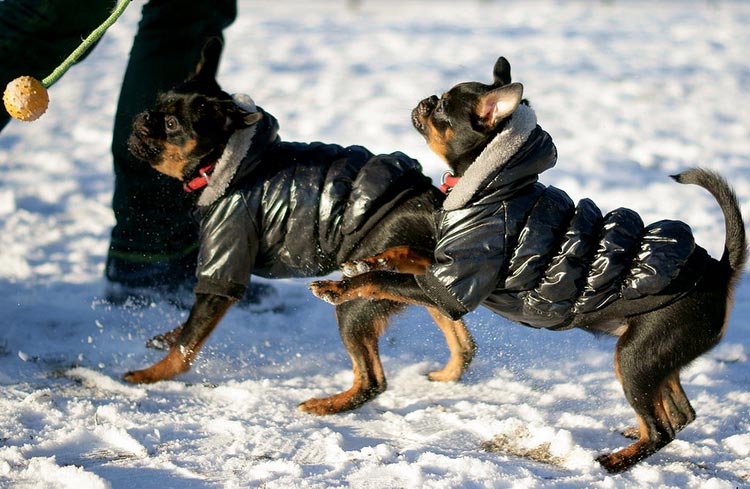
Owners should also remember that Griffons do not tolerate heat well. In cold weather, they will need appropriate clothing. The dogs are regularly vaccinated and treated against ectoparasites. The average lifespan is 12-13 years.
Choosing a Griffon Puppy and the Price
Choosing a puppy can begin with visiting a show, getting to know the breeders, and visiting representatives of the breed. Nothing speaks more about a puppy's potential than its parents. It's best to see them in person, not just in photographs, to assess their strengths and weaknesses, and observe their character and behavior.
Puppies are accepted for adoption at 2-2.5 months, and their first viewing can be done when they are 30-40 days old. Attention is paid to their living conditions and their appearance, which should largely meet the standard even at this age. Puppies should be active, inquisitive, and healthy, with no signs of fear or aggression.
The price of a Griffon puppy depends on the class and prospects, and ranges from $300 to $1,000.
Photos
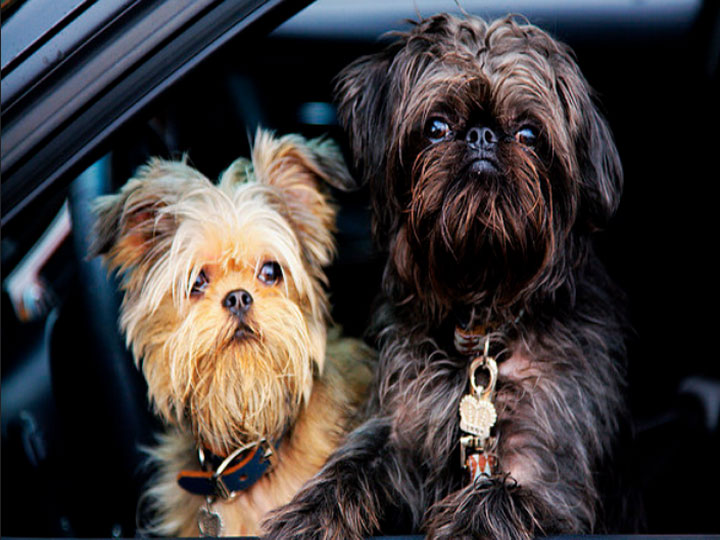
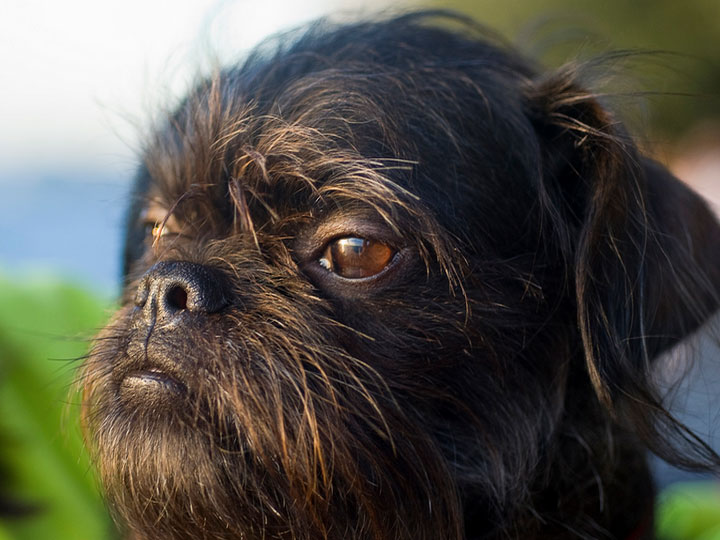
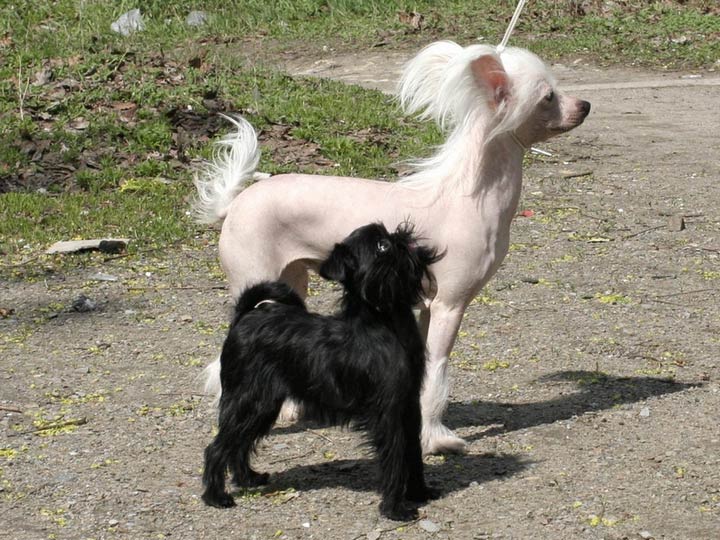
Photos of the Belgian, Brussels and Brabant Griffon:
Read also:
- Petit Brabançon (Small Brabançon, Brabant Griffon, Smooth-haired Griffon)
- Petit Basset Griffon Vendéen
- Griffon Korthals


Add a comment