
Greenland Dog (Greenland Sled Dog)
The Greenland Dog is an ancient breed of northern sled dog, perfectly adapted to work in harsh conditions. Greenland dogs are hardy, strong, and healthy, possessing a strong hunting instinct and a love of freedom. They are not suited to city or apartment life.
Content
History of origin
The origins of Greenland sled dogs are a matter of conjecture and speculation. Most cynologists believe they are descendants of the northern dogs that inhabited the Lake Ladoga region during the Stone Age. They arrived in Greenland with the Inuit from Canada. However, it's also possible that Spitz-type dogs arrived with the Vikings, who established settlements on the island's southern coast in the 8th century.
Unlike many other sled breeds, the Greenland Dog developed in a harsh, cold environment with very little food. This made it hardy, healthy, and capable of surviving long periods without food. Humans likely selected for obedience and a strong build. It's possible that they occasionally mated with local wolves.
Over the past 100 years, living conditions for Greenland dogs, like those of the people on the island, have improved significantly. Their use has also changed, becoming more sporting. Through targeted selection and the creation of a standard, their appearance has become somewhat more consistent. Today, Greenland sled dogs are recognized by virtually all canine organizations.
Purpose
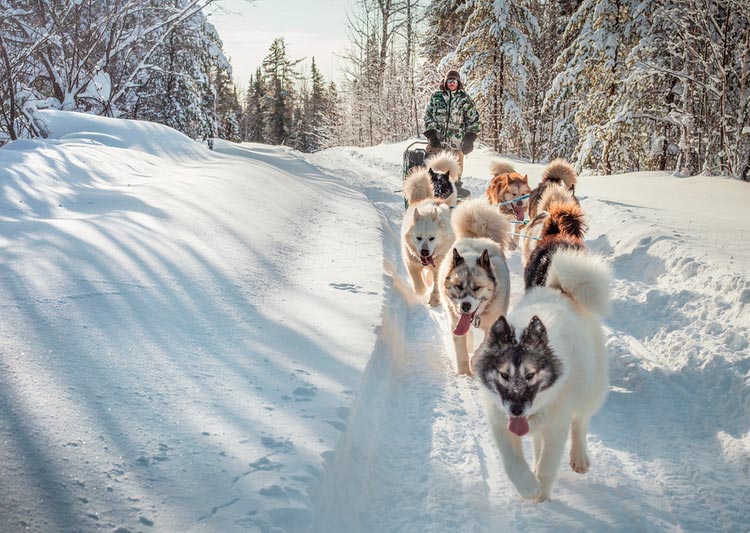
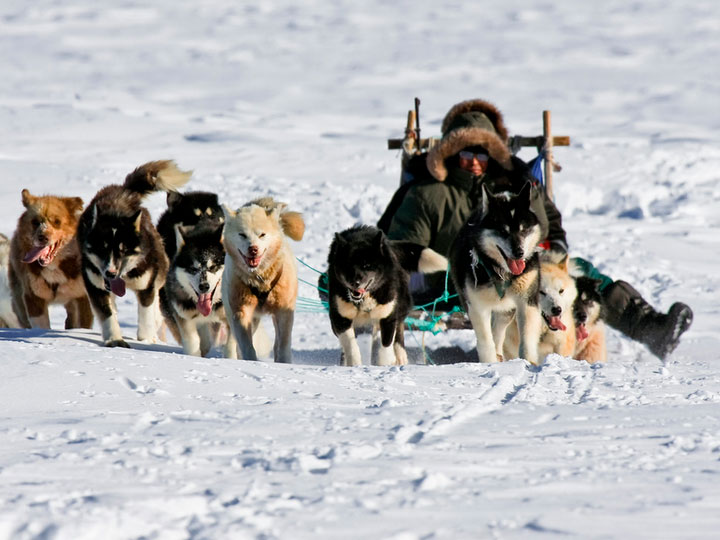
The Greenland Dog is a typical northern sled dog with a build, temperament, and coat suitable for this work. It is very hardy, has excellent orientation, a strong pack instinct, and a willingness to work in a team under the leadership of a leader. It is excellent for various sled dog disciplines on snowy trails, but less so on unpaved "summer" roads. This dog is not suitable for other popular sports such as agility or freestyle, which requires a high level of obedience and a willingness to obey the owner unconditionally.
The Greenland Dog is positioned as a companion for active people and sled dog enthusiasts, as well as a promising show dog.
The Greenland dog can be a valuable hunting companion. It can hunt both small and large game. In Greenland, they were previously used to hunt seals, bears, reindeer, and other animals. Furthermore, their strong pursuit instinct makes it difficult to keep Greenland dogs in other countries with other animals. On regular walks, they can pose a danger to smaller breed dogs.
Video about the Greenland Sled Dog breed (Greenland Dog):
Appearance
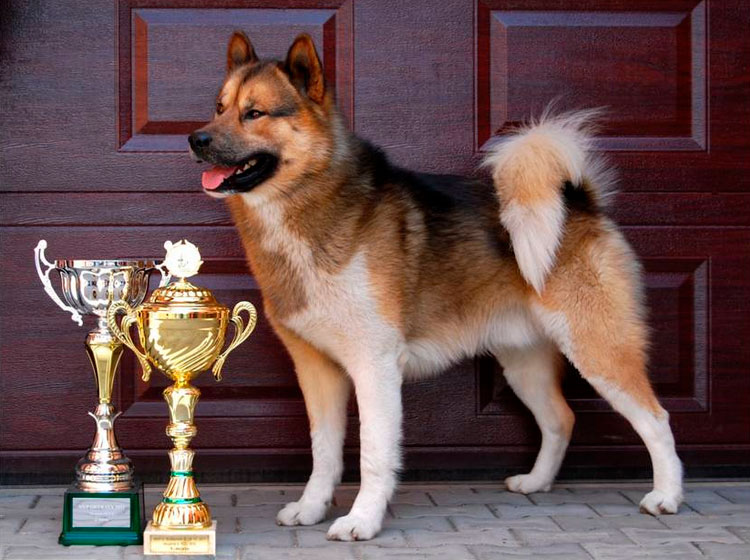
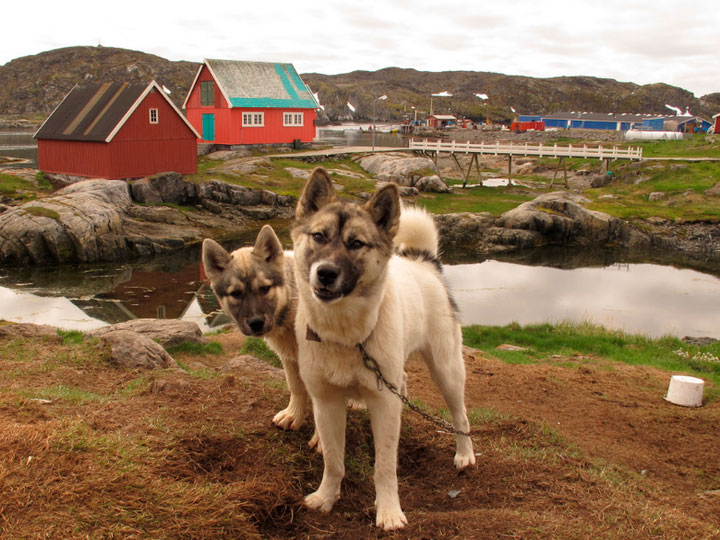
The Greenland Dog is a strong and sturdy Spitz-type dog, designed for sled work in harsh climates. Males stand approximately 60 cm at the withers, and females approximately 50 cm. The standard allows for some variation in size, as long as overall harmony and working ability are maintained.
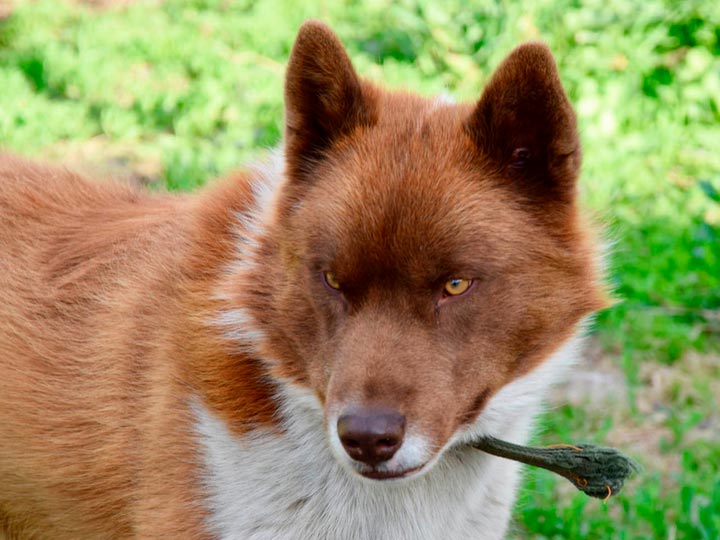
The skull is convex and broad. The stop is not too sharp. The muzzle is wedge-shaped, but not too narrow. The earlobe is large, dark or liver-colored in red-colored dogs. In winter, the pigmentation may be reduced (called a "winter" nose). The lips are tight and thin. The eyes are dark, set slightly obliquely, with an open, bold expression. The bite is scissor-like. The jaws and teeth are strong. The ears are triangular in shape, small, erect, and rounded at the tips.
The neck is relatively short and very well muscled. The body is strong, compact, slightly longer than tall. The back is straight. The loin is fairly wide. The croup is sloping. The chest is deep and wide. The tail is set high, curled over the back. The limbs are strong, muscular, and very powerful. The paws are rounded, fairly large, with strong pads.
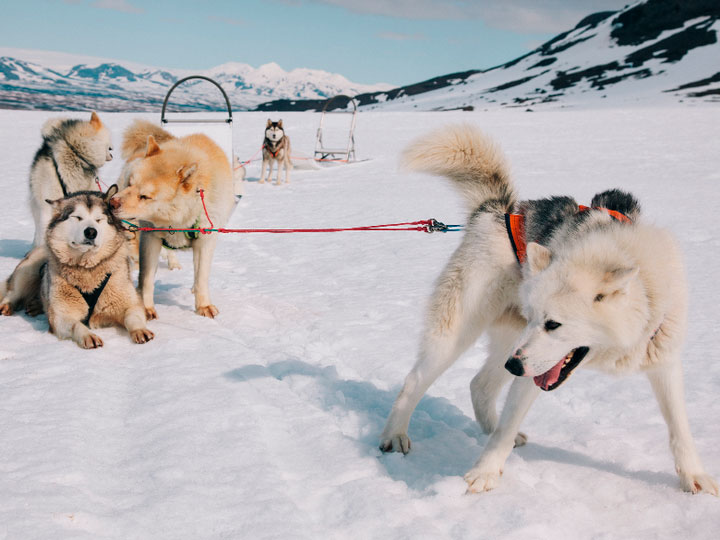
The coat is thick with a well-developed undercoat and long, stiff, straight guard hairs. The hair on the legs and head is noticeably shorter. Coloration is highly variable, with only albino being disqualified.
Character and behavior
The Greenland Dog is unlikely to ever become very popular. It is a specialized sled dog with a very complex character. Strong-willed and resilient, it has a well-developed sense of smell, is excellent at navigating its surroundings, and is not inclined to back down from a challenge. It is generally indifferent to people and shows affection only to its owner and family members, primarily during work together. It is completely unsuitable for guard or security work, as it is not inclined to protect people, much less property. It treats strangers with caution and a degree of indifference, although it can sometimes even be quite friendly. It is very rarely intolerant. Generally, these dogs are not aggressive toward people. The most they are capable of is defending their territory and the love of their fellow dog.
Greenland dogs thrive in packs where there is a hierarchy and chain of command, which isn't always respected. Fights between males are common, and females rarely get involved in conflicts. This is important for owners to consider. They must have sufficient willpower to establish leadership. Greenland dogs obey only their leader.
The Greenland Sled Dog is quite sociable, but will not demand attention. It tolerates solitude well if kept with other dogs. However, if treated this way, it can lose its connection and trust in humans. It usually tolerates changes in ownership relatively well, even in adulthood.
Despite their reserved appearance, the Greenland dog is very emotional and talkative. They express their emotions and desires through a wide variety of sounds: whining, growling, growling, howling, and everything in between. Owners note that Greenland dogs exhibit wolf-like behavior. It's quite possible that they did interbreed with their wild relatives at one time.
Education and training
The Greenland Dog is very difficult to train; it is independent, freedom-loving, and unaccustomed to being obeyed. Furthermore, it sees no point in following standard human commands, much less circus tricks. It obeys only its owner and, to a lesser extent, other family members, only when it deems it necessary. Training a dog with such a temperament will require considerable time and patience. Training and raising a Greenland Dog requires strict discipline; in some cases, it may even be necessary to trade carrots for sticks.
Good results can only be achieved through regular teamwork that utilizes the dog's natural skills and talents.
Content Features
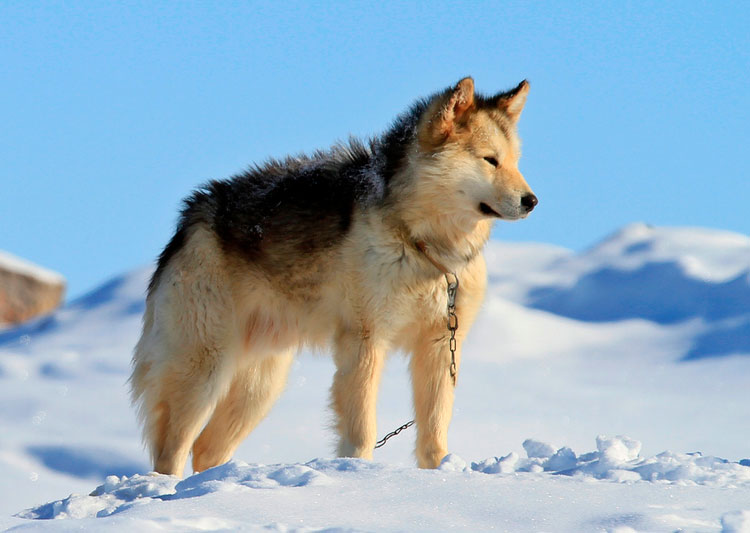
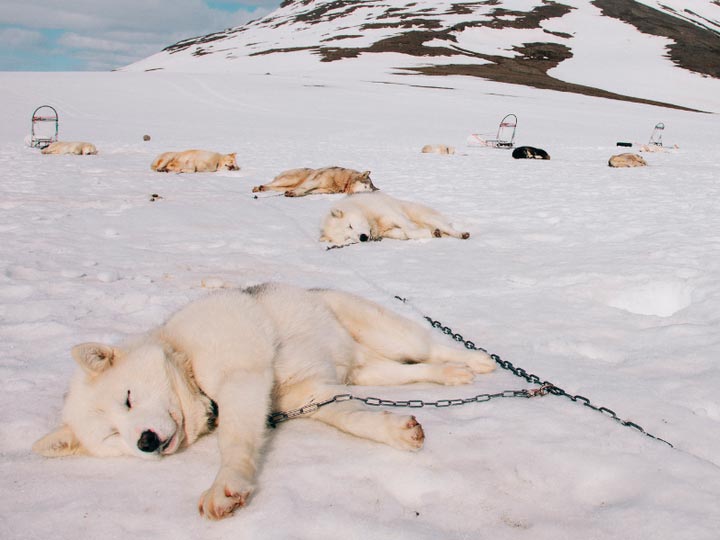
The Greenland Dog is not suitable for indoor living and is definitely not recommended for apartment or city living. It thrives in cold climates and constant work. In their native land, dogs are kept in spacious enclosures or leashed near a kennel. Free-range breeding can lead to escapes, uncontrolled mating, and regular fights between dogs. Thanks to their dense undercoat, they can easily sleep in the snow in extreme cold, but they do not tolerate heat well.
Greenland dogs need to spend a lot of time outdoors, so they are not suitable for apartment life.
Greenland dogs are considered best kept alone. If they are not kept with other sled dogs, they should at least live with other large and medium-sized breeds. Smaller breeds are generally not considered equals.
Care
Greenland dog grooming consists of regular brushing, inspection, ear cleaning, and nail trimming, as their nails often don't wear down quickly enough. They shed heavily, in patches, once a year—in the spring, after the frosts have passed. Autumn shedding is moderate.
Show dogs are rarely bathed, and it is not customary to bathe domestic sled dogs at all.
Nutrition
Nutrition should be balanced and complete, with adequate protein, fat, and carbohydrate levels. This will allow puppies to develop properly, and adult dogs to maintain tone and sufficient muscle mass for heavy work.
Surviving on minimal provisions is a thing of the past for them. Today, dogs are fed dry, prepared food or natural products, porridge prepared with meat or fish broth, and given meat, offal, fish, and dairy products. Vitamin and mineral supplements are regularly added to their diet.
Health and life expectancy
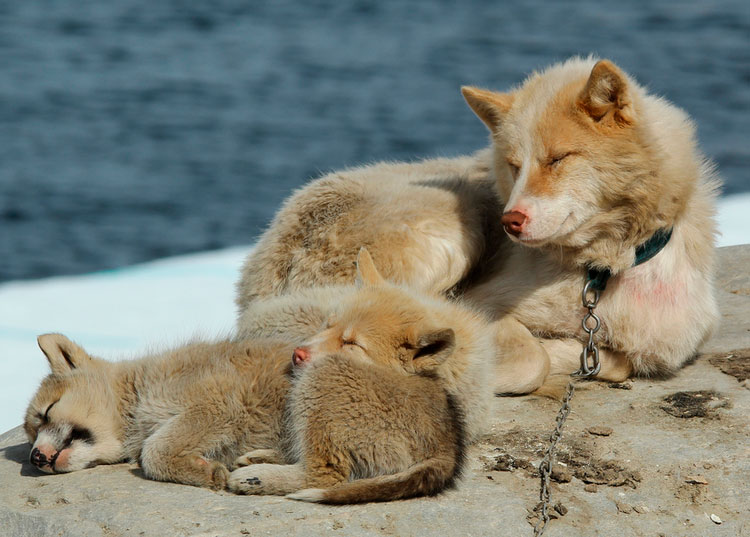
Natural selection has given Greenland dogs exceptional health and a strong immune system. Veterinarians recognize the breed as one of the healthiest. While some hereditary diseases are reported, their incidence is very low, averaging around 3%.
- Hip dysplasia;
- Gastric torsion;
- Eczema;
- Cryptorchidism;
- Hypothyroidism.
Good health does not eliminate the need to vaccinate dogs and carry out standard veterinary preventive measures. Life expectancy is usually 11-13 years.
Choosing a Greenland Dog Puppy
The majority of Greenland dogs, approximately 25,000 in number, are concentrated in their homeland. Outside of Greenland, isolated kennels are found primarily in northern countries: Norway, Denmark, Sweden, and Canada. This situation is due to the breed's unique characteristics and the difficulty of raising dogs in urban areas and warm climates. There are a few Greenland dogs in the CIS countries, but no professional kennels.
You should buy a puppy from a professional breeder, preferably from a kennel affiliated with a sled dog club, rather than from a seller with a dubious reputation listed in an ad. Moreover, the dog will still need to be shipped from abroad, which is too hassle-free and expensive to be left with "surprises" such as a lack of working ability, hereditary diseases, defects in appearance, and so on. The breed is recognized by virtually all canine organizations and is subject to working trials. This means that the parents of the litter, in addition to good pedigrees, must have working certificates. X-rays proving the absence of hip dysplasia are welcome. Puppies must have a tattoo, a puppy card, and a veterinary passport with vaccination records for their age.
Price
The price depends on many factors. On average, Greenland Sled Dog puppies from breeders cost $1,200. Adult dogs that have already proven themselves in races can cost as much as $5,000-$6,000.
Photos
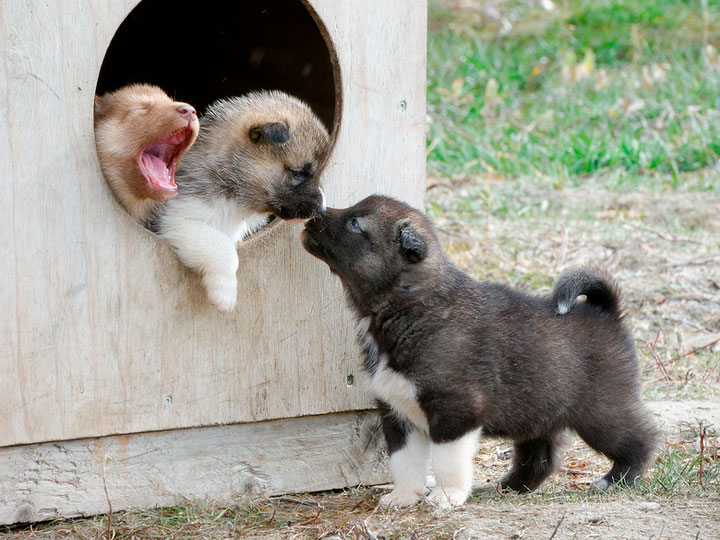
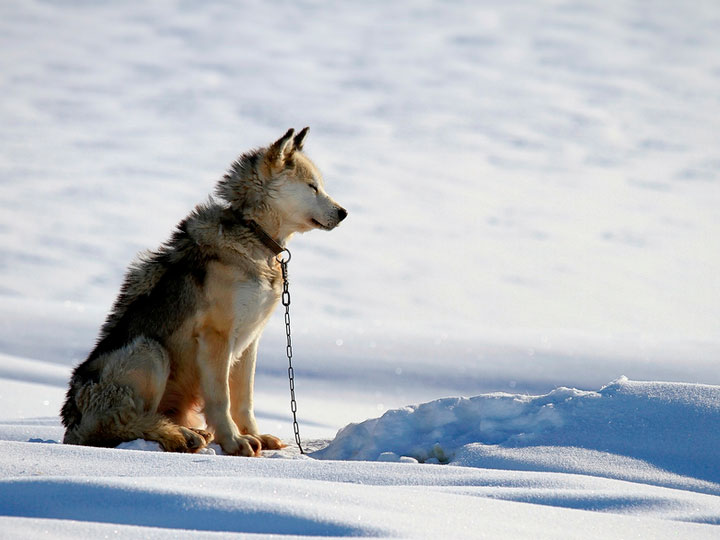
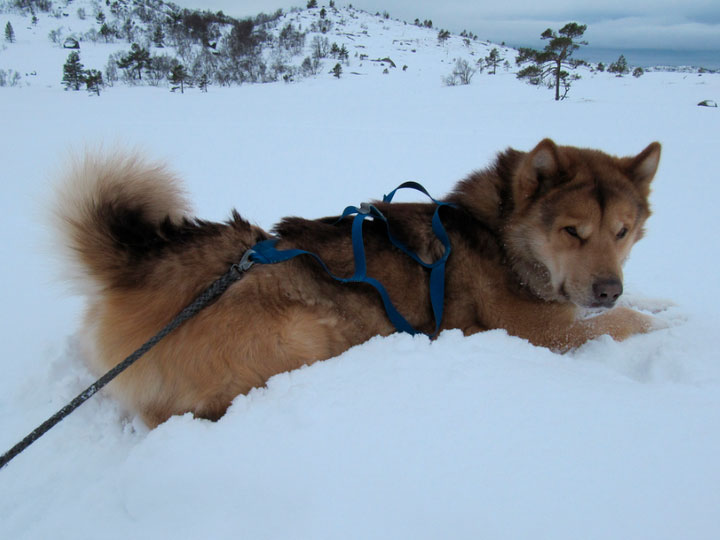
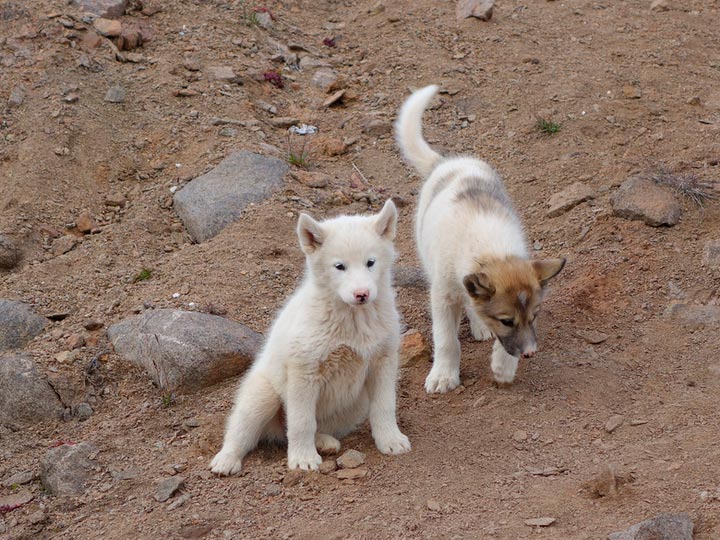
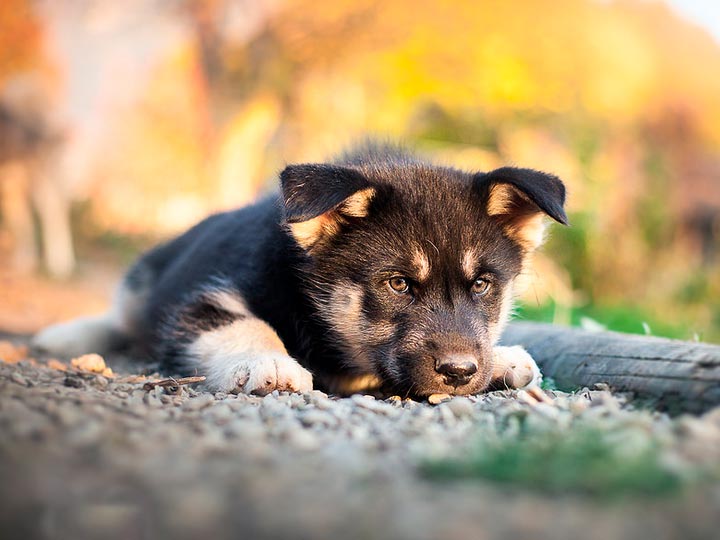
The photos in the gallery show what adult dogs and puppies of the Greenland Sled Dog breed look like.
Read also:


Add a comment