
Forticarb for dogs
Forticarb is a new-generation veterinary antiparasitic drug used for the treatment and prevention of piroplasmosis. Although Forticarb is safe for dogs, its use should only be done after consultation with a veterinarian.
Content
Composition and principle of action
The drug is based on imidocarb. It is active against babesia, a simple microorganism that causes piroplasmosis when it enters the body. The medication also contains excipients.
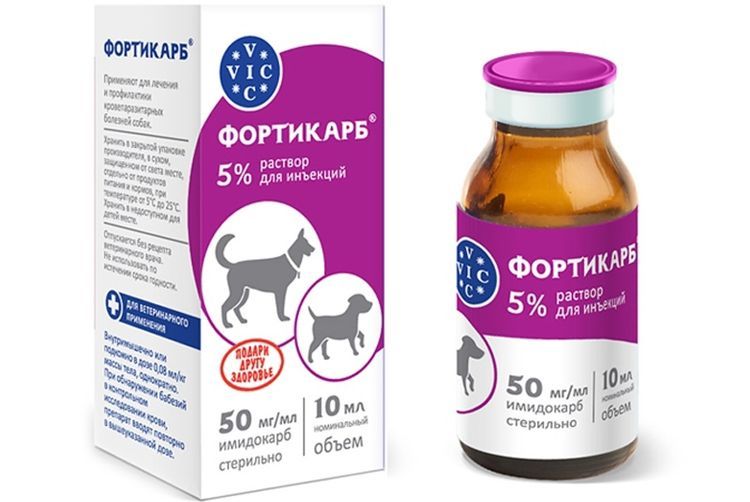
Forticarb is available as a sterile injection solution. The clear, light-yellow liquid is packaged in hermetically sealed glass vials. These vials are typically made of dark glass. The drug is available in two versions:
- with 5% imidocarb content;
- with an active substance content of 10%.
A 5% solution is used for dogs. Due to the lower concentration of the active ingredient, it is easier to accurately calculate the dose and avoid overdose. A more concentrated medication is usually used for livestock.
Once administered, imidocarb quickly spreads throughout the body's organs and systems, destroying harmful microorganisms. Its effect lasts for 14 to 30 days, making it suitable for both treatment and prevention.
It is excreted virtually unchanged through the liver and kidneys. Forticarb is classified as a low-hazard substance. When used according to recommended doses and treatment regimens, it does not exhibit embryotoxic, mutagenic, or other adverse effects. It is not addictive.
How much does it cost and where to buy it?
A 10 ml bottle of Forticarb for dogs costs an average of 570-620 rubles. The medication is available at any veterinary pharmacy. It can also be ordered online. The medication is available without a prescription, but it's best to use it only after consulting with a veterinarian.
Indications for use
Forticarb is used to treat and prevent the dangerous parasitic disease piroplasmosis, which can occur in acute or chronic forms. This potentially fatal disease is caused by Babesia, a protozoan pathogen. It is transmitted by ticks, which attach to dogs from spring to fall. Therefore, piroplasmosis is considered a seasonal disease, although tick bites also occur in winter.
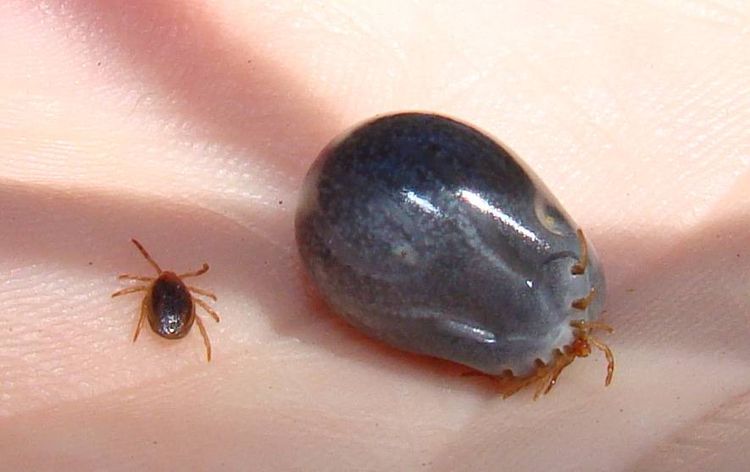
Forticarb effectively treats the disease if treatment is started promptly. Babesia bacteria can penetrate and destroy red blood cells, leading to internal bleeding and death. It's important to recognize the disease's early stages. Symptoms of piroplasmosis include:
- high temperature;
- lack of appetite;
- rapid fatigue;
- lethargy and apathy;
- darkening of urine;
- difficulty breathing;
- disorientation in space.
If you notice any of these symptoms, do not self-medicate. Consult a doctor immediately. Chronic infections may not have obvious symptoms. Forticarb should only be used after a diagnosis has been established. If your dog has been bitten by a tick, it's best to have a blood test.

For preventative purposes, the medication is used during peak insect activity, as well as when traveling to regions with a high risk of infection.
Instructions for use
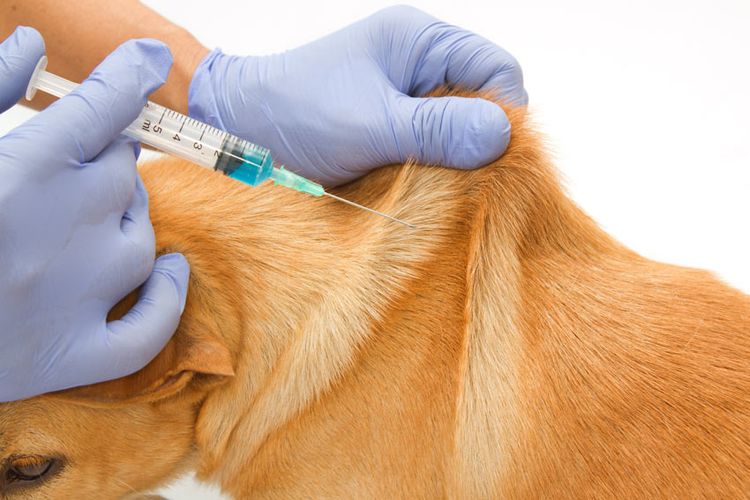
According to the instructions, Forticarb is administered to dogs intramuscularly or subcutaneously. The dosage is calculated based on the animal's exact weight. For every 10 kg of body weight, 0.8 ml of the drug is required. Injections should only be administered after testing and a diagnosis of piroplasmosis. Testing should be repeated after 24 hours. It is especially important to seek medical attention if the animal's temperature does not subside or other symptoms persist.
If Babesia is detected in the blood, the injection must be repeated at the same dose. There should be a two-day interval between injections.
When using the medication for prophylactic purposes, a dose of 0.5 ml per 10 kg of body weight is sufficient. Since the medication is toxic, its use to prevent piroplasmosis is recommended only when the disease is highly prevalent in the region and when a real threat arises, such as a tick bite. In this case, be sure to consult a doctor about the appropriateness of using the medication.
Treatment regimen
Forticarb is often used in combination with other medications. The following treatment regimen is typically used:
- Using Forticarb to kill parasites.
- Detoxification measures.
- Administration of drugs for the treatment of anemia, renal failure and other pathologies associated with piroplasmosis.
- The use of drugs containing antioxidants to enhance the body's defenses and normalize physiological processes.
- Prevention of secondary infections.

Do not attempt to treat your pet yourself if you notice symptoms of piroplasmosis. Remember that the disease is life-threatening, and only competent and comprehensive treatment can save your pet.
Contraindications and side effects
According to the instructions, Forticarb does not cause any side effects when used to treat dogs. However, in practice, the medication often causes allergic reactions, so treatment usually includes prednisolone or other antihistamines.
Allergic reactions can manifest themselves with various symptoms:
- redness of the skin, itching and rash;
- muscle cramps;
- anxiety;
- vomiting and nausea;
- increased salivation, etc.
Insensitivity to the components can manifest itself as anaphylactic shock or Quincke's edema, so a consultation with a veterinarian before the injection is mandatory.
The drug's administration leads to rapid destruction of microorganisms, resulting in severe intoxication. Its manifestations depend on the severity of the disease. In such cases, intensive therapy is administered, including intravenous fluids and symptomatic treatment.

It is strictly forbidden to combine the use of Forticarb with cholinesterase inhibitors, organophosphorus and organochlorine drugs.
Storage rules and special instructions
Special precautions must be taken when storing Forticarb. The storage location should be out of the reach of children and animals, as with List B (potent) medications. The temperature should be between 0 and 25°C.
The medicine should not be used under any circumstances:
- the packaging is not sealed;
- There is no information on the bottle about the production date, batch series and composition;
- the liquid has become cloudy or contains foreign impurities;
- the expiration date has expired;
- the correct storage conditions were not observed.
When handling this medication, follow the general rules for handling veterinary drugs. Aseptic technique is essential when administering injections. Wash your hands after handling the medication.
Advantages
Forticarb has several important advantages:
- High efficacy. The drug's effectiveness in both treatment and prophylaxis was confirmed by clinical trials conducted by VIC, the drug's developer and manufacturer.
- Long-lasting action. The active ingredient remains effective for up to 30 days, as it is gradually released into the animal's body in the doses required for protection.
- Low toxicity. Compared to diminazine-based medications, Forticarb does not have a strong toxic effect on the body. Due to its mild action, intoxication is usually less severe.
- Lower price compared to foreign analogues.
Owner reviews
Anna, the spaniel's owner:
"Because of her thick fur, we didn't even notice the ticks attached right away. We became alarmed when the dog developed a fever. Laura refused to eat and became lethargic. At the clinic, she was diagnosed with piroplasmosis and given an injection of Forticarb. We also gave her medications to boost her hemoglobin and immunity, as well as liver support. She recovered. We now carefully inspect her for ticks after every walk."
Svetlana, owner of three pugs:
"After removing ticks from our dogs that had attached themselves while we were walking, we gave them all a Forticarb injection. Two dogs tolerated the medication well, but the third developed a severe allergic reaction eight hours later. Luckily, we had Prednisolone on hand. The dog was saved. Please be careful when using this medication."
Veterinarian Reviews
Pavel Leonidovich, a veterinarian with 10 years of experience:
"Forticarb is an effective antiparasitic drug. I usually use it to treat piroplasmosis. I consider its main advantage to be its gentle action, although for severe infestations I usually choose stronger medications."
Victor, a veterinarian with 12 years of experience:
"An effective medication. Our clinic uses it to treat piroplasmosis. Side effects are usually not observed with combination therapy and concomitant antihistamine use. Over three years, only two cases of complications have been reported. However, I would not recommend using this antiparasitic medication for prophylaxis due to its high toxicity."
Read also:
- Piroplasmosis in dogs (babesiosis)
- My dog was bitten by a tick: what to do
- Dog Vaccination: Vaccination Schedule


1 comment
salad
This is a personal opinion. You should be the one asking all the questions, writing them down on paper and organizing them. Your pet isn't anyone's business, just like you or your children aren't. You should be able to use online searches, not wait for answers.
There are two types of piroplasmosis: acute and chronic. Chronic symptoms are less pronounced than acute ones. Decisions must be made quickly and wisely, just like our Vedic ancestors did before the Christianization of Rus'. If a dog is weak on its hind legs, has diarrhea, and isn't eating, this is a clear reason to sound the alarm. You should be aware of other signs of piroplasmosis, which can be found online. You should quickly be able to distinguish piroplasmosis from other possible illnesses, such as pancreatitis, hypopathology, etc. Nothing will happen on its own, except death. The one who moves wins.
If there are no obvious signs yet, Forticarb and similar medications containing the SAME SUBSTANCE should be injected strictly according to the dosage, in a STRICTLY VERIFIED DOSAGE. Of all the possible options, this is the best. If we were to rank the toxicity of such medications based on side effects, it would be third in toxicity, meaning it wouldn't cause the same tragic consequences as, for example, Berenil. Save money on your dog now by buying Berenil for 50 rubles instead of Forticarb for 550 rubles, and life will save money on you later – you'll be dying of cancer in pain.
You should take your pet to the vet, but you can't trust medicine 100%, maybe 50%. They might inject you with Berenil, for example, instead of Forticab or Imidosan (the same substance) against protozoa (babesia). They need money, long-term treatment, and the side effects they create themselves. In one case, the doctor actually diagnosed hypopathology (liver problems), and only later did a blood test confirm piroplasmosis. If you had followed his advice, the dog would have died. But pushing Royal Canin food is fine. But he's already been held accountable for that. Consult several veterinarians online, including with blood tests. You wouldn't sue such a doctor, would you? That's the basis for some of their actions. Of course, there are normal ones too. The same is true for human medicine.
I'm deliberately not writing out diagnoses and such, because you need to figure it out for yourself. And YOU make the decision, weighing all the risks percentage-wise and writing it down on paper—not a doctor or the state, as per Soviet habit, doing it for you. That's all. At such a moment, there's you, God (whatever you want to call him), and your dog—that's all. God (in any form) is the best ally for your mood.
Add a comment