
Fyprist for cats
Fiprist is a veterinary medication used to kill fleas, ticks, and other insects that infest cats. This topical medication is manufactured by the renowned company KRKA, which has been producing medications for humans and animals for many years. The medication is known for its effectiveness. It is available in several different formulations, so pet owners can easily choose the most suitable option based on their pet's specific needs and the specific problem they are experiencing.
Content
Operating principle
The drug is based on fipronil. This substance has the ability to affect the GABA receptors of external parasites. Under the influence of the active ingredient, fleas, lice, and other insects quickly die due to paralysis resulting from the disruption of the nervous system. When used correctly, all insects parasitizing the animal die within 24 hours.
The product has a contact effect. Its active ingredient does not enter the bloodstream, but accumulates in the sebaceous glands, hair, and the upper layer of the epidermis. This makes the antiparasitic product effective in killing ticks and fleas without adversely affecting the liver, kidneys, or other internal organs.
If used according to the instructions, Fiprist is considered a safe medication for cats. However, it contains toxins, so avoid allowing the solution to come into contact with the body or mucous membranes.
Release form
In pharmacies, Fiprist for cats is sold in the form of drops and spray for external use.
Drops
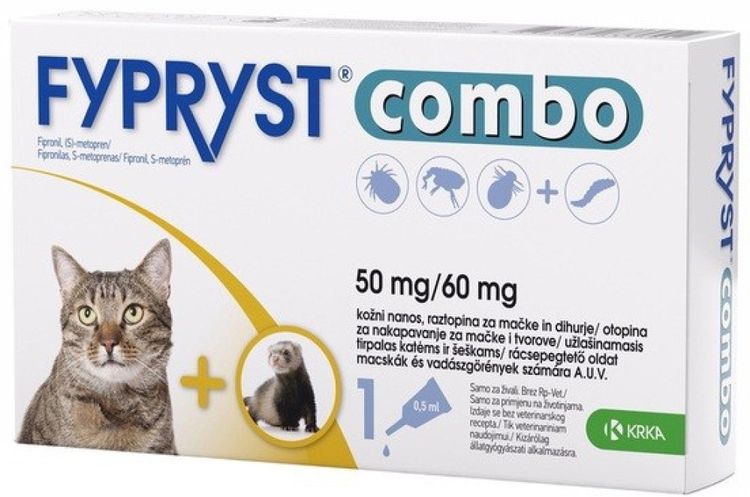
The manufacturer produces Fiprist spot-on and combo drops. The medications differ in their composition. In addition to fipronil, the combo drops contain another active ingredient, s-methoprene. The key feature of this substance is its ability to target the eggs and larvae of parasitic insects. This effectively kills ectoparasites at any stage of development and provides reliable protection for the animal for an extended period (about a month).
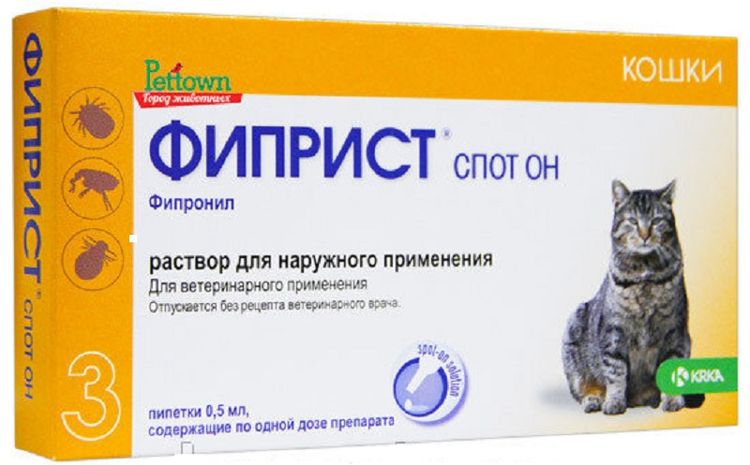
The drops are available as a solution packaged in disposable polymer pipettes. The medication's packaging is very convenient for use, as the solution is applied directly from the pipette. For cats, 0.5 ml polymer pipettes are used. They contain 50 mg of fipronil.
Please note! Fiprist drops are available for both cats and dogs. They differ only in volume and active ingredient content. When purchasing, select the medication according to its intended use; otherwise, the recommended dose may be exceeded, which can lead to toxic poisoning for your pet.
Spray
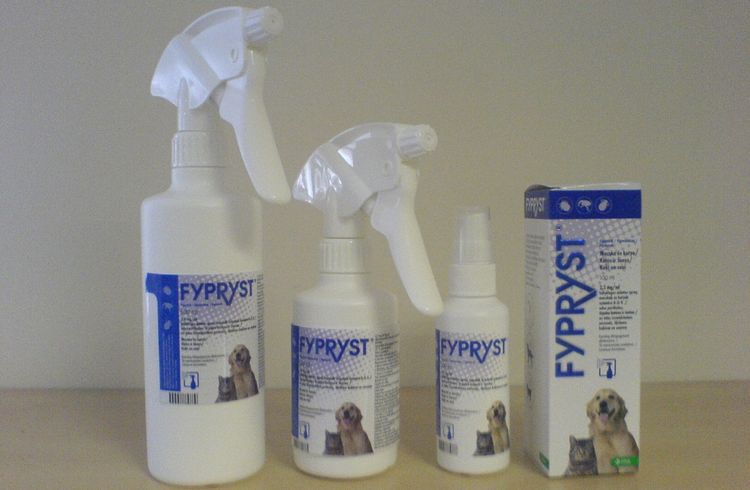
Fiprist spray is a clear, colorless medicinal solution. It is packaged in bottles equipped with a spray nozzle. Available in 100, 250, and 500 ml sizes. Cat owners typically purchase the smaller bottles, but if you have multiple pets, you can purchase the 500 ml bottle.
The spray contains 0.25% fipronil. The composition also includes the following auxiliary components:
- purified water;
- isopropanol;
- copovidone.
Please note! The spray should not be stored near heat sources or open flames, even for short periods.
When and how to apply
The medication is typically prescribed to kill ectoparasites. It is effective against the following insects:
- fleas;
- hair-eaters;
- lice;
- ixodid ticks;
- otodektosam;
- heylitellam.
This medication is often used as part of a combination therapy for allergic dermatitis caused by fleas or other insects. It can also be used prophylactically if there is a high risk of ectoparasite infestation, for example, if the animal spends a lot of time outdoors in the summer.
The specifics of using the drug depend on the form of release, although there are several general rules:
- It is strictly forbidden to allow your pet to lick the medicine.
- After applying the medication, avoid bathing the animal for 2 days, including with special shampoos. Avoid exposing the animal to rain. Contact with water may negatively impact the effectiveness of the medication.
- Avoid contact of the medicinal solution with eyes and mucous membranes, as irritation cannot be avoided.
If Fiprist is used to kill fleas, lice, or chewing lice, it's important to treat the animal's bedding and habitat with special products afterward. Otherwise, re-infestation will likely occur in the near future.
Application of drops
The dosage of Fiprist drops for cats, according to the instructions, is not dependent on weight or breed. A single application requires a 0.5 ml dropper. The medication is easy to use:
- Unscrew the cap on the polymer pipette.
- Use the back of the lid to pierce the protective film.
- Part the fur and drip the solution onto the skin. It's important that the solution reaches the epidermis.
- Apply the medication to one or more areas, but make sure the animal cannot lick it. The base of the neck is a good spot for this.
Repeated use of the drug is possible no earlier than after 3 weeks.
If the solution is used to treat ear mites, the following steps should be followed:
- Place 4-6 drops in each ear. Treat both ears, even if the tick is found in only one.
- Gently fold the outer ear in half and massage gently to distribute the medicine evenly.
- Place the remaining solution at the base of the neck.
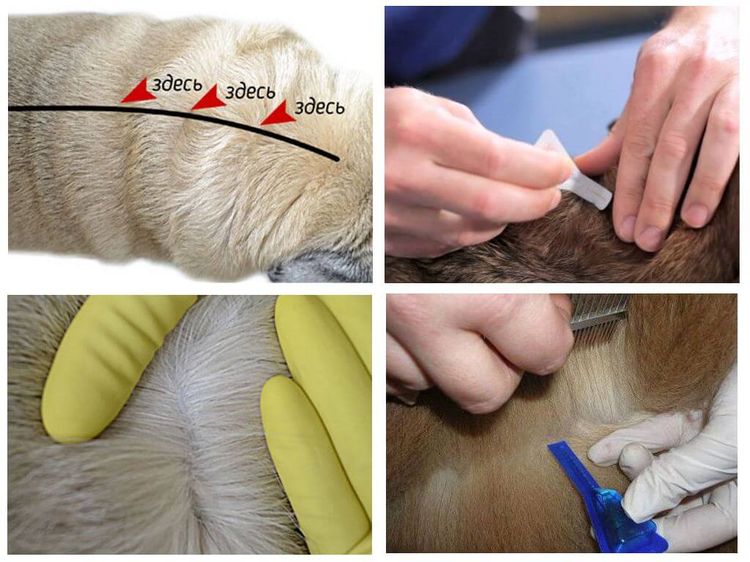
To ensure the medication is more effective, clean the outside of the ear canal of any scabs or crusts before applying the drops. It is advisable to use a special lotion for this purpose.
Features of using the spray
Before applying the spray to your cat, you need to put it on cervical collarTo prevent the animal from licking the medication. The dosage is calculated based on the pet's weight. Depending on the severity of the parasite infestation, 3-6 ml of medication is required per 1 kg of body weight. The dosage directly depends on the volume of the bottle. For example, one press of a 100 ml bottle dispenses 0.5 ml.
When spraying the product, keep the animal's eyes closed. Spray evenly over the entire body, holding the bottle vertically at a distance of 15-20 cm. If Fiprist is used on long-haired breeds, the fur should be lifted and parted by hand during treatment to allow the medicinal solution to penetrate the skin.
Keep your pet away from heating appliances and open flames until the solution has completely dried. If the procedure is performed indoors, ventilate the area afterward.
Price
The price of Fiprist for cats depends on the dosage form:
- spot-on drops – 250-270 rubles;
- combo drops – 280-320 rubles;
- spray, 100 ml – 600-700 rubles.
Contraindications and side effects
Fyprist should not be used in cats in the following cases:
- for intolerance to components;
- during the recovery period;
- in infectious diseases;
- when exhausted.
The drug can be used during pregnancy and lactation, but you should first consult a doctor and ensure that the animal has no other contraindications.
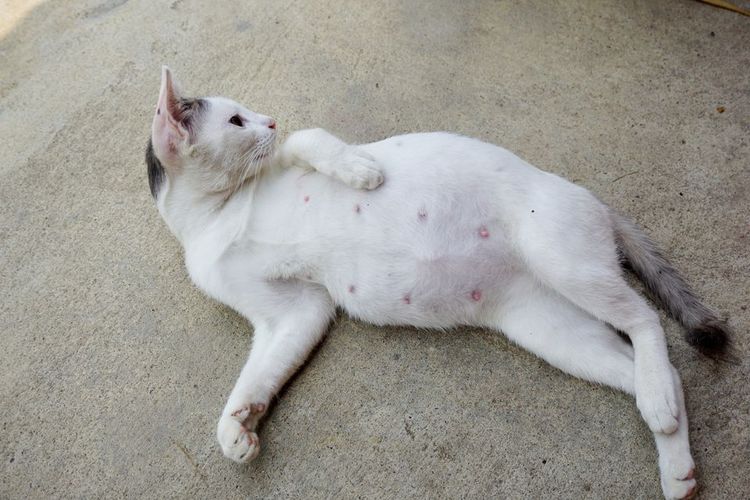
Please note! The spray can be used on kittens from one week of age, but the drops should not be used until they reach three weeks of age.
Occasionally, antiparasitic medications can cause skin irritation, which can be accompanied by itching and other unpleasant symptoms. If such symptoms are noticed, the pet should be removed immediately and a different antiparasitic medication selected.
If Fiprist is ingested, for example by licking, the following side effects may occur:
- vomit;
- diarrhea;
- lack of appetite and refusal to eat;
- change in behavior (apathy, depression).
In this case, it is necessary to flush the stomach and give the animal enterosorbents to remove the toxic substance from the body.
Owner reviews
Oksana, owner of a 6-year-old cat:
"We used flea collars to protect our cat from fleas before, but they were practically ineffective. On the pharmacist's recommendation, I bought Fiprist spray. 600 rubles wasted. After the treatment, the fleas continued to live peacefully on our Murka. I don't recommend it."
Margarita, owner of 5 cats:
"We have five cats and two dogs in our country house, so ticks and fleas are a big concern for us. We periodically use Fiprist drops. Cats are very easy to treat (they manage to remove their collars) and the effectiveness is excellent. Incidentally, we also buy this product for dogs, but in a different dosage."
Veterinarian Reviews
Antonina, a veterinarian with 7 years of experience:
"Despite this being a product from a well-known Slovenian manufacturer, I've heard a lot of negative reviews from my clients. I don't use it in my practice, and my colleagues' opinions are mixed. Some say it's a good product for the money, while others claim it's downright poisonous."
Maria, a veterinarian with 10 years of experience:
"I've been using Fiprist in my practice for a long time. Recently, complaints about the drug's ineffectiveness and numerous side effects have become more frequent. Animals at our clinic tolerate the medication well. I think the number of counterfeit drugs available in pharmacies has increased, leading to problems with effectiveness and tolerability."
Read also:


Add a comment