
Encephalitis in dogs: symptoms and treatment
Encephalitis is a severe brain disorder caused by an infectious or allergic process. A distinction is made between primary and secondary encephalitis. Primary encephalitis develops as a separate disease, caused by viruses, bacteria, toxoplasma, and other infectious agents. Secondary encephalitis is considered a complication of other pathologies.
Pet owners often ask whether dogs and cats can get encephalitis. Yes, both cats and dogs can develop primary or secondary encephalitis, affecting both the brain and spinal cord. In severe cases, it can take anywhere from half a day to a day from the onset of mild symptoms to a crisis.

Content
Subtypes of encephalitis and causes of development in dogs
Depending on the location of the affected area, a distinction is made between:
- meningoencephalitis, in which the inflammatory process affects the internal parts of the brain and the meninges;
- encephalomyelitis, affecting the tissues of the spinal cord;
- meningoencephalomyelitis, the affected area of which includes both the brain and spinal cord.
The causes of secondary encephalitis may be:
- purulent otitis (disease of the middle ear);
- head injury;
- bacteremia (blood poisoning);
- sepsis (general infection of the body).
Types of encephalitis in dogs and routes of infection
Competitors often identify varieties and transmission routes that you don't. Provide a clear classification:
Table: forms of encephalitis
| Form | Description |
|---|---|
| Primary encephalitis | Viral, bacterial, fungal or parasitic - develops on its own |
| Secondary encephalitis | Complications from other diseases - otitis, sepsis, distemper, piroplasmosis, etc. |
| Meningoencephalitis | Inflammation of the brain + membranes |
| Encephalomyelitis | Inflammation of the brain and spinal cord |
| Meningoencephalomyelitis | Inflammation of the brain, membranes and spinal cord simultaneously |
-
Transmissible (through ticks) - it is important to note that The encephalitis virus itself rarely infects dogs., but they often carry other tick-borne infections
-
Contact and feco-oral - infection through blood, saliva, dust, when the blood-brain barrier is weakened (for example, with otitis, sepsis).
-
Through head injuries, stomatitis, pyelonephritis, otitis, inflammation of the respiratory tract.

Primary encephalitis is most often caused by an infection or a severe allergic reaction to toxins secreted by an infectious agent or parasite. The disease can be caused by hepatitis, rabies, leptospirosis, and herpes viruses. Parasitic fungi such as Aspergillus, Blastomyces, Coccidioides, and Cryptococcus can also cause inflammation of brain tissue, as can certain parasites such as the nematode Ancylostoma caninum, the worm Dirofilaria immitis, the roundworm Toxocara canis, and the tapeworm Cysticercosis.
Tick-borne encephalitis, caused by a virus transmitted by the Ixodidae tick, is considered a separate species. This disease is rarely diagnosed in dogs, but its fatality rate is very high. Up to 98% of dogs that develop tick-borne encephalitis die if immediate treatment is not taken immediately after the tick bite.

A weakened immune system is usually a predisposing factor in the development of encephalitis in dogs. Young animals under 2 years of age and older animals over 8 years of age are more susceptible to the disease. In the former, the immune system is not yet fully developed, while in the latter, its activity is already reduced.
Signs and symptoms
The incubation period for tick-borne encephalitis ranges from 1.5 to 3 weeks. The virus enters the bloodstream, causing the destruction of red blood cells. The first symptoms of the disease include:
- lack of appetite;
- loss of activity;
- increase in body temperature.
As a result of the virus's effect on the brain, impaired motor coordination, tremors, seizures or convulsions, and vomiting may occur. General intoxication of the body with viral waste products and fragments of destroyed red blood cells can lead to kidney failure and urinary tract problems. The animal's urine becomes cloudy and dark, and may contain traces of blood.
If there is significant damage to the tissues of the spinal cord and brain, the pupil's reaction to light is impaired, uncontrolled movements of the eyeball (nystagmus) occur, and paresis or paralysis of the facial nerve or the nerves of the masticatory muscles may develop.

Important to know! A high fever and deterioration in general condition may persist for 1-2 days, sometimes followed by a seeming improvement. If you know your dog was bitten by a tick, don't assume this change means a full recovery. Your dog should be examined, and if tick-borne encephalitis is diagnosed, it should undergo treatment.
Clinical stages and symptoms
Competitors almost always have distinct stages and clear symptoms. Add a detailed description:
Phases of tick-borne encephalitis (similar to humans):
-
First (2–4 days): fever, weakness, muscle pain, malaise.
-
Remission (5–8 days): temporary improvement.
-
The second (meningoencephalitis) develops in 20–30% – neck stiffness, convulsions, impaired consciousness.
General signs:
-
Fever up to 42 °C, intoxication (vomiting, diarrhea, dark urine).
-
Active neurological symptoms: ataxia, falls, tremor, nystagmus, seizures, paralysis, visual and behavioral impairment (aggression or apathy).
-
Local pain reactions - pain in the head and neck, hypersensitivity
Emergency actions for a dog bitten by a tick
When keeping pets, particularly dogs, it's important to know what to do if your pet is bitten by a tick. Ticks are small arachnids that feed on blood. They are active during the warmer months: by attacking warm-blooded animals, ticks can transmit dangerous infections, including encephalitis.
Reacting to heat or the animal's scent, the tick senses its prey from up to 50 meters away, and when it approaches within reach, it attaches to the animal's fur. Within 1.5 to 2 hours, the insect selects the easiest spot on the animal's body to bite through. Typically, this is the abdomen, neck, ears, or inner thigh.
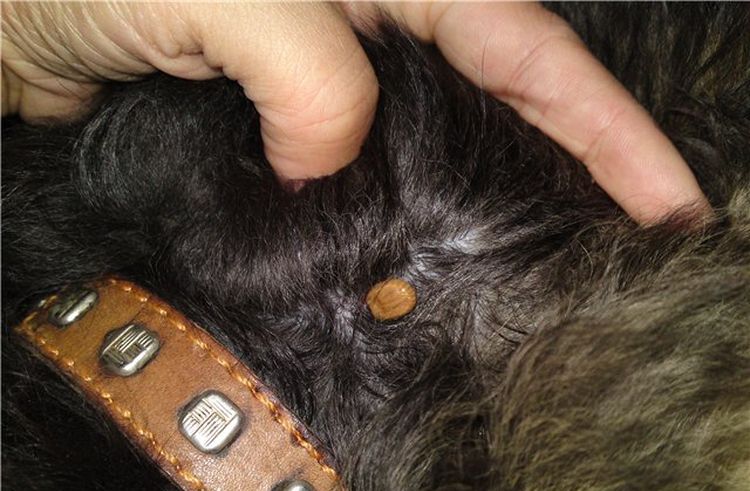
The tick "twists" its proboscis into the skin until the "drill" reaches a blood capillary, injecting an anesthetic to avoid deterring the victim. The parasite sucks blood, gradually swells, and then injects its waste products, along with the viral infection, into the animal's body. The insect then withdraws its mouthparts from the animal's skin and falls off. It takes the tick between 2 and 10 hours to satiate itself.
If a tick is found on a dog, it should be removed immediately. This should be done carefully, gently twisting the tick counterclockwise with tweezers, just as the tick screwed its proboscis in clockwise. Some recommend placing a drop of oil or alcohol on the tick to suffocate it and cause it to fall off. This is not recommended: the dead tick will remain on the skin with its proboscis still twisted in, making it more difficult to remove. Furthermore, when dying, the tick can release its stomach contents, which contain a large number of encephalitis virus cells, under the skin. Read more about... Why are ticks dangerous for dogs? on our website.
Important! Once you remove a tick, don't throw it away. The insect should be placed in a glass container and sent to a veterinary laboratory for analysis. This is necessary to determine whether it is mite carrier of the virus.
Diagnosis and treatment
A preliminary diagnosis is made based on an examination of the animal, collecting information about the dog's behavior and well-being over the past few days, and any previous illnesses. A more precise diagnosis can be made after a series of laboratory and instrumental tests. Depending on the symptoms, the following may be prescribed:
- blood and urine tests;
- Ultrasound or X-ray of internal organs;
- computed tomography;
- bacteriological analysis of cerebrospinal fluid.
Main treatment areas:
-
Hospitalization and inpatient treatment are mandatory.
-
For the infectious form - antibiotics (cephalosporins, fluoroquinolones, carbapenems) for bacterial encephalitis.
-
For viral/autoimmune diseases - glucocorticoids Dexamethasone, Prednisolone, Methylprednisolone (0.5-2 mg/kg).
-
Reducing intracranial pressure - Mannitol or Diacarb.
-
Anticonvulsants - Diazepam, Phenobarbital.
-
Symptomatic: infusion therapy, respiratory support, antioxidants, vitamins B & E.
-
Immunostimulants are strictly prohibited for coronavirus cases.
Rehabilitation:
-
After the acute period - a course of neuroprotectors, physiotherapy, exercise therapy.
-
Diet: easily digestible food, gentle on the liver/kidneys (Hills L/D, K/D, Purina NC).
-
Monitoring of neurological status: monitoring of coordination, vision, behavior.
Prognosis and complications
Competitors don't always provide forecast analysis—please provide justification:
-
Tick-borne encephalitis has a severe prognosis: 98% of cases are fatal without immediate support.
-
In case of bacterial/autoimmune causes, early diagnosis and adequate therapy provide a chance for partial recovery.
-
Possible consequences: cognitive impairment, epilepsy, paresis, kidney and liver dysfunction (especially after lipid preparations or long-term drug support).
Treatment for tick-borne encephalitis in dogs should begin as soon as it is confirmed that the tick that bit the dog is a carrier of the virus, even if symptoms of the disease have not yet appeared.

Antiviral medications are prescribed, and if signs of brain damage are present, restorative therapy is mandatory. This involves detoxifying medications to cleanse the body of toxins and hepatoprotectors to restore liver function.
Helpful statistics: Treatment of early-stage tick-borne encephalitis takes a few days, and complications are usually rare. Advanced cases are curable in 75% of cases, with recovery times ranging from one to three weeks.
Preventive measures
A dog can become infected with a tick even while walking in a clean, well-kept yard in a large city. Furthermore, avoid allowing your dog to come into contact with stray animals or run through tall grass in the park. After every walk, especially during the warmer months, thoroughly inspect your pet.

Sprays containing odor-repellent insect repellents are highly effective in protecting against ticks. These products are applied to the dog's withers and last for several days after treatment. There are also special anti-tick collars, the repellents are applied to the outer surface of the tape.
Vaccinating dogs against ticks is a new, recently developed method of short-term protection. It builds immunity to the tick-borne virus and can be used to kill ticks during mass infestations. However, this method has not yet undergone large-scale clinical trials, so its effectiveness and safety remain unclear.
You can also ask our website's staff veterinarian a question, who will answer them as quickly as possible in the comments box below.
Read also:
- My dog was bitten by a tick: what to do
- Kiltix: Anti-tick collar for dogs
- How to remove a tick from a dog at home


3 comments
Cat lady
Tell me, does it mean that encephalitis and piroplasmosis are different diseases?
Daria is a veterinarian
Hello! Yes, these are completely different diseases! One (tick-borne encephalitis) is caused by a virus—family Flaviviridae, genus Flavivirus. The other (piroplasmosis, babesiosis, borreliosis, nuttalliosis, haemobartonellosis) is caused by blood parasites from the order Piroplasinida. The former directly infect brain tissue, while the latter live only in red blood cells, destroying them (encephalitis in blood-borne diseases can develop as a complication, but not as a primary symptom). These diseases have only one thing in common—the vector. Specifically, the tick.
Pest
This disease is not generally recognized as a separate entity due to the lack of adequate treatment. Encephalitis has symptoms similar to piroplasmosis, but central nervous system (CNS) damage becomes noticeable early on. The disease is characterized by an acute allergic reaction, is untreatable, and results in the death of the animal. Euthanasia is recommended.
Add a comment