
Eczema in dogs
Canine eczema is one of the most common skin conditions seen in barking pets. It's essentially a type of dermatitis, but it affects the deeper layers of the skin (not just the surface). It's most common in older dogs, or in dogs with wrinkles or thick undercoats. Today, we'll discuss the symptoms of canine eczema and how to treat it at home.
Content
Types of eczema
Neuropathic eczema is a skin reaction to an autonomic disorder (rarely congenital, but more often developing after a previous illness). With this type, the eczema appears symmetrically, localized along the spine or affecting the outer thighs. After experiencing nervous stress, the rash progresses, and the itching intensifies.
Traumatic eczema is the body's response to irritation or damage to the skin. It can even be caused by a collar that presses or rubs the skin (in sensitive pets). Frostbite or a burn can also precede inflammation. Inflamed wounds, scratched parasite bites, and other untreated injuries are common triggers for eczema.
Reflex eczema is a skin reaction to an irritant. It can occur as a result of external factors (dirt, dandruff, chemicals and toxic substances, parasites, etc.) or internal problems (worms, nutritional imbalances, hormonal imbalances, allergies, internal diseases).
Causes of eczema in dogs
Even the most seemingly insignificant factor can cause eczema in dogs. It could be dust, skin parasites, and irritants. But let's explore as many factors as possible:
- Dust.
- Chemicals (acids, alkalis). Care should also be taken with detergents (such as soap). Dog grooming products should also be chosen carefully and thoughtfully, not haphazardly.
- Skin parasites. The saliva of these bloodsuckers contains irritants that cause inflammation in certain areas of the skin. It's also important to remember that the dog itself will scratch its own skin with its claws, which can lead to dermatitis, and then eczema.
- Intradermal parasites. These include mites that live in the skin (scabies, demodex, and sarcoptic mites). Removing these mites is much more difficult than removing skin "pests."
- Heat. Excessive temperatures are bad for your pet's health. If you live in a private home with a stove, don't let your dog lie too close to it. If your pet overheats (for example, by pressing its side against the stove), there's a high risk of developing eczema.
Short-haired or light-haired dogs should be extremely careful in the summer. Sunburn is also harmful and dangerous.
Factors influencing the disease
There are also predisposing factors that increase a dog's chances of developing eczema. These include:
- Improper grooming. This can include either insufficient or excessively frequent grooming. Animals don't need weekly shampoo and conditioner like humans do. And if you choose the wrong grooming products for your pet, skin problems are inevitable.
- Poor nutrition. An unbalanced or poorly formulated diet can cause a wide variety of illnesses in animals. And eczema in dogs is just the tip of the iceberg.
- A weak immune system or a tendency to allergies. And if you have helminths, allergies develop even faster.
- Changes in hormonal levels.
- Stress. Stress is never good. Stress can trigger health problems not immediately, but over time (a week, a month, or even longer). Sometimes owners are puzzled as to what caused their dog's eczema. It seems there was no stress, but then it turns out the owners left or moved a couple of months ago.
- Diseases of the internal organs. Any pathologies. Latent, acute, or chronic.
- And the skin condition. Sometimes excessive dryness can trigger dermatitis and eczema, but excessively moist skin should also be a concern for dog owners. Especially since dogs don't have sweat glands.
The mechanism of eczema development (an example with human eczema, but this also applies to dogs):
Symptoms of eczema in dogs
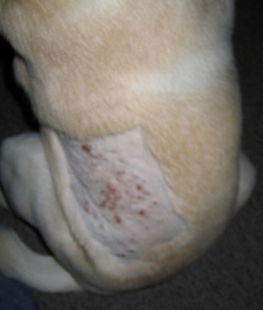
It's not easy to spot the symptoms of eczema in dogs at the very beginning, especially if your dog has a particularly hairy coat. Therefore, the first signs may only be noticeable in "nearly hairless" areas, such as the belly.
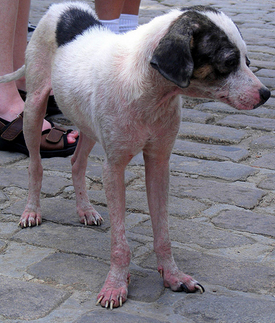
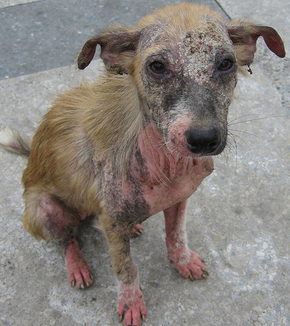
- At first, small red spots appear on the affected areas. They gradually merge into larger ones. Over time, a pustule forms in the center of these spots, which then bursts. A brown crust then appears in the center of the red spot. If there are numerous pustules and they burst rapidly, the skin becomes truly ugly. It turns into a solid, bright red, ulcerated surface. This is when veterinarians call it weeping eczema in dogs.
- The coat also changes. It first becomes tousled and coarser. And then completely starts to fall out.
- The animal is in great pain. Eczema in dogs is a rather debilitating condition, as the affected area expands, pustules burst, and the skin becomes painful. And if the dog doesn't receive the necessary veterinary care, the middle layers of the skin (the dermis itself) become affected.
- Itching. It's not enough that the skin looks like a sore; it's also itchy. The dog's claws cause further injury, introducing an infection, which leads to infectious dermatitis.
With chronic (dry) eczema in dogs, the skin becomes rough. In some cases, it becomes scaly, while in others, the skin becomes shiny and glossy. This is due to the skin being stretched too much. This causes it to crack, and along the edges of the wound, in addition to the oozing fluid, pieces of dead tissue are visible. However, the rash, itching, red spots, and pustules persist, although they are fewer in number than with acute eczema.
The photo shows several examples of eczema symptoms in dogs:
Treating a dog with eczema
How to treat eczema in dogs at home? Treatment should begin with identifying the cause. Therefore, it's important to consult a veterinarian who will conduct additional tests (if necessary, an ultrasound, blood, and urine tests). If the cause is an allergy to a food or medication, it should be eliminated and the animal given antihistamines. If eczema is confirmed, it's necessary to begin eliminating all suspected skin irritants:
- layer of dirt;
- parasites – fleas, ticks, etc.;
- excessive heat and sun exposure;
- dampness;
- chemicals that the dog may have come into contact with.
To prevent your pet from scratching or damaging the inflamed skin, experts recommend wearing a collar of the appropriate size during treatment.
This is usually enough for the treatment to work and the dog's eczema to disappear.
Treatment recommendations
To facilitate treatment of the affected area, hair removal is necessary. This should be done carefully, as any touch can cause excruciating pain. If the eczema is weeping, antibiotics must be prescribed even after the underlying cause has been eliminated (an open wound is a gateway for infection). Topical medications (directly applied to the affected area) are essential. However, with prolonged treatment, these medications may become ineffective and need to be replaced, otherwise there will be no recovery. These medications should only be changed with the veterinarian's permission; otherwise, the condition may worsen, and you'll have to start all over again. Dry skin requires ointments (antibacterial ointments would be better), and for weeping eczema in dogs, drying agents should be used.
Keep your skin dry and clean at all times. Also, keep an eye on your surroundings (there shouldn't be any drafts or high humidity). Change your diet. Increase your intake of zinc and sulfur (to promote skin regeneration), vitamins (especially ascorbic acid and folic acid), and trace elements.
Weeping eczema in dogs - treatment features
It's important to note that treating "wet" (or more accurately, moist) eczema in your pet without a definitive diagnosis is not an option. Diagnosing skin conditions, especially those affecting the inner layers of the epidermis, is quite difficult. Only a specialist can do this based on the results of various examinations.
Development wet eczema In dogs, medications that can absorb secretions (absorbents) and have astringent properties with antibacterial and anti-inflammatory effects can be used to stop the bleeding.
A popular representative of this group is the proven, multi-purpose product Lassar's paste. It consists primarily of starch (30%) and lanolin, which not only act as good paste-forming ingredients but also act as excellent absorbents. Zinc, also included in the paste, has astringent and healing properties. Another component, salicylic acid, has anti-inflammatory and bactericidal properties. Furthermore, this product is hormone-free, virtually eliminating the risk of side effects from medications containing it.
There are many causes of this type of eczema, the most common of which are:
- allergic reaction;
- consequences of injuries;
- psychosomatics (consequence of stress).
Often, the wet form of eczema turns into a dry form, in which the seemingly healed inflammation reappears during periods of exacerbation.
Dry eczema in dogs - treatment features
When severe lesions caused by dry eczema are detected, dogs are prescribed a comprehensive treatment. Sometimes, only systemic or topical treatment is required, depending on the underlying cause. Irritants are eliminated first. For systemic treatment, the veterinarian will prescribe antihistamines or hormonal medications.
For local use, sprays, shampoos, and ointments are prescribed that have an anti-inflammatory effect, as well as those capable of acting against bacteria and fungi in order to prevent and treat secondary infections.
The most important thing is to identify the underlying causes of dry eczema and consult a veterinarian promptly. Incorrect or delayed treatment can lead to complications from secondary infections and the risk of ignoring a more serious condition.
Prevention
To prevent eczema in your dog, avoid all possible factors and be vigilant if there's any predisposition. Create a sensible diet, groom your pet (but not too much, as that's bad), and avoid overheating or overcooling.
Deworm and treat for skin parasites regularly. And please don't forget to visit your veterinarian at least once a year (or twice a year for older pets) for tests and examinations. This way, you won't miss any inflammation (blood tests will tell you), and therefore, you won't lose track of your pet's health.
Make sure the collar and muzzle don't rub your dog's skin. It may initially develop into simple dermatitis, which, without proper treatment or under the influence of a predisposing factor, can quickly develop into eczema, which is much more difficult to treat.
Any questions? You can ask our website's staff veterinarian in the comments below, who will answer them as quickly as possible.
Read also:
- Foresto collar for dogs
- Weeping lichen in dogs: symptoms and treatment
- Ectoparasites in dogs and treatment against them


29 comments
Elena
Good evening. I left my dog with my sister for temporary care. She's a cocker spaniel. I came to pick her up in two weeks, and they told me she has a sore spot on her withers. We took her to the vet, where they gave her antibiotics and vitamins and sprayed her with something resembling silver paint. Now she has a thick crust. Should I soften it with something? I'm afraid it will take a long time to heal under such a thick crust. She's a Shih Tzu.
Elena
Hello, please tell me my German Shepherd's belly has become bald, damp, and smelly, and he's also losing his fur. We took him to the vet. We treated him for subcutaneous mites, but the smell has gotten worse. The folds under his paws are damp and smelly. Please help.
Daria is a veterinarian
Hello! How was the dog treated? What medication was prescribed? Shepherds are restricted from many treatments due to the MDR1 gene mutation, so treatment must be done with extreme caution. Further, to even narrow down the diagnosis, a thorough medical history is needed.
1. Age
2. Gender
3. castration(?)
4. lifestyle (apartment, enclosure, private house)
5. Walking (yes, no, where exactly)
6. presence of other animals
7. Diet
8. Treatment for helminths
9. Flea and tick treatment (what and when was the last time!!)
10. vaccination
11. Possible contact with animals
12. When and how did the first symptoms begin?
13. Seasonal or first time?
14. Are the symptoms always the same or do things change, disappear, or are added?
15. What treatment did you use before and did it help?
16. Was there a therapeutic diet (exclusion diet)? If so, was there a response?
17. Are the problems limited to skin issues? Or are there other symptoms, such as coughing, vomiting, diarrhea, fatigue, and so on?
18. Are there any other concomitant diseases?
19. Are there any symptoms in the owners or other animals in the house (if any)?
20. Were any antibiotics used? Were any dietary supplements, vitamins, or anything else used? Was anything washed with anything? Were the floors washed with any chemicals?
21. Is there a whitish coating between your fingers?
Irina
Hello. We have a 14-year-old German Shepherd. We put a flea collar on him about three weeks ago. He slept a lot this whole time, licking his paws frequently. A week ago, a thick, dry spot appeared on the outer thigh. I applied ASD, and it went away. Three days ago, it appeared on the other leg, and the next day it had doubled in size. Only then did I realize he was allergic to the collar. I took it off, but the skin along his spine itches, and the wound hurts and burns. Yesterday, I gave him an injection of Suprastin and treated the wound with diluted diphenhydramine. He fell into a deep sleep, and the itching and fever went away. This evening, the same thing happened. I gave him another injection of Suprastin. He doesn't refuse food at all, he eats a little. We made pollock fish soup, oatmeal with goat's milk, and kefir. Please tell me what to do next with the wound. Suprastin, I read here, is good for three days maximum. The wound is bad. Half is red, slightly crusty, half is yellow, dense.
Daria is a veterinarian
Hello! Your pet is very old (for German Shepherds, this is very advanced age; it's rare for one to reach that age). Therefore, to avoid serious problems, it's best to take your dog to the vet to rule out any tumors first (such as squamous cell carcinoma and other age-related conditions). Yes, suprastin should be used for no more than 3 days. Then, consider other antihistamines suitable for long-term use (assuming it's truly an allergy). Remove the collar completely and wash the animal. Apply at least Levomekol to the wound, then wipe it with an aqueous solution of furacilin (as an antiseptic). Protect the area from licking (put a protective collar on your dog). Don't cover the wound, otherwise it will start to ooze and the lesion will spread further. Do not apply iodine or brilliant green!
Victoria
Hello. Please tell me if testing is necessary to determine the cause of my irritable eczema. I have a Labrador, and during my doctor's examination, he was told he has a food allergy. They also told me to only feed him beef, not meat, but head, trachea, and stomach. Now I'm worried that this might be a mistake. How can I know the cause without testing?
Daria is a veterinarian
Hello! Ideally, yes, you should. A complete blood count and biochemistry panel would be a good start. However, Labradors are 90% prone to allergies. If fed improperly, they immediately develop allergic dermatitis, which manifests itself as oozing eczema. You can't feed them beef alone, either. Carbohydrates are also necessary, but you need to be careful with them. Feed them half a dose of Suprastin every day (maximum 3 days), make the food hypoallergenic, treat any eczema with chlorhexidine, and observe the animal. Will there be any improvement? But! Blood tests are required before administering medications!
Alexey
Hello. I have an Alabai dog. He's almost two years old. He had both wet and dry eczema. I almost cured the wet eczema. The pustules are gone. But the hair on the back of his neck is standing on end and it's kind of balding. I applied Akriderm ointment and gave him antibiotics. He gave him dexamethasone injections. And when he's dry, I apply salicylic-zinc ointment. He eats normally. I feed him porridge made from stewed meat, chicken skins, and meat. For lunch, I give him meat, bones, or cottage cheese. This started at the end of October 2018. First, it was dry. Then came the wet one.
Daria is a veterinarian
Hello! Before self-treating with ointments, have you tried going to a clinic, getting tests done, and finding the cause of the eczema? I would rule out an allergic reaction first and foremost. Where does the allergy come from? Review the diet. First, eliminate chicken COMPLETELY. Second, bones aren't food, they're garbage. They're not digestible, and they can also cause intestinal perforation from fragments. The cereals are unspecified, and they could also trigger an allergic reaction. Therefore, the first step is to completely adjust the diet: suprastin, 1 tablet 2-3 times a day for up to 3 days, and charcoal half an hour before feeding (1 tablet per 10 kg of body weight).
Svetlana
Hello! In August, a Central Asian Shepherd dog, a female, strayed into our dacha. We started feeding her and she gained our trust, but then disappeared for a few days! She showed up in a sorry state, beaten, with a huge abscess on her back, hairless thighs, and cuts. So, I kept her and nursed her back to health. We built a kennel and a small enclosure, and she lives at the dacha. I go every day to feed and walk her. My question is, the dog has developed weeping eczema again. I apply medication to one spot, it heals, but then it breaks out in another. The vet says it's genetic, is that true? What medications can I give my dog? Thank you.
Daria is a veterinarian
Hello! We need to thoroughly examine her feeding and living conditions. Something is causing the constant flare-ups. This means the underlying cause hasn't been addressed. It could be a food allergy. Have you treated her for parasites, including fleas and ticks? Where exactly is the eczema developing? How are you treating it?
Alena
Hello! I recently acquired a 2.5-month-old female German Wirehaired Pointer puppy. She was scratching herself, so naturally I bathed her with puppy shampoo called "Celandine." After the bath, I noticed she was still scratching herself. I laid her down and examined her, and she had dry sores on her back and front paws. I also found one on her belly near her breasts. She also started scratching herself more often and whining. I asked the person I bought her from about porositis, if they gave her any medication. The answer was yes. Please tell me what I should do and where to start treatment. Thank you so much in advance.
Daria is a veterinarian
Hello! You should start with an in-person examination by a vet. You can ignore what the salesperson told you. Do you have proof—a passport with veterinarian's notes on treatments (deworming, vaccinations)? If not, consider nothing done. You should check for fleas and apply drops to the withers (Inspector, Advocate, Strongold, Frontline, and similar products) as a preventative measure. Also, thoroughly examine the pet's diet for any potential allergens.
Sveta
Hello, I have a stray dog. I showed the photo to the local doctor and he said it's eczema and needs injections. Could you give me some advice on how to treat it without injections? I'm afraid of dogs. Maybe I should mix some ointments or medications into the food.
Daria is a veterinarian
Hello! Are you adding ointments to food? Or are you trying to apply them topically, even though you're afraid of your dog? Did you make the diagnosis based on a photo? I'm sorry, but that's not right, as there are hundreds of dermatological conditions with similar symptoms. You did make the diagnosis based on a photo, but why didn't you give any treatment recommendations? I'm sorry, but I don't understand how you can make a diagnosis based on a photo or remotely. Unfortunately, the error rate with this kind of "guessing from a photo" is too high.
In stray dogs, flea allergy dermatitis, demodicosis (and other diseases caused by subcutaneous mites), allergic reactions, pyoderma, infectious diseases, and other conditions should be ruled out. Each condition requires its own medications. Flea and worm treatments are the first priority. Then, glucocorticoids should be used to relieve itching, antibiotics to prevent (or treat) pyoderma, and antihistamines plus omega-3 fatty acids. This is the minimum that will help at least slightly relieve the itching. However, for a complete cure, diagnostics and an accurate diagnosis are necessary.
Irina
Hello everyone. My stray dog was missing for about a month. She came back in September completely bald with pus-filled skin. I treated the whole pack for parasites every three months. I caught her and took her to the vet, who prescribed treatment: 20 days of Synulox, 8-in-1 vitamins, and Hilavit. We also gave her two injections of Dexoform and Simparic for parasites. The vet stopped answering my questions about treatment, and the course of antibiotics has ended, so I don't know what to do next. We're taking vitamins and a mineral supplement.
Daria is a veterinarian
Hello! Did you take a skin scraping? Did you rule out subcutaneous mites? Pyoderma doesn't just appear out of nowhere. Simply administering antibiotics isn't enough; it's important to find the underlying cause. Is your pet itchy? Is hair still falling out? Has hair started growing in the bald areas? What other symptoms are there?
Olga
Hello! My 1-month-old female husky mix puppy has redness on her belly. She's restless, trying to lie down on the bare floor and stretching her legs. There's a foul odor in her groin.
Daria is a veterinarian
Hello! What are you feeding him? Are there any skin parasites? You need to rule out allergic/atopic dermatitis. He's so young, many medications are simply prohibited. Tell me more about his care and feeding. Is there any itching? Are there any blisters? What kind of rash is he: uniform or brightly colored in spots? Is he the only one in the litter suffering this way, or have you already weaned him?
Olga
Good afternoon! We're seeing improvements; the redness has gone down, and the puppy is calm and playful. Her groin area is occasionally wet, and her legs are damp. I washed her with potassium permanganate. She also pees a few times during the day while sleeping, so I gave her amoxicillin, bits and pieces. I had to rescue three puppies from two weeks of age and raise them myself. I blended chicken and rabbit and added them to ground, liquid milk porridge (rice, oatmeal, and buckwheat). Two of the puppies were adopted. When we were together, I didn't notice any problems with them, and their appetites were always good. Our girl is now one month and one week old. What vitamins and vaccinations would you recommend starting at what age? I'm also concerned that her back legs (inside, near the groin) are sometimes raw. When and with what medications can I treat her for fleas, and perhaps also for worms?
Daria is a veterinarian
Hello! Did you prescribe amoxicillin yourself? I don't see any reason to prescribe an antibiotic for such a small puppy. Why did you give away such small puppies? They don't socialize properly, and they still need to be fed. At two weeks of age, the puppies should have been fed milk replacer, not chicken cereal, even with a blender. This could be the cause of such a reaction. It strongly resembles atopic dermatitis (like diathesis in children) caused by feeding inappropriate foods. The diet should be appropriate for the puppy (based on its age). Vaccinations should be given only after eight weeks of age (but deworm twice beforehand; almost all anthelmintics are designed for two-month-old puppies). Flea treatments should also be given at 8-10 weeks. Choose medications based on the selection available at local veterinary pharmacies. If the legs are wet, smell them: do they smell like urine or are they damp from the skin?
Olga
Good evening! Thank you so much for your response and advice, I'm very grateful! It just so happened that I raised the puppies as best I could, but the mother (someone else's dog) died and gave birth under a neighbor's barn, an uninhabited house. The dog's owner, an elderly man, apparently couldn't help his pet in time. We live quite far from the district center, and milk replacer is probably expensive, but what's the big deal? Thank goodness the puppies are all alive, growing, and active. There is urine between their legs, and the skin is healthy. Why is there so much leakage? What should I do?
Daria is a veterinarian
Hello! The puppy is small and may not yet be in control. He may have caught a cold, but there's no way to tell without an examination. It could be cystitis or simply incontinence (due to weak sphincter muscles). Little children don't go potty right away either. Observe how often this happens, and how the animal behaves in general. How often does it leak? Maybe while sleeping?
Elena
Hello, I have a German Shepherd and he has developed psoriasis. I'm giving him medication as the doctor recommended. Yesterday, his nose was bleeding profusely. I don't know what's wrong! Please write to me.
Dasha is a veterinarian
Hello! Before giving advice, you need to know your pet's health history. What medications are you currently using? Perhaps one of them has the side effect of thinning the blood, which can make blood vessel walls more fragile or porous, causing them to rupture under any stress. Do you have Ascorutin on hand? The bleeding was yesterday, but you haven't seen your vet today? There was no bleeding today? Could your dog have hit his nose, or under what circumstances did the bleeding begin?
Anastasia
Hello! We have a 2-year-old male Labrador. We got him as a puppy. He ate natural food, but later he developed a rash in his groin area. We changed his food, but it would sometimes go away, and then get worse! We got him food, but at first he wouldn't eat it, and it was terrifying! In addition, the "wolf" began to worsen, he began to run away from home, "wander" and not eat even more, although he is a smart dog, in mid-August they castrated him, he tolerated it well, nothing happened, before the operation they dewormed him and dripped for fleas) he began to eat very well, we feed him 2 times a day, we moved to an apartment from the dacha, and recently eczema appeared on his back, we treated it, it began to die, the next day near the tail, another wet bald spot, terrible, all over his back you can feed and itch, there can be no parasites, we treated him, we do not have a veterinarian nearby (((and if you go to the city, they do not do tests there, nothing like that (what to do? I think it is from stress and the fact that he eats well? How to treat
Dasha is a veterinarian
Hello! Let's start by figuring out what you're feeding your pet. What other medications have you given it? Perhaps any dietary supplements, vitamins, or tablets? What are you washing it with and how often? Carefully inspect its body for any skin parasites (even if you've treated it). Examine it very carefully. Has dandruff developed? What other symptoms are there: itching, restlessness, lethargy, etc.? Is the eczema still festering? Is your dog licking it? We'll try to help you treat your pet, but please be as detailed and honest as possible. It's important to understand that without seeing your pet, it's extremely difficult to quickly treat it, but we'll do our best.
Love
What antibiotics should I inject into Kabaka for eczema?
Dasha is a veterinarian
Hello! What is the cause of the eczema? At what stage is it? Is it oozing heavily or not? Is there any pathogenic microflora "overlaying" on the resulting wounds? How is the animal feeling? What other treatments are you taking? Only after collecting a complete medical history can we determine the best treatment and course of treatment.
Add a comment