
Cat flap: buy or make your own?
A cat flap is a way for owners to free themselves from the chore of "opening the door." They can be purchased or made. Various designs are suitable for interior or exterior doors, allowing pets freedom of movement around the house and the ability to go outside at any time without their owner's intervention.
Possible design options
Cat doors vary not only in size and materials used (wood, plastic or metal), but also in design options:
- Laz A simple frame of any shape without a door, typically used for interior installations. Some models have an additional brush that removes pet hair as the pet passes through. However, it's important to note that the door doesn't prevent odors and noise from spreading between rooms, and it doesn't allow the passage to be sealed off if necessary.
- Window with a door – a design with a hinged door that opens freely in either direction. A latch can be installed if necessary to temporarily block access to pets. Disadvantages include potential noise from the door when slamming, poor thermal and sound insulation, and an unreliable lock if installed on an entrance door.
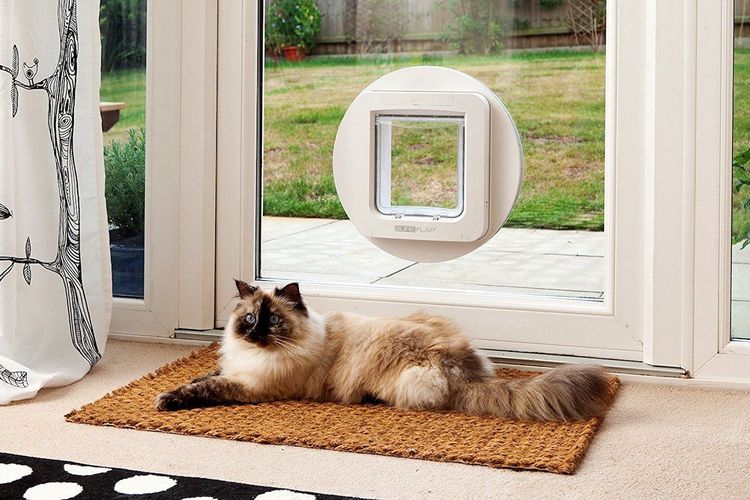
- Full-size mini-door – a recessed structure consisting of overhead frames and a connecting tunnel. A dense rubber seal ensures silent closing and provides thermal and noise insulation, making this design ideal for entry doors. The only drawback is the difficulty of DIY construction and a higher price compared to previous options.
What to look for when buying
When choosing a cat door, it is important to pay attention to the following points:
- Pet's size. The minimum door size is 10x10 cm, the average is 15x15 cm, and for larger animals, up to 20 cm. It's best to measure your pet's dimensions in advance or even take them with you to the store so the sales associates can help you choose the most suitable model. If you have multiple pets, the largest one should be your guide. It's also a good idea to add 4-5 cm to these measurements in case your pet gains weight.
- Installation location, as this will determine the type and material of the structure. For interior installations, options such as manholes or windows made of any material are suitable, while for entrance doors, sealed structures made of specially treated wood or plastic are suitable.
If you don't want to be woken up by the sound of a slamming door, it's best not to install a door in your bedroom. However, it's ideal for other rooms, providing your pet with easy access to the litter box in the bathroom or toilet, food in the kitchen, and access to the balcony or the street.
You can purchase a cat flap in a brick-and-mortar store or order it online, but the latter will require additional delivery to your city. Among the many models available, you can choose not only the perfect color and size, but also a design with special "bonuses," such as:
- magnetic latch on the door: on the one hand, it allows the animal to open the door without any hindrance, on the other hand, it slams shut immediately, thus providing sufficient protection from odors.
- A special opening sensor: it is triggered only by a signal from the chip in the cat's collar (included) and thus eliminates the possibility of strangers entering.
Among the most popular manufacturers are Trixie and Ferplast.
How to make it yourself
You can make a cat flap yourself. You'll need a minimal set of tools and materials:
- tape measure, pencil;
- drill, jigsaw;
- wooden or aluminum strips for the frame;
- sash material (plastic, rubber, fabric);
- fasteners and latches.
The easiest way to create a doorway is with a door panel made of wood or wood-like materials. The process is significantly more complicated with glass or metal structures and requires additional tools (glass cutter, grinder). If you don't have experience working with such materials, it's best to seek professional help.
Procedure:
- Remove the door leaf from its hinges, place it on a flat surface, mark the height of the future opening (optimally 10-15 cm from the bottom edge of the leaf) and its location.
- Cut out an opening of the required dimensions: first, drill 4 holes at the corners of the markings, then, inserting a jigsaw into each of the holes and gradually moving it along the marked lines, cut out the opening.
- Sand the ends with sandpaper. Optionally, you can make a frame out of wood or aluminum strips. The entrance can be left as is or equipped with an additional door.
- Install the fastening for the future sash at the top: hinges or loops.
- Make the sash. It's best to use a lightweight material, such as plastic.
- Hang the door on the hinges. It's important that it rotates easily so the cat can open it without effort.
- Install the door leaf back in place.
A thin sheet of rubber or even fabric would also be a good material for the door leaf; in this case, you can even do without installing hinges or hinges.
When installing a door on the front door, a locking mechanism (such as a deadbolt) should also be added. This also leaves the issue of thermal insulation open, which is especially important during the cold season. Using any sealed material can create difficulties opening and closing the structure. Therefore, if you need to provide a passageway for your pet to enter the outside, it's best to purchase a ready-made one from a store. In all other cases, you can do it yourself, after which all that remains is to train your cat to use the new entrance.
Reviews
Egor, the owner of two cats:
"We installed Ferplast cat doors in every room of the house. It wasn't cheap, but now our pets are their own bosses, and we can go about our business without being distracted by the door scraping. The doors are so lightweight, the cats can even run through them when playing, simply by pushing them with their heads."
Regina, Bars' owner:
"Our cat loves asking to go out and come back home at night. My husband installed a flap in the front door himself, but unfortunately, it didn't help in our case. Bars absolutely refuses to use his own entrance; he absolutely needs an open door, so my husband and I continue to take turns keeping watch."
Vika, owner of Sonya the cat:
"We installed Trixie's door in the bathroom where the litter box is. But Sonya didn't get used to it right away; at first, we had to nudge her. We also had to remove the magnet on the curtain. Firstly, it makes a bit of a noise when closing, and secondly, it requires extra effort for the cat to open it. Otherwise, it turned out to be a very useful purchase; the main thing is that Sonya figured out what it's for."
Read also:




Add a comment