
DIY cat house made of plywood
Many cats love to hide away from everyone in a secluded spot. A special house can satisfy this need for privacy. You don't have to buy one; you can build one yourself out of plywood. The key is to consider a few requirements, purchase the right materials, and devote some time to creating your pet's new home.
What to consider when manufacturing
When choosing a future cat house, you should consider a number of requirements for the design itself:
- The size is right. Be sure to take into account the “growth” parameters, especially if your pet is still a kitten.
- Sustainability. The house should not wobble or fall when the cat jumps or moves in any way.
- Safety. It's important that the structure be free of sharp corners, protruding nails, or loosely fastened elements. If there are metal parts, be sure to cover them with upholstery. Firstly, the animal is sensitive, and secondly, friction between fur generates weak electrical charges, and metal is a good conductor of electricity, so the pet may experience discomfort, at the very least.
- Convenient location. Some animals like to hide from everyone somewhere high up, while others prefer to be “closer to the ground.”
- Easy to care for. The material used should be easy to clean and, even better, should not absorb odors (either foreign or your pet's own).
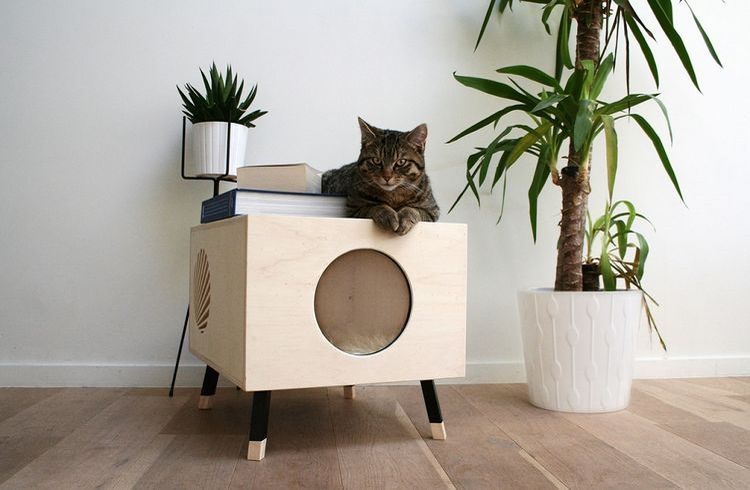
It is also important to pay attention to the selection of the right materials:
- No pungent odor. It's important to let the plywood dry out to remove any foreign odors. Cats are highly sensitive to odors and may even refuse a new home if it smells unpleasant.
- Safe glue. PVA is the best option – it dries and evaporates quickly and doesn't release toxins. Superglue is absolutely not suitable for this purpose.
- Natural or synthetic fabric for upholstery. It is important to check that the chosen material does not become electrified, so it is not recommended to use silk.
Recommendation: If the structure is planned for outdoor use, please note that plywood is not designed for long-term exposure to moisture. In this case, it should be treated with a special protective compound or additional external cladding should be used.
Manufacturing process
Building a plywood cat house yourself doesn't require any special skills, but it's still a bit more challenging than, say, cardboard, which can also be used to build a cat shelter. However, plywood is stronger, more durable, and more environmentally friendly.
Before you begin making the piece, you should decide on the overall design of the future structure: draw a diagram on paper and indicate the dimensions of all the parts. This will help avoid wasting material and ensure the most accurate cutting possible.
The classic version of a cat house is a square or rectangular structure, similar to a dog house.
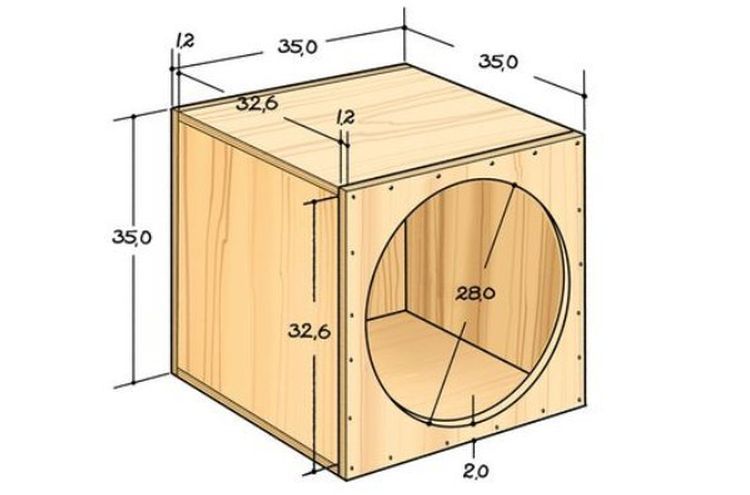
To make it you will need:
- plywood sheet 10-12 mm thick;
- jigsaw;
- upholstery material (carpet, felt, etc.)
- foam rubber;
- furniture corners/small nails/self-tapping screws;
- stapler and/or glue;
- ruler, scissors, compass;
- sandpaper (preferably fine-grained).
The manufacturing procedure will be as follows:
- Cut out six equal-sized squares from a sheet of plywood. Each square can be between 35 and 50 cm on a side, depending on the desired size of the future structure.
- Using a compass, mark a circle on one or two squares (depending on how many exits you plan to make) and cut out the holes. Sand the edges to prevent your pet from injuring himself when entering or exiting.
- Connect the 5 squares together using the chosen fasteners, forming a cube—the base of the house. Leave one side (with the future entrance or roof) open for now.
- Make the internal (and optionally external) lining: lay foam rubber along the bottom and side walls, secure it with a stapler, and attach the upholstery material on top.
- Attach the remaining part of the house to the furniture corners.
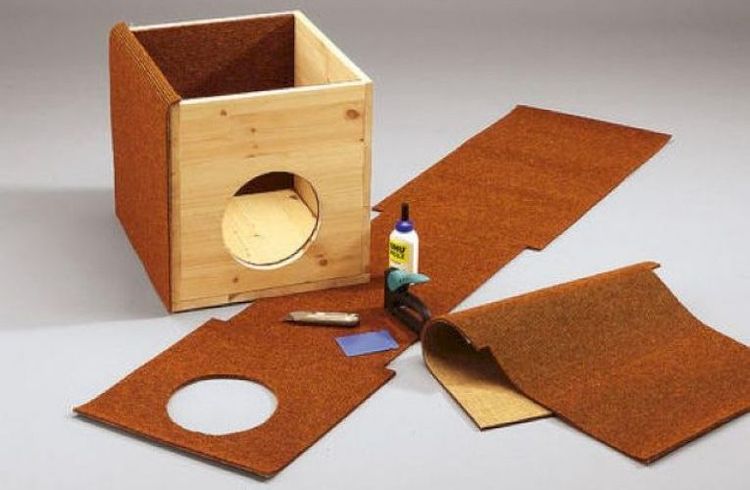
The plywood cat house is practically ready. You can leave it as is, or you can add exterior finishing touches with paint, varnish, or heavy fabric. By matching the colors to the room's tone, you can create not only a home for your pet but also a harmonious addition to your apartment's interior.
Additional elements
To make your cat's time more comfortable, you can add additional elements to the structure. These are typically attached to the body (for example, using furniture corners) or placed next to the house, connected by a common base. Depending on your cat's preferences, you can add:
- scratching post. It can be made from a plastic pipe, which is covered with liquid glue and tightly wrapped with jute rope (it is important that the turns fit tightly together).
- Observation deck on the roof. To do this, attach a round pipe to the roof (it can also serve as a scratching post if covered with jute rope), and place a small plywood platform of any shape on it, covered with soft fabric. For added softness, add a layer of foam under the upholstery. A hanging toy can be attached to the bottom of the observation deck.
Plywood cat house: video
Of course, you can buy a cat house at your local pet store, as the market offers a wide selection of plywood and other materials. However, a homemade structure can be tailored to your pet's comfort and preferences. Moreover, it will be significantly cheaper than store-bought alternatives. All that's left to do is place the homemade house where your cat prefers to spend most of its time, and introduce it to the new space. A favorite toy or treat left inside the house will help.
Read also:


Add a comment