
Until what age do cats grow?
In this article, we'll tell you about the age, or more specifically, how many months, cats grow to. Most felines reach adult size by puberty. Growth rate is influenced by many factors, including breed, diet, endocrine system function, living conditions, and so on.
Growth is generally understood to mean not only an increase in an animal's size but also the formation and development of all organs and body systems. Veterinarians say that male cats acquire their permanent characteristics by the age of three, while female cats typically remain unchanged after two years.
The endocrine system, particularly the pituitary gland, which produces the hormone somatotropin, is responsible for regulating body growth and internal organ development. Delayed or even complete growth arrest can also be caused by problems with the thyroid gland, reproductive system, and adrenal glands.
Content
Stages of formation
The active growth phase in most cats lasts until the end of puberty, usually 10-15 months (depending on the breed). Representatives of large breeds (Maine Coons, Bengals, servals etc.) grow up to 2, and some even up to 3 years.
A kitten's transition to adulthood occurs in several stages. It's crucial to create favorable conditions during each stage, otherwise irreversible consequences can occur: stunted growth, abnormal size, health problems, and so on.
- Neonatal. This lasts for several days after birth. During this period, most babies typically lose weight.
- Suckling. This lasts 3-3.5 weeks, during which the kitten steadily gains weight and grows.
- Transitional. This period lasts from 4 to 6 weeks. It's characterized by less active growth than in the first few weeks, but after that, if all the necessary conditions are in place, the baby continues to grow in size.
- Adolescence – the period from 2 months to the end of development (depending on the breed). The peak growth occurs between 3 and 5 months, when the kitten becomes an adult. By the end of this stage, female cats stop growing, and male cats may only grow 2-3 centimeters.
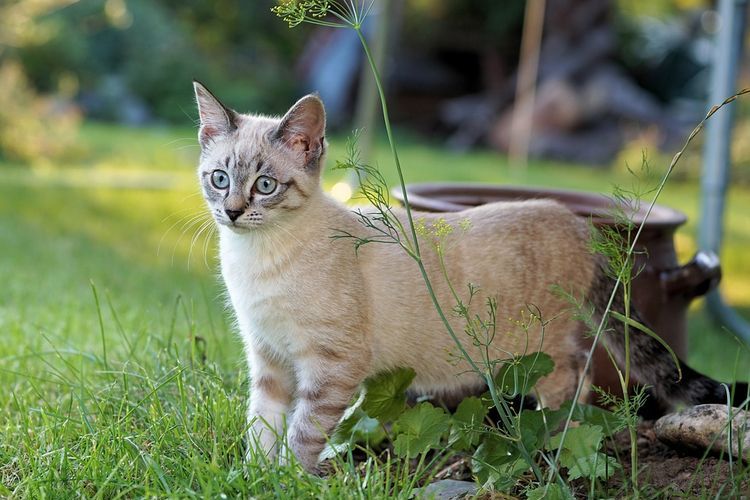
Up to a year, cats grow in length and width, then in width, gaining weight typical for their breed.
What influences growth rates?
The growth rate, how quickly a kitten grows, and the rate of development directly depend on several factors:
- Breed. The main factor influencing a cat's adult size is its breed. Maine Coons grow for up to 2 years, but are considered fully grown only at 3 years. Female Bengals reach maturity and peak size at 9 months, while males reach peak size at 2 years. The physical development of British Shorthairs (British breed), as well as Scottish Folds (Scottish breed), continues until 2.5-3 years of age. Siberian cats grow up to 1.5 years. sphinxes – up to 2 years. Non-pedigree cats, or, as they are more commonly called, domestic cats, due to their mixed genotype, do not have developmental norms, so some stop growing at one year, while others continue to grow in size until they are 3 years old.
- Heredity. Kittens very rarely grow larger than their parents. Only in rare cases does a small cat grow into a large kitten.
- Gender. Female cats are always smaller than male cats.
- Nutritional quality. Deficiencies in vitamins and essential macro- and micronutrients lead to slow or complete cessation of growth and disproportionate body development.
- Living conditions. A comfortable room temperature, proper lighting, good hygiene, and quality sleep promote proper development and maturation of the kitten.
- Diseases and parasites. Diseases of any type (hereditary, infectious, somatic) impair growth. Intestinal parasites, which drain vitamins and nutrients needed by pets, also adversely affect development.
- Lifestyle. Physically active kittens develop faster, their bodies are proportional in size, and their weight is within normal limits.
- Endocrine system function. Hormonal imbalances negatively impact a pet's growth. Stress, which triggers the production of certain hormones, can also trigger an endocrine imbalance.
- Neutering. Cats neutered later in life tend to be larger in size than intact cats and those neutered before the age of one year.
- Mating age. Although male and female cats are considered sexually mature by 8 months, mating at such an early age results in growth slowdown and sometimes even complete cessation.
Recommendations for creating favorable conditions
Every owner must provide their pet with optimal living and growing conditions, namely:
- Feed a balanced diet with the required amount of vitamins, macro- and microelements.
- Maintain a room temperature of at least 20 degrees and a humidity level of approximately 55%.
- Periodically give anthelmintic drugs and fight skin parasites, in particular fleas.
If, despite suitable developmental conditions, the animal lags behind in its development, it should be shown to a veterinarian.
Read also:
- How many times a day should I feed my cat?
- What are the largest domestic cats?
- The Importance of Exercise for Cats


2 comments
Natalia
My cat weighed 2.8 kg, a mixed-breed calico. Her son is now 2 years and 9 months old, weighs 4.2 kg, and has been steadily gaining weight for a year (45-50 grams per month over the past year). His father is a show Siberian. How much more will he grow? He eats the same food as his mother and still hunts. He is fully vaccinated and receives regular deworming and skin parasite treatment.
Daria is a veterinarian
Hello! Well, dad is big, so his genes took their toll. Of course, your cat won't grow up like dad—mom's genes have definitely spoiled his bloodline—but he'll still be big. Also, a lot depends on feeding and physical activity. What kind of food do you feed him? How many times a day and how much? Is the cat neutered? How much exercise does he get?
Add a comment