
Discopathy in Dogs: Symptoms and Treatment
Discopathy in dogs is a condition caused by degenerative processes in the spine, particularly the intervertebral discs. As a result of nutritional deficiencies in the spinal structures, symptoms may occur that require immediate medical attention for adequate treatment. In the early stages, the disease can be managed conservatively. However, as destructive processes progress, treatment for discopathy in dogs without surgery becomes ineffective.
General characteristics
The dog's spine consists of vertebrae, which are held together by joints and intervertebral discs. Each vertebra has a special opening through which the spinal cord passes. Together, they form the spinal column.
Intervertebral discs are ring-shaped, covered with dense fibrous tissue. This tissue is filled with the nucleus pulposus. This structure allows for shock absorption. The discs' function is to distribute loads across the spinal column and ensure its stability and support.
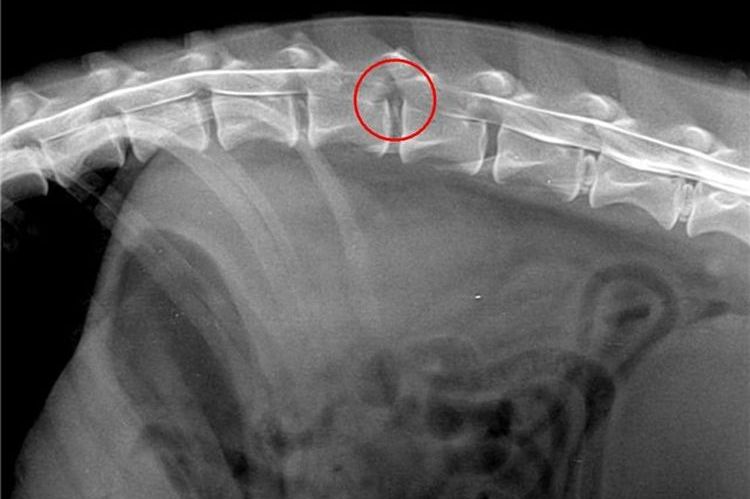
Discopathy can affect any part of the spine—cervical, thoracic, or lumbar—or several at once. If metabolic disturbances develop in the nucleus and annulus fibrosus, the level of proteoglycans (high-molecular-weight protein compounds) decreases, leading to a decrease in the concentration of water molecules. As a result, disc tissue begins to lose elasticity and degenerative processes develop, leading to impaired function. Under pressure from the spine, the disc begins to flatten, and its contents expand beyond their normal boundaries, negatively affecting nerve endings and the spinal cord.
As the disease progresses, it can have two development paths:
- protrusion – protrusion of the disc without rupture of the membrane;
- extrusion – a violation of the integrity of the tissues of the outer shell of the ring with the release of contents into the area of the medullary canal.
In any case, mechanical compression of the spinal cord and nerve endings occurs. Inflammation and tissue swelling occur. Subsequently, the vertebrae begin to deform.
Types
An alternative name for discopathy is Hansen's disease. It is divided into two main types:
- Type I. The degenerative process primarily involves the tissues of the outer ring, causing extrusion, or rupture. This results in spinal cord swelling and inflammation of the spinal nerve. This type of disease is characterized by rapid progression and is more common in young individuals.
- Type II. Most often seen in dogs over 6 years of age. In this case, degenerative and destructive processes progress much more slowly. Disc protrusion gradually develops, leading to the deformity of several vertebrae.
Reasons
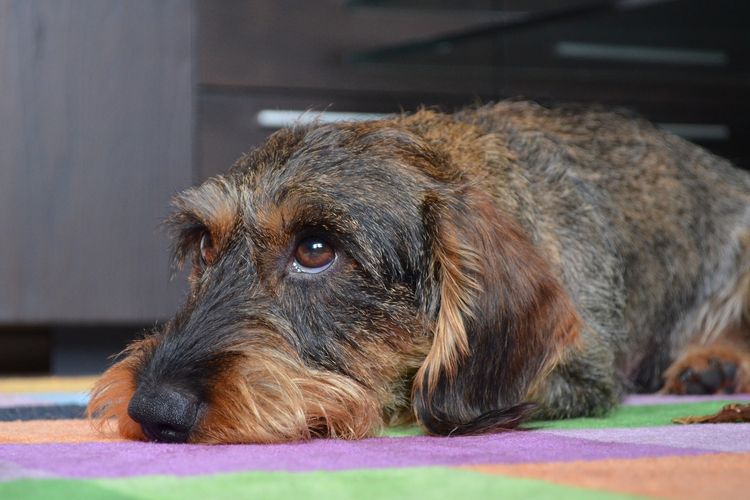
Chondrodystrophoid dog breeds, such as dachshunds, pugs, bulldogs, and Pekingese, are prone to disc disease. Dachshunds are at a higher risk for this condition. More than 60% of cases are found in this breed.
Dogs aged 4 to 7 years are most often affected. Predisposing factors for the pathology are: obesity and other metabolic disorders. Less commonly, the pathology occurs after a spinal injury.
The main causal factor in the development of discopathy is cartilaginous metaplasia. This process is a form of pathological regeneration in which one type of tissue is replaced by another. This is how fibrous tissue is replaced by cartilage or bone.
Metaplasia develops against the background of chronic inflammation, impaired tissue nutrition or metabolism.
Symptoms
If discopathy develops slowly in dogs, symptoms may not appear immediately. The animal may be ill for a long time before a clear clinical picture develops.
As the degenerative process progresses, symptoms will intensify. The animal will experience pain, which may manifest as follows:
- the pet limits its movements;
- a change in gait is observed, it becomes more constrained and heavy;
- lameness occurs (in one or more limbs);
- the pet has difficulty jumping, going down or going up stairs;
- coordination of movements is impaired;
- may whine when trying to change position;
- trembling in the paws and convulsions occur;
- In advanced cases, the dog cannot walk.
Depending on the location of the degenerative process, discopathy will manifest itself in different ways:
- If there are problems in the cervical region, the dog has difficulty moving its head or tilting its head;
- If there are problems in the lumbar-thoracic region, an unnatural curvature of the back and the appearance of a hump may be observed.
In any case, the pet will be restless, will react inappropriately to touch, and will not allow itself to be petted.
Diagnostics
To prescribe adequate treatment for discopathy, it is necessary to make a correct diagnosis and determine the location of the pathological process. Veterinary assistance is essential for this. Determining the type of disorder and its extent on your own is impossible. Delaying treatment can lead to significant negative consequences, including paralysis in dogs.
The veterinarian will prescribe the following types of examinations:
- Physical examination. This will include an assessment of the animal's condition and neurological testing. The doctor will observe the animal's movements, its ability to jump, and its ability to overcome obstacles. Reflexes will be assessed, and pain responses will be checked.
- Laboratory tests: complete blood count and biochemical blood test. Additional tests may be ordered at the physician's discretion.
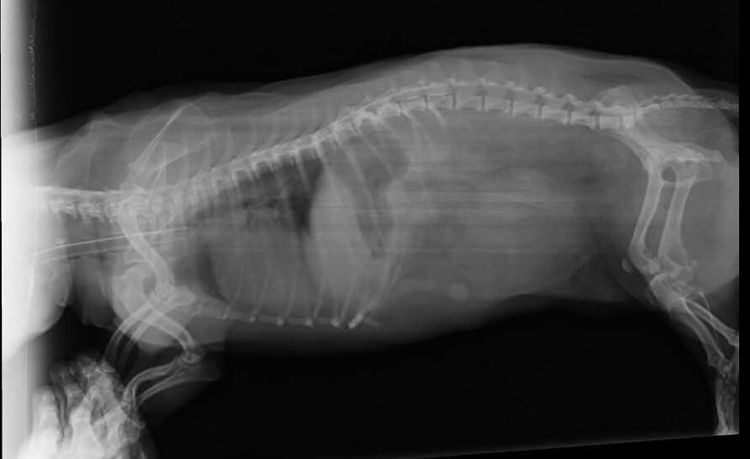
- Spinal X-ray. This examination will help determine the affected area and the extent of damage to the vertebral tissue and intervertebral discs. X-rays are essential in diagnosing discopathy.
The most informative diagnostic methods are magnetic resonance imaging and computed tomography. However, these examinations are rarely performed on animals due to their cost.
Treatment
Treatment for discopathy in dogs depends on the stage of disease progression, its type, and clinical manifestations. In the early stages, conservative therapy will be required, using medications from various groups prescribed by a veterinarian. In this case, treatment can be carried out at home with constant monitoring of the condition.
Conservative treatment includes the use of the following medications:
- steroidal and nonsteroidal anti-inflammatory drugs (NSAIDs) to relieve inflammation of the spinal nerve and adjacent tissues;
- painkillers (analgesics and NSAIDs);
- muscle relaxants to relieve muscle spasms;
- sedatives;
- B vitamins.
Additionally, physiotherapy procedures are prescribed.
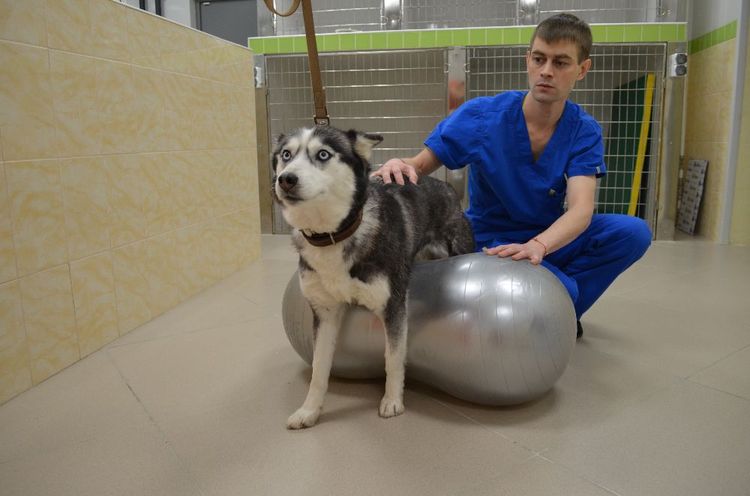
Important! Treatment cannot completely cure discopathy. All treatment methods are aimed at relieving symptoms and slowing or stopping the degenerative processes.
If the pathological process involves the bone tissue of the vertebrae, or a rupture of the fibrous ring has occurred, then the dog will definitely require surgery.
The surgeon will remove the intervertebral disc fragments that have penetrated the spinal cord and remove the damaged tissue. This surgery is necessary to relieve the pressure in the spinal space. If the damage is not corrected surgically, there is a high risk of rapid paralysis.
Discopathy in dogs has a favorable prognosis. If treatment is started early, the animal can remain active for a long time. Post-surgery recovery can take about a month or two. The animal will require complete rest, a nutritious, low-fat diet, and mandatory wearing of a corset.
During the postoperative period, the owner needs to help his pet:
- turn him over on different sides to prevent bedsores;
- massage your paws and belly to improve digestion.
After a while, the dog can be taken out for short walks, gradually increasing the exercise. The brace should be worn until the vet determines it is no longer necessary.
Moderate exercise (especially swimming) and a healthy diet are good preventative measures. Obesity should be prevented. Chronic conditions should also be monitored with regular veterinary visits.
How to massage a dog with discopathy: video from a veterinarian
Read also:
- Hind Limb Paralysis in Dogs: Symptoms and Treatment
- Broken front and back legs in dogs: symptoms and treatment
- Lumps on a dog's hind legs: causes and treatment


Add a comment