
Dexafort for dogs
Dexafort is a hormonal anti-inflammatory drug. This medication, which belongs to the glucocorticosteroid class, was developed by the Dutch company Intervet but is now successfully used by veterinarians worldwide. Since Dexafort has contraindications, it is important to carefully read the instructions before using it on dogs.

Content
Appearance, composition and storage conditions
The white suspension is intended for injection. It is packaged in 50 ml glass vials. To maintain a hermetic seal, the glass containers are sealed with rubber stoppers and aluminum caps.
Two active substances provide the elimination of inflammatory processes:
- dexamethasone phenylpropionate (1 ml of the medicine contains 2.67 mg of this substance);
- dexamethasone sodium phosphate (its content is 1.32 mg in 1 ml).
The active ingredients have similar effects, but the difference is that dexamethasone sodium phosphate is rapidly absorbed and begins to act immediately, while dexamethasone phenylpropionate is absorbed slowly. As a result, the drug begins working immediately but has a long-lasting effect.
The injection solution also contains additional components that perform only an auxiliary function.
Dexafort can be stored for 3 years from the date of production, but subject to simple rules:
- The air temperature should be between 15 and 25˚C.
- Store away from direct UV rays.
- The medicine cannot be kept near food or feed.
- Children and animals should not have access to it.
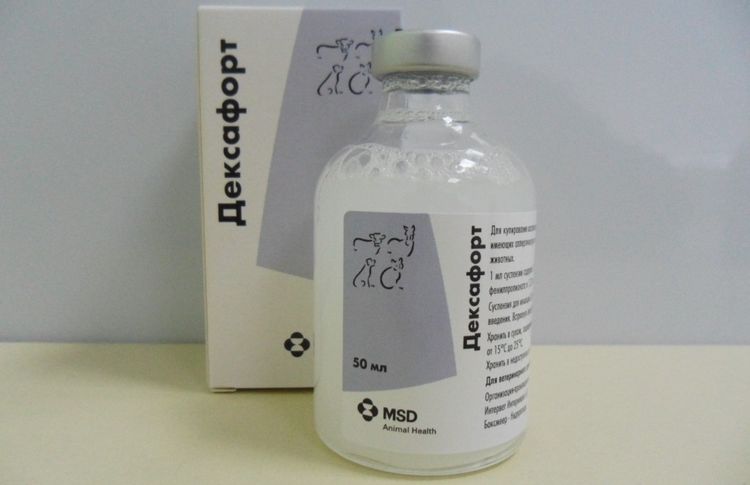
Important! Once the bottle is opened, the solution can only be used within 28 days. Afterwards, the medicine must be discarded.
Properties and operating principle
Dexafort works because its active ingredient is a synthetic analogue of cortisol. Glucocorticosteroid hormone is produced in animals by the adrenal cortex. This hormone is unique in that it blocks the production of substances involved in inflammatory processes. Furthermore, the drug stimulates the synthesis of substances that have an anti-edema effect.
Pharmacological properties include the following:
- has an anti-allergic effect;
- relieves inflammation;
- eliminates swelling;
- increases cellular immunity;
- has a desensitizing effect, that is, it reduces the body's sensitivity to irritants.
Taking the drug increases the ability of cell membranes to resist damage, resulting in anti-shock and antitoxic effects. Furthermore, vascular permeability is reduced, and liver cells are activated, metabolizing toxins and harmful substances and promoting their elimination from the body.
Just one hour after the injection, the concentration of active components in the blood reaches its maximum. The drug's effect lasts for an extended period—from 30 to 96 hours. This period depends on the animal's weight, body characteristics, and existing pathologies. The drug's components are eliminated through the kidneys and liver.
Dexafort is classified as a moderately hazardous substance, but its use without a doctor's prescription is prohibited.
How much does it cost and where to buy it?
Dexafort is quite expensive. One 50 ml bottle costs approximately 950 rubles, although the price may vary depending on the pharmacy. You can buy the medication at your nearest veterinary pharmacy. Residents of small towns may encounter unavailable stock. In this case, you can purchase it online, but be sure to use reputable stores and pharmacies.
Indications for use
The drug is used to relieve inflammation caused by allergic reactions or autoimmune diseases. According to veterinary instructions, Dexafort is prescribed for dogs for the following conditions:
- for allergic dermatitis;
- for bronchial asthma;
- for joint diseases;
- in acute mastitis;
- for eczema.
The drug can also be used to treat post-traumatic edema.
Instructions for use
Injections are given subcutaneously or intramuscularly into the thigh muscle. This is the largest muscle, making it easy to hit. Subcutaneous injections are given into the withers or the crease below the knee, with the former being preferred. To administer an injection into the withers area, pull back the skin with one hand, and use the other to puncture the crease with the syringe needle and slowly inject the medicinal solution.
Dexafort is administered to dogs as a single dose of 0.5-1 ml, depending on their weight. In severe cases, the injection is repeated after 7 days. A repeat injection is only possible after a veterinary examination.

Special instructions
If the inflammation is complicated by a bacterial infection, Dexafort is used in combination with antibiotics.
To speed up the onset of a therapeutic effect in anaphylactic shock, the medication is used in conjunction with anti-allergy medications. In some cases, the use of adrenaline is also necessary.
To reduce pain, you can use an insulin syringe with a thin needle. When giving an intramuscular injection, insert the needle about 1.5 cm into the muscle. Inserting it deeper can damage the bone.
Before drawing the solution into the syringe, be sure to shake the bottle well. If you're apprehensive about giving your pet injections, leave this to your veterinarian.
Contraindications and restrictions
The use of Dexafort for dogs is impossible in the presence of the following pathologies:
- osteoporosis;
- viral infections;
- hyperadrenocorticism;
- diabetes mellitus;
- fungal diseases;
- heart failure;
- stomach ulcer or duodenum;
- corneal ulcer;
- kidney disease.
In early pregnancy, the drug is used only when absolutely necessary, as there is a high risk of causing fetal abnormalities. The medication is contraindicated in late pregnancy, as it may trigger premature labor or miscarriage.

Important! Dexafort should not be used concurrently with vaccines, as it has an immunosuppressive effect.
This medication can reduce the effectiveness of certain medications, so it should only be prescribed by a doctor. Do not self-medicate unless you have veterinary training!
Side effects
The use of the drug may cause the following side effects:
- intense thirst;
- excessive food consumption;
- increased urine production.
When used as directed and dosed, the medication rarely causes side effects. Long-term use or overdose may result in Cushing's syndrome (hyperadrenocorticism), which is caused by elevated corticosteroid levels. In this case, the animal may experience the following symptoms:
- weight loss;
- drowsiness;
- osteoporosis;
- muscle weakness;
- frequent urination;
- urinary incontinence;
- increased appetite;
- symmetrical baldness, etc.
If you notice any of these symptoms, you should seek medical help.

Owner reviews
Tatyana, owner of a 12-year-old fox terrier:
"Despite his age, our dog remains active and cheerful. However, a tragedy occurred – he began scratching himself intensely, scratching until it bled. He had almost completely lost the fur on his back. After a full examination, it was discovered that the itching was caused by a hormonal imbalance. The vet prescribed Dexafort. After just the first injection, the dog calmed down, stopped scratching, and began sleeping at night. We now use the medication once a week to prevent a recurrence of the condition, but Rick tolerates the injections well and has no side effects."
Maria, owner of a French bulldog:
"My dog has hypersensitivity. The list of factors that can trigger allergies is quite long, and protecting him from them all is very difficult. The itching was often accompanied by hair loss and eczema. We tried various treatments, but to no avail. The doctor recommended Dexafort. And although I didn't want to inject my dog with hormones, I didn't regret the decision later. The symptoms were quickly relieved, and after a course of three injections, his fur began to grow back."
Veterinarian Reviews
Elizaveta, a veterinarian with 15 years of experience:
"I use a variety of medications in my practice, but I always need to have some so-called emergency medications on hand. Dexafort is one of them. It's practically indispensable for allergic reactions accompanied by severe itching and other unpleasant symptoms. It helps quickly eliminate the symptoms of the condition."
Pavel, a veterinarian with 8 years of experience:
"Dexafort is a real lifesaver for animals with severe allergic reactions. Itching and other symptoms subside within an hour after the injection. And although the manufacturer warns of possible side effects, pets generally tolerate it well. The only drawback I find is the 50 ml bottles. Dog owners often have to pay for the suspension, which then has to be discarded due to expiration."
How to give a dog an intramuscular injection: video
Read also:


5 comments
Tatiana
We gave our dog two shots, and I can agree with all the reviews above, but the question remains: two shots, two weeks without any itching... but what next? The itching is already starting to reactivate, and one milliliter lasts exactly a week. How can a dog diagnosed with an "allergic reaction to environmental components" continue to live?
Daria is a veterinarian
Hello!
Unfortunately, we didn't see your message earlier. But allergies are always a hot topic, especially with summer approaching, so we'll answer your question; perhaps it will help someone in the future.
Indeed, Dexafort doesn't treat allergies; it only relieves the acute phase. It helps relieve itching and discomfort in the animal.
In dermatology, there's a concept that says not everything itchy is atopic. Atopic diagnosis is a diagnosis of exclusion. To arrive at it, parasitic diseases and food allergies must be ruled out.
If you're confident in your vet's approach and have been properly administering antiparasitic treatments, eliminating provocative diets, and these haven't had any effect, then an environmental allergy panel is performed. This test is similar to an allergy test in humans, but in animals it's performed under sedation. Based on the results of this diagnostic, ASIT therapy is administered. However, these methods are only available in large cities (primarily St. Petersburg and Moscow; in other cities, you can check with your veterinary center).
But! If ASIT therapy is unavailable, there is an option for atopic patients: drug therapy with a drug that suppresses the immune response. This is a non-hormonal medication! It does not carry severe side effects and is suitable for long-term use.
Consult a second specialist, not a general practitioner, but a dermatologist, as a competent dermatologist will not prescribe Dexafort for atopy.
Shiny coat and health to your pet!
Natalia
After administering a microdose of Dexafort, three minutes later, our dog's hind limbs stopped working, her heart rate increased, and she fainted. We barely managed to revive her with an antidote. When we arrived, she was almost healthy. She was scratching her ear. They found no fungus or ear infection, but her ear was red. The veterinarian insisted on a Dexafort injection. So, we arrived at the veterinary clinic healthy, but she left weak in our arms. Previously, when she had ear complaints, we had also given injections with other medications, and everything was fine. Be very careful. Wishing everyone good health.
Daria is a veterinarian
Hello! This is a hormonal medication. I'm always wary of such medications, as hormones are not to be trifled with, and their blind use can cause far more harm than good to an animal. For example, glucocorticoids (which Dexafort is) are contraindicated in diabetes and adrenal disease. Immediately administering dexamethasone without a diagnosis seems strange. What about a scraping for parasites? A culture? How about ruling out a food allergy? A hormone is given only in an emergency, when quick help is needed or other medications are ineffective. For dogs with itching, it's best to start with Apoquel. Yes, it's expensive, but it's the safest. Besides the ears, what else is bothering your pet?
Vladimir Borisovich
The doctor taught the subject of surgery poorly, completely rejecting asepsis and antisepsis.
Add a comment