
Dalmatian (Dalmatian)
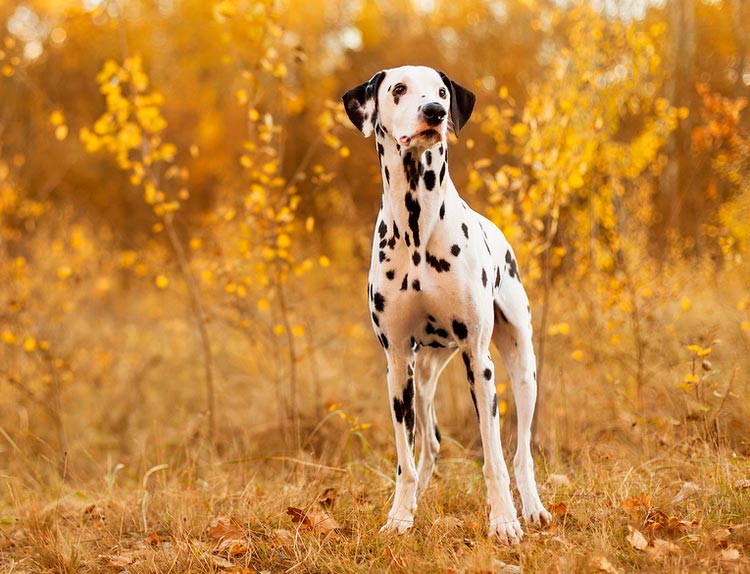
The Dalmatian is one of the most recognizable dog breeds in the world, largely thanks to the film "101 Dalmatians." In subsequent years, the popularity of these spotted pets has skyrocketed. These dogs are highly energetic and intelligent, and are easily trained, but require an experienced and consistent owner. Dalmatians are friendly, sociable, and find it easy to get along with people. In their native Croatia and beyond, they were used to hunt fur-bearing and small ungulate animals, as well as to escort carriages. Today, the primary role of this breed is to be a reliable and devoted companion.
Content
History of origin
The breed's origins are in Dalmatia, the Republic of Croatia. The Dalmatian is a very ancient breed, likely dating back thousands of years. Some historians attribute Egyptian or Roman origins to these spotted dogs, comparing the modern breed's appearance with drawings of dogs found in frescoes discovered during excavations.
The breed takes its name from the historical region of Dalmatia in the northwest Balkan Peninsula, located in what is now Croatia and Montenegro.Church chronicles from the 14th century and chronicles dating to 1719 clearly point to a Mediterranean origin. The earliest depictions of Dalmatians can be found in paintings by 16th-century Italian artists and in frescoes in Zaostog (Dalmatia).
The Dalmatian was probably formed by Istra hound and mastiff-like dogs with a merle coloring. In the 19th century, the breed became popular in England. The first detailed description of the Dalmatian was written by the Englishman Vero Shaw in 1882, and in 1890 it became the official breed standard.
Purpose
Throughout their long history, Dalmatians have been used as hunting, herding, circus, and guide dogs. Today, they compete in various sporting competitions, can work as bloodhounds, and participate in search and rescue operations. However, they are most often simply pets and companions.
Appearance
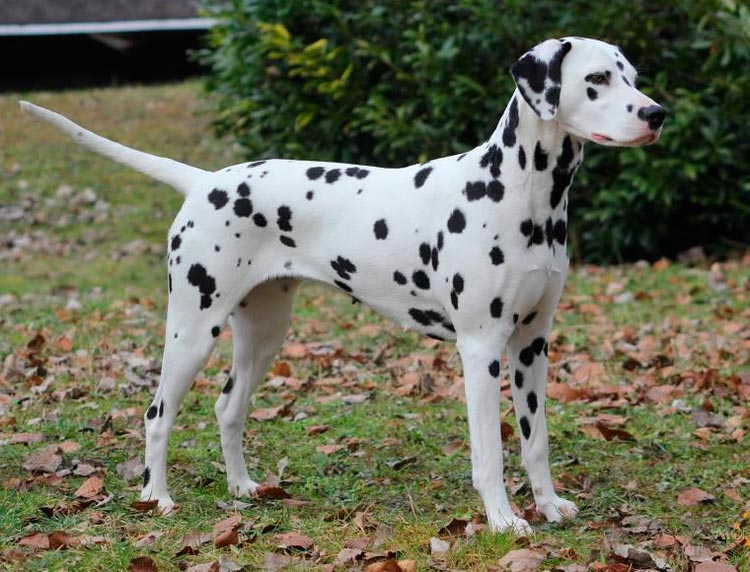
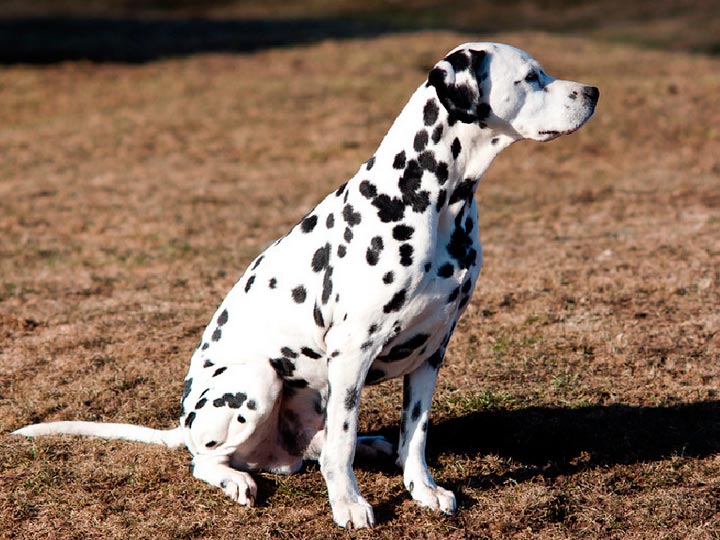
The Dalmatian is an elegant dog with a well-proportioned build. Its constitution is lean and strong. Its muscles are well developed. Sex differences are noticeable.
- The height at the withers of males is 56-62 cm; weight is 18-32 kg.
- The height at the withers of bitches is 54-60 cm; weight 15-24 kg.
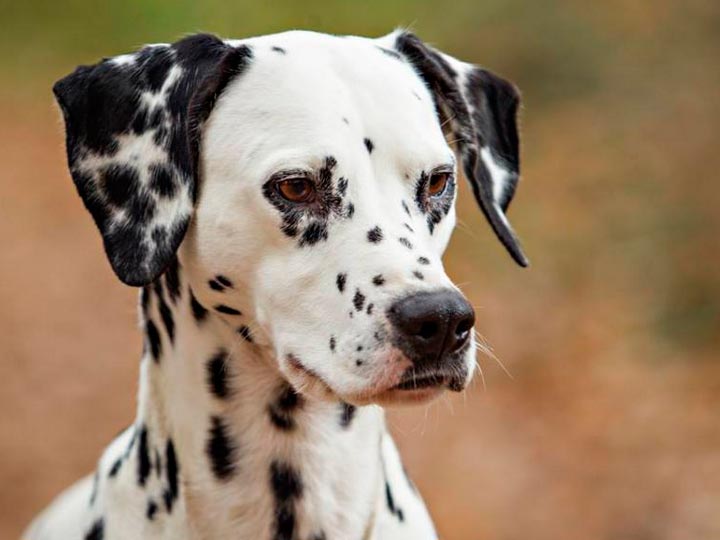
The head is elongated, with well-defined cheekbones. The top lines of the forehead and muzzle diverge slightly. The stop is moderately defined. The muzzle is well developed. The bridge of the nose is straight. The jaws are strong. The earlobe is large, with pigmentation corresponding to the color of the markings. The lips are close to the jaws; full pigmentation is desirable. The bite is scissor-like. The eyes are oval, brown, and set slightly obliquely. The eyelids are pigmented to match the color of the markings. The ears are set wide apart, of medium length, and pendulous. The neck is fairly long, tapering toward the head, without dewlap.
The body is strong, with well-defined muscles. The ratio of body length to height is 10:9. The withers are well defined. The back is level. The loin is short. The croup slopes no more than 30 degrees. The chest is deep, spacious, and not too wide. The belly is moderately tucked up. The limbs are proportional, straight, with well-developed muscles, and parallel. The paws are cat-like, with compact toes.
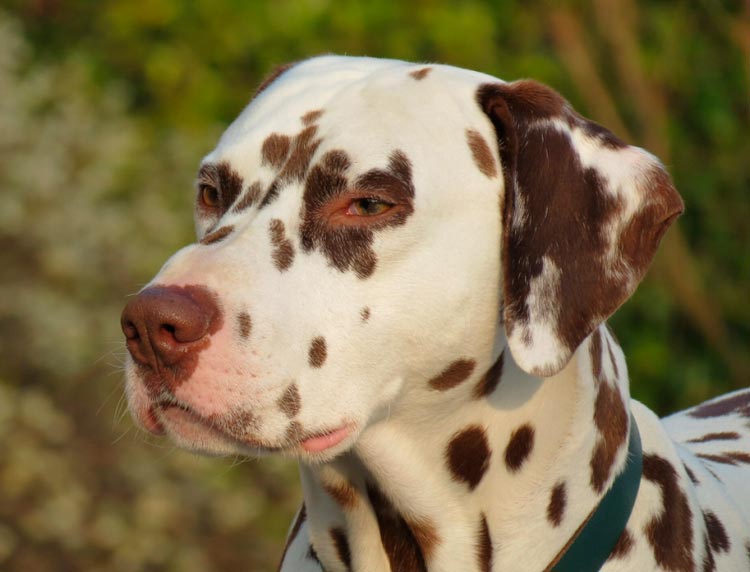
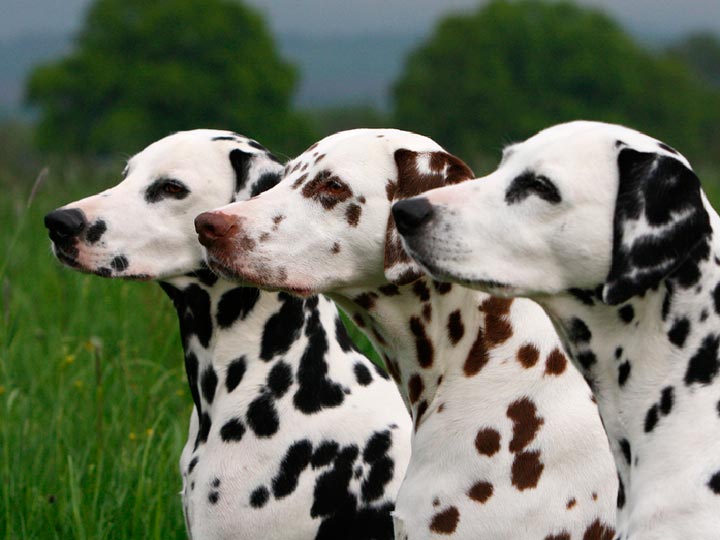
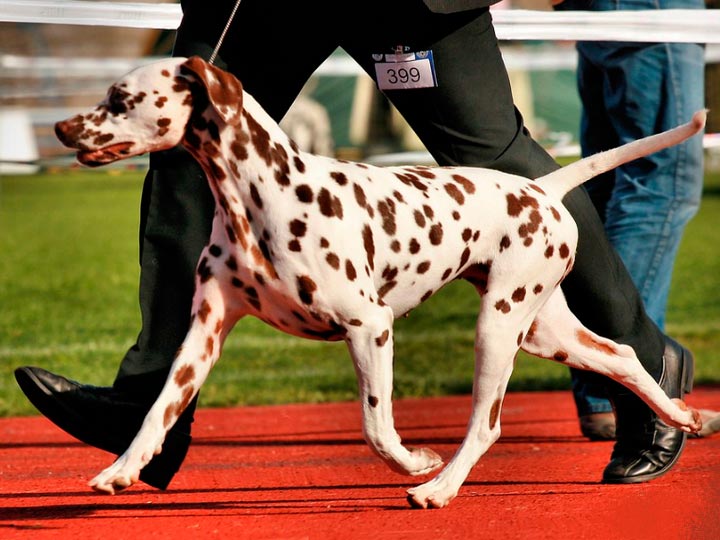
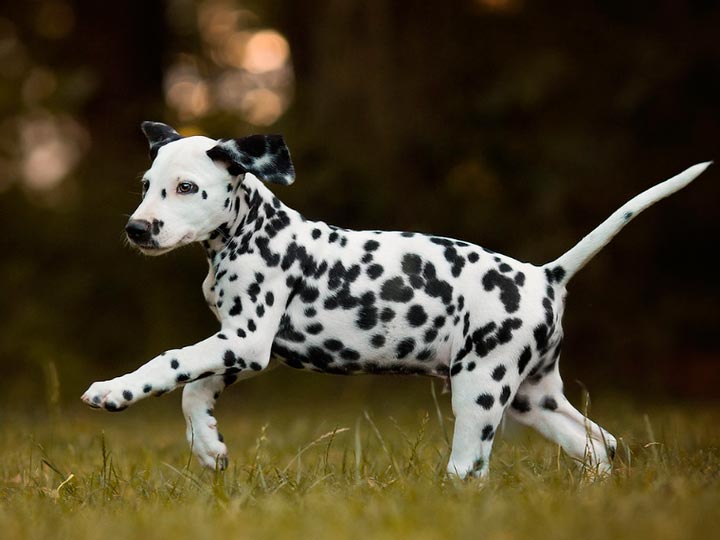
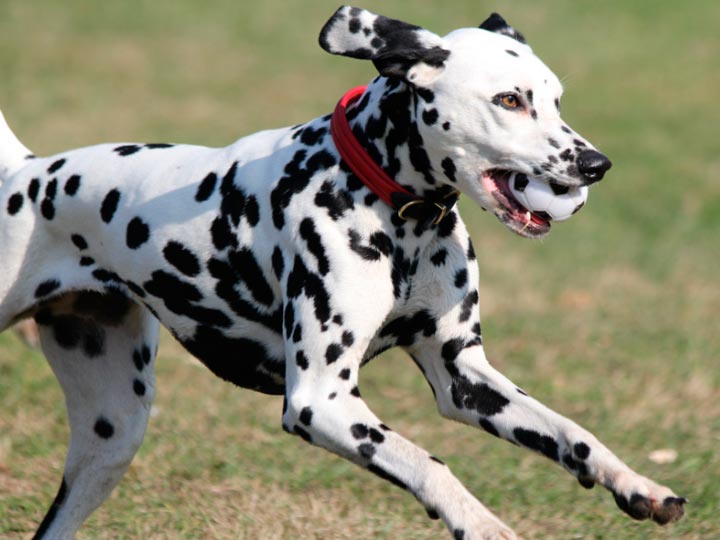
The coat is short, harsh, shiny, and lies close to the body, densely distributed over the entire body. The color is white with black or white with brown spots. The spots are approximately the same size, without interspersed white hairs, and are distributed evenly and symmetrically over the entire body. In the black variety, the spots are approximately 2-3 cm in diameter, while in the brown variety, they are approximately 2 cm. Speckling is undesirable.
Character and behavior
Dalmatians are naturally sanguine. They are very active, sociable, and agile, self-confident, and adapt quickly to their surroundings. They exude energy and resourcefulness when it comes to solving a problem or pleasing their owner. They are inquisitive and observant, curious about everything and eager to poke their noses into everything. They are playful, friendly, and affectionate. They are always cheerful and happy. They adore everyone in the household and try to show it in every way possible. They suffer from loneliness and separation anxiety. Adult dogs have a very long and difficult time adjusting to a new family. At the same time, they have a strong sense of self-worth, can be stubborn, and cunning in achieving their goals. At a young age, they need a fair mentor. Therefore, they are best suited to people with experience with hunting breeds and an understanding of the basics of dog socialization and training.
They are friendly with strangers and warm with family friends. They will bark at the doorbell, but are not guard dogs. They are genuinely happy to see anyone who comes in. Dalmatians have stable temperaments and get along well with other animals. They enjoy walking with other dogs that are not aggressive. Minor conflicts are possible between males living together.
Dalmatians are optimistic by nature, but it's worth noting that they can be quite vindictive and will not tolerate indifference, much less cruelty. These dogs are quiet and very loyal. They are easy to get along with. They form particularly strong bonds with children and are always very kind. However, this dog is not the best choice for families with small children precisely because of its playfulness and energy. They can knock even an adult off their feet with joy.
Education and learning
- Dalmatians have exceptional intelligence and an excellent memory. They quickly grasp new commands and happily perform tasks, especially when they see interest and attention from their owner.
- These dogs love being the center of attention and are ready to perform even the most complex tricks to impress others. It's important to remember, however, that Dalmatians are impulsive, emotional, and sometimes act like teenagers. Without proper training, they can grow up disobedient and willful.
- The breed adapts easily to various living conditions, quickly adjusting to new circumstances and adopting the behavior of household members. Therefore, it's best to begin training a puppy from a very early age.
- Once the puppy has settled into the house and learned its sleeping, eating, and toileting areas, it's time to begin training. It's important to clearly define what is and isn't allowed and strictly adhere to these rules. The puppy must understand that it's not allowed to beg for food from the table, chew on other people's things, or sleep in inappropriate places.
- Communication with a Dalmatian should be gentle and confident. Harshness or raised voices are avoided: these dogs are sensitive and can permanently lose trust in their owner if treated harshly.
Education and training
Dalmatians have a reputation for being stupid and difficult to train, but this isn't true. While there are some nuances and challenges, they are generally naturally intelligent and quickly learn commands. Dalmatians should be trained and educated as early as possible, and it should be made clear from the start that humans are in charge. From then on, they will need to constantly maintain their "leader" status.
Dalmatians are naturally independent and obey only those they respect. If they don't feel their owner's firmness, they act on their own.
Training this breed requires consistency and firmness; they are quite intelligent. They do not tolerate harsh treatment or yelling. Difficulties also arise due to their excessive energy. It can be difficult to motivate a Dalmatian to obey; they are much more interested in playing and running around like crazy.
Content Features
A Dalmatian can be kept in an apartment or a private house, but not as a yard dog. They don't tolerate cold well and require constant companionship. A Dalmatian won't thrive in a family where everyone is busy with work for long periods of time.
Dalmatians are very energetic and active. Their owners should provide them with long walks, regular outings, and plenty of fresh air. If they aren't exercised outside for two to three hours, they'll tire everyone else out. And if they get bored, they'll start to ruin things.
To a calm person, a Dalmatian may seem overly active.
Mental stimulation, various exercises, and training in new commands are also important. It's best not to leave the dog alone for long periods of time. In cold weather, a Dalmatian's thin ears should be protected from hypothermia, and walks should be kept to a minimum.
Care
Grooming their coat is quite complex. This is primarily due to the animal's year-round shedding. Their coat is short, sparse, and lacks an undercoat, but it still requires daily brushing. Dalmatians are very clean and have virtually no odor, so bathing them is rare. Periodically, it's important to inspect their ears and the skin between their toes to spot any problems.
Dalmatians shed heavily and almost year-round. Their fur is short, white, clingy, and very noticeable on furniture and clothing.
Nutrition
Dalmatians are generally not picky eaters and adapt well to any type of food. It's important that the diet be complete and consist of high-quality ingredients. The diet is selected based on the dog's age, size, and maturity. Dalmatians are not prone to overeating or obesity; in fact, they often arrange fasting days for themselves.
Owners should be aware of the risk of developing allergies to new and familiar foods. A veterinarian may recommend a low-protein diet and special food to prevent urolithiasis, which Dalmatians are prone to.
Health and life expectancy
The breed has very few serious congenital problems. The most common include:
- Urolithiasis (associated with elevated uric acid levels);
- Congenital deafness;
Approximately 12% of Dalmatians are congenitally deaf. Therefore, each puppy is individually tested. This is an important procedure, as training a deaf dog is difficult. Deaf Dalmatians typically grow up fearful and aggressive. Furthermore, the condition puts the pet at constant risk of getting into accidents.
- Dermatological diseases (interdigital or pododermatitis, atopy);
- Ophthalmological diseases (glaucoma, cataract, PAS);
- Epilepsy;
- Allergy.
Life expectancy is 10-14 years.
Choosing a Dalmatian Puppy
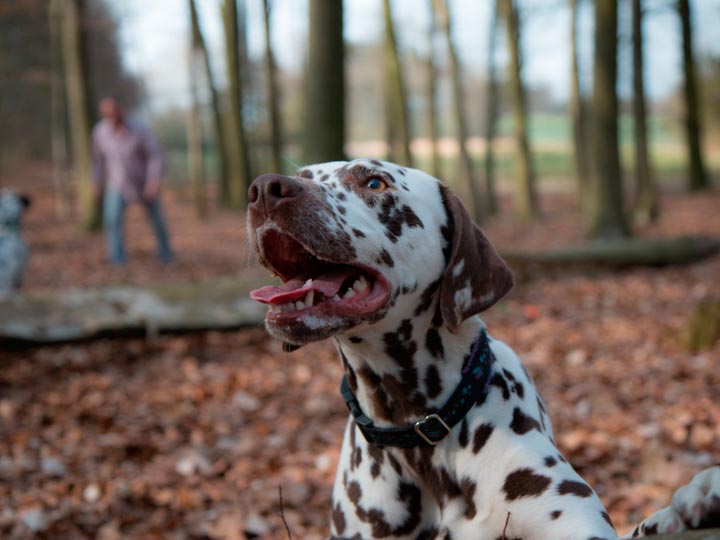
Dalmatians are often abandoned because people don't appreciate their free time and activity level. If the decision is positive, you need to decide what kind of puppy you need and for what purpose. Dogs with brown spots are very rare; they are generally stronger and larger than their black-and-white counterparts. Otherwise, they are no different. Gender is a matter of personal preference, but it's worth remembering that training a male is somewhat more challenging.
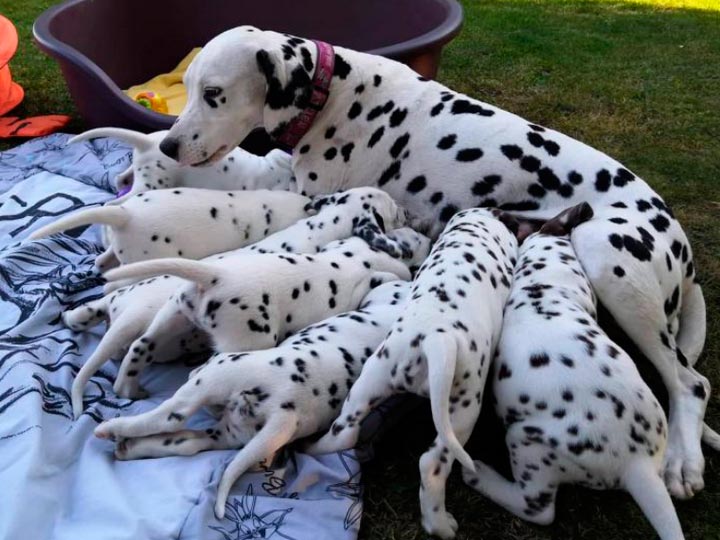
When the puppies are 1-1.5 months old, the breeder selects the best and identifies any puppies with exterior flaws. If you're looking for a future champion or a breeding dog, the puppy must be carefully assessed for compliance with the standard, or you should consider buying a young puppy. Purchase only from a kennel through a club. If you're simply looking for a pet, consider mid-grade puppies or defective puppies (with abnormal markings, blue eyes, etc.). These puppies are also considered purebred and must have documentation of their origin, but they cannot be shown and must be spayed/neutered.
A healthy puppy looks well-fed, with no tucked-up belly or prominent ribs. The skin is loose and easily folded. The coat is shiny and smooth. There should be no bald spots or discharge from the eyes or nose. The puppy is checked for deafness, hernias, and kinks in the tail, and the movement and position of the limbs are assessed. There should be no signs of aggression or shyness in behavior. It's also worth making sure that the breeder has provided the initial stages of socialization, which is important for developing a stable temperament.
Price
Show-quality Dalmatians often cost over $1,000. Pet-quality puppies cost an average of $500. You can find ads for puppies for sale for up to 10,000 rubles. These are often litters from unplanned matings or from dogs without a pedigree, meaning there are no guarantees regarding temperament or health.
Photos and videos
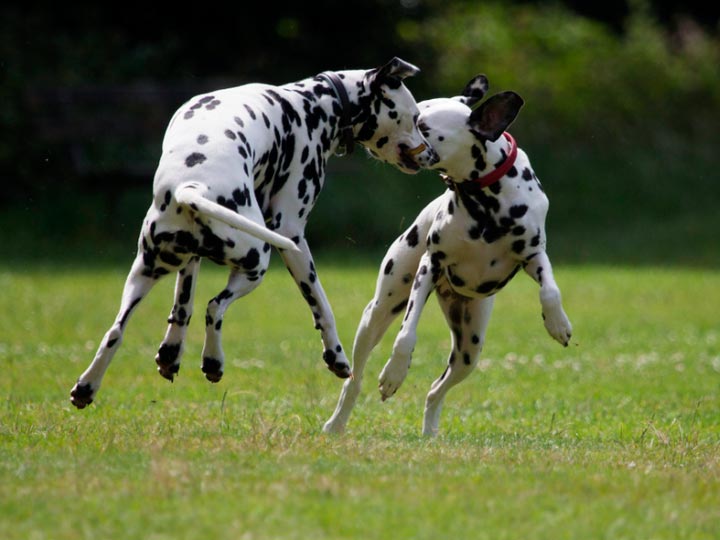
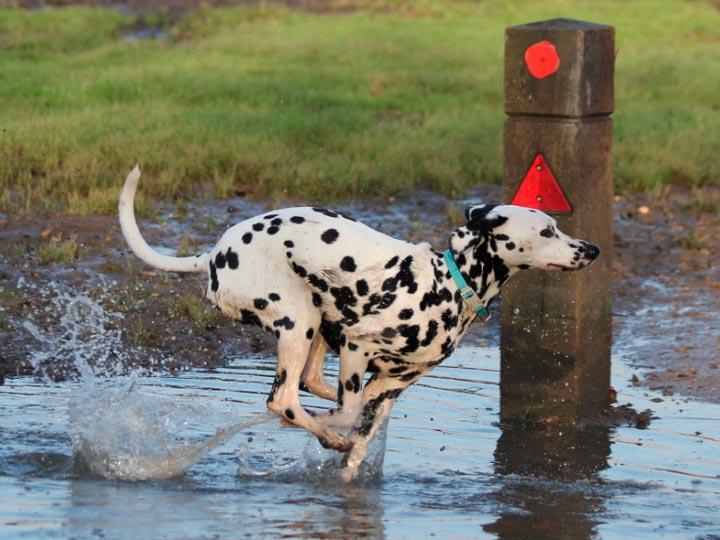
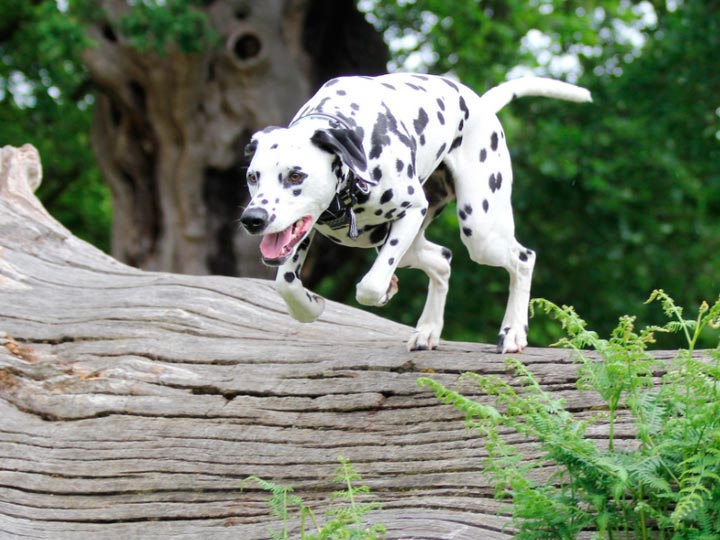
You can see more photos of Dalmatians in the gallery. Even in the photos, you can see how active they are and how they seem to radiate energy.

Video about the Dalmatian dog breed
Read also:


Add a comment