
What to do if your dog is choking
Sometimes dog owners contact the veterinarian with complaints that their dog is choking on a bone or has attempted to swallow an inedible object. Due to the anatomical features of the nasal passages of canines, foreign objects rarely enter their respiratory tract, whereas a bone, a lump of food, or a small ball can easily become lodged in a dog's throat. This can cause suffocation or even death. In such cases, the pet's life depends on your prompt and appropriate action.
However, it often turns out that the dog owner is unaware of first aid or has misdiagnosed the animal. Therefore, dog owners should be aware of the symptoms that indicate a foreign body is lodged in the animal's throat, larynx, or respiratory tract, and know what to do if such a dangerous situation arises.

Content
Typical signs
When a dog chokes, the foreign body in its throat becomes an obstruction and causes pain. This causes the animal to refuse food, sometimes even unable to drink, and drooling constantly. The inability to remove the obstruction causes the dog to panic, yelping, pawing at its muzzle, and craning its head downward.
Frequent bouts of severe coughing, which produce nothing, and fruitless gagging eventually develop into continuous wheezing when the animal is unable to inhale enough air due to swelling of the larynx caused by an object lodged there. The swollen mucous membranes become red or bluish. In severe cases, when the airway is almost completely blocked, the dog may lose consciousness.
You can recognize that your dog is choking by the following symptoms:
-
Restlessness and attempts to use paws to get something out of the mouth.
-
Cough, wheezing, or difficulty breathing.
-
Blueness of the tongue and gums.
-
Attempts to burp or gag.
-
Loss of consciousness in severe cases.
It's important to distinguish choking from a normal cough. Choking means the airway is blocked and the pet can't breathe, whereas coughing allows breathing.
Caution! If you are unsure whether the symptoms described are caused by a bone or other object in your dog's throat, taking any independent action is not recommended. Try to get your pet to a veterinarian as soon as possible, as it could actually be due to a medical condition that causes similar symptoms. Resuscitation should only be attempted if you see your pet choking and you simply cannot get to a veterinary clinic in time.

Other causes of similar symptoms
Similar symptoms include difficulty breathing, cough, salivation, vomiting can be caused by:
- Heart failure. The cause in this case is oxygen starvation, but the symptoms of suffocation develop gradually and are not so clearly expressed.
- Respiratory tract irritation. When substances that can irritate or injure the mucous membrane enter a dog's mouth, it will experience severe coughing fits, but there are no other signs typical of a situation where the dog is choking.
- Adenoviral infection (adenovirus). A disease of the upper respiratory tract and gastrointestinal tract caused by a DNA virus. Typical symptoms include coughing, sneezing, conjunctival redness, and fever.
- Rabies. The distinctive signs of this dangerous disease, in addition to difficulty breathing, severe salivation and refusal to eat, are photophobia and paresis of the limb muscles.
What to do
If you notice signs that your dog is choking, first assess its condition. If the animal has lost consciousness, has an irregular pulse, or is not breathing, immediate resuscitation is necessary: artificial respiration or chest compressions.
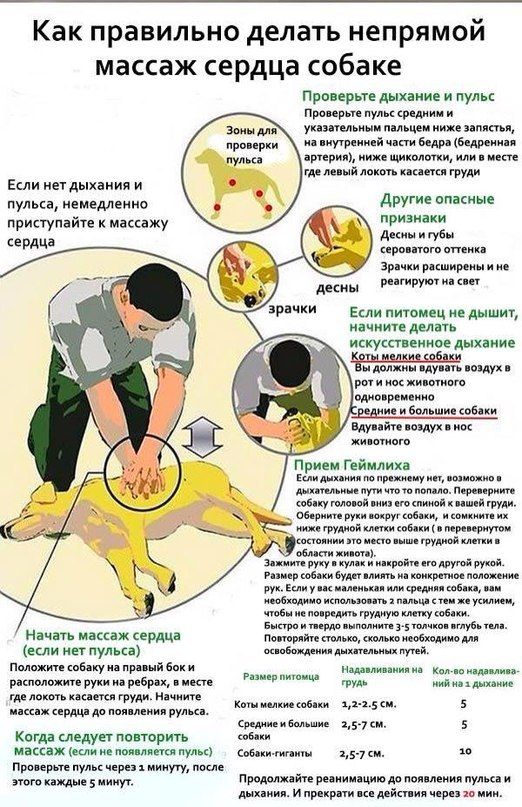
If your dog is conscious but showing signs of choking, take them to the vet immediately; every minute counts. If the dog isn't life-threatening and symptoms are limited to coughing and attempts to scrape the object out of its mouth with its paw, try to encourage swallowing by gently massaging its throat or offering it a tasty treat. You can also give it something to drink.
Caution! Some dog owners believe that pouring a couple of spoons of vegetable oil or egg wash into the dog's mouth can help dislodge an object stuck in the throat. However, to do this, you must be sure the foreign object is not sharp and is small.
If your attempt to "wash" the object from the throat's mucous membrane failed, you'll need to look down the dog's throat. To do this, sit the dog down, supporting its body with your legs, grasp the skin at the withers with one hand, and open the mouth wide with the other. Carefully examine the throat. If you find the foreign object, try to carefully remove it, being careful not to push it deeper.
There are special techniques for removing foreign bodies from a dog’s larynx or respiratory tract:
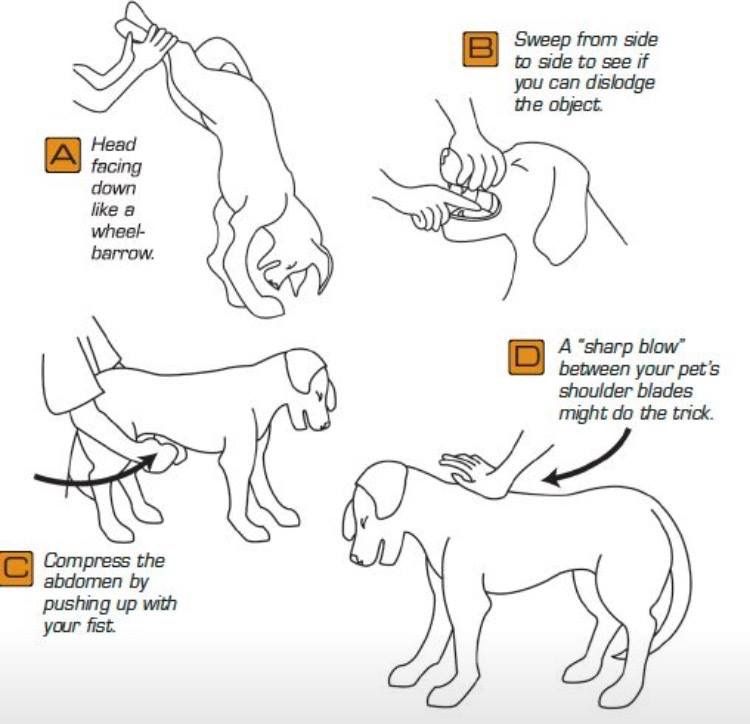
- Method 1: If your dog has tried to swallow a large amount of dry food at once and is choking on it, and is unable to drink water, lift it by its hind legs, head down, and shake it vigorously several times. If you don't wait until the dog's condition worsens and its larynx becomes swollen, this may be enough to dislodge the kibble.
- Technique 2: If your pet is choking on a small rubber toy, such as a ball, you can try to dislodge it by applying upward pressure on the dog's neck where the bulge is felt. Since these dog toys slide quite easily, this technique is quite effective.
- Technique 3. The most popular technique among veterinarians for removing a foreign object from a dog's throat when it's choking is to force it out with a stream of air while exhaling forcefully. To do this, pick up a small dog with its back against you, or place a larger dog on a flat surface and wrap your arms around its body. Then, place the fist of one hand on the upper abdomen where it meets the sternum. If you now press the abdomen upwards with a strong push, toward the front legs, the animal will exhale sharply, pushing the lodged bone or food bolus forward. This maneuver can be repeated several times until the foreign object is in the mouth, where it can be easily removed.
Of course, it's best to avoid such unforeseen circumstances. It's easy to do. Monitor what and how your pet eats. Train it not to pick up inedible items outside, and avoid giving it toys that it can easily swallow at home. Organize your pet's feeding schedule properly to avoid a situation where a hungry dog greedily pounces on food, risking choking. For "chronic hurriers," dry food can be soaked in warm broth or just water before serving. It's best to cut meat into small pieces. Sharp bones should never be given to dogs! One more piece of advice: it's a good idea to find an experienced veterinarian you can contact for help 24/7.
Even if the object has been removed and the dog is feeling better, it is recommended to consult a veterinarian for an examination, as airway damage or complications may occur.
Prevention
To prevent your dog from starting to cough, there are some precautions to take:
- Do not give your dog small bones or toys that it might swallow;
- Make sure your pet does not pick up objects on the street;
- Feed your dog in a calm environment, avoiding haste;
- Check toys regularly for integrity.
Knowing these simple rules will help you avoid dangerous situations and keep your pet healthy.
Veterinarian's comment
A professional opinion from a specialist: what to do after providing first aid:
Once a foreign object has been removed from a dog's airway, precautions don't stop there. Veterinarian Antonina Ivanova emphasizes:
"I always recommend additional examinations after removing a foreign object. Radiographs in two projections help ensure that no fragments remain in the trachea or esophagus. They also help rule out the development of a pneumothorax. We once had a case where, after performing the Heimlich maneuver, a dog's rib cracked, causing a lung injury.
If there's a suspicion that something sharp, such as a bone or plastic, remains in the throat, we order an endoscopic examination. We had a dachshund who developed a small esophageal rupture after a bone was removed, which later led to inflammation.
In situations where the object was removed with force or has been in the body for a long time, we perform an ultrasound of the abdominal organs—the liver, spleen, and kidneys—to rule out hematomas or hidden bleeding.
Sometimes a blood test for C-reactive protein (CRP) is required—this is a marker for inflammation. It can happen that an animal develops a latent infection 5–7 days after the incident. Another potential risk is hypoxia, when tissues don't receive enough oxygen. In such cases, we temporarily place the dog on an oxygen mask to prevent cerebral edema.
Regarding nutrition, after the object is removed, I recommend fasting for at least 12-24 hours. After this, it's best to switch to a bland diet. Pates and soft, pre-soaked foods are suitable. This diet should be maintained for 3-5 days until the pharyngeal mucosa recovers.
Important: If your dog continues to wheeze or cough a few days after the incident, be sure to get a follow-up x-ray. There was a case with a poodle where a plastic fragment from a toy lodged in its bronchi, causing inflammation and abscess formation."
Quick checklist: what to do if your dog is choking
In an emergency, there's no time to read instructions. Therefore, it's important to have a quick action plan at hand:
-
If your pet is coughing and appears agitatedDon't disturb him. This may be an attempt to relieve the obstruction in his airway. Try to remain calm and monitor your dog closely.
-
If breathing is difficult and the cough is weak or absent, try carefully examining the mouth and, if possible, removing the stuck object. Do this carefully to avoid pushing the object deeper.
-
If the object cannot be removed and the dog loses consciousness, apply the Heimlich maneuver. If you're unsure of the correctness of your actions, take your pet to the veterinarian immediately. Time is running out.
-
Contact a veterinary clinic even if there seems to be an improvement.A specialist examination will help rule out complications that may not appear immediately.
Read also:


Add a comment