
African black-footed cat (ant tiger)
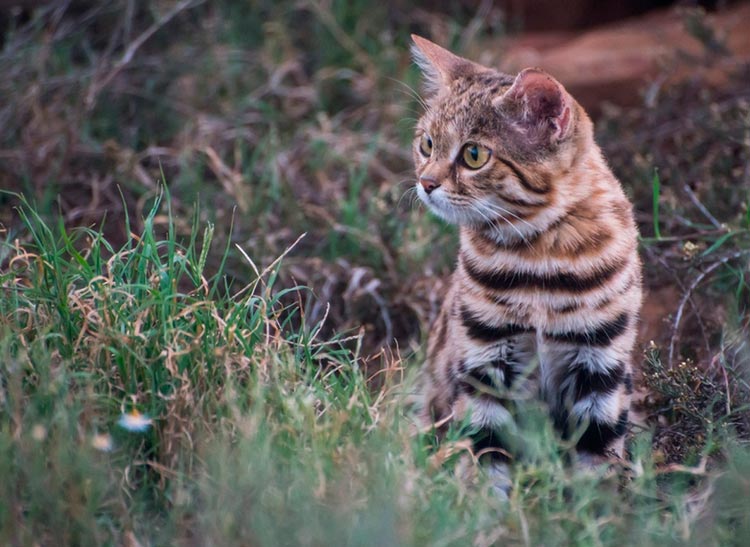
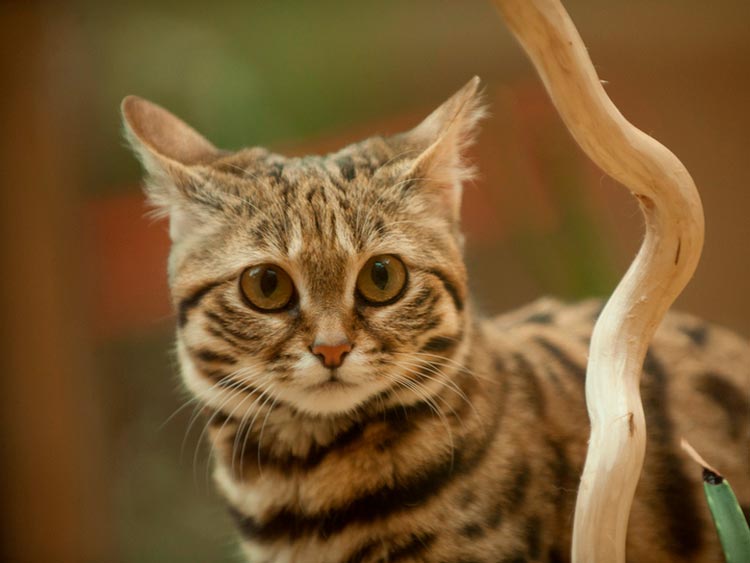
Black-footed cat The African wild cat is a charming member of the feline family native to South Africa. Its diminutive appearance and beautiful spotted coat conceal a wild, predatory nature with an insatiable hunting instinct. Since 2002, it has been listed as a critically endangered species, making it difficult to keep as a pet for this and other reasons.
Content
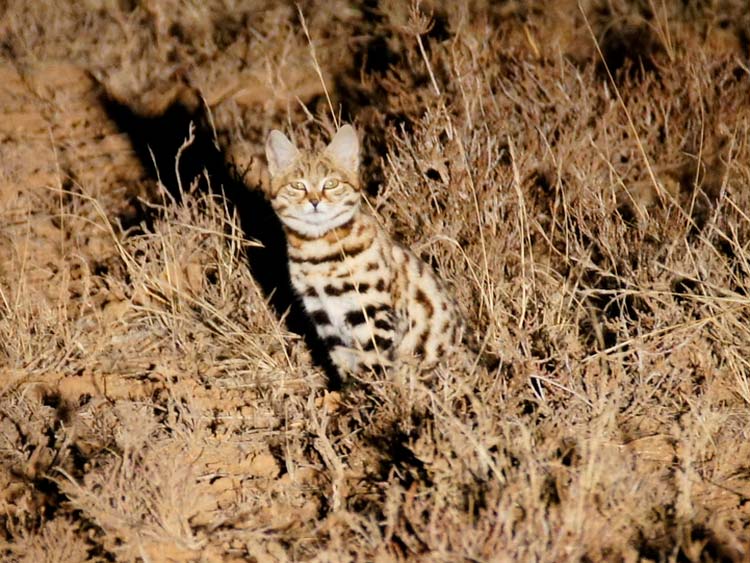
Black-footed cat in the wild
Black-footed cats are endemic to southern Africa. They inhabit grassland and semi-desert areas, including arid open savannahs, where small rodents and ground-roosting birds are abundant. These small predators nest in empty porcupine and aardvark burrows, as well as in empty termite mounds, which is why they have earned their second unofficial name—ant tiger. Zoologists distinguish two subspecies of black-footed cats:
- Felis nigripes nigripes is found in Namibia,
- Felis nigripes thomasi (darker in colour) is found in Botswana.
These small "tigers" are tireless hunters. They can travel up to 16 km in a single night, searching for small mammals, and they make one leap every half hour to catch their prey. More than half of these leaps are successful. Black-footed cats hunt at night in all weather conditions, and their survival skills are remarkable. Few arid predators can boast a diet consisting of 54 different species of animals and birds. Furthermore, these cats can go for long periods without water, absorbing as much liquid as possible from live food.
The black-footed cat leads a solitary lifestyle. Males occupy a home range of up to 15 square kilometers, often overlapping with females' territories, which cover approximately 10 square kilometers. Both male and female cats mark their territories. While females primarily use scent marking, such as rubbing against objects, leaving feces or urine in visible areas, and scratching, males can spray urine up to 12 times an hour. Female cats' calls are very loud compared to animals of similar size. At close range, they use quieter sounds: purring, gurgling, hissing, or growling if threatened.
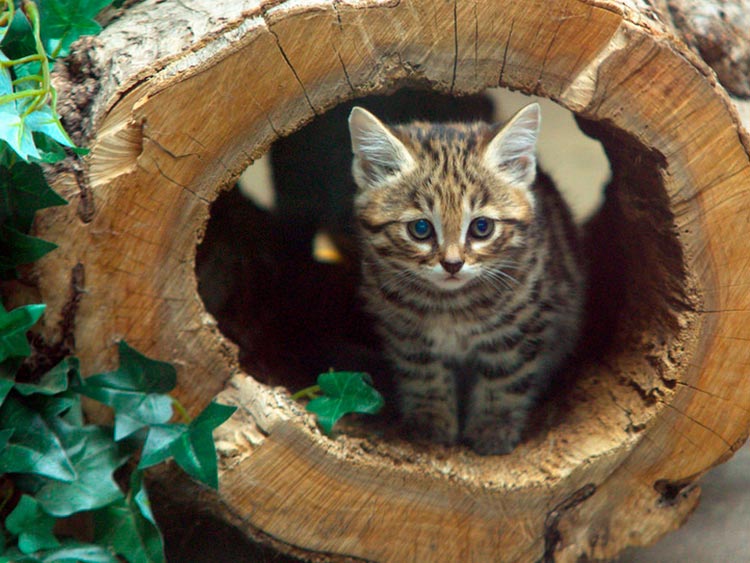
Females reach sexual maturity at 8 to 12 months. The period of sexual activity lasts only 1-2 days, and fertilization is possible only for a few hours. After courtship and mating, the couple separates. Gestation lasts 60-68 days. One or two semi-hairless kittens are then born, which are fully furred only by 6 weeks, but by 3 weeks they begin to emerge from the den. Interestingly, if threatened, they do not return to the house, but disperse and hide in nearby shelters. They remain quiet until called by their mother. At 7-8 weeks, the kittens begin to hunt prey brought to the den by their mother, and by 3-4 months they begin to forage for food on their own. Female cats can have up to 2 litters per year.
The black-footed cat is listed on the IUCN Red List of Threatened Species and in Appendix I of the CITIES. Hunting is prohibited in South Africa and Botswana. There are just over 13,000 black-footed cats in the wild, of which approximately 10,000 are sexually mature.
Video about African Black-footed Cats:
Appearance
The black-footed cat is the smallest of all African cats and is only slightly larger rusty spotted cat, and therefore ranks a respectable second on the list of the world's smallest wild cats. Male cats range in body length from 37 to 44 cm, with a tail measuring 16 to 19 cm. The average weight is 1.9 kg. Female cats weigh an average of 1.3 kg, with a maximum of 1.6 kg. Their body length typically does not exceed 36 cm, with a tail measuring 12.5 to 17 cm.
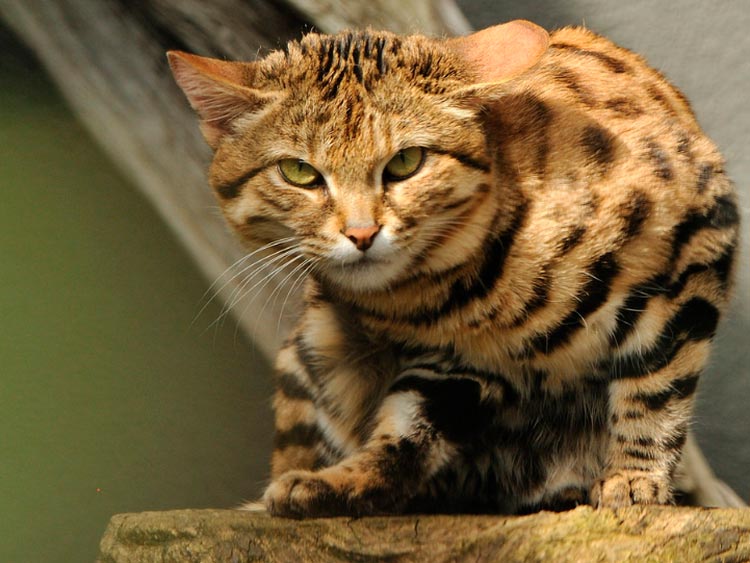
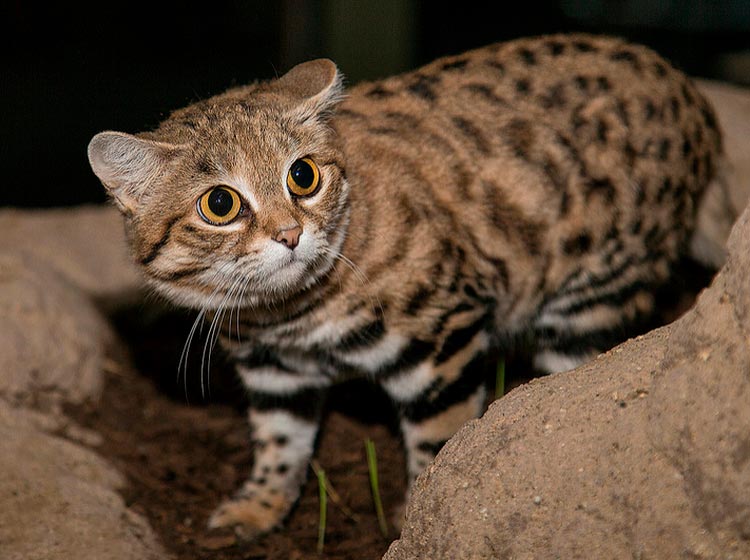
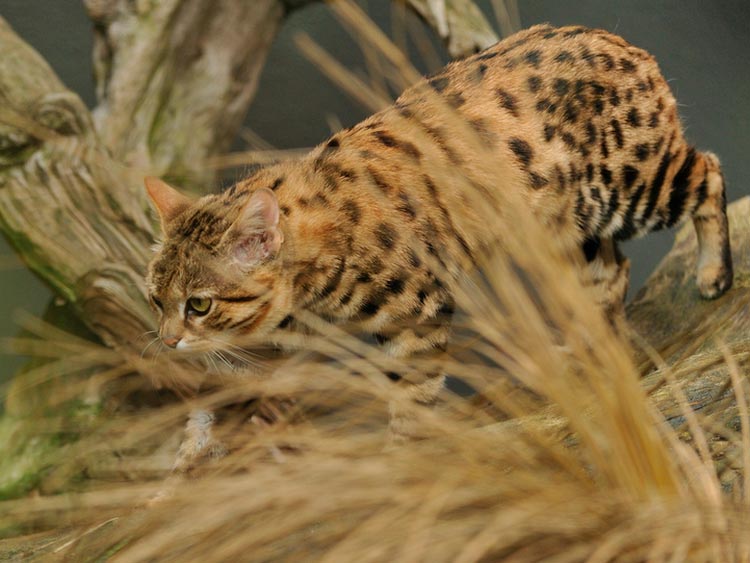
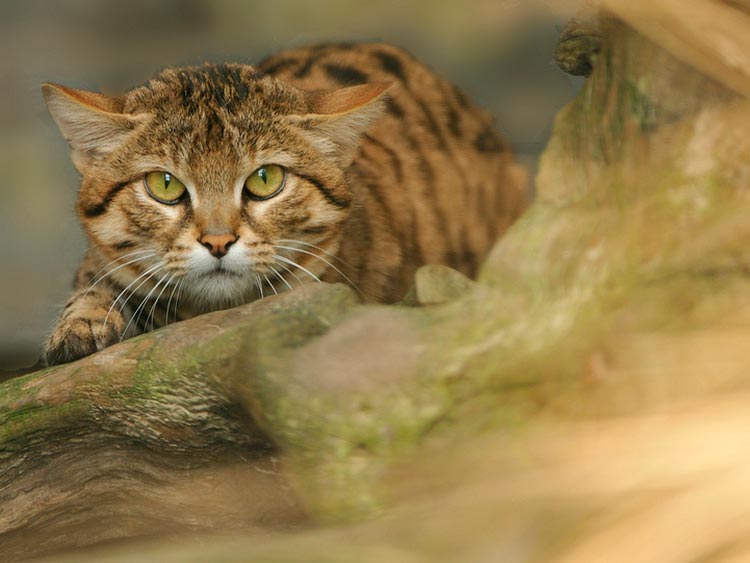
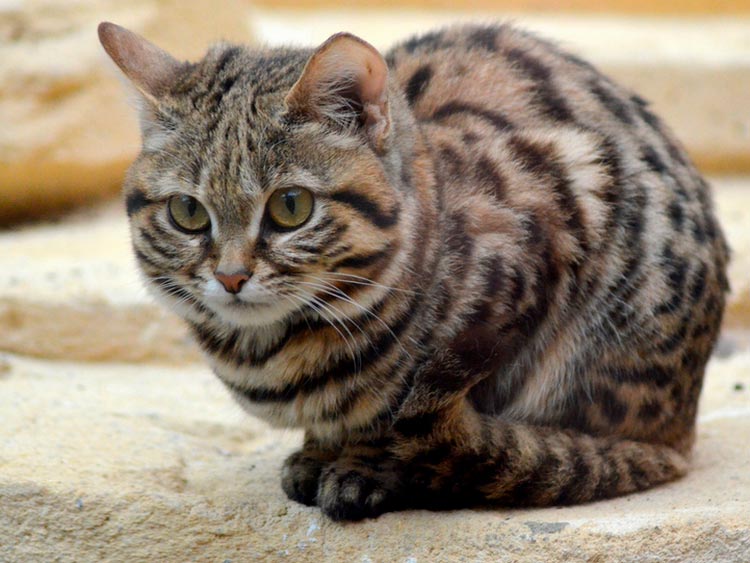
Don't be misled by the name of these cats. In fact, only the lower part of the legs that touch the ground, no higher than the metatarsus and carpus, is black. Overall, the coloring is very beautiful: yellow or yellow-brown with dark spots and rosettes on the body. On the upper legs, dark stripes form rings, on the neck there is a "necklace," and on the muzzle, two distinct arrows extend back from the eyes.
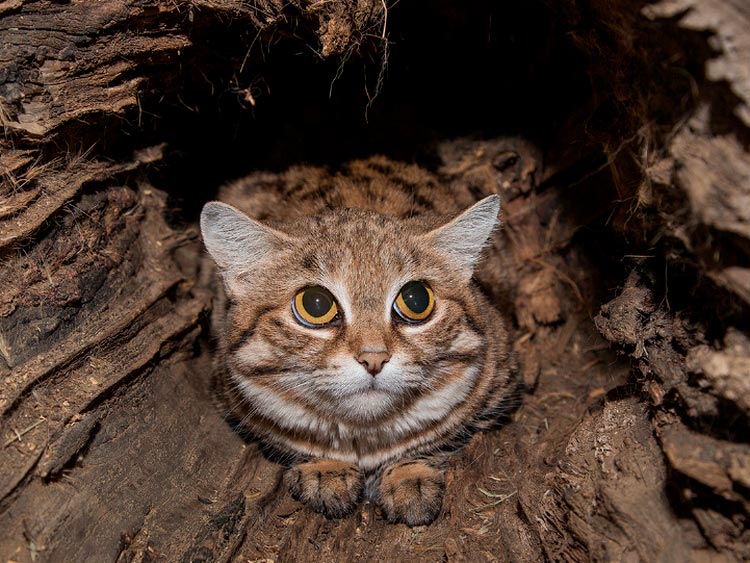
Thanks to its coloring, the small cat is well concealed from enemies and unnoticed by its prey. Its large eyes are perfectly adapted for hunting at night, and its rounded, mobile ears catch every sound.
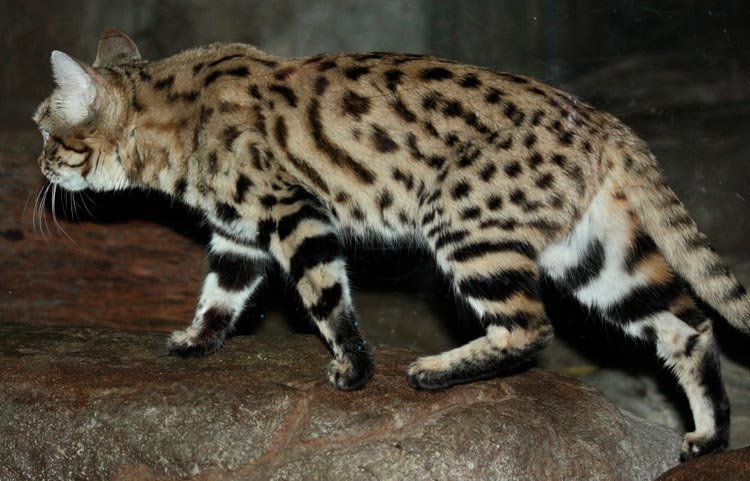
The black-footed cat is quite stocky with large eyes, rounded ears, a short tail, and moderately long legs. Additionally, black-footed cats have only six mammary glands (compared to eight in other cats) and light, unpigmented skin, which is unusual for animals with a spotted coat.
Character and habits
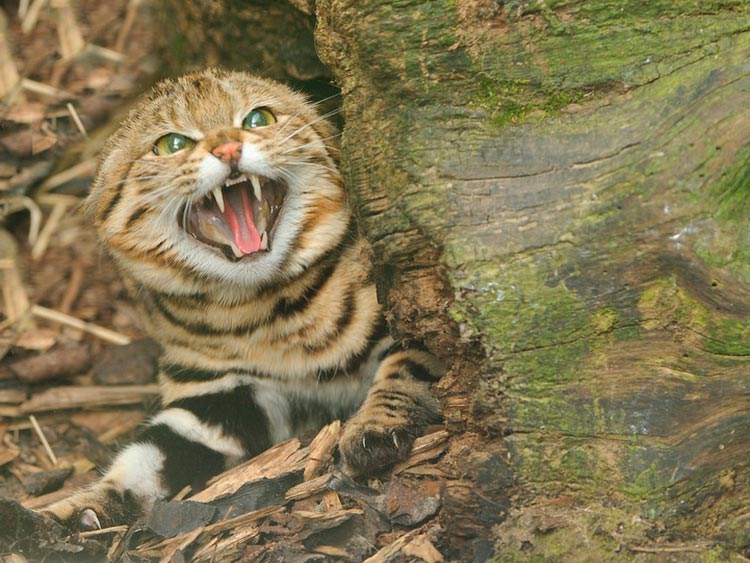
The African black-footed cat is exceptionally unsociable, retreating to a shelter at the slightest sound, but when cornered, it will defend itself fiercely, displaying incredible courage and tenacity. Females become especially aggressive during the mating season, pregnancy, and kitten rearing.
Black-footed cats are primarily active hunters. They dislike sitting in ambush for long periods of time and rarely wait for rodents near their dens. They utilize the darkness of night and their keen sense of smell to track tracks and get as close to their prey as possible until they can pounce. Unlike other cats, they dislike climbing tree branches. Their stocky bodies and short tails are not suited for this, but they can vigorously dig in the sand to alter the shape of their den, making it more spacious or deeper.
The black-footed cat's predatory nature is legendary among Bushmen. It is said to be capable of killing a giraffe. This is, of course, an exaggeration, emphasizing its assertiveness and predatory nature. However, it is indeed capable of attempting the impossible. Eyewitnesses recount how a 1.5 kg cat stalked an ostrich on its nest for over an hour. Just as the predator was about to pounce, the bird rose to its feet and, without even noticing, disappeared in a cloud of dust.
Diet
This small predator feeds on small animals, gerbils, shrews, as well as small birds, insects, and reptiles. It also enjoys eggs. In its hunting frenzy, the cat will not hesitate even to hunt prey twice its own size. A hare or black bustard may be its breakfast. The thrifty animal does not abandon any leftovers, storing them in its burrow and then returning to them.
The black-footed cat has very high energy requirements. In one night, it kills about 14 small animals and consumes approximately 250 grams of a variety of food, which is one-sixth of its body weight.
Health and life expectancy
Very little is known about the health of black-footed cats in the wild. Scientists have discovered an unusual high creatinine levels and urea levels in the blood of healthy animals. Furthermore, they have higher energy requirements than other African wildcats. They are susceptible to the same diseases as domestic cats, so in zoos, they are vaccinated against the main infections. Their lifespan in captivity is approximately 10 years.
The main threats to anttigs are habitat degradation and the indiscriminate use of pesticides, which they accidentally consume. Other threats include human impacts on their habitat, agricultural development, and the expansion of cattle pastures. Black-footed cats can be killed in encounters with snakes, jackals, and caracals. They are also occasionally attacked by domestic dogs.
Conservation work and captivity
The black-footed cat has been studied far more than many other small cats. Since 1992, research has included animal monitoring, screening their movements with radio collars, and studying threats and the status of the species in various habitats. Worldwide, only about 50 black-footed cats are kept in zoos, approximately 20 of which are in the United States, and a few in private hands.
Black-footed cats have difficulty adapting to captivity and reproduce poorly. Many zoos have special breeding programs to maintain genetic diversity and minimize inbreeding. One of the leading breeding centers for black-footed cats is the zoo in Wuppertal, where they have been successfully bred since 1957. It is here that their international studbook is kept.
In 2011, a black-footed cat gave birth to two kittens through artificial insemination at the Center for the Study of Endangered Species in America. In 2012, at the same center, embryos were implanted into a common domestic cat, who successfully carried the pregnancy to term and gave birth to one black-footed kitten.
Black-footed cat hybrids
There is successful crossbreeding of the black-footed cat with sand dunes and domestic cats. Such experiments pose a threat to the species' existence, but this hasn't stopped breeders from trying to develop a domestic cat with a similar pattern. It's likely that the world of felinology will soon be enriched with another interesting breed.
Those wishing to have a spotted cat with a pattern similar to the African Black-footed Cat may want to consider the following breeds: Ocicat, California Shining, bengal cat, Kanaani, Arabian Mau, Egyptian Mau or Serengeti.
Where to buy an African black-footed cat
Many exotic animal lovers would love to have this adorable wild cat as a pet, but purchasing a kitten is quite difficult. And it's not just the price. This rare animal is endangered, and its ownership and breeding are strictly regulated. According to some estimates, the price of a black-footed cat is $10,000-$15,000.
Photos
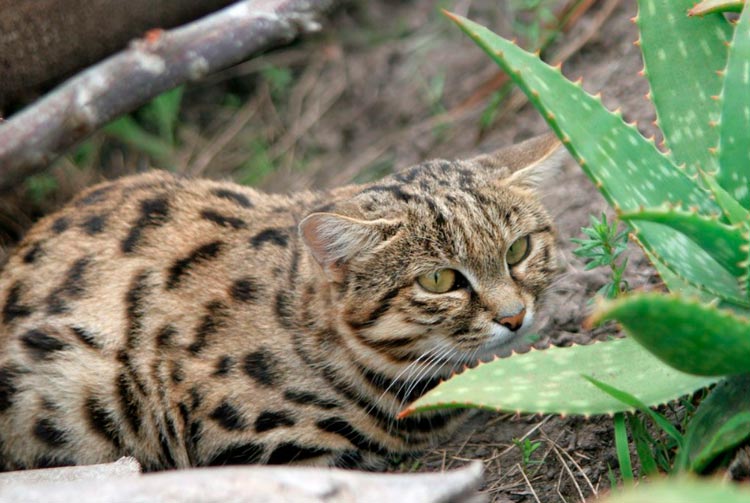
The gallery contains photographs of African black-footed cats in their natural habitat and in zoos.
Read also:


Add a comment