
What diseases can a person get from a cat?
Pet owners often wonder what diseases cats can transmit to humans. After all, as the saying goes, forewarned is forearmed. Knowing the potential dangers makes it easy to prevent the development of diseases.

Content
- 1 Why are diseases transmitted from cats to humans?
- 2 Helminthic infestations
- 3 Rabies
- 4 Ringworm
- 5 Toxoplasmosis
- 6 Salmonellosis
- 7 Tuberculosis
- 8 Allergic reactions caused by contact with cats
- 9 How to minimize the risk of infection
- 10 Risk factors for pregnant women
- 11 Comparison of common diseases transmitted from cats to humans
- 12 When to see a doctor
Why are diseases transmitted from cats to humans?
Many feline diseases are zoonotic in nature, meaning they can be transmitted from animals to humans. Transmission routes vary, including bites and scratches, contact with animal fur, saliva, and secretions, and poor hygiene. Children, the elderly, and people with weakened immune systems are particularly at risk.
Helminthic infestations
Cats, like other animals, are susceptible to various diseases. Some of these can be transmitted to humans. The most common of these diseases include helminthic infestations, but not all types of parasites can be transmitted.
People can catch the following helminths from cats:
- ascaris;
- cucumber tapeworm;
- echinococci.
The remaining species can be considered safe for humans, as their members are not adapted to survive in the human body. Even if accidentally exposed, they quickly die.

These species are often transmitted from pets to humans. Because they live in the intestines, digestive problems can occur, but often the illnesses are asymptomatic in humans. Children who have close contact with animals are particularly at risk. To prevent infection, it is important to strictly observe hygiene rules, including washing your hands thoroughly after contact with pets. Furthermore, it is important to deworm your cat regularly, and check children for worms.
Rabies
Infectious disease rabies Rabies is rare in domestic cats, as they are vaccinated against this deadly disease. Infection most often occurs from stray animals through bites or scratches. Signs of rabies in cats include excessive aggression, foaming at the mouth, and photophobia.

If you suspect a rabid cat has attacked, flush the wound with clean water and seek immediate medical attention. If treatment is started immediately, the chances of recovery are high. Otherwise, there is a high risk of death.
Ringworm
This is a disease It's not life-threatening in humans, but is easily transmitted from cats. This dermatological condition is caused by fungi or mycosporia. Symptoms of ringworm include pink, sharply bordered spots on the skin that constantly peel. They can grow in size, causing itching and discomfort. Children are most susceptible to the disease due to their weakened immune system.

Infection occurs through direct contact with an infected pet. Ringworm in cats can be identified by bald patches on the body and scaly lesions, usually located near the head but can also be found elsewhere. If ringworm is detected in a cat (confirmed by a skin scraping), contact with children should be limited, and hands should be washed thoroughly with antiseptic. When treating wounds, it is best to use medical gloves to prevent fungal spores from penetrating the skin.
Toxoplasmosis
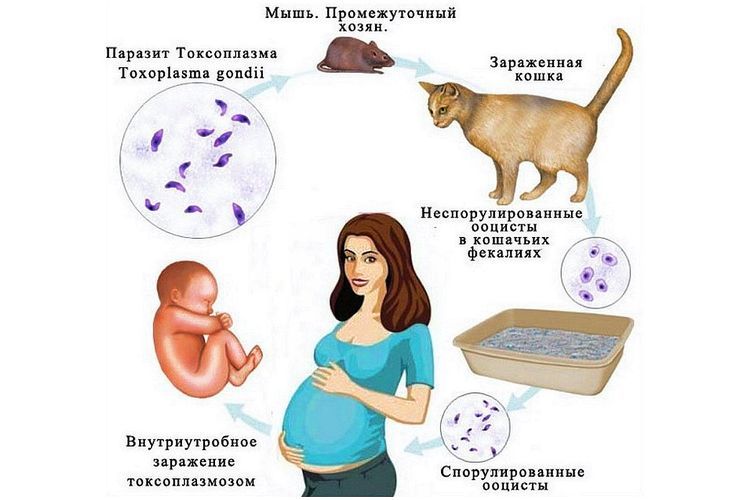
You can get infected from a cat toxoplasmosisPregnant women should be especially careful. Infectious pathologies caused by protozoa can cause fetal abnormalities or miscarriage.
Signs of the disease in humans include the following symptoms:
- weakness and lethargy;
- increased body temperature;
- enlarged lymph nodes;
- headaches.
The course of toxoplasmosis is similar to influenza.
In animals, the disease is most often caused by eating spoiled meat or fish. Humans can become infected if hygiene rules are not followed. Hands should be washed especially thoroughly after cleaning the litter box. It's best to use special hand sanitizers for this purpose.
Salmonellosis
Salmonellosis It occurs in both animals and humans, but is usually caused by different bacterial strains. Therefore, the disease is rarely transmitted from cats to humans, only if the pet is infected with bacteria that can live in humans. Microorganisms are transmitted through feces and saliva, that is, through direct contact or by cleaning the animal's litter box. Signs of the disease include:
- severe diarrhea;
- nausea and vomiting;
- sharp abdominal pain;
- black stool.

Bacteria enter the body of pets through raw meat, eggs, and unpasteurized dairy products.
Sometimes, some other types of pathogenic microorganisms are transmitted from animals to humans – campylobacter, listeria, etc., although in most cases, feline intestinal infections are not dangerous to humans.
Tuberculosis
In cats, tuberculosis is caused not by Koch's bacillus, as in humans, but by a different type of bacteria. Despite this, the microorganisms are dangerous to humans and easily transmitted. However, the disease is quite rare in animals. Tuberculosis in cats has the following symptoms:
- high body temperature;
- heavy breathing;
- weight loss;
- lethargy;
- excessive drowsiness.

Allergic reactions caused by contact with cats
Although allergies are not infectious, they are also considered a negative consequence of exposure to cats. Allergens are found not only in fur, but also in the saliva, urine, and skin secretions of cats. For some people, contact with a pet can lead to persistent runny noses, coughing, and skin rashes.
How to minimize the risk of infection
Prevention is always easier and more effective than treatment. To reduce the risk of infection, cat owners are advised to:
-
deworm your pet regularly;
-
keep the litter box, feeders and places where the cat likes to rest clean;
-
carry out vaccinations in a timely manner;
-
avoid close contact with stray animals;
-
wash your hands after playing and interacting with your pet;
-
Keep cats away from table surfaces and food.
Risk factors for pregnant women
Pregnant women are at particular risk, as cats can carry toxoplasmosis. While the disease may be asymptomatic for the cat, it can pose a serious risk to the fetus. Therefore, it's important for pregnant women to get tested and avoid cleaning the litter box without gloves and practicing proper hand hygiene.
Comparison of common diseases transmitted from cats to humans
To make it easier to navigate, we provide a table:
| Disease | Pathogen | Routes of infection | Symptoms in humans |
|---|---|---|---|
| Toxoplasmosis | Toxoplasma gondii | Contact with feces, dirty soil, meat | Increased temperature, enlarged lymph nodes |
| Ringworm | Fungi Microsporum, Trichophyton | Contact with wool and skin | Red spots, itching, hair loss |
| Cat scratch disease | Bartonella henselae | Bite or scratch | Inflammation of the lymph nodes, fever |
| Salmonellosis | Bacteria of the genus Salmonella | Contact with feces, contaminated food | Diarrhea, vomiting, abdominal pain |
| Chlamydia | Chlamydophila felis | Contact with mucus or secretions | Conjunctivitis, redness of the eyes |
When to see a doctor
If unusual symptoms develop after contact with a cat, such as a high fever, persistently swollen lymph nodes, severe itching, or a skin rash, you should consult a doctor. This is especially important for children and people with weakened immune systems.
The best way to prevent the disease in humans is to follow hygiene rules, since the main route of infection is through direct contact with a sick pet.
Knowing the potential illnesses that can be contracted from a domestic cat, owners are paying more attention to personal hygiene and disease prevention. Caution is advised when playing with your pet, as it can cause cat scratch disease. It is characterized by inflammation and festering wounds that develop at the site of the scratch. To avoid potential unpleasant consequences, scratches should be immediately washed with water and treated with an antiseptic.
Read also:


Add a comment