
How and what to use to wash a kitten's or cat's eyes
Kittens and adult cats sometimes experience eye problems due to infectious diseases (viral rhinotracheitis, chlamydia, panleukopenia, etc.), injuries, anatomical differences in certain breeds (Sphynx, British Shorthair, Rexes), age, foreign particles, allergies, helminthiasis, and inversion of the eyelid. If your cat experiences tearing, eyelid sticking together, purulent discharge, or other visible changes, the eyes should be flushed.
You don't need to go to a veterinarian for treatment, as the procedure isn't complicated. Knowing what to use to flush your cat's eye and how to do it properly at home will help your pet and avoid worsening its condition.
Content
Rinsing agents
The nature of the discharge can help determine the cause of the problem and determine how to flush or clean your cat's eyes. Thick, purulent, yellowish discharge and stuck-together eyelids indicate a fungal, bacterial, or other infection. Watery, colorless discharge indicates an injury or allergic reaction. Colorless discharge that turns brown when dry indicates dirt or dust particles in the eyes.
Ready-made solutions for washing dirty pet eyes are available at veterinary stores and regular pharmacies. They are safe for pets' eyes. You can also make them at home using readily available ingredients. If you're unsure how to clean and treat your cat's eyes, check out our recommendations.
Caution! Don't rinse your cat's eyes as a preventative measure, as this can cause harm to their sensitive eyes.
- Furacilin. The most effective and inexpensive eye wash is a 0.02% furacilin solution. Higher concentrations of the medication can cause irritation and even corneal burns, so diluting the solution yourself is not recommended.
- Boric acid. Can be used in case of suppuration and inflammation of the eyes in the absence of bleeding and damage to the mucous membranes.
- Physiological solution. Saline solution should be purchased from a pharmacy in a concentration of 0.9% to avoid burning the mucous membrane.
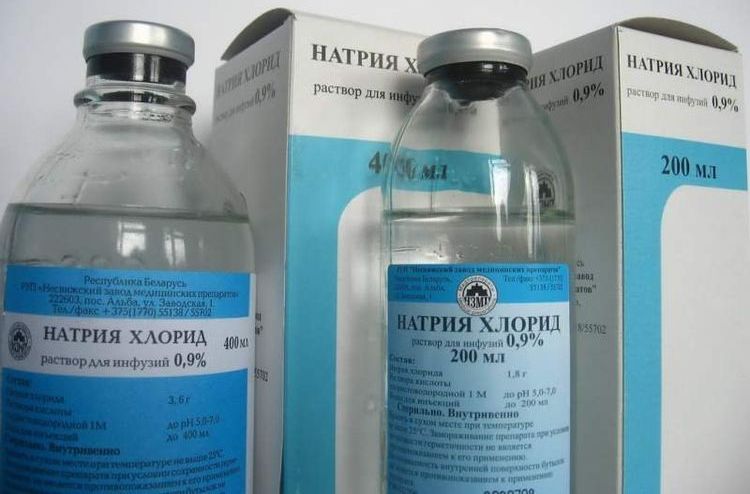
- Chlorhexidine. You can also rinse your cat's eyes with chlorhexidine at a concentration of 0.01%. This solution is easy to use at home.
- Potassium permanganate. Potassium permanganate crystals must be dissolved in water until a pale pink liquid is obtained. Undissolved crystals can cause a chemical burn.
- Herbal infusions. To wash your eyes, you can use weak infusions of herbs such as calendula, hyssop, chamomile, or St. John's wort. Pour 1-2 teaspoons of the herbs into 200 g of boiling water and let steep for 7-10 minutes. Then strain through several layers of cheesecloth, cool, and use.
- Black tea. For rinsing cats' eyes, you can use used tea leaves rather than freshly brewed tea. Allow the tea leaves to sit for at least 10-12 hours, or preferably a day, before use. Also, don't use tea bags; only loose leaf tea.
When it comes to kittens, it's best to leave the choice of eye treatments for young pets to a veterinarian. Over-the-counter medications or home remedies that successfully treat adult cats may not be suitable for kittens due to their immature immune system. If the discharge is minor, you can rinse the kitten's eyes with plain, clean, boiled water. However, if the discharge is profuse, including pus, the following remedies should be used:
- Diamond Eyes — the main component is chlorhexidine. Taurine and Chlorocide C, also included in this medication, have a healing effect;
- "Bars" drops are recommended for use as a compress. The preparation contains furacilin, which kills microbes. Novocaine provides anesthetic properties.
- medicine "Iris" contains the antibiotic Gentamicin and healing components such as sodium metabisulfite, polyvinylpyrrolidone, EDTA;
- with purulent conjunctivitis use eye drops containing antibiotics Levomycetin or Ciprofloxacin. They can be administered in the same way as human eye drops.
Features of the treatment procedure for adult cats
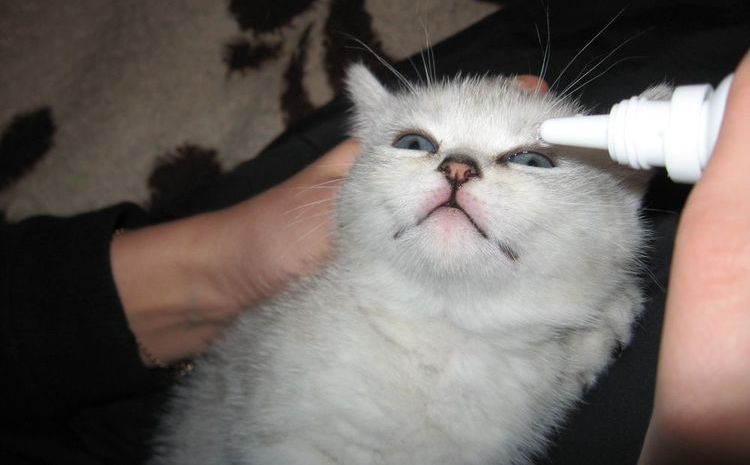
Cats are usually reluctant to allow any medical procedures to be performed on them. Therefore, eye irrigation is difficult to perform alone. It's best to do this with an assistant who can hold the animal.
- Prepare the following equipment: cotton pads, cloth napkins, gauze or bandage, 5 or 10 cc syringes without needles.
- Wrap the animal in a towel or soft cloth to secure it.
- Soak a cloth in warm medicinal solution and squeeze it onto the sore eye.
- Wait until the crusts soften, and then remove them with a cotton pad, moving from the outer corners of the eyes to the inner ones.
- If your eyelashes are stuck together with pus or your eyes are watery, move the tissue from your nose to your ears to open your eyes. Change the cotton pads as they become dirty.
- Carefully pour the solution onto the cornea of the cleaned eye using a syringe.
- Remove excess solution by blotting the eye with a dry tissue or a cotton swab wrapped in a bandage. Avoid touching the eyeball with the gauze or swab during this procedure.
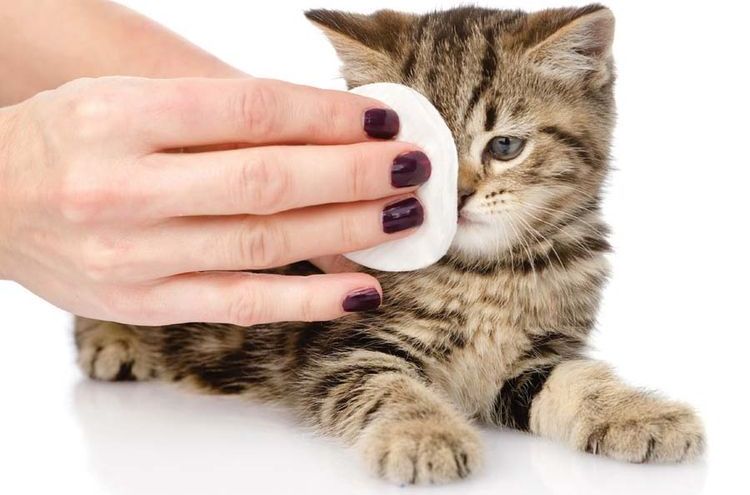
Caution! Before rinsing your cat's eyes, do not wipe them with dry cotton wool, as this will further irritate the eyes.
Features of the procedure for kittens
Kittens are born with their eyes closed. They begin to open after 3 to 12 days. Initially, the iris is a cloudy gray, but later, depending on the breed, it turns yellow, green, or blue. During the first few days of life, kittens' eyes secrete mucus, which is removed by the mother cat. Cat saliva has antibacterial properties, protecting the eyes from infection. Over time, kittens learn to clean themselves. However, if they are unable to do so, they need assistance.
The procedure for washing kittens' eyes is similar to that used for adult cats, whether they're Scottish Fold, British Shorthair, or other breeds. However, it requires more gentleness and care. Furthermore, a single person can wash a kitten's eyes.
If your pet's doctor has also recommended eye drops If you're using ointments or creams, you can apply them 5-10 minutes after cleaning their eyes. This waiting period is necessary to avoid causing an adverse reaction between the ingredients of the medications.
You can also ask our website's staff veterinarian a question, who will answer them as quickly as possible in the comments box below.
Read also:
- When do kittens open their eyes?
- My kitten has pus in his eyes: causes and what to do
- Why does a cat have pus in its eyes?


39 comments
Svetlana
Hello! The kitten is 20 days old! His eyes are festering and stuck together.
Violetta
Good afternoon.
Could you please tell me? My kitten has had light green discharge from her eyes for two months, and then it hardens. This continues throughout the day. We've been using chamomile tea for a couple of days, but I see no results.
What is the best way to treat it?
Daria is a veterinarian
Hello! We need to determine the underlying cause of the discharge. Is it an underlying problem, or is it a symptom of another infectious disease? The treatment plan will then be determined based on this. Either topical antibiotic treatments (drops) or intramuscular antibiotic therapy and symptomatic therapy will be prescribed. You can wipe the area with a sterile aqueous solution of furacilin (from the outer corner to the inner corner). Is there any nasal discharge? Are your pet's vaccinations up to date?
Lyudmila
Hello, we found a stray kitten. He has a cloudy, very bulging eye with a white coating and purulent discharge. We gave him antibiotics and washed it, applied tetracycline ointment, the pus disappeared, but it didn't help the eye. There is still a coating, the pupil is not visible, but the kitten plays and eats normally. Please help.
Daria is a veterinarian
Hello! The kitten most likely suffered from an infectious disease that lasted a long time. Therefore, there may be irreversible changes in the cornea, which led to the cloudiness. An in-person examination is necessary to assess the situation and determine whether there is a chance of fully restoring the eye's health or whether the little one will be left with this condition for the rest of their life.
Valery
Dasha, thank you for your recommendations (advice).
All the best in life
Maria
Hello! A month ago, we adopted a kitten at our dacha. Literally two days later, a dark ring appeared on the iris of one eye, and the cornea became cloudy. The only medication we had was Norfloxacin eye drops (we used them for 10 days, although improvement was already visible on the second day). Today, the situation with the eye repeated itself. We started rinsing with Furacilin (one tablet per 150 ml of water). QUESTION: Can we use Norfloxacin drops again? It's only been two weeks since the previous course, and we don't have anything else, and there's no pharmacy nearby.
Daria is a veterinarian
Hello! It's certainly advisable to change the antibacterial medication. But if you don't have anything on hand, there's no choice. Are you sure it's an inflammatory process? Perhaps it would be better to look for medications for intramuscular or oral use? Perhaps the eye problems are just a symptom of an underlying disease, not the actual problem. Using eye drops only alleviates the symptom, but the underlying problem persists, causing the eye problems to recur. Do you have a pharmacy nearby? At least look for amoxiclav; it's available without a prescription. Although it would be a good idea to also give antiviral medications, since the nature of the disease is unknown.
Alla
How to obtain an aqueous solution of furacilin for rinsing the eyes of an adult cat?
Daria is a veterinarian
Hello! Yes, you can buy it pre-prepared at a pharmacy. It's very cheap and, most importantly, sterile. You can make it yourself, but it's not very convenient to count. You'll need to dilute 1 g of furacilin in 1500 g of distilled (or at least boiled) water (for an aqueous solution, the concentration is 1:1500). But it's better not to bother and buy it pre-prepared at the store. Some come in bottles, some in bags. In any case, draw it up with a syringe, then moisten sterile wipes or at least bandages (without protruding threads, so as not to get any in your eyes).
Oksana is a pharmacist.
Bring 1 furacilin tablet to a boil in 100 ml of hot water. Cool to room temperature. Store in a sealed bottle. The solution has a shelf life of 10 days.
Catherine
Good afternoon! We adopted a two-month-old Sphynx kitten. His eyes are watery. I wash them with tea. It helps for a short time, but then it goes away. What vaccinations should we get and at what age? Do we need a veterinary passport?
Daria is a veterinarian
Hello! It's essential to get a veterinary passport. This is a kind of vaccination record for your pet, which lists all preventative treatments. Vaccinations include combination vaccines against infectious rhinotracheitis, calicivirus, and panleukopenia. A more comprehensive vaccine is also available, which also protects against chlamydia, leptospirosis, rabies, and infectious peritonitis. Two weeks before vaccination, parasites should be eliminated. But before vaccination, it's important to understand the cause of the watery eyes. What kind of discharge is coming from the eyes? What are you feeding? What is the body temperature?
Irina
Hello, my kitten is 1 month old, his eye is stuck together and green pus has appeared. I wash it with furacilin and put in Anandin drops, but it doesn't help.
Daria is a veterinarian
Hello! Anandin is an immunostimulant, often prescribed for viral infections as an ADDITIONAL medication (in addition to the main treatment regimen). Pus is caused by bacteria. You need to use antibiotic eye drops. Wipe the eye as often as possible (from the outer to the inner corner). Has the kitten's mother been vaccinated? Does the mother have access to the outdoors? Are there any other pets? Intramuscular antibiotics may also be necessary if the infection is advanced.
Alena
Please help, I found two abandoned kittens, one of whose eyes won't open and is stuck together. I've tried furacilin to no avail. He has a very bad cold and won't eat anything on his own, but he's regained his appetite. I give him food and stuff it into his mouth. He eats happily. Please help me cure his eyes.
Daria is a veterinarian
Hello! Furacilin is good for cleaning, but you should also use eye drops. If the kitten's nose is stuffy (there's purulent discharge), and it's sneezing, snorting, and rubbing its nose and eyes with its paws, then you need to rule out infectious rhinotracheitis (although the second kitten would have shown signs of the disease if it had). You should use eye drops (such as tobramycin-based), such as Forvet, and nose drops (such as Maxidin, Anandin, or Ciprovet). Intramuscular antibiotics or at least tablets (such as Amoxiclav) should be given to completely eliminate the infection.
Irina
Hello. Our cat is a first-time mother, with one kitten. Two weeks after she gave birth, she went into heat and didn't show up for two days. We caught her outside. Now we don't let her out; she's staying with the kitten but she's eager to go outside. We felt her, and her nipples were completely empty. What should we give her? To stop her heat and get her milk coming in? I feel sorry for the kitten. Please help.
Daria is a veterinarian
Hello! If a cat's milk has dried up, you won't be able to get it back. The only way is to introduce a kitten and have it "dissolve" itself (milk production and letdown are triggered by the hormone oxytocin, which is released after exposure to the mammary glands). However, a cat has no maternal instinct whatsoever. Even newborn kittens are still very protective. Wean the kitten off to a milk replacer gradually, and you can gradually introduce solids from a month on. Do not inject the cat with any contraceptives or other hormonal medications. Firstly, it's dangerous. Secondly, what if the kitten dissolves the mother's milk and then gets that nasty stuff? Cats go into heat quickly (a week at most). If the cat isn't breeding, have her spayed. I'd also recommend an ultrasound to check her ovaries. It could be a cyst, since she started heat so quickly after lambing.
Victoria
Hello, we adopted a kitten who looks no more than a month old. Her eyes are oozing pus, her eyelids stick together after sleep, and she can't open them. We've been washing them with chamomile tea throughout the day. Could you please advise if she needs eye drops, as the pus is yellow and builds up quickly?
Daria is a veterinarian
Hello! Wipe the eyes at least 3-4 times with an aqueous solution of furacilin (available inexpensively at human pharmacies). If the kitten is a month old, be very careful with drops. Antibacterial drops (tobramycin-based ones are possible, but use with caution, as the animal is very small). Nasal drops of anandin, maxidin, fosprenil, and their analogues (prescribed for viral diseases) are also recommended.
Michael
My cat sometimes gets things in her eyes, and she blinks, and everything is fine. But for the past two days, something has been bothering her. Should I rinse her eyes in these cases, or will she handle it on her own? If so, what should I do? Thank you.
Daria is a veterinarian
Hello! Well, first, it's necessary to examine the eye to rule out injuries (maybe it was washing itself with a paw, maybe it caught a claw on the cornea, or maybe a hair got caught, or maybe it's been irritating the conjunctiva and cornea for a long time) and inflammatory processes (if conjunctivitis is just beginning, and the animal is bothered by a burning and itching sensation, increased lacrimation, and redness is noted). Treatment is selected based on the diagnosis. Secondly, you can rinse the eye either with a warm chamomile infusion (thoroughly filtered to ensure there are no plant materials, even small particles), or a sterile furacilin solution (water-based, available at a human pharmacy). Soak sterile wipes in the solution and wipe from the outer corner of the eye to the inner corner.
Lily
Hello! My cat's conjunctiva suddenly (literally within an hour and a half) turned red and started producing mucus, and he squints. What could it be? We thought it might be an allergy, since the symptoms developed so suddenly, but we don't know what it's from. He's a Scottish Fold, and this is the first time this has happened to him. We rinsed his eyes with black tea. What could this be and what should we do about it? Please advise.
Daria is a veterinarian
Hello! It's not necessarily an allergy. Infectious diseases can also quickly cause redness. The incubation period is latent so that symptoms aren't visible, but as soon as the incubation period ends, clinical signs begin to appear (sometimes all at once, sometimes gradually). If the cat hasn't been vaccinated, then viral infections should be ruled out first. But why did you think it was an allergy? Did the allergen actually enter your cat's system? The easiest way is to give 1/4 of a suprastin dose. If the redness subsides, then yes, it's possible it's an allergy. If the redness persists, then go to the vet and have a conjunctival swab done to rule out bacterial and viral infections. Has your cat's temperature been taken?
Ala
I want to adopt a cat from a shelter. I already have pets of my own. What tests and vaccinations should I give her to rule out hidden infections and the possibility of infecting other pets?
Daria is a veterinarian
Hello! First of all, you need to vaccinate your cats! If they haven't been vaccinated before, they need to be vaccinated twice, 21-28 days apart. After the second dose, you need to wait at least 14 days for full immunity to develop (meaning at least a month and a half). If you add deworming before vaccination, the waiting time increases to 2-2.5 months. Once your cats are protected, you can consider getting a new pet. Testing depends on the clinic's laboratory capabilities: panleukopenia (distemper), FIP or coronavirus, infectious rhinotracheitis, and calicivirus—at a minimum. Vaccinations will be needed for panleukopenia, irritable bowel syndrome, calicivirus, and rabies. There is no vaccine for coronavirus/FIP, but feline infectious peritonitis is fatal, and treatment is symptomatic.
Michael
Hello, my little guy has dried teardrops on his right eye. Today I noticed a small translucent spot on his cornea, but I can't determine if it's a foreign body, a lesion, or some kind of fungus. He's not letting go. Any advice on what to do? There's no blood, his eye is open normally, but there are small dried tears, and this spot is on his cornea.
Dasha is a veterinarian
Hello! Take your pet to a veterinarian for an in-person examination. How can you diagnose and prescribe treatment without seeing the animal? Especially since there's no medical history: does the animal go outside, does it interact with other animals, is it feeling well, has it been treated, what are you feeding it, are its claws trimmed? It could be an injury (like rubbing its eye with a paw), keratitis, or some other eye condition. It needs to be examined.
Catherine
Hello, could you please help? We bought a Scottish Fold kitten. After sleeping, the kitten has a small amount of dried discharge near its eyes. I wash it with boiled water. Is this normal, or should I use eye drops?
Dasha is a veterinarian
Hello! If the spots don't bother your cat, aren't itchy, don't ooze pus, and don't stick together, there's no need to panic. Sometimes, even humans get dry crusts in the corners of their eyes in the morning; it's nothing to worry about. You can wipe them with chamomile tea. Most cats experience this, but they groom themselves. There's no need to apply any drops unless there are no other symptoms.
Araksi
Hello. I recently adopted a kitten. Her eyes were watering and some brown spots had formed in the corners. I can't see a vet anytime soon. What should I do in this situation? What's the best way to clean her eyes? She's a little over a month old.
Dasha is a veterinarian
Hello! A sterile aqueous solution of furacilin is best. But you need to find the cause. Maybe you need antibiotic drops, maybe you need an antiviral, or maybe you need some other medications and injections. You could also use Solcoseryl gel, or at least Ciprovet drops.
Nastya
We found a stray cat on the street. Apparently, he (she) has conjunctivitis, and he looks about 4-5 months old. The poor thing can't see (which is why he's so easy to catch). His eyes are closed. Any idea how we can help without scaring the feral mother cat too much?
Dasha is a veterinarian
Hello! Treatment requires a comprehensive approach, including frequent eye irrigation (chamomile tea is a last resort, but a sterile aqueous solution of furacilin is better) – 5-6 times a day for 10 days. Apply eye drops three times a day, apply Solcoseryl eye gel, and Vibrocil to the nose. Intramuscular immunostimulants (Ribotan, Immunofan) and Katozal, as a metabolic booster, should be administered. As you can imagine, you won't be able to treat this outdoors (especially if it's a viral or bacterial infection, which may require intramuscular antibiotic injections).
Antonina
Tell me what to do. My kitten's pupil is covered with a thick layer of pus and it has dried up. How can I clean it now?
Dasha is a veterinarian
A pupil? What's that? How long has the animal been without treatment for the pus to dry up like that? Don't remove it yourself. Run to the clinic and save the kitten's sight! Based on your description, the animal urgently needs to see a vet: let them assess the situation. If you start peeling it yourself, you'll expose the erosive surface (a kind of ulcer), which is a gateway for infection. A veterinarian will examine it and decide how to soak it, carefully remove it, and then treat the kitten. Antibiotics are a must, along with immunostimulants, and antivirals may also be needed.
Vera
The vet prescribed Betadine for my kitten's eyes due to brown crusts in the corners of both eyes. The solution was recommended to be prepared at a 1:50 ratio. After reading the Betadine instructions, I didn't find any instructions for using it as an eye wash. I'm afraid to use it, as it's an iodine solution, as I don't want to burn my eyes.
Dasha is a veterinarian
Hello! Why did the veterinarian prescribe this treatment? What was the diagnosis? Why can't I just start cleaning the eyes with chamomile tea? Are there really no eye drops available? Does the kitten have any other symptoms? Is there something else bothering him besides the eye discharge? Is he vaccinated? Does he have access to the outdoors?
Add a comment