
Burmese cat
Burmese cat or Burma Burmese cats are one of the most popular breeds in the United States. Their numbers are somewhat lower in Europe, and they are still relatively unknown in Russia, having only begun to actively develop in the mid-1990s. Burmese cats are muscular, strong, medium-sized cats with large, expressive eyes, very soft, short fur, and an incredibly affectionate nature.
Content
History of origin
To fully appreciate the breed's charms and understand what the Burmese cat is really like, a description of the breed should begin with its history. In 1934, Joseph Thompson brought an unusual cat from Burma to the United States. Meanwhile, they had been living on the Indonesian island for a very long time, believed to be around 500 years. Artwork depicting Burmese-like animals dates back to the 14th to 17th centuries.
The modern Burmese cat comes in two types: American and European, which is due to the parallel development of the breed on different continents.
.jpg)
American Burmese cat
Let's return to San Francisco breeder Joseph Thompson. He was very impressed by the Burmese cats' appearance, but he was even more surprised by their reddish-brown coloring, later dubbed "Burmese sepia."
Of the possible partners for breeding with his Burmese, Thompson chose a seal-point Siamese cat, which was the closest in phenotype (Siamese cats looked somewhat different at the time). The litter produced kittens of two types: one with their mother's coloring and the other with the Siamese coloring. The dark-brown kittens were selected for further breeding, while the kittens that resembled their father had no breeding value.
Dr. Thompson and his enthusiasts successfully conducted breeding work, identifying and consolidating the breed's distinctive traits. In 1934, they developed a preliminary standard for the Burmese cat, and by 1936, it had been officially accepted by the CFA.
The demand for Burmese kittens was enormous. Breeders continued to use Siamese cats to increase the limited population, but ultimately only produced many hybrids. Because of this, in 1947, a decree was issued that only Burmese cats that met the standard's description and had three purebred generations would be registered. Later, in the 1960s and 1970s, other native cats were imported from Indonesia, but most modern owners of truly purebred cats proudly trace the pedigree of their pets back to Thompson. In 1958, Burmese fanciers began developing a standard, which was later recognized by all feline clubs and organizations, including the CFA. American Burmese cat pictured.
European Burmese cat
In 1949, breeder Lillian Fnance of Derby brought three Burmese cats to England, and the new breed immediately attracted attention. In the mid-1950s, a Burmese fanciers' club was founded. To increase their numbers, breeders also introduced Siamese, but this was the modern, more refined type of the breed. As a result, the appearance of European Burmese cats began to differ from their American relatives, with a more refined form.
European breeders focused on obtaining new colors, but their American colleagues did not share their aspirations and believed that, having acquired new colors, Burmese cats had lost their natural uniqueness.
In the early 1990s, CFA representatives noticed that there were very few Burmese cats in Europe. It turns out that breeders simply weren't showing them due to the visible phenotype differences from American cats. So, in 1993, it was decided to separate two lines: the Burmese cat and the European Burmese. European Burmese cat photo.
Video review of the Burmese cat breed:
Description of the breed
The Burmese is a medium-sized cat with well-developed muscles and good bone structure. Their expressive expression sets them apart from other breeds. A Burmese's body should be in good physical condition, with no signs of weakness or obesity. They weigh considerably more than their appearance suggests, leading them to be jokingly referred to as "bricks wrapped in silk."
Head and muzzle
The Burmese cat's head is shaped like a short, blunt wedge, slightly rounded, with prominent cheekbones. The ears are wide apart. Viewed from the side, the rounded forehead is visible, adding even more definition to the nose. The ears are slightly tilted forward, medium in size, wide at the base, and rounded at the tips. The eyes are large, expressive, set well apart, and rounded. The lower eyelid is particularly well rounded. The iris ranges in color from light yellow to dark amber; the richer the color, the better. The chin and tip of the nose are aligned.
Body, paws and tail
The neck is well developed and short. The body is compact. The chest is broad and rounded. The backline is level. The limbs are proportionate to their size and moderately slender. The paws are small and rounded. The tail is medium-length, straight, and tapers to a rounded tip.
Wool
The Burmese's coat is shiny and fine, with a satin-like texture. The hair is short and lies flat against the body. There is virtually no undercoat. Regardless of the cat's color variation, the underparts should be lighter than the legs and back, but the transition should be smooth, with no spots or stripes. A slight contrast is acceptable on the face and ears.
Burmese cat colors
The main difference between the European and American Burmese standards is the number of colors. The American type includes four:
| American Burmese colors | Colors of the European Burmese cat |
|
|
The last one (sable) is considered the darkest for the breed and if they say Burmese black cat, then it is not Burmese.See the photos below to see what the colors of Burmese cats look like.
Burmese sable cat:.png)
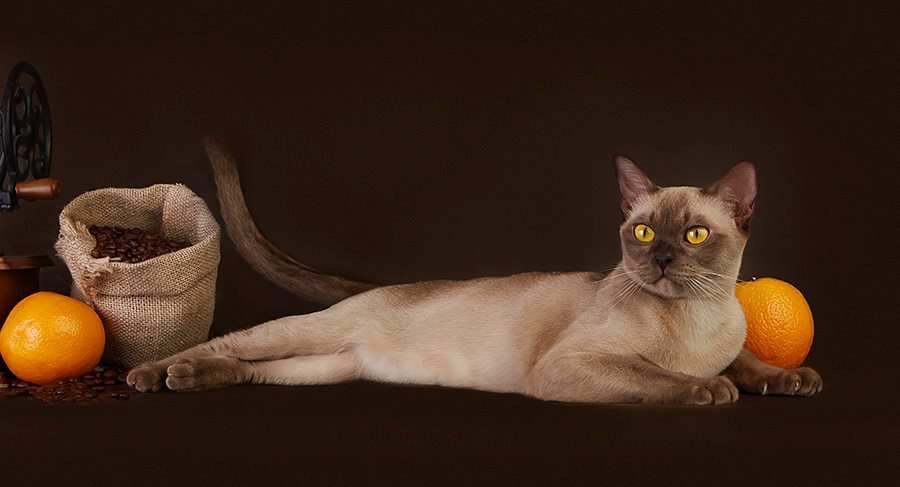
Chocolate Burmese cat:
Lilac Burmese cat:
.png)
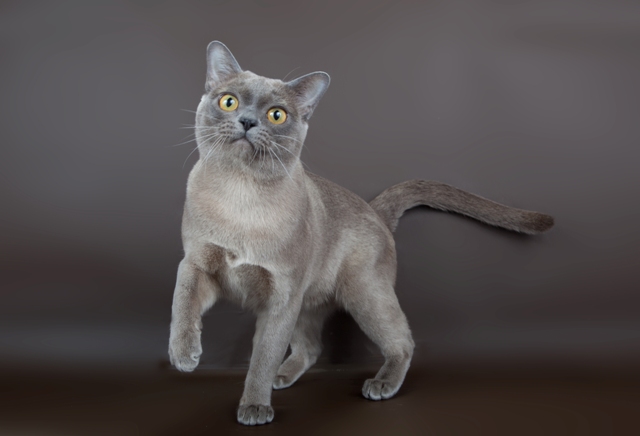
Blue Burmese cat:
Red Burmese cat:
.png)
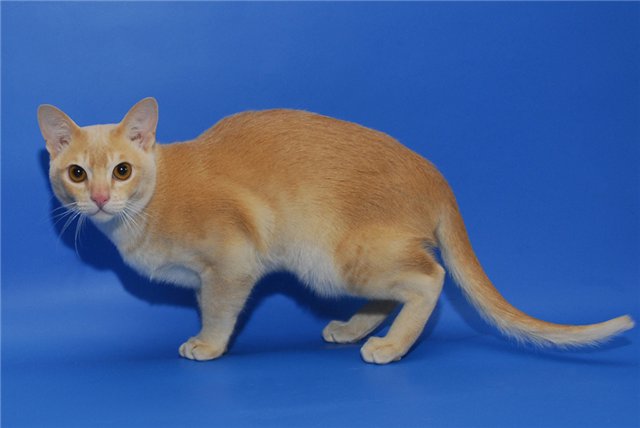
Cream Burmese cat:
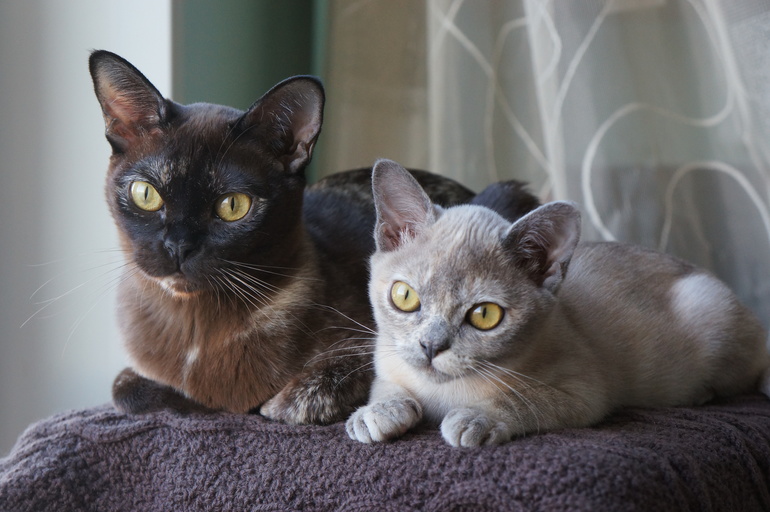
Burmese tortoiseshell:
Character
Cheerful, curious, highly intelligent, and affectionate—the Burmese cat has it all, and its personality has played a significant role in its popularity. Burmese thrive on being the center of household activities. These cats demand a lot of attention and dislike loneliness, but in return for love, they build strong relationships with their owners.
Among all family members, cats usually choose a favorite with whom they prefer to spend most of their time. Affection is one of the Burmese cats' distinctive traits, which they demonstrate unobtrusively and tactfully. Burmese cats are very talkative, using variations of "meow" and "purr" when communicating. Burmese cats are quite trainable, but when choosing commands for your pet, consider their preferences and abilities.
Burmese adapt easily to new surroundings. They quickly get along with other pets, as long as they're okay with it. Burmese get along well with children, are very patient, and would rather avoid annoying attention than scratch them.
Reviews of the breed
Judging by reviews of Burmese cats, they have no downsides at all, only advantages, with rare exceptions. Analyzing the opinions of owners of these beautiful animals, we will highlight the main qualities of Burmese cats:
- Burmese are active and curious;
- Curious and sociable;
- They become very attached to their owner and need human company;
- Many people note that they are talkative, but their quiet voice does not seem intrusive;
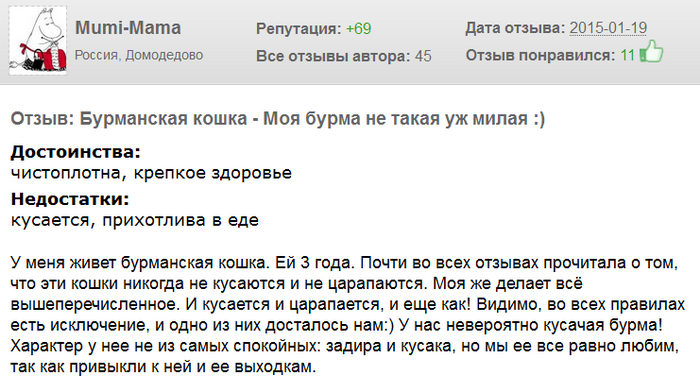
- With rare exceptions, Burmese cats do not bite or scratch, even when it comes to "child caresses." The cat will tolerate this and, if possible, will hide from the child's sight.
- One cannot ignore their beautiful appearance and incredible, silky soft fur coat.
- He is wary of strangers, but not aggressive.


It's hard to say whether a Burmese cat will be a picky eater. Some owners are lucky and don't have such problems, while others are constantly tweaking their food.
Burmese cats are sociable, balanced, affectionate and loyal, which is why they are often compared to dogs.

When you see a Burmese, no one will say that it looks like a stray cat.

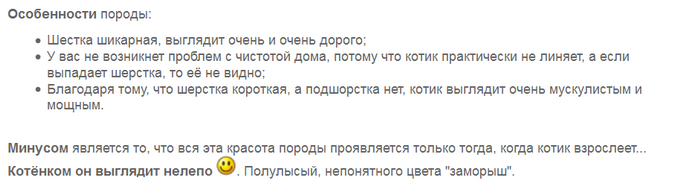
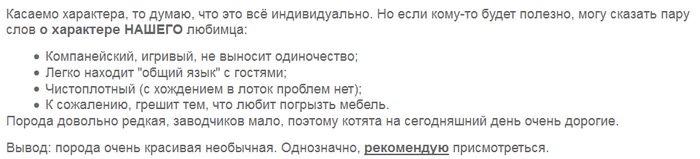
Perhaps the only downside that owners mention is the unattractive price of the Burmese cat.
Burmese kittens don't look particularly attractive as babies, but by the time they're a year old, they've transformed into gorgeous cats with soft, shiny fur and a beautiful, unique coloring.

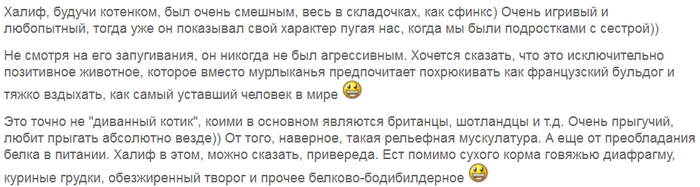
Burmese cats are not recommended for busy people who are constantly away from work. However, even this problem can be solved by purchasing two kittens, who will entertain each other.
Maintenance and care
It's worth noting that the Burmese cat breed is designed for apartment living. Due to the lack of an undercoat, these cats are sensitive to cold and drafts. If owners plan to take their pet for walks in the future, they should be accustomed to a leash and outdoors from an early age, and only after proper preparation, including vaccinations and insecticidal treatment.
A Burmese should have its own sleeping area (a bed or a house) at home. While this isn't essential, it's highly recommended. Burmese are very clean creatures, so their litter box and food bowls should be kept meticulously clean. A few toys are also essential.
Grooming Burmese cats is not difficult, but regular hygiene procedures are essential. A special rubber brush is recommended for their fine, soft fur. Weekly brushing is sufficient to keep the cat well-groomed and neat. Burmese cats do not shed heavily. Regular bathing is not necessary; bathing them once every four months or before a show with a shampoo designed for short-haired cats is sufficient. After bathing, it is not recommended to dry the cat's fur with a hairdryer, as the hot air can dry out the delicate skin.
Nail trimming is recommended about once a month, but this is at the owner's discretion. Teeth should be brushed once or twice a month, and ears should be cleaned as needed. Eyes and tear ducts should also be kept clean.
Feeding
Burmese cat food should be healthy, balanced, and appropriate for the animal's physiological condition (age, pregnancy, spaying, neutering, etc.). You can feed your cat natural foods or commercially prepared foods, but mixing the two is strictly not recommended.
Natural food should be high-quality and nutritious. The diet is based on lean meat (about 80%), with the remainder consisting of grains and vegetables, along with a small amount of dairy or fermented milk products. Once a week, they are given sea fish fillet and a hard-boiled quail egg.Spicy, fatty, fried, salty, and sweet foods are strictly contraindicated. If a cat eats natural food, its diet must be supplemented with vitamin and mineral complexes.
Owners who prefer commercial pet foods should choose premium or super-premium formulas. These mixtures feature a balanced formula and contain the necessary amount of nutrients.
Health
Burmese cats are fairly robust and have a strong immune system, but they are genetically predisposed to various health conditions, including gingivitis and excessive tearing. Some animals have congenital skull deformities and breathing difficulties caused by shortened nasal passages.
Burmese cats are not long-lived, with an average lifespan of 10-11 years.
Choosing a kitten and price
It's best not to buy kittens that are too young; the optimal age to adopt a kitten is 3-4 months. By this time, the animals are already quite independent and adapt easily to new surroundings.
How to choose a Burmese kitten?
When choosing a kitten, first decide whether you want a "pet cat" or a breeding cat; this will determine the price. Next, consider which type of Burmese you prefer: American or European, or perhaps it doesn't matter. Look at photos and choose a color. Sable is the most popular, but you might also prefer a lighter coat. Only after deciding on the type, gender, and color should you begin searching for a suitable cattery or breeder.
Price of Burmese kittens
The price of a Burmese kitten depends on its compliance with breed standards, the quality of the breed, the prestige of the cattery, and other factors. On Avito, prices for Burmese cats start at 15,000 rubles.
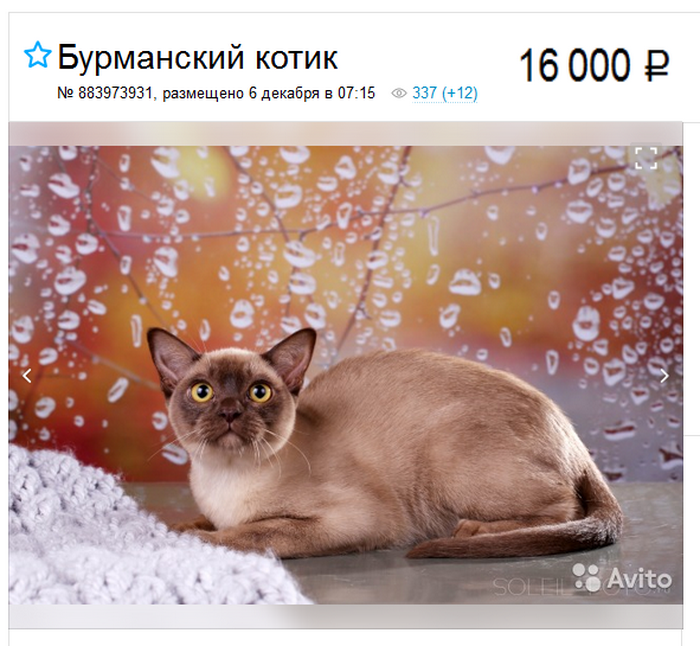
The most expensive kittens from catteries with good prospects, intended for breeding or a show career.
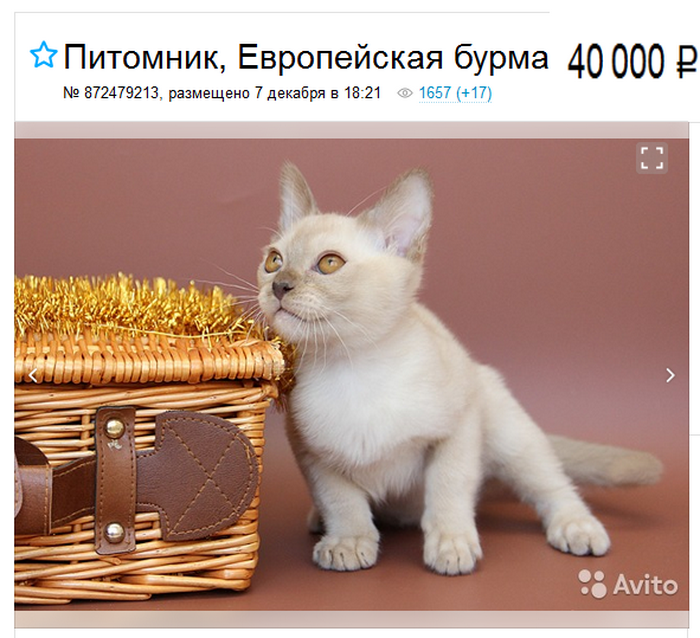
- Average price in Russia: 15,000 - 35,000 rubles
- Average price in the world: $550–$700
Photos
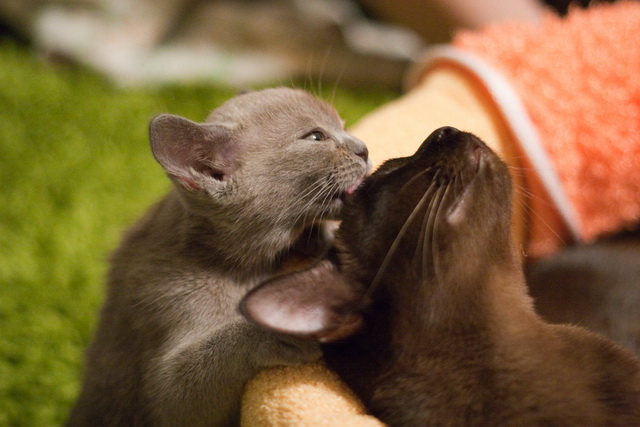
Photos of Burmese cats:
.png)
.png)
.png)
.png)
Read also:


Add a comment