
Brazilian Terrier (Fox Paulistinha)
The Brazilian Terrier (Fox Paulistinha) is a relatively new breed of small dog that is typical of terriers in character and purpose. They are agile rodent and small game hunters, vigilant guardians, and devoted companions. Having won love and recognition in their homeland, the Brazilian Terrier is becoming increasingly popular abroad.

Content
History of origin
The Brazilian Terrier was developed in Brazil in the early 20th century. At the turn of the 20th century, many Brazilians went to study at European universities, primarily in England and France. Young people often returned home with their families and dogs, which were subsequently crossed with local farm and urban relatives. Thus, a new type was formed. It was reinforced over the next several generations by enthusiastic breeders. The founders of the breed are believed to have been Jack Russell Terrier, Smooth Fox Terrier, pinscher, large Chihuahua and others.
Another name for the breed is Fox paulistinha, which translates from Portuguese as "little terrier from São Paulo."
The first standard was published in 1964. For a long time, the breed was reluctant to be recognized in Brazil, much less internationally, but thanks to the efforts of Fox Paulistinha enthusiasts, the effort was finally successful. In 2007, the breed was finally recognized by the International Cynological Federation (FCI) under the name Terrier Brasileiro (Brazilian Terrier).
Appearance
The Brazilian Terrier is a slender, medium-sized dog, well-balanced, square in build, and strong but not heavy in structure. Males stand 35-40 cm at the withers; females 33-38 cm. Weight: approximately 10 kg.
The head is triangular in shape, tapering noticeably from the eyes to the nose. The skull is rounded. The furrow between the eyes is well developed. The stop is noticeable. The muzzle is shaped like an isosceles triangle. The nose is moderately developed with wide nostrils. Color varies depending on the coat color. The lips are dry and close-fitting. The teeth are complete, with a scissor bite. The eyes are set midway between the occiput and the nose, straight ahead, rounded, well open, and as dark in color as possible. They are set high, with the tips pointing toward the outer corner of the eyes.
The neck is of moderate length, well defined, dry, clean, and slightly arched. The body is square, with well-defined curves. The topline is straight and firm. The withers are well defined. The back is relatively short. The loin is strong and short. The croup is slightly sloping. The chest is deep and long, reaching to the elbows. The ribs are well sprung, and the underline is moderately tucked up. The tail is long or short (congenital bobtail). The limbs are thin, dry, straight and parallel.
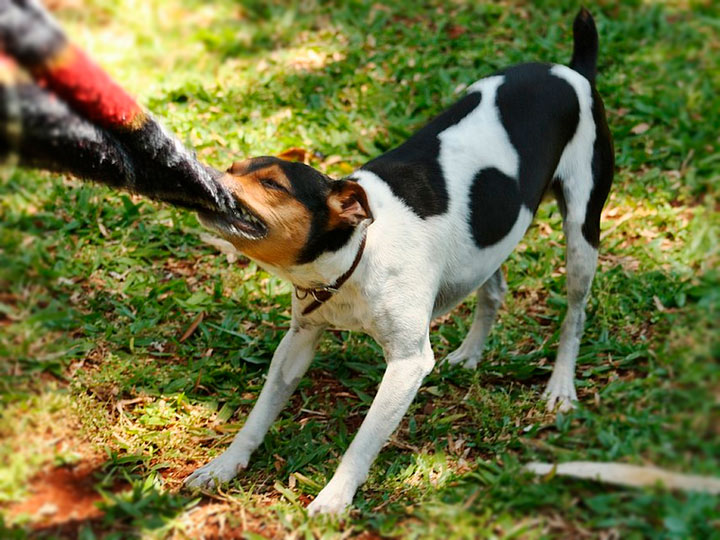
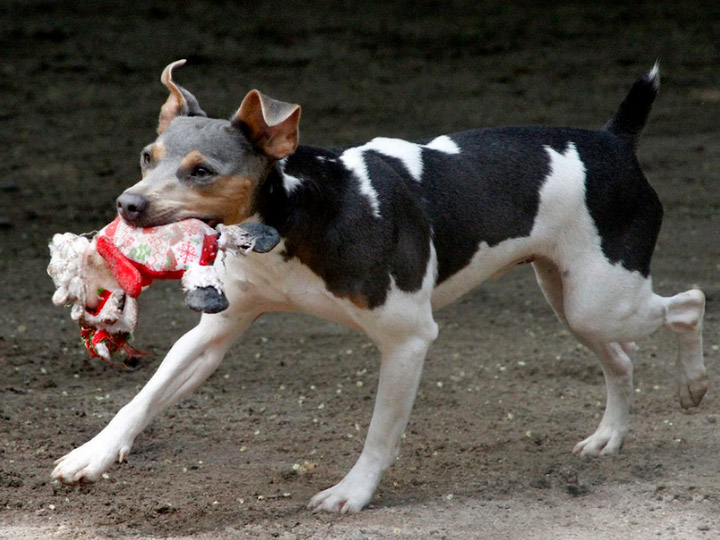
The coat is short, smooth, and lies close to the skin. It is finer and sparser on the head, ears, neck, and the insides of the front and hind legs. The base color is white with spots of black, blue, brown, or burgundy. Red markings are found above the eyes, on the inner edges of the ears, and on the muzzle. Speckling may be present on lighter areas of the body.

Character and behavior
The Brazilian Terrier is restless, even somewhat restless, energetic, and alert. Friendly and affectionate with family and friends, they are wary of strangers. Aggression is rare. Small terriers are almost never shy. They are fiercely protective of their territory, always barking loudly when approaching its boundaries, and will even fight back if the animal is smaller. They are suitable for families with children, provided the puppy has been raised around them.
Brazilian Terriers are cheerful and intelligent, and love to play and dig holes. With proper upbringing and training, they are obedient and sociable. They form strong bonds with all family members, but they see only one as the leader and master.
Brazilian terriers have very strong hunting instincts, so they shouldn't be left alone with small animals or expect to coexist peacefully with a hamster. They get along well with other dogs, but rarely get along with cats. These small terriers were originally used on farms in Brazil to exterminate rodents, and to a lesser extent, to hunt small animals. These dogs work equally well alone or in a pack. Once they sense an enemy, they chase it to the point of exhaustion. The method is simple but effective.
Education and training
Early training and comprehensive socialization are essential for the Brazilian Terrier. These dogs are quite difficult to train, especially as puppies. They are often overly independent and very energetic. Training should be consistent, with plenty of praise and treats. During the first months of life, it's best to conduct training in a playful manner. As the dog matures, it will become calmer, but correcting undesirable behavior will be virtually impossible.
If a Brazilian Terrier is not raised and trained, it will most likely grow up to be an unruly and self-sufficient individual with many bad habits.
The Brazilian Terrier will learn quickly if you can engage him in activities and turn them into a fun game. Some Brazilian Terriers successfully compete in agility and other sports.

Content Features
The Brazilian Terrier is not the best choice for a small apartment. He is very active and needs to be on the move a lot, otherwise he becomes restless and destructive. Even though he spends his days chasing cats around the yard, regular walks outside are essential. The Brazilian Terrier makes a wonderful companion for active people who enjoy long hikes.
A Brazilian Terrier left in a confined space will be a disaster.
The Brazilian Terrier does not have an undercoat to keep it warm, so when cold weather sets in, the dog will need to be warmed up for walks.
Care
The Brazilian Terrier requires little grooming. During the shedding season, the short coat sheds moderately, but lightly at other times. A thorough bath is recommended once or twice a month. Weekly teeth and ear brushing are recommended. Eyes should be cleaned as needed. Nails should be trimmed every 3-4 weeks or less frequently.

Health and life expectancy
Brazilian Terriers are strong and resilient dogs that are free of hereditary diseases. This is largely due to the International Cynological Association's (ICA) requirements for breed recognition: the breed must not only be large enough but also health-tested. Life expectancy is 13-14 years.
In general, the Brazilian Terrier needs the same preventative measures as any other dog: vaccinations, deworming, medical examinations, good care and nutrition.
Choosing a Brazilian Terrier Puppy
The breed is quite well-known in Brazil, where the majority of dogs and professional kennels are concentrated. The breed's recognition spurred the spread of Brazilian Terriers around the world, but today they are very few in number outside their homeland. Besides Brazil, there are large kennels in the United States, Portugal, Austria, and Finland. Individual representatives of the breed can be found in other countries in Europe, South America, and North America.
Price
In Brazil, the average price of a puppy is 1,300 Brazilian reals, or approximately $350. Meanwhile, in Europe and America, prices are quite different, with a purebred puppy from a breeder asking $500-700. This is an average figure that varies significantly depending on the breeder's geography, the value of the line, and the puppy's prospects.
Photos and videos
The gallery features photos of Brazilian Terrier (Fox Paulistinha) dogs of different sexes, ages, and colors.








Video about the Brazilian Terrier (Fox Paulistinha) dog breed:
Read also:


Add a comment