
Bravecto for dogs: instructions for use
Bravecto for dogs is a chewable tablet for oral administration with an appealing flavor and aroma that provides protection against fleas and ticks. A single dose offers a broad spectrum of activity and provides long-lasting protection (up to 12 weeks). This medication should only be used after consultation with a veterinarian, as a high number of side effects associated with the tablets are reported annually.
Content
Benefits of using Bravecto for dogs
The active ingredient in the tablet (Fluralaner) begins to work within two hours of administration. In addition to eliminating current flea infestations, Bravecto for dogs (price: 1,100-1,500 rubles) also combats ticks. The manufacturer offers a pre-calculated dosage (for both small and large breeds), but it's best to consult a veterinarian before use.
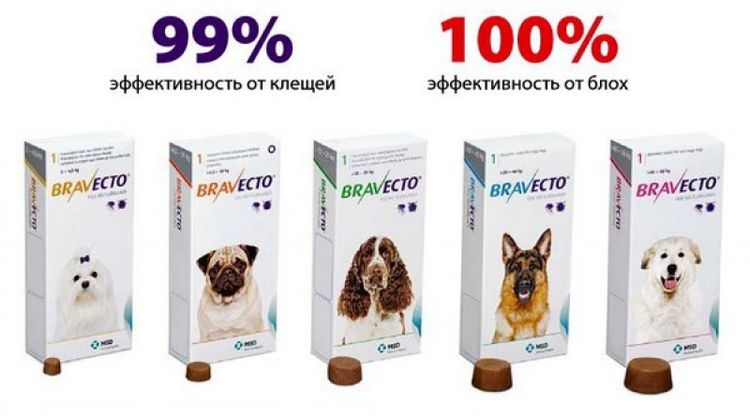
Other benefits of the drug:
- the first tablet can be given at any time of the year, and not only in the spring-summer season;
- preventive treatment can be continued year-round without interruption (provided that the dog does not have an individual intolerance);
- Just one tablet will protect your pet from fleas and ticks for 12 weeks;
- To provide year-round protection for your pet, just 4 tablets will be enough;
- Dogs really like the taste of the medicine, so there are no problems with its use.
However, despite all the benefits, the drug has numerous drawbacks and side effects. Therefore, before giving the pill to your pet, be sure to consult a veterinarian.
Instructions for use
The tablets can be given to dogs over 8 weeks old and weighing over 2 kg. It's best to mix a single dose with your dog's regular food. Fluralaner (the main active ingredient in Bravecto) binds to chloride channels in nerve and muscle cells, thereby blocking nerve signal transmission.
Affected parasites lose their ability to move, resulting in death. Fluralaner has a similar mechanism of action in mammals. Therefore, the instructions for Bravecto for dogs strictly prohibit exceeding the dosage prescribed by your veterinarian.
Bravecto's mechanism of action is quite simple. After entering the animal's body, the tablet dissolves in the stomach, and the active ingredients accumulate in the tissues just beneath the skin. When fleas and ticks feed, they ingest the poison along with natural skin oils and blood. High concentrations of Fluralaner remain in the subcutaneous tissues for 12 weeks, so new parasites will die after their first feeding.
Pharmacokinetics
The instructions for Bravecto for dogs explain the pharmacokinetics of Fluralaner using statistical data, allowing veterinarians to select additional treatments (if needed). Although the manufacturer does not prohibit giving additional anthelmintic medications to dogs taking Bravecto, it is best to consult a specialist.
Fluralaner is rapidly absorbed into the bloodstream. Peak concentrations of the active ingredient, Bravecto, are observed 24 hours after administration. The average half-life of the pesticide is 14-15 days.
Caution! Bravecto's bioavailability is significantly reduced when administered on an empty stomach.
After Fluralaner's half-life, subcutaneous tissue concentrations remain stable for approximately 60 days, after which they begin to be eliminated from the body within 14 days. The highest concentrations of the pesticide are found not only in subcutaneous fat, but also in the liver, kidneys, and muscle fibers of animals. Almost 100% of the active ingredient in Bravecto is bound to blood proteins, meaning that drugs with similar pharmacokinetics should be avoided.
The drug is excreted as the unchanged parent molecule, primarily in the feces (90% of the administered dose). Less than 10% is excreted in the urine, indicating the pesticide's effect on the kidneys.
Side effects
The official manufacturer states in the instructions that side effects are "practically non-existent," but numerous negative reviews of Bravecto for dogs indicate the opposite.
Since Fluralaner is a pesticide, it can cause the following unpleasant symptoms after entering the body:
- a sharp decrease in appetite (in 14% of animals);
- vomiting (observed in 7% of dogs);
- itching (in 5% of those who took the tablet);
- hair loss (5%);
- diarrhea (in 5% of dogs);
- constant drowsiness, a sharp decrease in activity (in 5%);
- the appearance of polydipsia (excessive thirst) (in 2% of dogs);
- the appearance of scabs and ulcerative lesions (in 2% of animals).
It's worth noting that these statistics are based on veterinarian reports. This means the percentage was determined only among animals whose owners sought veterinary help. Also, don't worry about your dog experiencing all of the above side effects at once. Even in the case of an individual intolerance, you'll likely only notice two or three unpleasant symptoms.
Side effects are more common in small breed dogs. This is due to owners being unable to determine the correct dosage. Overall, the above statistics indicate that the vast majority of animals tolerate Bravecto very well.
Myths about the drug and their debunking
The manufacturer makes no secret of the fact that Bravecto's main active ingredient is a pesticide that kills fleas and ticks by accumulating in the animal's tissues. Naturally, many owners are concerned about their pet's blood constantly containing a small dose of a toxic substance.
Bravecto has been the subject of years-long online controversy. Numerous negative reviews contradict its effectiveness and the sustained, high concentration of the active ingredient. Bravecto, a tick tablet for dogs, is said to cause serious harm after just one use. So many upset owners, whose pets suffered serious complications after taking the tablet, have created their own groups on social media. In 2015, an online petition was even created to remove Bravecto from production. In response to such widespread criticism, the American Veterinary Association conducted an independent study of the drug and confirmed its safety.
To reassure consumers, the manufacturer has compiled a list of the most common myths and debunked them.
Myth #1:Bravecto causes very serious health problems in animals, including blindness, cancer, and liver failure.
Fact:Clinical studies and analysis of veterinary reports do not demonstrate a cause-and-effect relationship between Bravecto and the above-mentioned conditions. Indeed, some animals develop side effects or individual intolerance. However, the percentage of such dogs is extremely small (approximately 5%), and the side effects themselves (usually gastrointestinal upset) can be quickly resolved even without veterinary attention.
Myth #2:Side effects from Bravecto may appear after several years of regular use.
Fact:Individual intolerances appear immediately after taking the first tablet. Allergies cannot be acquired and may develop several years after regular use. However, a responsible manufacturer thoroughly investigates every complaint to ensure the safety of dogs regularly taking the product. In most cases, delayed side effects develop as a result of combining Bravecto with other medications. Unpleasant symptoms can also develop due to incorrect dosage. Dogs, like humans, can rapidly gain and lose weight. Therefore, before each use of Bravecto, it is necessary to consult a veterinarian or weigh the animal.
Myth #3: Every year the number of animals affected by Bravecto increases exponentially.
Fact: This myth was debunked not even by the manufacturer itself, but by the European Medicines Agency and the US Pharmaceutical Products Agency. Based on veterinarian reports, it was concluded that the incidence of adverse side effects is classified as "rare." This means that only 5% of animals may actually suffer from Bravecto. Moreover, most side effects will not cause irreversible harm to the pet's health.
Regarding the increase in the number of animals affected, this is indeed true. However, this negative trend is not due to a deterioration in the drug's quality, but to an increase in sales volume. In 2016, more than 30 million doses of Bravecto were sold worldwide, compared to 13 million in 2014. This positive sales trend reflects the confidence of both pet owners and veterinarians. Of course, the absolute number of dogs experiencing adverse reactions has also increased. However, the relative figure has remained unchanged. The number of animals affected remains only 5%.
Drops for external use
Bravecto for dogs is also available as a solution for topical use. This clear, oily solution is typically packaged in disposable droppers with screw-on caps. The manufacturer offers a variety of drops for dogs of different weight categories:
- 2 – 4.5 kg – 0.4 ml;
- 10-20 kg – 0.89 ml;
- 20-30 kg – 1.79 ml;
- 30-40 kg – 3.57 ml;
- 40-50 kg -5 ml.
This packaging makes dosing easy. Simply know your pet's weight and select a pipette of the appropriate capacity. Incidentally, the price of Bravecto drops depends on the size of the package. One pipette costs between 1,100 and 1,500 rubles, but this dosage form of the medication is not very popular in Russia and is often unavailable in pharmacies.
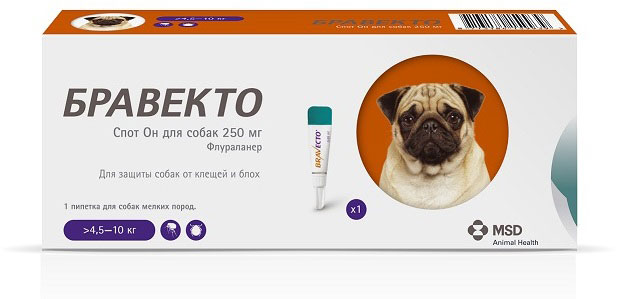
The active ingredient in the drops is also fluralaner. The medication provides effective protection against external parasites because the active ingredient accumulates in the fur and epidermis. The medication enters the bloodstream and is distributed throughout the body, so it works throughout the body, not just at the site of application. Because fluralaner is slowly eliminated from the body, the medication has a long-lasting effect.
When and how to apply
Bravecto drops for dogs are used to kill ticks, fleas, and other parasites, as well as prevent their recurrence. The medicinal solution is applied dropwise. Using a dropper of the appropriate size, unscrew the cap and apply the solution to your pet's skin. It's important that the drops reach the skin. For this reason, be sure to part the fur with your hand. For larger dogs, apply the solution in several places, but be careful not to let them lick it.
Please note! This product should only be applied to dry, undamaged skin.
If the medication is used therapeutically, a single treatment is sufficient to eliminate parasites. When used preventatively, Bravecto can provide protection for up to 12 weeks, but sometimes more frequent treatments are needed. Combining the medication with other antiparasitic medications is not recommended.
Limitations and possible side effects
Overall, the medication is considered safe. The instructions for use state that Bravecto drops can be used even in pregnant and nursing dogs. The medication should not be used in the following cases:
- if the puppy is under 8 weeks old;
- weighing less than 1.2 kg;
- in case of intolerance to the components.
After treatment, avoid bathing your pet for several days and avoid contact with water. The medication generally does not cause side effects, but in rare cases, skin reactions (redness, itching, rash) or hair loss at the site of application may occur. If the pet reacts negatively to the solution, bathe it with shampoo.
Reviews from veterinarians and pet owners about tablets and drops
It's perfectly normal for a responsible pet owner to thoroughly research online reviews before giving a new medication to their pet. However, it's important to remember that social media can paint a distorted picture. Always consult a veterinarian for the most complete assessment of your pet's health.
Artem Pavluchenko, Vet-Info specialist:
"I've been recommending Bravecto to my clients for years. There have been side effects, but nothing severe. I've never experienced any fatalities related to taking the pill. I don't understand the source of all the mass hysteria on social media. In any case, I regularly study relevant medical publications, communicate with my European colleagues, and I can say with certainty that the drug doesn't cause widespread side effects."
Anna Ustyugova, veterinarian:
"In my practice, severe side effects have only been observed in dogs whose owners adjusted the dosage themselves or gave a double dose 'just in case.' I recommend Bravecto to owners whose pets spend the summer outdoors. There's no better protection against fleas and ticks! But if the dog is a small breed and is almost always indoors, I prescribe topical drops. Bravecto is toxic, and it must be used judiciously."
Galina, 23 years old:
"I'm disappointed! Bravecto tick tablets for dogs cost almost 1,500 rubles, and I haven't noticed any effect. For the first two or three weeks, the tablet seemed to be working; at least the dog didn't scratch. But then I noticed a tick behind his ear! The parasite didn't attach, though; it was just dangling from his fur."
Christina and Mikhail:
"We breed German Shepherds, so Bravecto is on our list of mandatory medications. No side effects have been observed in over 15 dogs over two years of use."
Antonina, the owner of the Spitz:
"We used Bravecto tablets a couple of times. Overall, we were satisfied, but I didn't want to destroy the animal's internal organs, so we bought drops with the same name last time. The ticks would stick, but they would fall off on their own within a couple of hours, so I have no doubt about the effectiveness of the product. The effect lasted almost the entire summer. Yes, the drops are expensive, but the results are well worth the money."
Valentina, a veterinarian with 12 years of experience:
"Bravecto tablets quickly gained popularity due to their ease of use and safety, but the drops are usually unavailable at our clinic. The problem is that pharmacies are now full of drops from other manufacturers at a lower price but with the same effectiveness."
Read also:


20 comments
Olga
The puppy weighed 12 kg when we gave him Bravecto (dosage for 10 to 20 kg). A month later, the puppy has grown to 20 kg. Is the pill effective? If not, how can I protect the puppy?
Daria is a veterinarian
Hello! Your puppy has gained quite a bit of weight in a month =) Don't worry, it's still working. Firstly, the upper limit is 20 kg, and your pet hasn't reached that limit yet. Secondly, you initially administered the medication when the puppy weighed 12 kg. You couldn't give him a pill "in advance," otherwise you would have overdosed. Wait another full month, and then you can give him a pill for a weight of 20-40 kg (I don't think he'll gain 20 kg in 3 months). Yes, Bravecto works for 3 months, but in your case, it's better to be on the safe side and give another pill after 2 months (this is due not only to the increase in body weight, but also to the fact that the medication will become less effective). Due to these factors, I would recommend repeating the treatment a little earlier than the prescribed time.
Larisa
I have two Pomeranians, each weighing 4.5 kg. One of them has had pyroplasmosis three times. How should I give Bravecto tablets or drops?
Daria is a veterinarian
Hello! This medication must be administered strictly according to the package insert, adjusting the dosage according to your pet's weight. However! For dogs with multiple episodes of piroplasmosis, a kidney and liver ultrasound and a blood chemistry panel should be performed first to rule out any underlying conditions (read the contraindications for this medication to understand why these health checks are necessary). Piroplasmosis can damage the liver and kidneys, so a thorough examination is essential.
Lyudmila
Hello!
Please tell me how soon can I give my dog Bravecto after taking antibiotics?
Dasha is a veterinarian
Hello! Which antibiotic exactly? How much did you take and for how long? What was the diagnosis? Bravecto is best given to a healthy animal to minimize the risk of complications. It's still better to wait two weeks after recovery to allow the animal to recover; I'd be on the safe side (although I haven't seen any specific restrictions). However, antibiotics do put a strain on the liver, no matter what.
Irina
Hello! My dog, a pug, is unbearably itchy, the hair on his neck and under his arms has fallen out, his face has turned completely black. We went to the vet for the first time and they said it was ringworm, prescribed vaccines and Immunofan, nothing helped, it got even worse and his paws started itching. We went again and they prescribed Bravecto plus antibiotics and shampoos with ketoconazole. Our white blood cells are elevated, she is 5 years old, and I am very worried. Is it possible to give antibiotics and Bravecto together?
Dasha is a veterinarian
Hello! Did you take a skin scraping? Did you rule out demodicosis? What kind of ringworm is on the eye? What kind of vet diagnosed this? Bravecto is fine, and you can also apply avermectin ointment to the affected areas, but you should put a collar on the dog to prevent him from licking the ointment.
Bravecto is given to healthy animals (kidney, liver, gastrointestinal tract, heart). It fights ticks with flying colors. Antibiotics are useful if the animal already has scratches or blood, to prevent complications from a subsequent bacterial infection.
Valentina
Hello, our two-month-old Akita Inu puppy weighs 5 kilos. He managed to get a tick, but thankfully it didn't stick. The vet recommended Bravecto just in case.
We took a 250mg tablet with food from 4.5 kg to 10 kg. For the fourth day after taking it, we've been asking for mucus. I'm very worried about this. What can I do?
Dasha is a veterinarian
Hello! What's the point of taking Bravecto AFTER a tick bite? It doesn't treat piroplasmosis. Were you dewormed before? Are you vaccinated? What are you feeding me? Is your body temperature low? Are there any other symptoms?
Elena
What dosage of Bravecto should I give to a dog weighing 80 kg or more?
Dasha is a veterinarian
Hello! There are tablets for dogs weighing 20-40 kg and 40-56 kg. It all depends on the exact weight of your pet. You can calculate the required dosage based on the required dosage per 1 kg of the animal's body weight: 25-56 mg of fluralaner per 1 kg. So, if your pet weighs 83 kg, you need to give them tablets with a dosage of 2015 (25 mg * 83 kg) to 4648 (56 mg * 83 kg) of the active ingredient. It is better to calculate based on the lower dosage (i.e., from 2015 mg of the active ingredient), i.e. 2 tablets for animals weighing 40-56 kg (each tablet contains 1400 mg of active ingredient), or 2 tablets for animals weighing 20-40 kg and 1 tablet for animals weighing 2-4.5 kg (to accurately determine the dose, it would be 1000 + 1000 + 112.5 = 2112.5 mg, which is close to the required limit of 2015 mg). If the weight is less than 80 kg, you can group the 20-40 kg and 40-56 kg tablets. If you have difficulty choosing the right dose yourself, consult your veterinarian in person. Just be sure to know the animal's weight precisely (not just guess)! They will calculate everything for you on the spot.
Nida
Hello. My dog (Corgi), male, is 1 year and 4 months old. We used Bravecto last year and were satisfied. Can we use it this year if we plan to breed the dog?
Dasha is a veterinarian
Hello! If your pet has no health contraindications, please use it. The medication is quite strong, so it's not recommended to give it on a whim. A veterinary examination is essential (to ensure there are no contraindications).
Irina
How long after vaccination can the drug be taken?
Dasha is a veterinarian
Hello! Ideally, anthelmintics are administered two weeks after vaccination (depending on the type of vaccination administered). This is when immunity develops, and administering such a strong anthelmintic can be a significant strain on the animal's body. If deworming is urgently needed, the time period after vaccination is no longer important. However, if it's for preventative purposes, it's best to wait 14 days.
Irina
My dog had surgery to remove her uterus and ovaries. They told me I can't use Bravecto. Why?
Dasha is a veterinarian
At first, yes, until the body recovers. Bravecto is a strong drug. It affects the entire body. It's not recommended for weakened animals. Also, if there are gastrointestinal problems, liver problems, inflammation, or the animal has had surgery. What was the reason for the uterus removal? Were there any complications? Or was the spay/neuter procedure performed simultaneously?
YURI
CAN BRAVECTO BE USED TO TREAT DEMODICOSIS IN DOGS?
Dasha is a veterinarian
Yes, according to the instructions included with the medication. The course of treatment is determined based on the severity of the disease. In addition to Bravecto, there are also Frontline Nexgard tablets and topical drops (Inspector, Advocate, Stronghold). The drops are administered once a week (a course of 5-7 doses is required, meaning therapy will last 5-7 weeks). Tablets are administered 2-3 times every two weeks (the resulting treatment course is essentially the same). In addition to these medications, other treatments are necessary (both topical and liver support). Self-medication is not recommended for this condition; it is best to seek the help of a veterinarian. Without proper differentiation, demodicosis can be confused with sarcoptic mange or other diseases caused by other scabies mites.
Add a comment