
Bombay cat
Bombay cats Breeders and owners often joke that Bombay cats are miniature panthers. This relatively rare breed is becoming increasingly popular, thanks to its striking appearance and gentle nature. A description of the breed will help you understand what the Bombay cat is like.
Content
History of origin
The Bombay breed is a relatively new breed. These black cats with bright yellow eyes are the creation of an American breeder named Nikki Horner. From the age of sixteen, she began breeding cats that were excellent representatives of their breeds and participated in various shows. Among the champions were Burmese cats, Himalayan, Persian, exotic, American Shorthairs and Siamese. In the 1950s, Niki wanted to develop her own breed, something special, for example, a miniature panther with a shiny black wool and copper burning eyes.
The breeder made her first attempt in 1958, crossing a Buma with an American Shorthair, but the result was a failure. The resulting kittens looked like American Shorthairs, but with numerous breed defects. In 1965, Niki tried again, this time more carefully selecting the parents for the future litter and ultimately achieving the kittens she had dreamed of.
Despite criticism from Burmese breeders, the Bombay Cat Association registered the new breed in 1970, and six years later, it was awarded championship status. As is already clear, the cats have no connection to the Indian city.
By the time the breed was registered, Niki had stopped breeding Bombay cats, but fellow breeders, captivated by the character and beauty of the black cats, took up the baton. One of these was Suzanne and Herb Zwecker. It was this couple who produced the famous Love It Black, which became the standard for the breed and can be traced in the pedigrees of many modern specimens.
By 2000, the breed was still small in numbers, but had already overcome opposition. The Bombay cat was accepted by most philological associations. In Russia, it only began to develop rapidly a few years ago. Surprisingly, many breeders claim that the Bombay craze is linked to contemporary design trends. These small panthers look incredibly aesthetically pleasing against the Scandinavian minimalism of modern apartments. Fortunately, these cats have many other advantages beyond their appearance.
Overview video About the Bombay cat breed
Description of the breed
Bombays are cats with well-developed muscles and bones, and for their medium size they are surprisingly heavy. There are two types of the breed: traditional cats have a narrower and longer muzzle than modern ones.So, a detailed description of the Bombay cat:
General impression and main qualities
The Bombay cat's body is muscular and medium-sized. The tail ends in a rounded tip. The head is rounded, wide, and short. The ears are medium-sized, tilted slightly forward, and set wide apart. The eyes are round and large, ranging in color from golden to copper. The coat is short, soft, and lies close to the body. It is a shiny black color throughout the entire coat; even the paw pads should be black.
Muzzle and body
The Bombay cat's head should be pleasantly rounded, with a broad muzzle. The stop is distinct, especially in profile. The tip of the nose should be slightly rounded downwards, maintaining the overall roundness of the head. The ears are medium in size, set wide apart and tilted slightly forward. The tips are rounded, and the base is wide. The eyes are also rounded and set wide apart. The cornea color ranges from yellow to amber. The jaws are strong, with a correct bite. The Bombay cat's body is compact and medium in size, with a medium-length, strong tail with a rounded tip.
Coat and color characteristics
The coat is thick, short, and fine, reminiscent of satin. It lies close to the body and shimmers with a lacquered sheen when the cat moves. The coat is exclusively black. The entire length of the hair must be colored. The skin on the paw pads and nose is also black. You can see what the Bombay cat breed looks like in the photo.
The Bombay's main advantage—its thick, shiny coat and black color—is caused by dominant genes. However, the cats also carry another, recessive gene, which results in the sable coloring characteristic of Burmese cats. Sometimes, when two black Bombays are bred, sable babies can be born.
Bombays are a very complex breed genetically. When crossed with Burmese, the litter typically produces only one black kitten that meets breed standards. Today, Bombays are still bred with black American Shorthairs and sable Burmese.
Character
Generally speaking, Bombay cats are incredibly affectionate and gentle animals with a balanced psyche. These small panthers are moderately playful, and in addition to pretending to hunt, they enjoy tasks that require resourcefulness and ingenuity. Incidentally, most members of the breed are very intelligent and easily trained..png)
Bombay cats don't handle loneliness well. They'll find something to do to pass the time, but if someone is home, they'll follow their owner around like a dog, demanding attention. Bombay cats are very talkative and will make their demands with varying vocal tones. They generally get along well with other animals, although their interactions with birds and small rodents can be unpredictable.
They are tolerant of children, do not show aggression, and simply leave if they receive too much attention. The Bombay cat is prized for its docile nature.
Reviews of the breed
All reviews of the Bombay cat breed are extremely positive. Happy owners of these black panthers report no shortcomings. They most often highlight their pets' affectionate nature and strong attachment to family members, as well as their intelligence and cleanliness.

Another review of the Bombay cat, in which admiration can be read between the lines:


Be careful!
Unfortunately, there are also some absolutely absurd reviews on the internet, like this one:

The author writes: "It was previously considered a royal breed..." But it's unclear which kings!? A young American woman began developing the breed in the late 1950s, and it wasn't until 2000 that it was recognized by international feline associations. And another absurdity: "...since there are so many of these cats..."—today, the breed is rare worldwide, including in Russia.
Maintenance and care
Bombay cats are considered to be apartment cats, but they are also very comfortable outdoors. There are no special requirements regarding the content.
The cat should have its own sleeping area, a clean litter box, its own food bowl, and at least three different types of toys. A play structure is a great option for a pet, like the one the Bombay cat is lying on in the photo.
.png)
Bombay cats require minimal grooming. To keep your cat's coat shiny and well-groomed, brushing it once a week with a special rubber mitten is sufficient. If the kitten is accustomed to this procedure from an early age, it will lie quietly and even happily offer its back. Bombays aren't known for their fondness for water treatments, but it's advisable to bathe them at least once every two months, otherwise their greasy coat becomes dull. Using a hair dryer after washing is not recommended.
Ears should be cleaned as needed. Brushing your cat's teeth at least once a month can be an excellent preventative for tartar buildup. As your cat's tear ducts become dirty, wipe them clean and ensure the skin there is always dry and clean. To trim or not to trim your pet's hair claws, individual decision of the owner.
Feeding
Bombay cats have a healthy appetite. If they aren't given a strict feeding schedule, they'll happily eat all day long, which can lead to weight gain and loss of their athletic physique. Adult cats are recommended to be fed 2-3 times a day, preferably at the same time each day.
As for food, it can be either natural food or premium or super-premium prepared foods. If your pet does gain weight, consider a low-calorie diet. Many breeders also practice a combination diet: feeding frozen poultry or beef along with dry food, which makes cats look more muscular.
Health
Overall, the Bombay cat breed is genetically sound. Representatives are quite robust and hardy. The average lifespan is 12-15 years, but some well-cared-for specimens can live up to 17-20 years.
Unfortunately, Bombays have their own breed-specific diseases:
- They note a tendency to gum disease;
- Obesity due to uncontrolled eating;
- Congenital heart defects occur;
- Due to the special structure of the skull (short muzzle), problems with nasal breathing and increased lacrimation are often observed.
Bombay kittens
If you're planning to buy a purebred Bombay kitten not just for yourself, but also for pride, showing, and producing good offspring, you should look no further than a breeder. Only an official breeder can guarantee the purity of the breed, for which you're paying a considerable sum, and is responsible for the kitten's health.
Often, "purebred" kittens are sold by private owners who do not have official breeding permits and are not registered anywhere, but there is a chance that "Bombay" kittens will be the fruit of a love affair with a neighbor.
The average price of Bombay cats in nurseries is $200, and from private sellers up to $100.
How much does a Bombay kitten cost?
The selection of Bombay kittens for sale on Avito and other classifieds is very limited. This is likely due to the fact that breeding this rare and expensive breed is primarily carried out by catteries with their own websites and kittens sold by appointment. Among the ads, you'll find many enticing headlines: "Bombay cat at a low price," "Excellent Bombay kitten for a good home," but these usually follow more honest explanations, such as "mixed breed," "very similar," and so on.
The most expensive “lot” (70,000 rubles) turned out to be a black baby, apparently in the photo he is with his mother.
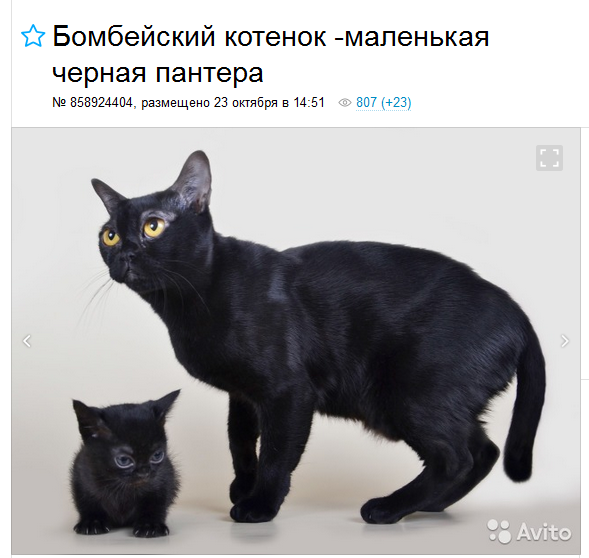
The price of kittens in catteries in Moscow and the region may be slightly higher.
Photos
A Bombay cat in all its glory in this photo:
.png)
.png)
.png)
.png)
Read also:


Add a comment