
Aujeszky's disease in dogs
Everyone knows about such a disease as rabiesHowever, only a few people know about pseudorabies. This disease has another name: Aujeszky's disease in dogs. It can affect not only dogs, but also rodents, cats, pigs, and even humans. Although serious complications are extremely rare in humans, pseudorabies usually runs a mild course in humans.
This disease is viral in nature. It is caused by a member of the Herpesviridae family (herpes viruses). These microorganisms are very resistant to the environment, so any items used for caring for sick animals (bowls, leashes, bedding, etc.) can be sources of infection.
Methods of infection
The virus is carried by small rodents (mice, rats). They excrete it into the environment through feces, urine, and mucus from their nasal passages. Cats and dogs become infected not only by eating infected rodents but also by eating raw pork. Rodents don't just roam basements or garbage dumps, as many people think. They are also common in warehouses. Rodents defecate on food products. If these items aren't washed thoroughly, infection is easy.
The virus enters through the oral mucosa. Less commonly, through broken skin, but such cases do occur. To reduce the risk of infection, pest control is essential. Even if you don't have mice or rats, periodically place poison (out of reach of pets and children). The virus is found not only in meat but also in organ meats (liver, lungs, kidneys, heart, and other internal organs).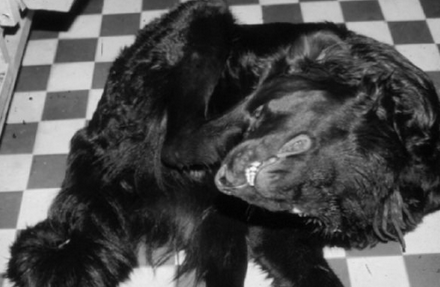
There is a carrier state for the virus, so sick or recovered pets release the pathogen into the environment for a long time, thereby infecting other animals and even people.
Symptoms of Aujeszky's disease in dogs
The time from infection to the first symptoms of Aujeszky's disease in dogs is very short—usually two to five days. You can tell by the animal's behavioral changes. The virus attacks the central nervous system. As a result, pets become extremely fearful and nervous. Sleep is disrupted, they become restless, and their appetite often disappears completely.
- Breathing is impaired. It feels like something is blocking the whiskered one's breathing.
- If the temperature rises, it is only slightly, practically within normal limits.
- A clinical sign such as severe itching cannot fail to attract the owner's attention. The animal literally scratches itself until it bleeds. And the itching extends beyond the skin, to the gums and lips. The pet constantly licks itself and may rub against objects.
- After constant itching, aimless running and jumping begins. The pet rolls around. Aggression is noted. BUT! Unlike rabid animals, animals with pseudorabies do not attack humans. They only bite other animals, but there is no virus in their saliva! Aujeszky's disease is characterized by a sharp change in activity, rest, drowsiness, and apathy.
- Another difference from rabies in dogs is that there is no fear of water; on the contrary, the sick pet experiences a terrible thirst. The lower jaw does not droop, and there is no paralysis of the larynx. The final stage is paralysis of the limbs. The animal begins to stagger, with an unsteady gait. If this has already occurred, the animal will, unfortunately, die within a few days.
These are perhaps the main and quite distinctive symptoms of Aujeszky's disease in dogs.
Prevention and treatment
Only a veterinarian can make a diagnosis based on clinical signs and laboratory test results. It's crucial to avoid confusion with rabies, distemper, demodicosis, allergies, and other diseases. Don't expect to determine the exact illness your pet has on your own. Only a veterinarian can do that.
There is no treatment for Aujeszky's disease in dogs. Death occurs within the first two days after the first symptoms of Aujeszky's disease appear. This means that the time from infection to death can range from four days to two weeks. The disease typically progresses extremely rapidly, with owners often not realizing their pet is seriously ill.
Vaccination has always been and always will be the best prevention! It provides lasting immunity. It's essential to carry out rodent control, even if you think there are no rodents in the house. Those living in a private or multi-story building with a garbage chute should always be vigilant. Never feed raw meat or offal to an animal! This is especially true if the pig died on its own or was forced to be slaughtered due to poor health. Never buy meat or offal without veterinary documentation.
Any questions? You can ask our website's staff veterinarian in the comments below, who will answer them as quickly as possible.
Read also:


6 comments
Stanislav
I recently had a dog and a cat die with similar symptoms, practically on the same day. Rabies was suspected, but the lab tests didn't confirm it. I wonder if they test for Aujeszky's worm. I have doubts about the integrity of the tests. I fed my pets raw pork chops bought at the store.
Daria is a veterinarian
Hello! No, they rarely test for Aujeszky's, provided that the accompanying documentation for the pathological specimen specifically states to exclude both rabies and Aujeszky's disease. For pseudorabies, there must also be an indication (circle movements, scratching, itching, and, in dogs, often chewing off their own limbs). Aujeszky's disease is most often observed in animals displaying aggression toward themselves, while rabies causes aggression toward others (but not always!). There's no need to doubt their integrity. They thoroughly test for rabies! Because it's a dangerous, incurable, and fatal disease of all warm-blooded animals, including humans. However, other diseases are only ruled out if noted on the accompanying documentation (perhaps they didn't tell the veterinarian who collected the specimen the full symptoms).
Stanislav
Hello, Daria. Thank you for your reply! My dog had scratched her ear until it bled, and she scratched for two days before she died. She had heavy breathing and foamy saliva that didn't last long. She couldn't drink anymore, only moistened her tongue. She had stomach muscle spasms. Tremors were observed before death, with heavy salivation. The cat came an hour after the dog's death, meowing pitifully. He lost coordination and lay on his stomach. Drooling began in the evening, and he died closer to the morning, meowing dully. Could this have been intentional poisoning with signs of Aujeszky's disease? I fed my pets raw pork chops bought at the store.
Daria is a veterinarian
Hello! It could indeed have been poisoning, which led to the development of symptoms of nervous system damage. A lab could have immediately conducted a toxin test. But it could also be Aujeszky's disease (there are similar symptoms). In that case, you need to notify the veterinary service so they can conduct an investigation (in case there have been deaths of other people's pets or neighbors) and check the quality of the products purchased at the store (veterinary certificates). Pseudorabies is dangerous! And not only for animals, so this issue cannot be left unresolved. It's better to deny this infection than to let it slide.
Stanislav
Hello, Daria. The thing is, here in Belarus, everything is hidden. I called the veterinary station in the evening, after work. They saw the cat still alive, but they didn't care, leaving and only collecting the body the next day. According to my intelligence, this disease is being treated on pig farms. Everything is fine here. They only tested for rabies. However, none of the Evil One's lackeys will say that; it's an axiom. I have one question: if possible, could you tell me approximately what poisons can cause symptoms of nervous system damage?
Daria is a veterinarian
Hello again. Just out of curiosity, what kind of region in Belarus is this where veterinary specialists don't respond immediately to a call if rabies is suspected? Here, if there's even a hint of it, they immediately provide a car and dispatch a virologist and epizootologist, and the brain is urgently sent to Minsk that same day (something absurd happened: when a hamster bit a child, they sent the hamster's tissue for testing). In the morning, we already know whether the case is present or not, and within 24 hours, we receive an official response from the Minsk Regional Office. We have no allegations of any cover-up (at least, I can vouch for my region). Pig farms vaccinate against Aujeszky. So the risk is minimal, although up to 10 Aujeszky-affected areas are identified annually in Belarus. Nervous symptoms can be caused by poisoning with both isoniazid (an anti-tuberculosis drug) and arsenic (perhaps the neighbors were poisoning rodents; this is not uncommon in rural areas). You should ask your neighbors.
Add a comment