
Biewer Yorkshire Terrier (Biewer Yorkie)
The Biewer Yorkshire Terrier, or simply Biewer Yorkie, is a relatively young breed originating from Germany. The name is no accident; these dogs are indeed closely related to the more famous and popular Yorkshire Terrier. Biewers are luxurious toy dogs with an innate sense of self-worth, a stable psyche, and a friendly disposition.
Content
History of origin
The Biewer Yorkie is a proprietary breed created by the Biewer couple from Germany. Werner and Gertrud (as the couple were called) were long-time Yorkshire Terrier breeders. One day in 1984, a black, white, and gold puppy was born in a litter of regular Yorkies. The Biewers were extremely surprised, as such a case had never occurred before. They decided to name the unusual girl Snowflake. Subsequent matings produced two more girls with the same coloring. These three females became the breeding core. The Biewers succeeded in increasing the number of dogs with the desired coloring and character. To prevent inbreeding depression, the dogs were later crossed with Yorkshire Terriers. Some cynologists claim that Shih Tzus and Maltese, but there is no evidence of this.
In 1988, Werner Biewer presented his dogs at a show in Wiesbaden. At the time, they were called black and white Yorkies.
The first Biewer dogs were brought to Russia by enthusiasts who saw a bright future for the breed, which at the time was not yet recognized by the FCI. Judging by the growing popularity of these small dogs, they were right.
Video review of the Biewer Yorkie dog breed
What does a Biewer Yorkshire Terrier look like according to the standard?
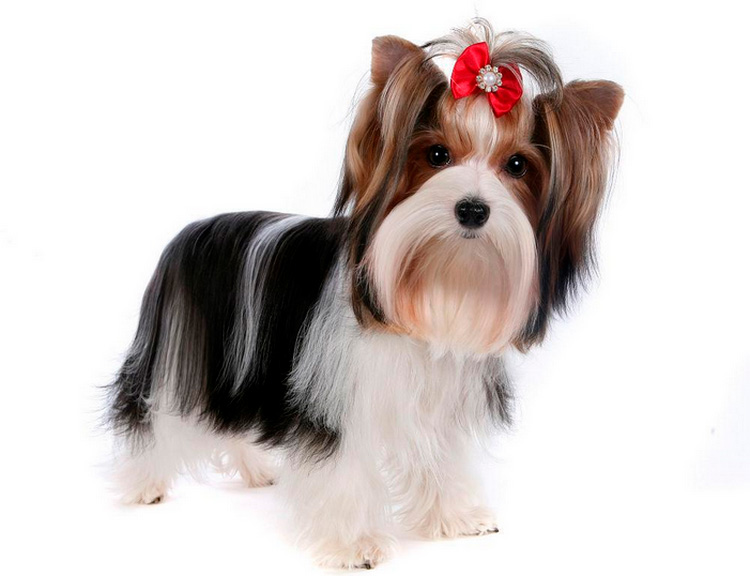
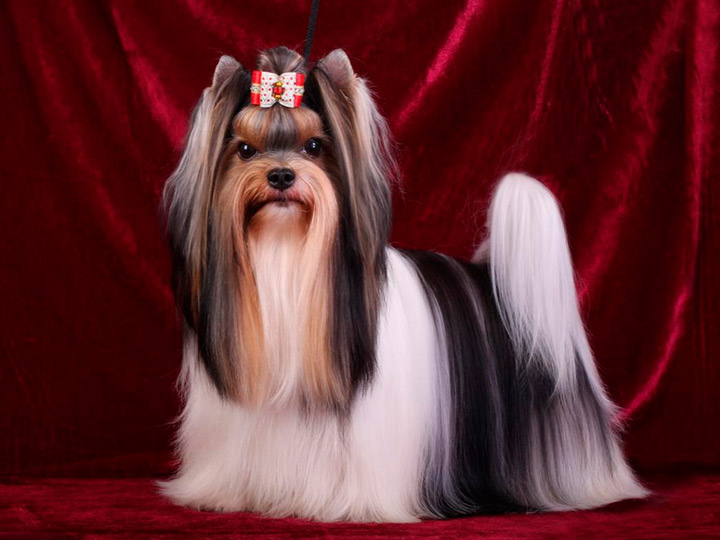
A preliminary standard has been adopted for the Biewer Yorkie, placing the breed in FCI Group 9. The Biewer Yorkie is a small, compact dog with long, flowing hair and a symmetrical coat. Sexual dimorphism is pronounced, but not pronounced. The desired height is 22 cm and the weight is 2-3.5 kg.
The head is small and in good proportion to the body. The skull should be flat, never massive or rounded. The muzzle is not too long. The eyes are medium in size, set straight, dark in color, and framed by well-pigmented eyelids. The expression is intelligent, slightly mischievous. The ears are set high, erect, small, triangular in shape, and not too wide apart. The nose is black. The bite is scissor-like, but a level bite is also acceptable. The absence of two premolars is also possible.
The body is compact, the topline is level, and the ribs are of ample length. The chest reaches down to the elbows, with the forechest slightly extending beyond or in line with the shoulder blades. The tail is set high and is not docked. The forelimbs are straight and parallel. Wide, evenly spaced shoulder blades form a barely noticeable withers. The hindquarters are straight, with well-defined hocks. The lower thighs and upper thighs are of equal length and not too deep. The stifles are strong. The feet are rounded and have white or black nails.
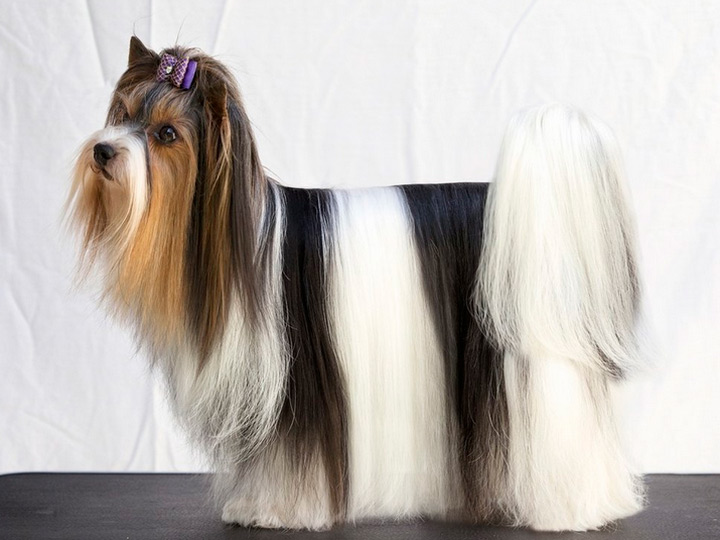
The coat has a silky texture, is very thick, dense, and completely straight, reaching up to 30 cm in length. However, it does not obscure the proportions of the body.
Color is tricolor. The head may be white, blue, gold, or white, black, or gold. Good symmetry is desirable. On the body: black and white or blue and white throughout, as well as black or blue with a white collar, but no gold, with only white patches. From the chest, white may extend to the neck and chin. The muzzle may be gold with some dark hairs.
The difference between a Biewer Yorkie and a Yorkshire Terrier
Many people ask the question: what is the difference between a Biewer Yorkshire Terrier and a Yorkshire Terrier? In fact, it’s very easy to tell them apart – by color.
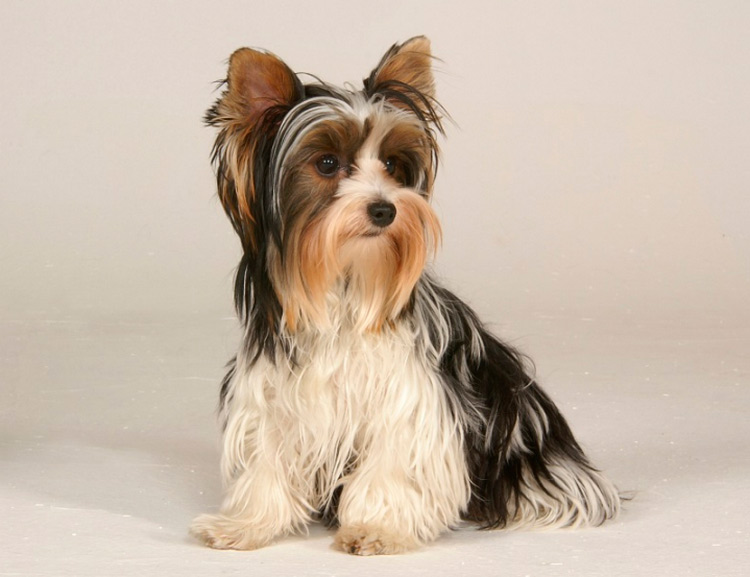
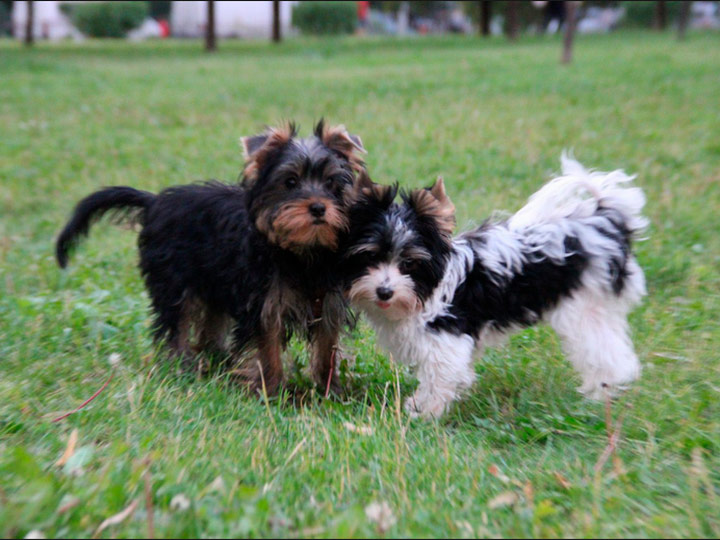
The Yorkshire Terrier has a dark, steel-blue coat, while the Biewer has a lighter coat due to the presence of white. Therefore, they are sometimes called black-and-white Yorkies, although tri-colored Yorkies also exist.
There are also differences between the breeds that can be seen in photos: beavers have stronger bones, particularly their kneecaps. Their coat is more resistant to dirt, but is also more prone to matting. Beavers are more stable and less fussy.
There's another variety of Yorkshire Terrier—the Biro Yorkie. These are bicolor dogs, with a rich chocolate hue on a white background instead of black or blue. These dogs are very rare; only a few kennels in Germany breed them.
Character
Biewer Yorkies are lively, cheerful, intelligent, and self-assured dogs. They are very sociable and affectionate, with a balanced and strong character. Simply put, they are wonderful companions who form strong bonds with all family members. These dogs are great with children, get along well with other pets, and easily adapt to the rhythm of family life. They are the most simple-minded and undemanding of all creatures.
Biewer Yorkies adore attention and care, and in return, they give their owners love and endless devotion. They are born to be pampered, but at the same time, it's important to remember that they are terriers, meaning they can be quite stubborn and temperamental. Some dogs can be very pugnacious and jealously defend their territory from any intruder, but this is the exception.
Content
The first two months after a puppy's arrival in a new home are the most challenging times for both its owner and its puppy. You'll need to be careful to ensure this tiny creature doesn't swallow anything out of place, or get stepped on or pinched. During this period, avoid noisy groups of people in the house—this will hinder the dog's successful adaptation. Furthermore, if you have small children at home, limit their interaction with the puppy, and only allow them to interact with it under adult supervision. Beavers are very clean and not at all burdensome.
At home, a Biewer Yorkie should have its own sleeping area, toys, and bowls. If desired, the puppy can be trained to relieve itself on a pad, which will help owners avoid unwanted walks in rainy or cold weather. Of course, this doesn't mean the dog can sit indoors all day long. A Biewer Yorkie, like any other dog, needs regular exercise to help the puppy develop properly physically and psychologically. Socialization, introducing it to new smells, people, and animals, is crucial.
One of the undoubted advantages of the breed is the absence of shedding and a specific odor.
Grooming Biewer Yorkie
Grooming a Biewer isn't particularly difficult, but you'll need to devote time to its grooming every day. It's important to accustom the animal to hygienic procedures from an early age, even if they're initially more symbolic. The puppy should become accustomed to hands, tools, and actions.
Eyes should always be clean and healthy. This is achieved by washing them daily. It's also essential to carefully remove hair from the eye area and prevent tangles from forming. Ear cleaning is recommended once a week. Hair inside the ear canal should be plucked, as it interferes with the natural cleaning of the ear canal. Regular grooming will prevent severe pain.
To make paw care easier, the hair between the toes and around the pads is trimmed. After walks, the pads are coated with a rich cream or oil to prevent cracking. Every 7-10 days, the paws are inspected and the nails trimmed if necessary.
Teeth should be brushed at least once a week. Given that beavers are prone to oral diseases, it's a good idea to massage their gums with propolis while brushing.
Grooming
The dog's coat deserves special attention. It is soft, long, and prone to matting. Therefore, it is necessary to brush the dog daily, preferably twice a day. It is recommended to bathe a Biewer no more than once a week. During bathing, use a shampoo for the appropriate coat type. After bathing, be sure to apply a conditioner and balm to facilitate combing.
Many owners prefer to clip their bievers, which makes grooming much easier. You can choose any style to suit your taste.
Feeding
Most breeders prefer to feed their dogs commercially prepared food. They eat very little, and even holistic foods are relatively inexpensive. This option is also convenient, eliminating the need for food preparation and vitamin and mineral supplementation. Portions are calculated by weight, based on the recommendations on the packaging.
Some beavers don't know when to stop eating, which can lead to obesity. Dogs should be weighed regularly, and if they gain weight, their food intake should be reduced.
If desired, you can stick to natural foods. In this case, prepare porridge with meat (beef or poultry) and vegetables. Dairy products, a little honey, and boiled seafood can also be included. For every 500 grams of body weight, feed approximately one level tablespoon of food. To prevent plaque, especially during teething, Beavers can be given pressed beef sinew.
The beaver's food bowl should be at chest level. To achieve this, place it on a small shelf or stand.

Health and life expectancy
It would be tempting to say that Biewer dogs, unlike Yorkies, enjoy robust health and strong immunity due to the breed's newness. Unfortunately, this is far from the truth. They are also prone to various illnesses, often associated with their small size, and are susceptible to certain genetic disorders. The main ones are:
- disruption of tooth change;
- districhiasis (appearance of extra eyelashes);
- tracheal collapse (breathing failure due to anxiety);
- femoral head necrosis;
- dislocation of the patella;
- non-closure of the fontanelle;
- dental diseases, including delayed tooth replacement;
- cryptorchidism;
- allergies of various kinds;
- sensitive digestion;
- inflammation of the paranal glands;
- coprophagia.
Before purchasing, puppies must be vaccinated according to age. Dogs are dewormed every three to four months. From the onset of warm weather until late autumn, external parasite treatments are administered. Their lifespan is typically 13-15 years.
Choosing a puppy
The most common way to choose a puppy is by looking at photos online. But it's not the only possible or, certainly, the right way. The smart way to start is by choosing a breeder and parents. To do this, it's advisable to visit several major shows or at least the kennel's websites. If you're planning a breeding, you'll have the opportunity to study the pedigree and ensure the puppies aren't the victims of inbreeding. It's also a good idea to evaluate the parents' personalities, as there's a good chance that all positive and negative traits will be inherited.
It's recommended to bring a puppy to its new home no earlier than 10-12 weeks and only after it has had its vaccinations. At this age, the puppy is no longer dependent on its mother, begins to explore the world around it, and usually copes with the move without any problems. For breeding and show purposes, it is better to choose a puppy between 5 and 6 months of age. When the breed qualities necessary for show-class dogs are already evident.
Along with the puppy, the breeder is required to hand over a pedigree card and a veterinary passport to the future owner. Puppies born as a result of a planned mating at 45 days undergo a veterinary inspection and are then tattooed with a number that must match the one on the birth certificate.
The dogs' living conditions and appearance are also important factors. They should be moderately well-fed, with a soft, clean coat, no bald spots, clear eyes, a good appetite, and a playful disposition.
Price
Price is only approximate, as it varies significantly depending on the kennel's location, the quality of the puppy, and demand. Pet-class puppies, not for breeding, cost between 15,000 and 35,000 rubles. Promising puppies can cost 50,000 rubles or more.
Photos
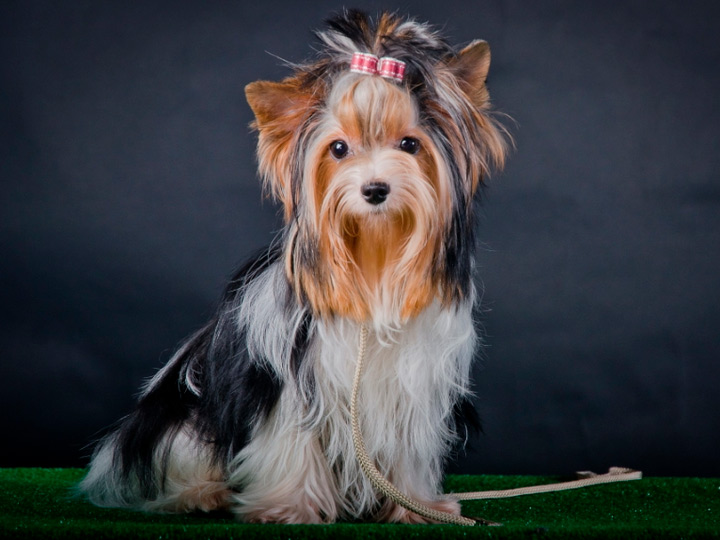
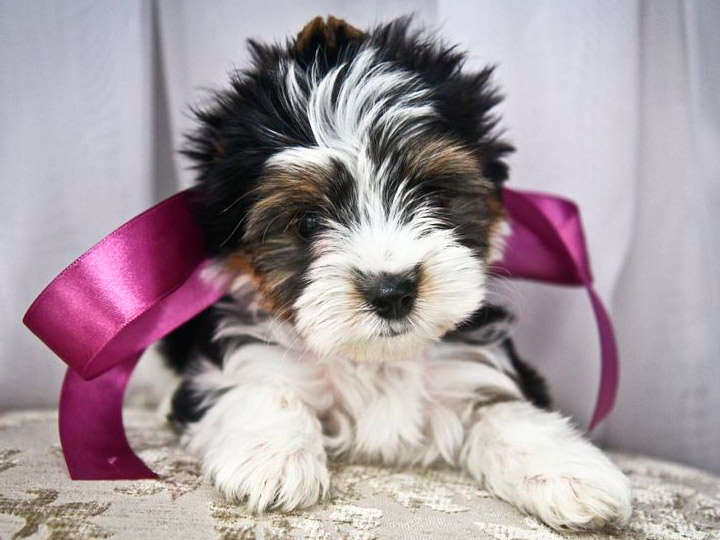
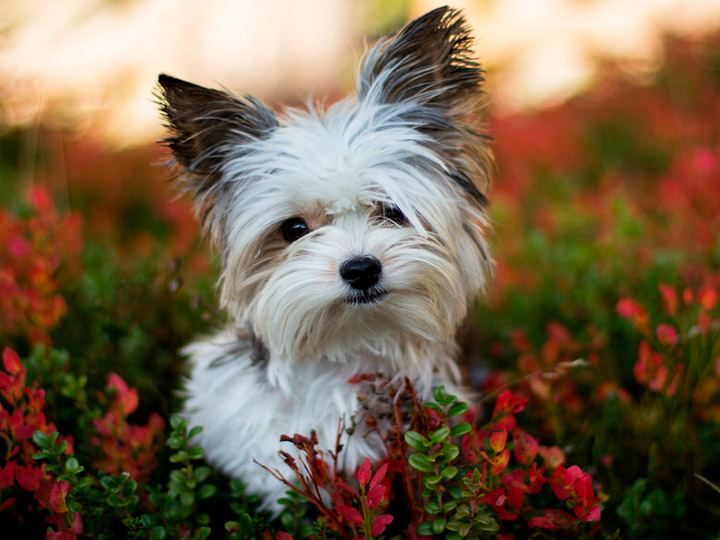
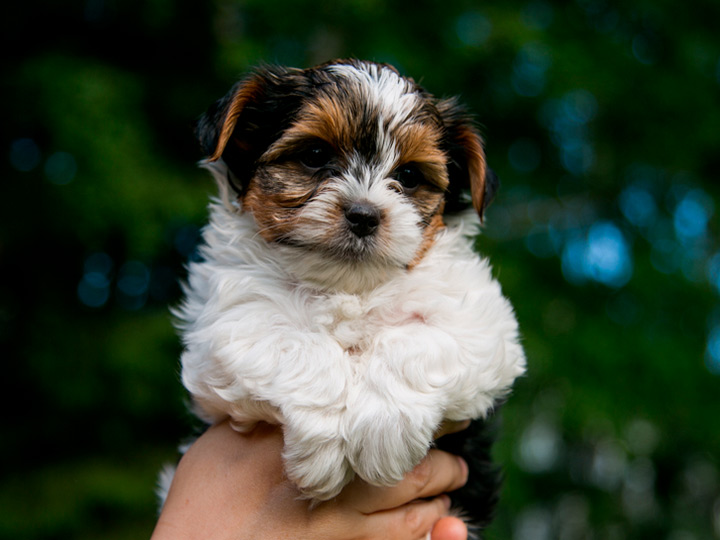
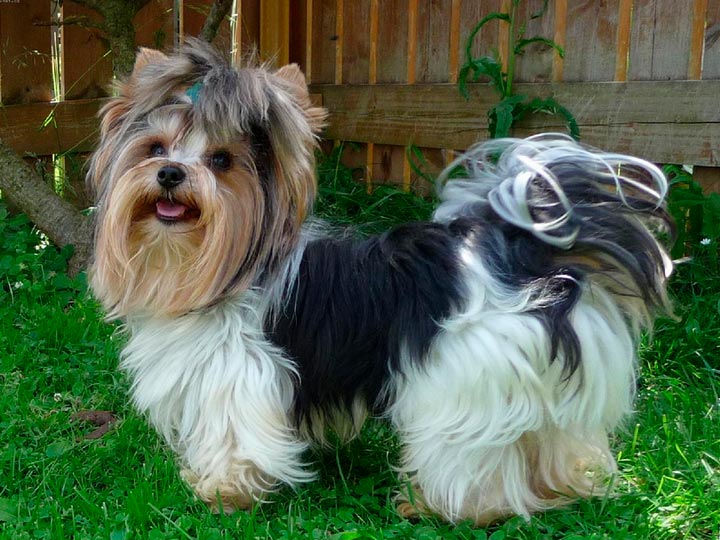
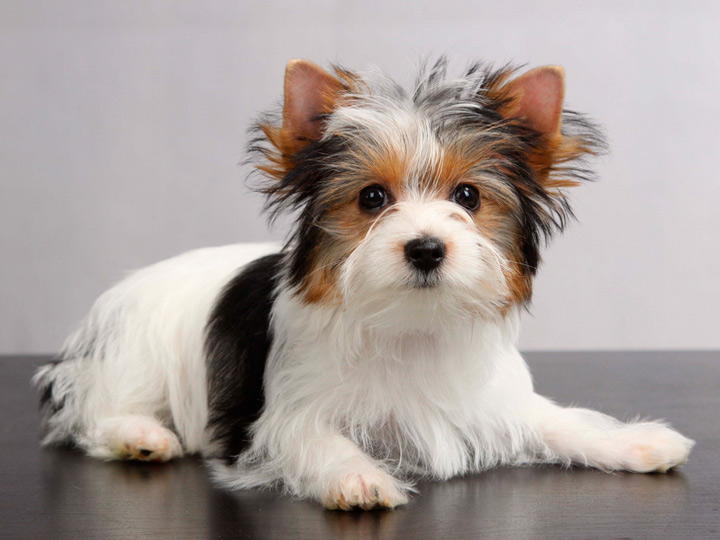
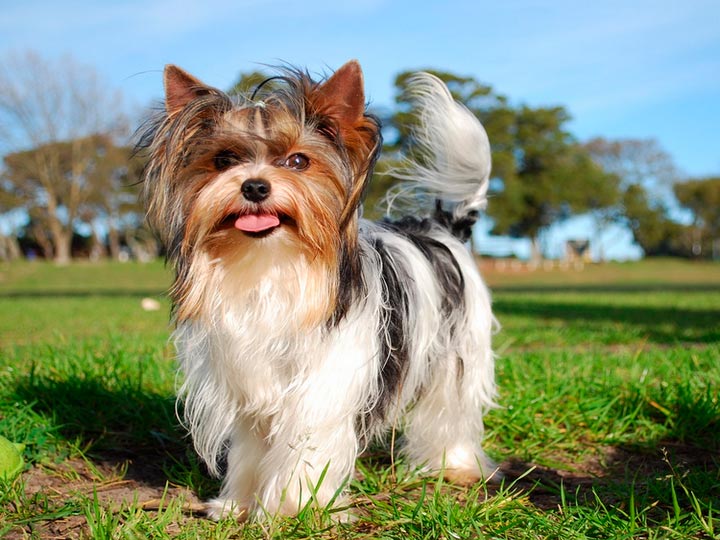
This gallery features photos of Biewer Yorkshire Terrier puppies and adults. The photos clearly show what these dogs look like with different haircuts, long and short coats, colors, and, of course, the differences between a Biewer and a Yorkie.
Read also:


Add a comment