
Bisco – dog food
Today we're introducing dog food from Bisco, a domestic manufacturer of dry, ready-to-eat pet food. We'll try to objectively evaluate how good this food is and whether it lives up to its premium status. We'll also provide a detailed analysis of the ingredients to understand the true makeup of Bisco dog food.
Content
Feed manufacturer
Bisko LLC is a Russian manufacturer of dry kibble pet food. Using an imported, full-cycle production line and the most advanced knowledge and formulas in pet nutrition, the manufacturer guarantees the high quality of its products. It's also worth noting that the Kuban-based plant utilizes the latest European technologies, guaranteeing the absence of defects and perfect compliance with the stated composition.
It is especially emphasized that Bisco dog food does not contain dyes, preservatives or flavor enhancers – that is, nothing that could provoke various diseases and ailments in animals.
Another important point is that, according to the company, all foods offered for sale are complete, meaning they do not require supplementation with other foods or the addition of vitamin and mineral supplements.
Bisco dog food range
The list of available feeds is quite modest – only 10 items:
- Junior is a diet designed for puppies of medium and large dogs.
- Junior Mini is food for small breed dogs up to one year old.
- Regular is food for adult dogs.
- Mini food for adult dogs of small breeds.
- Premium – food for dogs leading an active lifestyle.
- Super premium – food for dogs with high energy expenditure.
- Super-premium with lamb – food with the addition of minced lamb.
- Reproduction is a special formula for pregnant and lactating bitches.
- Reproduction mini is a diet for nursing and pregnant dogs of small breeds.
- Light is a special food for older dogs, as well as for overweight pets.

The selection isn't limited—every breeder can find the perfect food for their pet. However, the line doesn't include highly specialized (pedigree) or veterinary foods.
Reviews of Bisco dog food often point to one peculiarity: the bag size. Junior, Regular, and Premium are available in 3, 6, and 10 kg packages, while the other foods are only available in 6 and 10 kg bags. This is the source of complaints from dog owners: there is no small 1 kg or 0.5 kg bag. This means that if you want to give your pet a new food to try, you'll have to buy a large bag or find a store that sells these foods loose.
Composition of Bisco dog food
To analyze all the components of the food, we selected the most versatile diet available – Bisco Regular. The information on the package shows that this food contains:
- Ground beef and meat meal (30% in total).
- Rice.
- Corn.
- Animal fat.
- Blood meal.
The first five ingredients make up the lion's share of the total feed weight. The remaining ingredients listed are additives designed to enhance the diet.
The list continues with flaxseed, beet pulp, and mineral supplements. Following these are the probiotic content. The final ingredient is a vitamin and mineral supplement.
That's the entire composition of the food. Frankly, it's quite meager, even for a premium product.
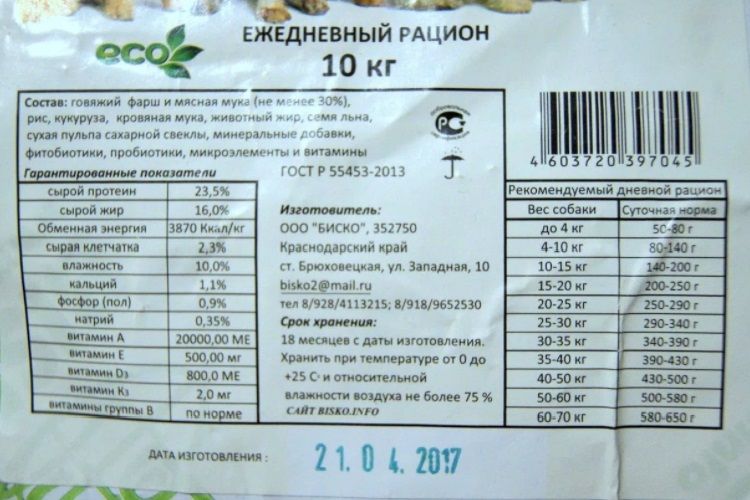
Nutritional composition:
- Protein – 21%.
- Fats – 14%.
- Moisture – 10%.
- Fiber – 2.3%.
- Ash - 7%.
As for the carbohydrate content, the manufacturer doesn't list it. This doesn't mean there are no carbohydrates at all—they are present, and in quite large quantities. Simple math shows that carbohydrates make up approximately 45-50% of the food. This is a significant amount, especially considering the source—grains.
Dogs are carnivores, and eating bread isn't typical for them—everyone knows that. While you can certainly feed them plant-based foods, they'll survive, but they won't get the necessary nutrients—they don't have enough protein or fat.
Predators need meat – this is an axiom, and no fillers like corn or rice can replace it.
In addition to the ingredients we've reviewed, the manufacturer emphasizes the "Eco" label on the food packages. This symbol appeared on the packaging in January 2017, but it has nothing to do with the eco-friendliness of the food or its ingredients. Instead, it informs consumers that the ingredients contain a "natural amino acid nutrition corrector, or phytobiotic."
Upon closer examination of this supplement, we see that it consists primarily of plant components and Turbinella spirum snail shells. Neither the mass fraction of this eco-supplement nor the quantities of individual ingredients in the mixture are provided. Only the miraculous properties of all the substances in this nutrient are described, including improving immunity, stimulating appetite, improving coat condition, and much more.
Just looking at the list of ingredients in this supplement and examining all the benefits it supposedly provides for dogs, we doubted its apparent benefits. It looks more like a marketing ploy to lure in customers, but we can't say for sure.
Now let's study all the components of the feed in more detail.
Squirrels
Ground beef and meat meal are listed as protein sources, accounting for 30%. Blood meal, which also contains a significant amount of protein, is also listed. There are no other meat components.

Ground beef is a good source of animal protein. It's a processed product containing ground meat and soft tissue. By definition, it should be free of bones and solids, but this depends on the quality of the raw material. The stated content refers to the raw product; after processing, due to the loss of water, it will significantly decrease in volume (and therefore as a percentage of the total feed weight).
Meat meal is a source of protein. It is obtained from any part of the animal using a rendering process. It can contain meat and connective tissue, as well as bones and cartilage. It is typically used as a cheap component to "add" the required protein percentage, but as a result of extensive processing, it loses other beneficial substances.
Blood meal is a byproduct of processing the blood of any animal. It contains a lot of protein but is several, if not dozens, times cheaper than meat. It serves as a cheap source of animal protein.
Fats
The only source of lipids listed is animal fat. This is a rather vague term, not indicative of the quality of the raw material. Typically, it's the lard byproduct of carcass processing, which is unfit for human consumption. It's often a low-quality product designed to supplement the food's fat content to the required percentage. This additive is rather a drawback of Bisco dog food.
Carbohydrates
Although the percentage is not listed, the ingredients list the main sources: rice and corn. These are not beneficial for dogs; they are simply cheap fillers added to reduce the price of the finished food. They are used by many pet food manufacturers (even well-known and reputable ones).
Additional components
Flaxseed is a good source of antioxidants and omega-3 polyunsaturated fatty acids. This ingredient is beneficial for dogs' coats and skin, maintains vitamin balance, and serves as a powerful anti-aging agent. However, there is still debate about whether animals can fully absorb all the beneficial substances found in flaxseed.
Beet pulp, or beet pulp, is a waste product from sugar production. It's a cheap source of plant fiber and offers no other nutritional benefits for dogs.

Probiotics are a beneficial supplement for regulating digestion. However, the specific bacteria used are not specified, making their benefits highly questionable.
Vitamins and minerals – a complex of premixes that provide the minimum required daily intake of substances.
Let's summarize. After analyzing the ingredients of Bisco dog food, we can say that the manufacturer rightly calls it premium nutrition – it contains significantly more animal ingredients than economy-class foods, but it doesn't quite reach the level of super-premium.
Bisco dog food reviews
We analyzed numerous reviews of Bisco dog food and concluded that breeders generally praise this food, while only those whose dogs were clearly unsatisfied with it and experienced health problems report that the food is of poor quality. Let's look at some opinions on these diets:
Elena, Chinese Crested breeder:
"We'd always fed him a well-known brand, but then I noticed it had gone bad. Meanwhile, the price hadn't dropped at all, so we started looking for an alternative. A friend recommended Bisco. I was honestly apprehensive—I don't trust domestically produced foods. But after trying it, we were surprised: he eats it with gusto, feels great, and the price is much better. For now, we'll stick with Bisco!"
Alex, the Labrador's owner:
"My Bucks has always been picky about his food. It was hard to find a good food, so on the vet's recommendation, we tried Bisco. He eats it well, but I don't like his appearance—his coat has become dull, I think. And the ingredients are concerning—it's too poor. We want to switch to a higher-quality diet and are looking for alternatives."
Ksenia, pug owner:
"I decided to save money and bought bulk Bisco from the nearest pet store. My dog didn't even eat the 300 grams—she started vomiting. I had to throw the rest out. I wouldn't recommend it to anyone!"
As we can see, opinions are quite varied. As for the experts' perspective, veterinarians' reviews of Bisco dog food are generally consistent: it's a regular premium dog food for all types of dogs. If possible, meat ingredients should be added to the food, or alternatively, a higher-quality commercial diet should be used. We haven't encountered any doctors who categorically condemn this food as unhealthy, nor any outright praise.
Price of Bisco dog food
This is an affordable food compared to other premium brands. This is likely due to its domestic production and the absence of expensive imported ingredients—everything is made from Russian raw materials.
For example, the price of Bisco Regular adult dog food is only 420 rubles for a 3 kg bag, and 1050 rubles for a 10 kg bag. Junior food for medium and large breeds is slightly more expensive: 3 kg will cost 480 rubles, 6 kg will cost 900 rubles, and 10 kg will cost 1250 rubles.
Bisco Super Premium with lamb is the most expensive option. A 6 kg bag costs 1,200 rubles, and a 10 kg package costs 1,700 rubles.
As you can see, this food is quite affordable and can be used by breeders of any budget. We hope our review has provided you with a wealth of useful information, and will now make choosing the right food for your four-legged friend much easier!
Read also:



Add a comment