
English Setter (Laverack): dogs
The English Setter (Laverack) is a dog breed familiar to many from the wonderful film "White Bim Black Ear," in which this breed was presented in all its glory. Today, we'll tell the story of its origins and share a full description of the breed: personality traits, care and maintenance recommendations, health, puppy prices, photos, and a video review.
Content
History of the breed's origin
The English Setter (Laverack) is a breed of dog from the group cops, officially bred in England specifically for hunting. This breed has gained particular popularity among hunters for its excellent retrieval skills combined with an ideally docile nature.
At home
In its native Britain, the setter is known as the "dog of lords." The majestic grace of an aristocrat is combined with the superb sense of smell and agility of a professional hunter. For several hundred years, the English setter has been rightfully considered the finest hunting gundog. The English call setters dogs that stop when they spot prey, thereby indicating it to the hunter. The word "setter" comes from the English word "to sit," meaning "to lower oneself" or "to sit."
For many centuries, Britain had only one type of dog used for hunting any animal or bird—hounds. However, between the 11th and 15th centuries, knights returning to Britain from the Crusades brought other dogs with them. From the East, they brought rather large, heavy-boned, drooping-eared hounds, and from the European mainland, water spaniels trained to hunt small game. According to one theory, these dogs became the ancestors of the English setter.
In medieval England, hunting game birds with nets was at the peak of popularity. Therefore, hunters were extremely interested in breeding dogs that could not only quickly track game but also lie low to the ground, allowing a hunter to cast a net over it. Such dogs, capable of pointing, were called setting dogs. They were slow-moving, fairly heavy animals. When hunting with nets gave way to guns, the slow-moving setting dogs, which were afraid of gunfire, no longer suited the English. They needed fearless, agile dogs with a good sense of smell, capable of not only detecting game but also flushing it out of sight. This wave of development began the gradual development of the optimal hunting dog. Setting dogs were crossed with pointers, greyhounds, retrievers and poodles. The result was light, fast, gun-toting hunting dogs known as setters.
Selection of the breed
At first, there was no clear division into separate breeds. Dogs were distinguished only by the name of the kennel from which they came. The division into English, Irish And Scottish Setters The breed appeared later. The English preferred dogs best suited for hunting in marshy areas. These dogs were distinguished by their large chests, which allowed them to swim well, and their smooth, so-called cat-like gait.
However, the official creator of the English Setter, with the appearance and hunting skills they are known for today, is Sir Edward Laverack, who began to systematically improve this breed in 1825. Using close crossbreeding and selecting only the best qualities, over more than 50 years of breeding, he developed the optimal type of English Setter. Laverack's specimens earned high praise and recognition among English hunters. This is why the name "Laverack" has become so firmly attached to this breed.
On January 28, 1859, the first English Setter exhibition took place, and two years later the breed was officially recognized.
In Russia
The English Setter was brought to Russia from England in the 1870s, where it quickly gained popularity. In the 1920s and 1930s, the English Setter was a favorite breed among Russian hunters. At the Moscow Regional Cynological Show in 1958, all eight first places were won by English Setters. It should be noted that the current Fédération Cynologique Internationale (FCI) Standard for the English Setter is dated October 28, 2009.
Breed description and standards
A description of the English Setter breed should, of course, begin with its appearance and breed standards. The Laverack is a medium-sized dog. Its light weight, combined with its stamina and strength, makes it capable of both short-distance running and long-distance sprinting. A lying position is considered an officially accepted standard for this breed.
- The English Setter's build is strong, dry and stocky.
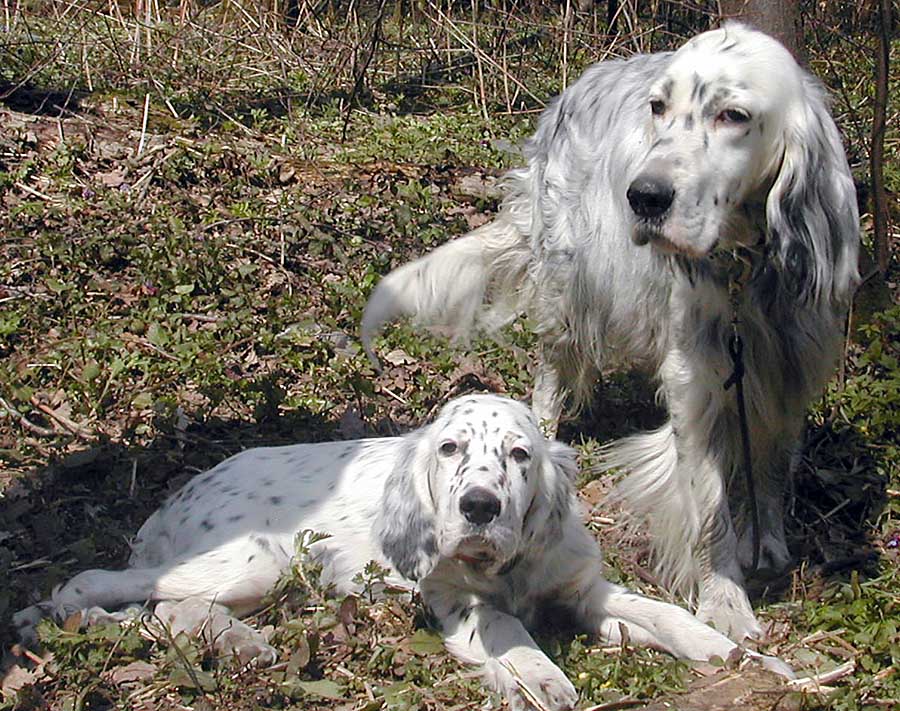
- The coat comes in a wide variety of colors: black-speckled, yellow-speckled, brown-speckled, or tricolor (black, white, and dark red). Only small speckled spots all over the body are acceptable. Large spots are undesirable.
- The head is elongated with a prominent occipital bone. The stop is sharp. The length from the tip of the nose to the stop is equal to the length of the cranial portion of the head. The nose color is predominantly black or dark brown, depending on the overall coat color of the dog.
- The eyes are round and shallowly set. Eye color can vary from coffee-colored to dark brown or dark coffee-colored. Darker eye colors are preferred. The brow ridges protrude slightly.
- The ears are medium in length, set parallel to the eye line, hanging, and soft. The fur on the ears is moderately developed. If pulled forward, the ear reaches the tip of the nose.
- The neck is muscular and long, without dewlap, dry, and tapering toward the head. An excessively thick or short neck is unacceptable.
- The body length is medium. The coat is long, silky, and dense. The back muscles are well developed. The loin is slightly arched and wide. The abdomen is moderately tucked in. The ribcage is large.
- The tail is saber-shaped, straight, and continues the line of the back. The hair on the tail is long. Normally, the tail is carried straight or slightly lowered.
- The forelimbs are parallel and straight. The shoulders are muscular and angled. The paws have long fur between the toes.
- The hind limbs are long and well muscled.
- The coat is well developed all over the body and has a slight sheen and silkiness. It is especially abundant on the back of the legs, ears, lower chest, and tail. The coat is brushed in places.
Height from 53 to 64 cm depending on gender. Recommended weight from 20 to 30 kilograms.

Character
English Setters are extremely intelligent and sociable, and this is their main character trait. This breed is literally born to socialize. The more people or other animals a Setter is around, the better they feel. But above all, they enjoy interaction with their owner. This dog will always be happy to see you and your family. Setters get along well with children and can play for hours with your child. However, if the child is very young, you shouldn't leave them alone with the dog, as they can easily hurt the dog. Wait until your child is older and teach them how to properly interact with the Setter. Then you will always have peace of mind for your child, and they will gain a wonderful four-legged friend who is always ready to help.
The English Setter has a balanced personality, a gentle and sensitive nature, and is easily obeyed and obedient. This dog makes a great companion on any trip or adventure. Thanks to its excellent character, traveling with it is hassle-free. A muzzle is completely unnecessary, as the Setter will never bite under any circumstances. This dog is equally at ease in the car and on public transportation. The only problem during a picnic might be a Setter trying to steal a small piece of treat, as its natural sense of smell allows it to detect scents with exceptional precision. This dog rarely barks and is almost never aggressive. It greets guests very kindly, readily allowing itself to be petted, and may even want to sit next to a guest on the sofa.
The Setter is very sociable and peaceful, allowing other pets to play with it. It gets along well with domestic cats and other dogs. It may only show a hunting interest in birds and rodents due to its natural instinct.
It's important to remember that the English Setter is, first and foremost, a hunting dog, and therefore very active and energetic. If you occasionally let your Setter run around in a field searching for small birds, the dog will be thrilled. Watching a Setter's shuttle run is a true joy for its owner, too. In the field, the Setter is literally transformed. English Setters are unique gundogs with a high work ethic, well-developed search skills, and smooth, graceful movements reminiscent of a cat. The Setter is not afraid of water and swims whenever possible. And they dive with great pleasure, as if they were made for the water.
Care
The English Setter has a long, silky, and shiny coat that requires careful grooming. To do this, purchase a special rubber brush-glove from a pet store and use it to brush the coat daily. After brushing, simply wipe the dog with a damp cloth. It is recommended to wash dogs with this type of coat no more than twice a month. To maintain the coat's good texture, it is occasionally trimmed, especially around the neck (dewlap) and belly (frills). Trimming the hair on the ears and between the toes is also possible. These dogs shed infrequently, and their hair doesn't stain clothing or fly around, unlike the hair of shorter-haired dogs.
English Setters have long, drooping ears, so regular inspection for mites and other parasites is essential. Carefully remove excess earwax from the ears using cotton swabs dipped in boric alcohol. Without proper ear care, dogs can develop serious complications such as otitis. The first signs of otitis are unmistakable: the dog will constantly shake its head, tilt it toward the affected ear, experience unbearable itching and pain, and constantly try to scratch the ear. In such cases, consult a veterinarian immediately. Avoid self-medication and neglecting the condition, as in severe cases, damage to the inner ear can lead to complete deafness.
Content
An English Setter can be kept in an apartment, but a private home is ideal. It's important to note that this is a very active and active dog, and to maintain good health, brisk walks of at least one hour a day are recommended.
Since these dogs aren't exactly homebodies, the ideal home for them is a country house with a fenced yard where they can roam freely without a leash. These dogs need exercise like they need air. This could include playing games outdoors, running behind a bike, or simply jogging.
Despite all their activity, such dogs are not at all suitable for guarding the house, since they will greet not only your guests, but also strangers with equal kindness.
Health
Setters are naturally robust. However, there are a number of hereditary health conditions that can manifest suddenly in an adult puppy. These include atopy (a dermatological condition), hip dysplasia (English Setters are more susceptible to this dangerous condition than other dog breeds), congenital deafness, lysosomal hyperplasia (complications of this condition lead to blindness), ectopia (inverted eyelids), retinal atrophy, and others.
Some hereditary diseases cannot be cured, and many of them persist throughout a dog's life. The only protection against such diseases is choosing a puppy wisely from reputable breeders.
With proper care and maintenance, English Setters have a lifespan of 15 years. However, their typical lifespan is 11-12 years, depending on proper exercise, nutrition, and a number of genetic factors. It's worth noting that English Setters are prone to obesity and related metabolic disorders, which can lead to premature aging. Therefore, these dogs should not be overfed and their diet should always be carefully monitored.

Feeding
Feeding an English Setter is usually not a major hassle for owners, as these dogs are known for their excellent appetites and are quite fussy eaters. However, a setter's diet must be closely monitored, as it must contain the optimal amount of proteins, fats, carbohydrates, vitamins, and microelements to support health and immunity.
The main source of protein for such dogs should be:
- Fresh lean beef;
- Chicken;
- Turkey;
- You can include a small amount of lean fish in your diet;
- Eggs can also be given to the setter, but they must be boiled first.
A dog's diet should include healthy carbohydrates and fiber. This can include a variety of grains and vegetables. Your dog might enjoy oatmeal or buckwheat porridge cooked in meat broth with a small amount of high-quality vegetable oil. Vegetables that can be included include any type of cabbage, carrots, and cucumbers. Some setters enjoy raw pumpkin. Vegetables can be offered raw or stewed.
High-quality vegetable oils or fish oil can be a source of healthy fats in your dog's diet. To support good digestion, you can feed a variety of fermented milk products, such as cottage cheese, kefir, fermented baked milk, and yogurt.
Many setters love cheese, which can be a great training aid to reward the dog.
If you don't have enough free time to prepare your setter's food, feeding canned or dry food is perfectly acceptable. However, carefully review the ingredients and choose the best option for your dog. Choose higher-quality foods, even if they are significantly more expensive, as your pet's health and well-being depend on the food you choose.
Whatever diet you choose for your dog, always remember to supplement with vitamins during periods of stress, pregnancy, lactation, and after illness. Consult your veterinarian for the correct vitamin and mineral supplement. Properly selected vitamins and minerals will help strengthen your dog's immune system and prevent many illnesses.
Cost and nuances of buying a puppy
It's recommended to purchase an English Setter puppy at 3-4 months of age, when the puppy is already strong enough. First, look at all the puppies in the litter, choosing the calmest and most balanced, but not inhibited, puppy. Pay attention to how it plays and interacts with the other puppies. Your puppy shouldn't be overly aggressive or shy.
- Choose a puppy with an even color, without any abrasions, sores, or diaper rash.
- Setter puppies have a uniform color; characteristic spots appear only when they are closer to one year of age.
- The paws should be strong and thick enough, the puppy should not limp.
- Eyes - without inflammation, uniform dark color.
- The puppy itself should be moderately well-fed.
The cost of an English Setter puppy from a registered breeder can exceed 20,000–30,000 rubles. You can also buy an English Setter puppy for a more affordable price (5,000–10,000 rubles) if you don't plan to participate in shows and simply want a loyal four-legged friend. However, in this case, you should have the puppy examined by a veterinarian and receive all necessary vaccinations immediately after purchase.
Remember that when you purchase a puppy from a registered breeding kennel, you receive all the necessary documentation, care and feeding recommendations, and, most importantly, a guarantee that your puppy is healthy and free of any genetic diseases. Therefore, if you are interested in acquiring a healthy, high-quality English Setter puppy with good genetics, you should only buy from breeders with documentation.
Photos
English Setter Photos:


Read also:


1 comment
Bim
The author is a true expert on the breed! The description is full of insightful comments.
Add a comment