
English Mastiff
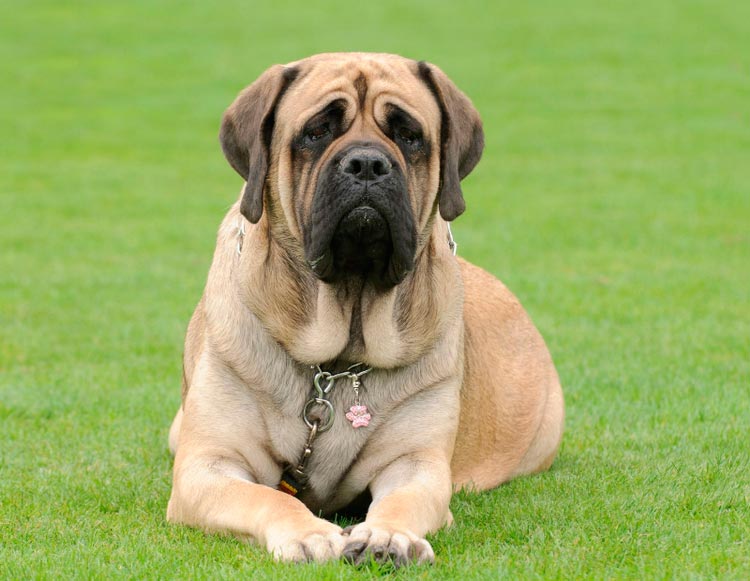
The English Mastiff is a very large dog that harmoniously combines great strength, good nature, and docility. Its ancestors were used for hunting, guarding, dog fighting, and bull baiting, but modern representatives of the breed will do everything possible to stop an attacker without resorting to brute force or injuring themselves. This calm and loyal giant is suitable for families with children. It requires little grooming and gets along well with other pets.
Content
History of origin
Cynologists believe the English Mastiff is a descendant of ancient Assyrian dogs. They arrived in Great Britain during the Celtic era, around the 2nd century BC. Mastiff breeding in England began in the 15th century.
There are several theories about the origin of the word "Mastiff." One holds that it is a shortened form of "master of thief." Others claim the word derives from the Anglo-Saxon "masty," meaning "strong," or the Old French "mastin" (modern Mâtin), meaning "massive, large." According to research by V.V. Voldarskaya, the English borrowed the name "mastiff" from the Romans as early as the 9th century.
Since the ban on dog fighting in 1835 and up until today, the English Mastiff has degenerated and been rebuilt practically from scratch several times. First, in the 1830s, then in the late 1800s (after the first attempt to revive the breed), and after the end of the First and Second World Wars. In 1947, only seven dogs were presented at a show organized by the Old English Mastiff Club. At that time, there were 30 dogs in the United States and Canada. Over the next 20 years, enthusiasts from Europe managed to restore and improve the breed. In 1964, the English Mastiff was officially recognized by the FCI. In the United States, selective breeding led to the emergence of a new breed: American Mastiff.
Purpose
The English Mastiff's ancestors were used for hunting large game, in warfare, guarding and protecting property, bear baiting, and dog fighting. Today, it is a guard dog, family dog, and companion. In the United States, the English Mastiff can be found among therapy dogs.
Appearance
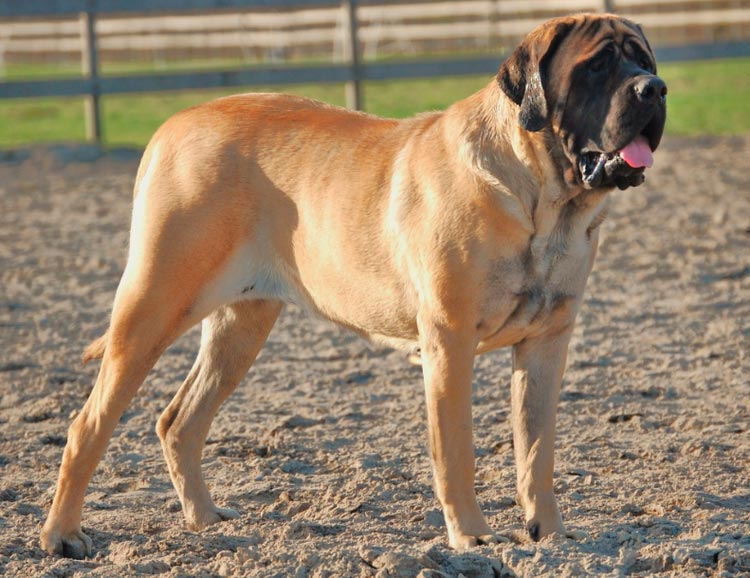
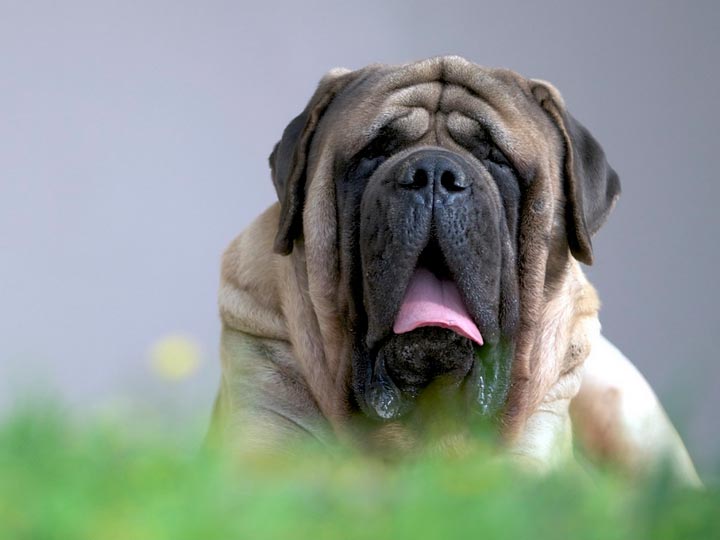
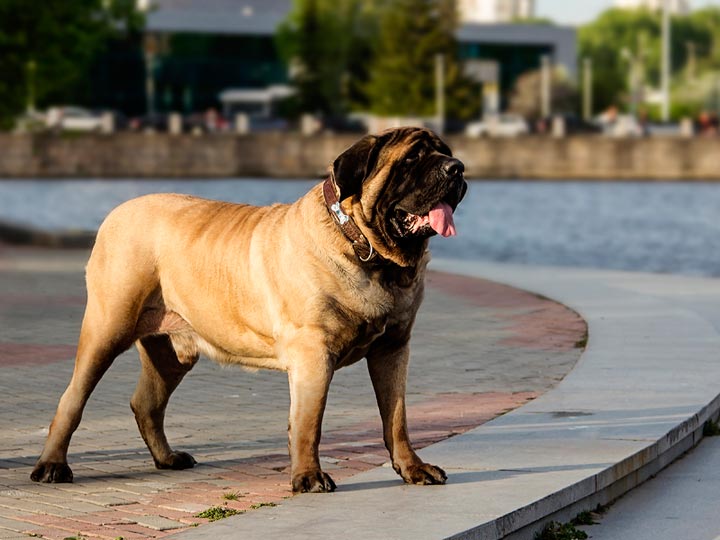
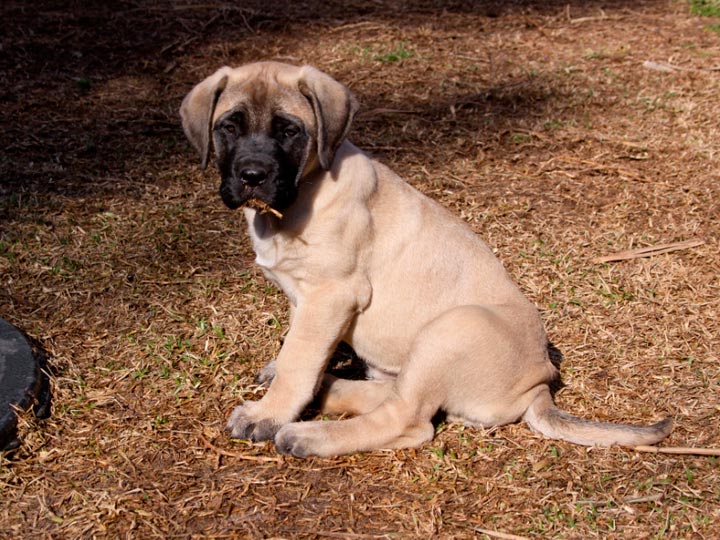
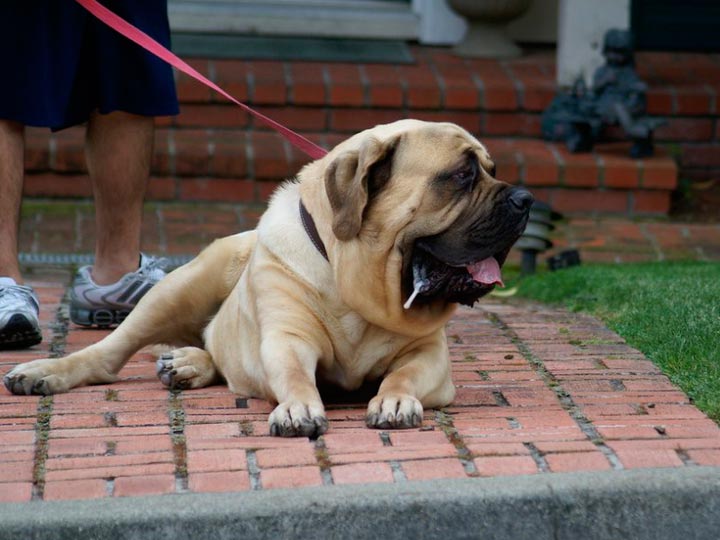
The English Mastiff is a very large, short-haired dog with a massive bone structure. Its constitution is strong, with elements of coarseness and roughness. Its body is proportional and symmetrical. Its skin is elastic, forming folds on the head that are more noticeable when excited. Sexual dimorphism is good.
- Height at withers of males: 70–91 cm; weight: 73–100 kg.
- Height at withers of a bitch: 70–91 cm; weight: 54–77 kg.
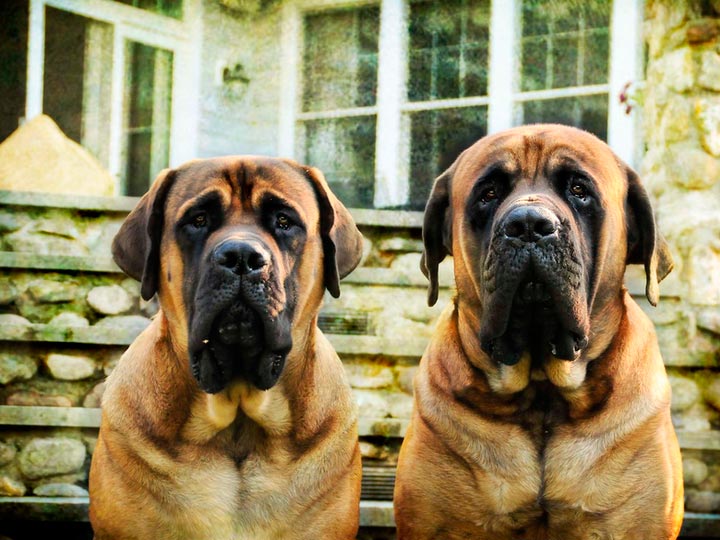
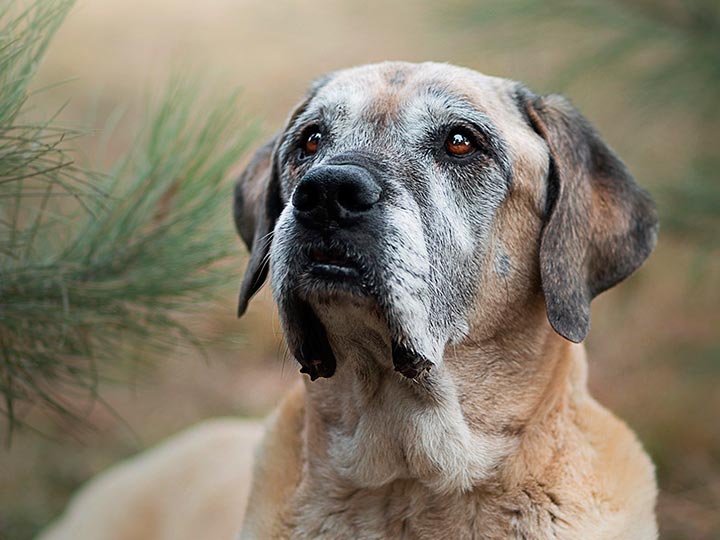
The head is square, massive, and wide. The stop is distinct. The axes of the skull and muzzle are parallel; the ratio of the circumference of the muzzle to the head is 5:3. The muzzle is short, deep, wide, and rectangular. The earlobe is flattened from top to bottom, with open nostrils. The lips are fleshy, with black edging. The jaws are square and strong. The ears are relatively small, set high, and lie close to the cheeks. The ear leather is equilateral in shape, thin, with rounded tips. The eyes are rounded, small, set straight, and relatively wide apart. The bite is scissor-like. The neck is short, powerful, and of medium set-up. On the throat, two small, symmetrical folds run from the chin to the middle of the neck.
The largest dog ever recorded was an English mastiff named Aikami Zorb from La Sousa. At age seven, he stood 94 cm tall, weighed 155.6 kg, and measured 251 cm from nose to tail. The measurement was taken in 1989 for the Guinness Book of World Records.
The body is slightly elongated. The withers are moderately pronounced, turning into a straight topline. The back is of medium length, wide, and strong. The loin is wide, slightly arched. The croup is muscular, moderately sloping. The tail is set high, long, sickle-shaped, and hangs down when relaxed. The chest is massive, deep, and wide. The circumference of the chest is 1/3 greater than the height at the withers. The abdomen is moderately tucked up, the flanks are tucked up. The forelimbs are dry, with strong, powerful bone, set straight and wide. The pasterns are short, set almost vertically. The hindquarters are strong, muscular, set wide apart, parallel and straight. Slightly drawn beyond the line of the ischial tuberosities. The lower thighs are dry, massive, not long. The hocks and stifles are well defined. The metatarsus is vertical. The paws are rounded and large. The claws are black. Correct structure of the limbs ensures free, straight and elastic movement, during which the topline remains straight.
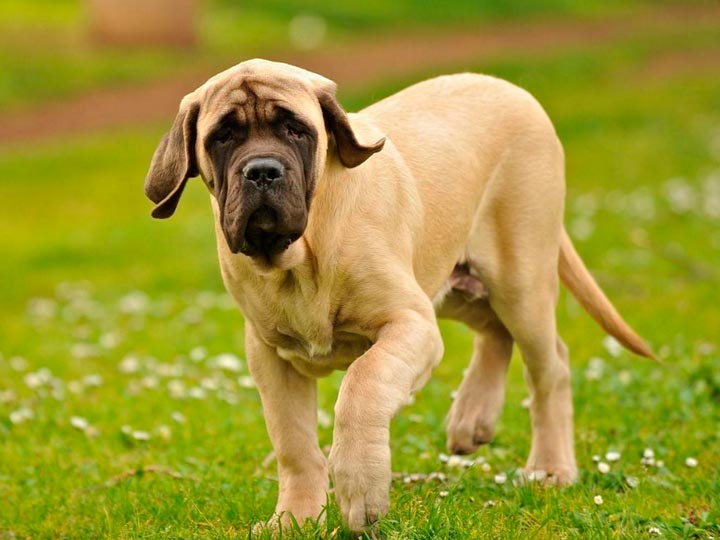
The coat is short, straight, and lies close to the body. The undercoat is well developed. Colors: fawn, apricot, fawn, silver fawn, dark fawn, and brindle. A dark mask is required on the muzzle for all colors. A small white spot on the chest is permitted.
Character and behavior
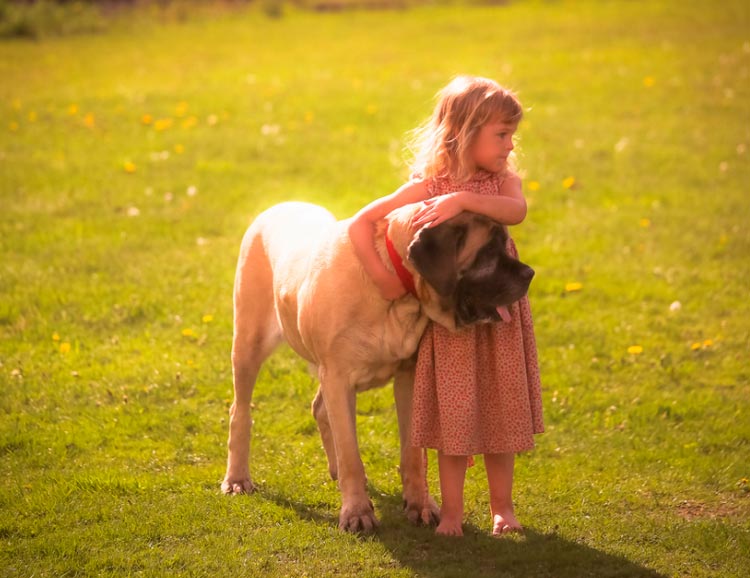
The English Mastiff has a calm, even temperament. He is a devoted friend and companion, truly loving and protective of all members of the household. He is able to control and subjugate situations, yet behaves like a true gentleman, reserved and patient. He gets along well with children, treating them like puppies. He may express his displeasure by gently holding a child's hand or by walking away. At a young age, he may accidentally knock over a child during play.
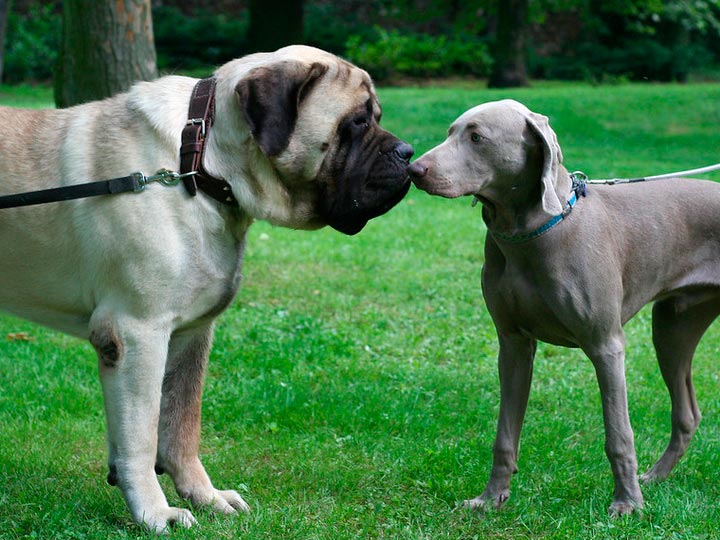
English Mastiffs get along well with other pets. Outdoors, they ignore small, barking dogs and avoid larger, argumentative dogs. If threatened or attacked, they will fight back without hesitation. At home, conflicts between dogs of the same sex can occur if each is prone to dominance, but serious injuries are usually avoided.
The English Mastiff is an excellent watchdog. Wary of strangers, intelligent and courageous, but not aggressive. Often, its deep bark and fearsome appearance are enough to deter intruders. If someone attempts to enter the house, the English Mastiff will attempt to stop them by making its presence known. In extreme cases, it can knock someone down and hold them, but without resorting to biting. Unmotivated aggression or cowardice are faults. Such dogs are dangerous and should be excluded from breeding.
The English Mastiff is a working breed used for guard duty. It is designed to alert property trespassers with a loud bark and, if necessary, to stop the attacker without causing serious injury.
English Mastiff Training
Mastiffs are quite apathetic when it comes to training. During training, you might find that the dog has wandered off to have a snack or rest. They are stubborn and sensitive by nature, but respond well to affection and positive reinforcement. They are considered low-training dogs. Understanding and remembering a new command can sometimes require up to a hundred repetitions, but achieving it according to the owner's wishes is even more difficult. It is recommended that English Mastiffs undergo obedience training or general training, and then practice and reinforce the acquired skills. Guard dogs often require no additional training.
Short but regular training sessions will teach the mastiff obedience, and comprehensive socialization will help it respond appropriately to changing life situations. It's equally important for the owner to become a leader and mentor. They should be firm and demanding, but without resorting to yelling or brute force.
Lack of proper training, socialization, and regular exercise can leave owners with a 100-kilogram dog they can't control. This is dangerous not only for others, but also for the owner. Jumping on people or pulling on the leash is highly undesirable. These habits must be eradicated in puppyhood. Obedience can only be achieved through regular training and interaction. If a mastiff is abandoned in the yard, it is unlikely to possess all the qualities for which it is valued.
Content Features
The English Mastiff is not the best choice for an apartment, especially a small one. A suburban or country house with a spacious yard is the ideal choice. Mastiffs are not suited to year-round outdoor living or confinement. They thrive in temperatures ranging from 15°C to 25°C. Furthermore, they require constant contact and companionship, which is virtually impossible to provide if the dog is kept alone in a yard.
In the house, an English Mastiff doesn't get in the way, being practically unnoticeable. Even as a puppy or while teething, they're not prone to damaging furniture, slippers, or wires. Their biggest drawback is drooling. Although owners say you get used to it, just like carrying a towel around with you everywhere.
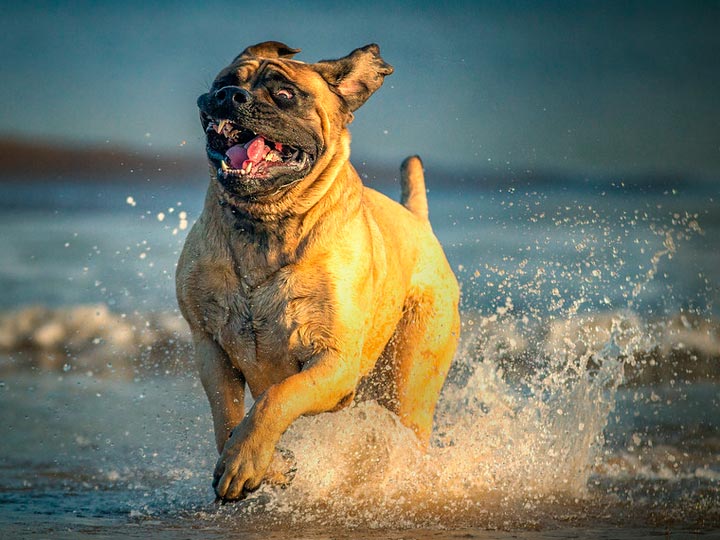
A Mastiff won't become a lazy, phlegmatic dog unless its owner encourages it. It's a moderately active breed, enjoying long, leisurely walks and short jogs. Keeping it in a spacious home doesn't eliminate the need for regular walks outside. When young, it's important to limit exercise to avoid harming its health.
Nutrition
Mastiffs eat a lot, which is one of the reasons they are quite expensive to maintain. High-quality commercial food in the recommended amounts is the easiest way to provide your dog with a balanced diet. Feeding natural foods is also possible. The diet is formulated according to standard recommendations for giant breed dogs, taking into account their age, weight, and activity level. It is recommended to divide the daily portion into 2-3 meals.
English Mastiffs are prone to obesity. Therefore, it's important not to overfeed them and to provide them with sufficient exercise.
Care
Caring for an English Mastiff is not difficult and comes down to basic hygiene procedures.
- The coat is brushed several times a month, and daily during heavy seasonal shedding.
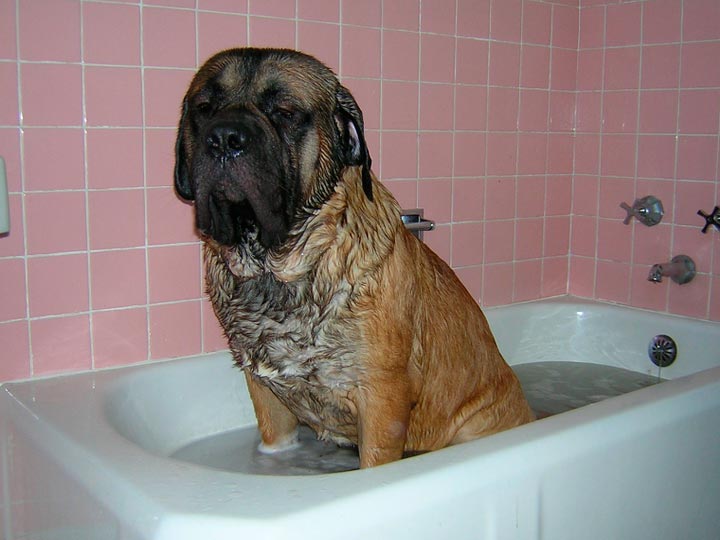
- Bathe as needed, using special dog shampoos. Human shampoos can cause irritation and dry skin.
- Inspect the ears weekly and clean the canal as needed. Special lotions are helpful for cleaning the ears.
- They keep their eyes clean.
- Wipe the folds of your head daily. They should be dry and clean.
- Claws are trimmed or filed down as needed.
It's important to accustom your dog to grooming from an early age. Trimming the nails or cleaning the ears of an adult mastiff who isn't familiar with the procedure can be challenging.
Health and life expectancy
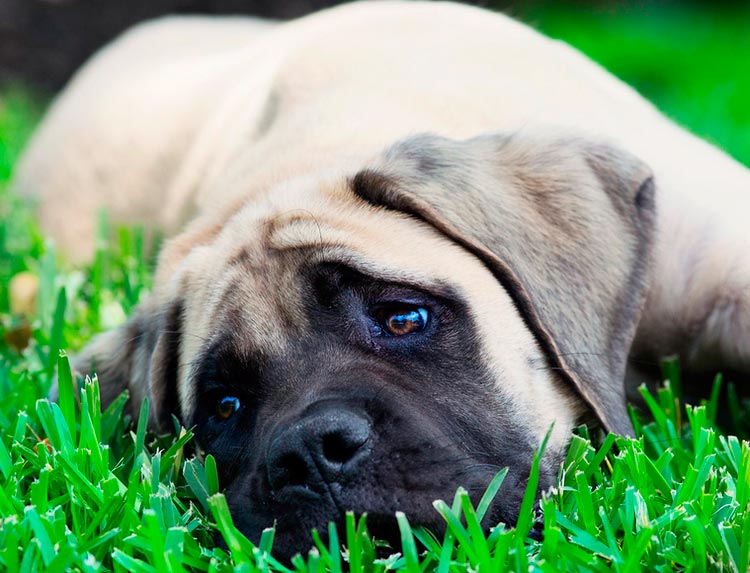
The English Mastiff is a relatively healthy breed, but there are a number of issues to be aware of before purchasing a puppy. Common hereditary conditions in the breed include:
- Elbow and hip dysplasia;
- Epilepsy;
- Leukemia;
- Ophthalmological diseases (cataract, progressive retinal atrophy, corneal dystrophy);
- Cardiovascular diseases;
- Allergy.
Poor living conditions, improper nutrition and lack of necessary physical activity can lead to diseases of the musculoskeletal system (arthritis, arthrosis, spinal spondylosis, bursitis), other diseases and dangerous conditions (superficial pyoderma; demodicosis, gastric torsion, cardiomyopathy, diabetes, obesity, urolithiasis).
To maintain health, it's also important to keep your pet regularly vaccinated and treated for external and internal parasites. An annual medical examination is recommended. Life expectancy is 8-10 years.
Choosing an English Mastiff Puppy
Choosing a puppy should start with finding a breeder. If you're happy with the puppies' living conditions, parents, and price, you can move on to the next important step: choosing a dog from the litter.
All puppies should be healthy, well-fed, and approximately the same size. However, they vary greatly in temperament. Leaders are the first choice. These should be chosen by someone experienced with large breeds and confident in handling a dog prone to dominance. If there are children in the family, a calm and quiet mastiff is preferable. Under no circumstances should a puppy display any signs of shyness or aggression. These traits are disqualifying for the breed; training such a dog is more difficult, and there is a risk of developing behavioral problems as it ages. The selected puppy is carefully examined. It should appear completely healthy. Conformity to the standard is equally important, at least in those areas that can be assessed at a young age (color, bite, paw and tail position, etc.).
It's recommended to bring a puppy into a new home no earlier than 2-2.5 months of age. If you're looking for a dog exclusively for shows and breeding, you might consider purchasing a young puppy that has already proven itself in the show ring and received a high rating. At the time of purchase, the puppy should have a birth certificate (puppy card) and a veterinary passport with vaccination records.
Price
The average cost of an English Mastiff puppy is 100,000 rubles.
Photos and videos
You can see more photos of English Mastiff dogs in the gallery.
Video review of the English Mastiff breed
Read also:


Add a comment